Blog
Hamilton’s First Ferrari GP Win: What the Barcelona Result Means for F1
 123Helmets Editorial Team
Lewis Hamilton crossed the line in Barcelona wearing the Scuderia Ferrari red for the first time as a winner — a moment that rewrites the narrative of one of the most scrutinised driver-team unions in modern Formula 1 history. Here is our full verdict on what it means.
Key Takeaways
Hamilton’s Barcelona win is his first for Ferrari, ending a winless run that stretched back to China 2024 and silencing growing retirement questions.
The 2026 technical regulations appear genuinely better suited to Hamilton’s driving style than the ground-effect era — this is no longer a hypothesis, it is a result on the board.
Ferrari’s upgrade package, combined with Hamilton’s recovered late-braking instinct shown in Montreal and now Barcelona, produced a combination that turned a caveat-heavy season into a genuine talking point.
The Scuderia Ferrari red helmet and livery Hamilton wore at the podium in Barcelona represent one of the most display-worthy moments in recent F1 collector history.
The Result That Rewrote the Season
Lewis Hamilton won the Barcelona Grand Prix for Ferrari — a result that, for most of the 2025 season, looked closer to fiction than fact. At no point after China in 2024 did the Hamilton–Ferrari union look like it was heading anywhere near the top step of the podium. Hamilton had publicly wrestled with self-doubt. Qualifying gaps were real. The ground-effect machinery that defined the previous regulatory cycle never seemed to bring out his best.
Then something shifted. Montreal showed signs of his trademark late-braking precision returning. Barcelona confirmed it. The upgraded Ferrari package arrived at a circuit that suited the car’s new characteristics, and Hamilton converted. The win did not arrive with asterisks — it arrived with a chequered flag, a radio message, and a full podium in red.
For context, the gap between Hamilton’s last win and this one represents one of the longest dry spells of his career at the top level. That makes the Barcelona result not just a race victory but a statement about where his career stands heading into 2026.
What the 2026 Rules Have Given Hamilton Back
The 2026 technical regulations are measurably kinder to Hamilton’s driving style than the ground-effect era was. That is no longer a hope or a pre-season talking point — it is a conclusion supported by on-track evidence across multiple weekends.
Ground-effect cars demanded a specific mechanical sensitivity and a particular rhythm through high-speed corners that never fully aligned with the style Hamilton developed across his Mercedes years. The new regulations reduce that dependency. The result is a driver who can lean on his instincts — particularly his late-braking approach, which has always been one of the most discussed technical assets in the paddock — rather than working against them.
At Barcelona, that braking precision was visible on multiple laps. The upgraded Ferrari SF-26 gave Hamilton a platform where his input translated directly into lap time, rather than fighting the car’s natural tendencies. The combination produced a race-winning performance, and it has to be taken seriously as a sign of what the remainder of this season could hold.
Is Hamilton a title contender? It is far too early to state that with confidence. Charles Leclerc has faced brake reliability issues across several weekends, and several of Hamilton’s strongest circuits have come in sequence. Those are fair caveats — but they apply to the title question, not to the retirement question. That question has now been answered.
The Podium Visual: Red, White, and a Helmet Worth Displaying
The image of Hamilton standing on the top step at Barcelona in full Ferrari red is one of the most striking podium visuals F1 has produced in recent memory — and for collectors of full-size 1:1 replica helmets, it marks a genuine reference moment.
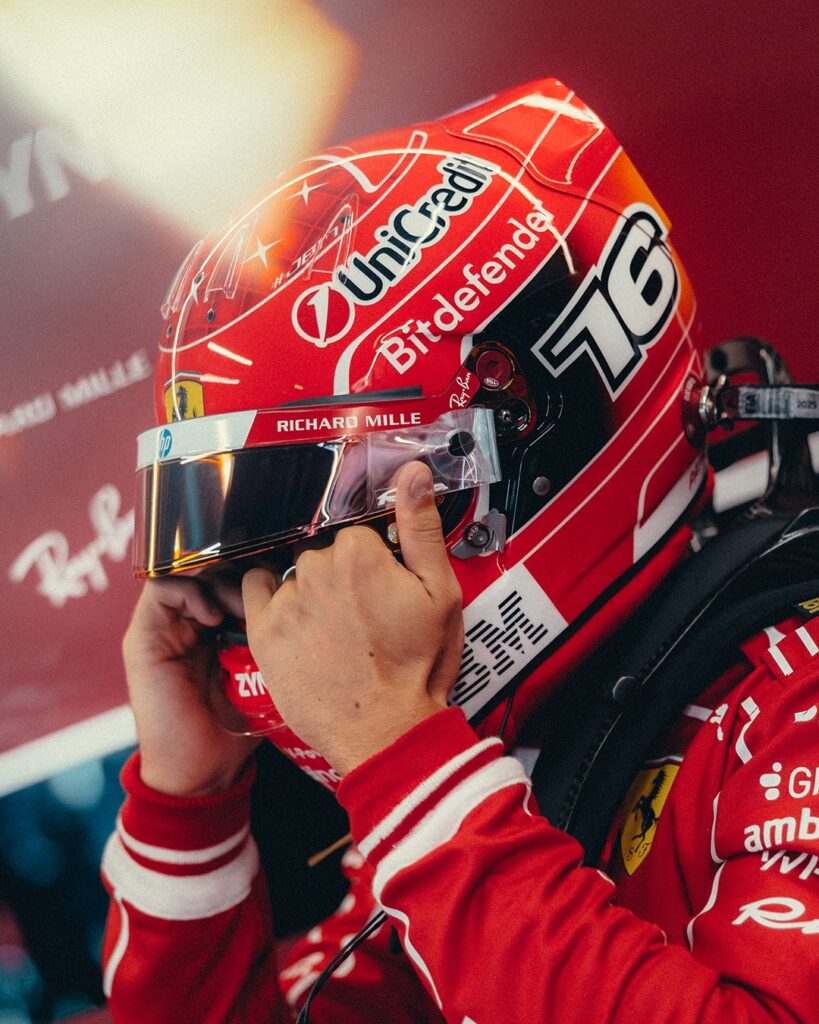
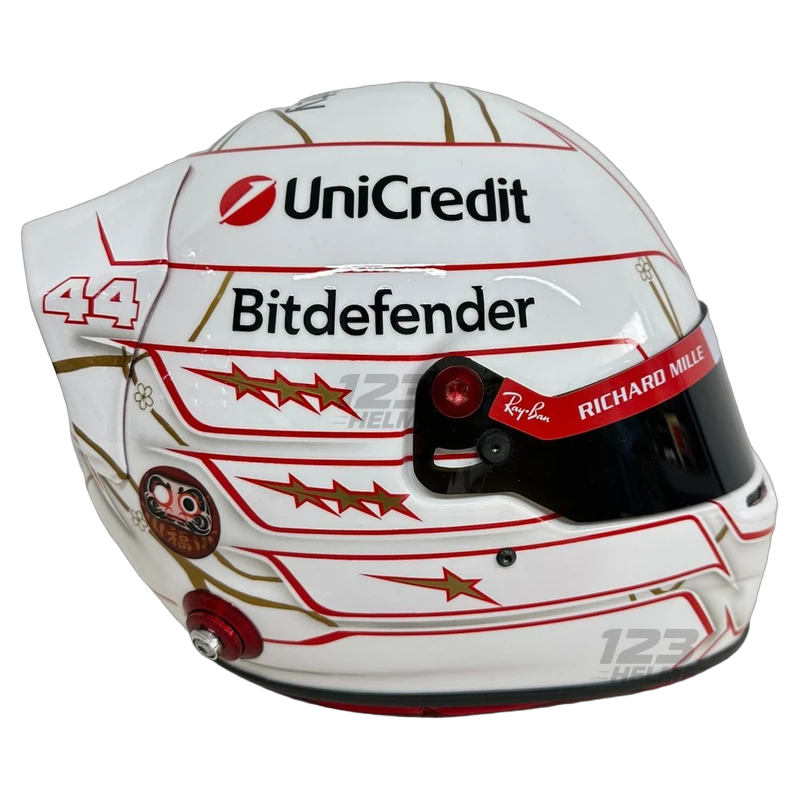
Hamilton’s Ferrari race helmet combines the iconic Scuderia red base with his personal design language: the steepled visor cut, the colour transitions that have become recognisable across decades of liveries, and the Ferrari Prancing Horse branding integrated at the crown and sides. The visor itself on his race specification unit sits at approximately 3 mm thickness, framed by a shell construction that defines the silhouette instantly in any display setting.
Full-size 1:1 display replicas of Hamilton’s Ferrari helmet capture that podium identity at a 1:1 scale, making them exhibition-quality collector items rather than scaled-down souvenirs. The shell dimensions — typically 29 × 25 × 35 cm across the major axes for a standard full-face replica in this specification — mean the piece commands real physical presence on a shelf or in a cabinet. At approximately 1.2–1.5 kg for a standard display-grade replica shell, it carries the weight expected of a serious collector item.
This is a display piece that marks a specific, dateable moment in F1 history: the day Hamilton first won for Ferrari. That specificity is what separates a replica helmet tied to a race result from generic merchandise.
Ferrari’s Trajectory and What This Means for the Championship
Ferrari’s Barcelona win is significant beyond Hamilton’s personal story — it represents the first time the Scuderia has produced a race-winning package under the 2026 regulations that looks repeatable rather than circumstantial. The upgrade introduced at the Spanish Grand Prix addressed the aerodynamic instability that had cost Ferrari qualifying positions at several earlier rounds, and the data collected from Hamilton’s winning stint will inform development across the remainder of the season.
The broader championship picture remains open. Ferrari now has a driver who has demonstrated he can extract a winning result when the car allows it. Whether the car allows it consistently — at circuits less aligned with its current strengths — is the question the next six to eight race weekends will begin to answer.
What the Barcelona result does confirm is that F1 in 2026 has genuine narrative momentum. A sport that spent several years under the shadow of one team’s sustained dominance now has multiple teams capable of winning, a seven-time world champion performing at a level that silences retirement discussion, and a new regulatory framework that has reshuffled the competitive order in ways that remain unpredictable. That is a healthier sport. The Barcelona result contributed directly to that health.
Why This Moment Belongs in the Collector Record
Hamilton’s first Ferrari win is a datable, singular event in F1 history — the kind of moment that defines what serious helmet collecting is actually about. The full-size 1:1 display replica of the helmet he wore at Barcelona 2026 is not general Hamilton merchandise; it is a physical reference to a specific race result that changed how his career at Ferrari is understood.
Collector replicas tied to landmark wins carry a different weight in any display than standard season-issue pieces. The helmet Hamilton wore at the podium in Barcelona — Ferrari red, with his personal livery and the Scuderia branding — represents the intersection of two of the most storied identities in motorsport. That intersection, in the context of a first win together, is what gives this particular replica its display value.
Exhibition-quality full-size replicas of this helmet are produced to 1:1 scale from the original tooling references, with paint layer counts typically reaching 8 to 12 individual coats depending on the finish specification. The visor is rendered at accurate thickness for visual authenticity. These are collector items built for display, not certified for any protective or safety use — and their value to a serious collection is precisely that they exist as physical documents of a race that will be referenced for years.
The Barcelona podium, with Hamilton in Ferrari red on the top step, is the kind of image that defines an era of the sport. Owning a 1:1 display replica of the helmet he wore that day means owning a piece of that record.
Our Verdict
Hamilton’s first Ferrari win is the most significant single result in F1 so far in the 2026 season — for the driver, for the team, and for the sport’s wider competitive health. The retirement narrative is closed. The hypothesis that the new regulations would suit Hamilton better than ground-effect machinery has moved from possibility to demonstrated fact. And the image of him standing on the podium in Scuderia red is one that will be reproduced on walls and display shelves for a long time.
There are genuine caveats when the question turns to the title. Leclerc’s brake issues, circuit sequencing, and Ferrari’s consistency away from their preferred tracks all introduce uncertainty. But those caveats belong to a different conversation. The conversation this result demands is simpler: Hamilton is back winning Formula 1 races, he is doing it for Ferrari, and the sport is better for it.
For collectors, this is the moment to document. A full-size 1:1 display replica of the Barcelona 2026 race helmet — Ferrari red, podium-accurate — is the physical form of that documentation. It is an exhibition-quality collector piece tied to a result that will not be forgotten.
“At no point after China last year did this union ever look like it was on a trajectory leading to a win. Hamilton had self-doubts, even if he insisted his faith in Ferrari was undimmed.”
— 123Helmets.com Editorial
“It’s fair to conclude that these rules are kinder to Hamilton than ground effect ever was, and allowing him to perform more consistently at his best.”
— 123Helmets.com Editorial
FAQ
Q: When did Lewis Hamilton win his first race for Ferrari?
Hamilton won his first race for Ferrari at the Barcelona Grand Prix in 2026 — the result that ended a winless run stretching back to the 2024 Chinese Grand Prix. The win came following an upgraded Ferrari package and a recovery of his late-braking precision across Montreal and Barcelona.
Q: What does Hamilton’s Ferrari win mean for his retirement chances?
The Barcelona win effectively silences the retirement debate that built through the 2025 season. A driver producing a race-winning performance under new regulations, with his late-braking instinct visibly recovered, is not a driver whose career is in decline — that is the clearest conclusion the result supports.
Q: Is the Hamilton Ferrari helmet from the Barcelona podium available as a collector replica?
Full-size 1:1 display replicas of Hamilton’s Ferrari race helmet — as worn at the Barcelona 2026 podium — are available as exhibition-quality collector items. These replicas are produced at 1:1 scale with accurate shell dimensions of approximately 29 × 25 × 35 cm and a weight of around 1.2–1.5 kg. They are display pieces only, not certified for any protective use.
Q: Why are the 2026 F1 regulations better suited to Hamilton’s driving style?
The 2026 regulations reduce the dependence on the specific mechanical sensitivity required by ground-effect cars, which consistently worked against Hamilton’s natural driving inputs. The new rules give him more scope to apply his late-braking style and consistent corner-entry approach — the traits that defined his best performances across his career.
Q: What makes a race-specific helmet replica more valuable to a collector than a standard season issue?
A replica tied to a specific race result — particularly a landmark win like Hamilton’s first for Ferrari — carries a precise historical reference point that a generic season-issue piece does not. The Barcelona 2026 helmet represents a datable, singular moment in F1 history, which is what gives it distinct display value over non-event-specific merchandise.
Shop Lewis Hamilton Collection — own a full-size 1:1 display replica of the Ferrari helmet worn by Hamilton at the podium. Exhibition-quality collector items. Not certified for protective use.
Display and collector replicas only. Not certified for protective use. Full-size 1:1 scale.
This article was written with the help of AI tools. Editorial policy