
Blog
“You Helped Me Achieve This Dream” — Hamilton’s Emotional First Ferrari Win
 123Helmets Editorial Team
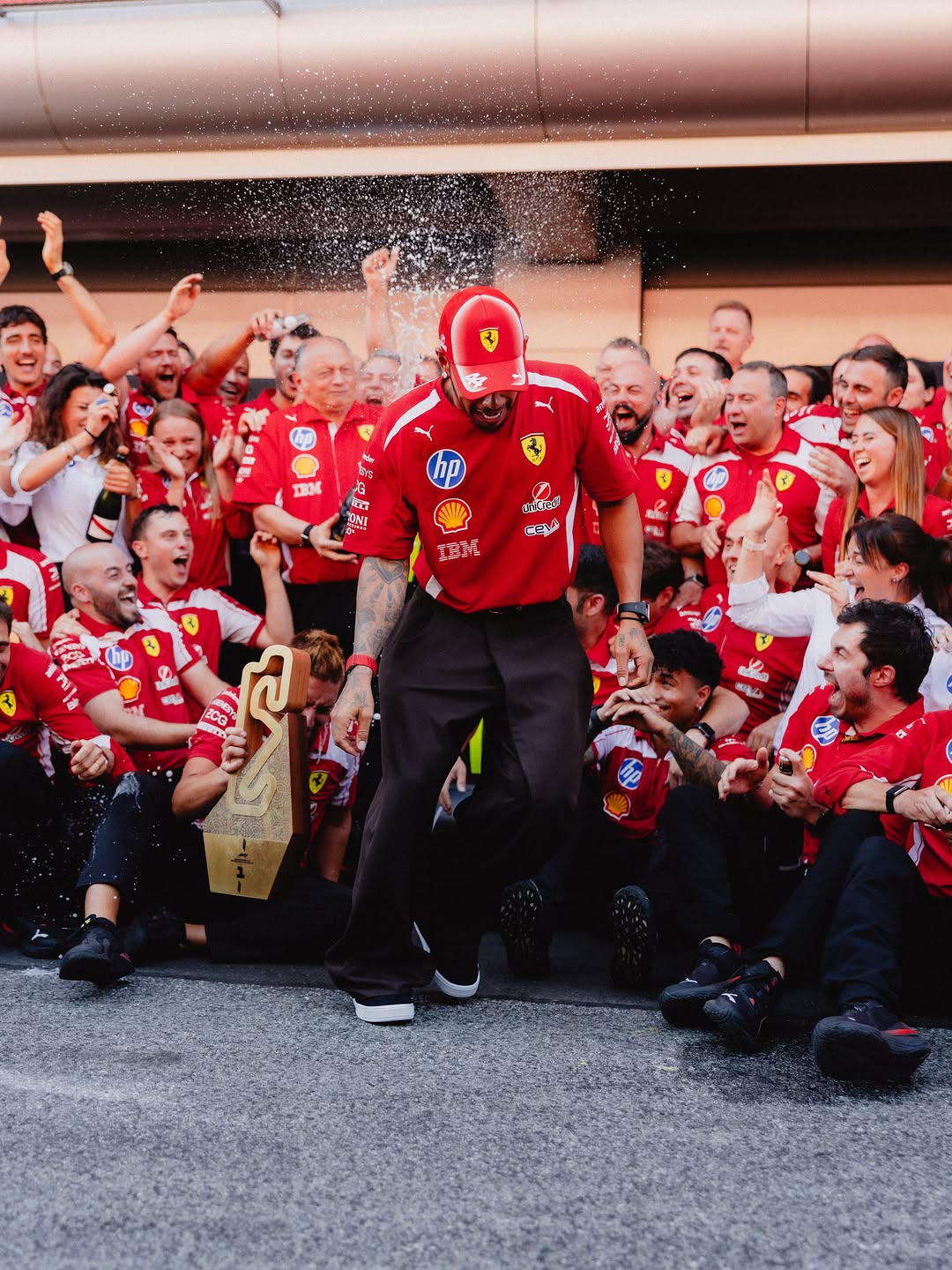
Lewis Hamilton crossed the line at Circuit de Barcelona-Catalunya in Ferrari red, claiming his 106th grand prix win and his first for the Scuderia. On the cooldown lap, voice cracking through the radio, he told Maranello: “You helped me achieve this dream.” The helmet he wore that afternoon — scarlet livery, prancing horse, 41 years of racing distilled into one visor — is already the kind of display piece collectors will chase for years.
Key Takeaways
Hamilton’s 106th win came on his 31st attempt as a Ferrari driver, making it one of the most anticipated victories in recent memory.
A soft-tyre gamble at the start forced a three-stop strategy that ultimately unlocked the full pace of the upgraded SF-26.
Fernando Alonso’s lap-40 retirement triggered a virtual safety car that gave Hamilton a free final pit stop at a decisive moment.
The scarlet helmet Hamilton wore at Barcelona — his first race-worn Ferrari livery on a win — marks an immediate collector milestone.
Win Number 106: What Happened at Barcelona
Lewis Hamilton’s 106th grand prix win arrived on his 31st attempt in Ferrari red, at a sweltering Circuit de Barcelona-Catalunya. That number — 31 attempts — tells its own story. No other win in his career carried quite this particular weight of expectation, and the manner of it, earned through tyre strategy rather than outright qualifying pace, made it feel entirely like Hamilton at his most calculating.
Pole position belonged to George Russell in the Mercedes. Hamilton started on soft tyres while most frontrunners, Russell included, chose a different compound. In Barcelona’s punishing heat, that soft-tyre gamble locked Hamilton into a three-stop race — a path that looked risky on paper but turned into the correct call once the degradation numbers started rolling in from the pit wall.
Russell and Kimi Antonelli in the second Mercedes were nursing hard tyres, managing pace rather than pushing. Hamilton, freed from that conservation mode by his strategy, used the SF-26’s upgraded package to apply sustained pressure. Russell in particular was struggling with a lack of front load, making it increasingly difficult to hold position against a Ferrari that was clearly quicker on fresher rubber.
The decisive moment came on lap 40, when Fernando Alonso parked his Aston Martin and triggered a virtual safety car. Hamilton took his final stop under those conditions, effectively receiving a free pit stop at the exact moment it mattered most. Even without that slice of fortune, the Ferrari’s pace in the final stint pointed to a result that was coming regardless — it simply arrived more cleanly with the VSC in play.
The Radio Message That Defined the Moment
On the cooldown lap, Hamilton delivered one of the most quoted team radio messages in recent Formula 1 history: “Grazie a tutti Maranello, thank you so much. You helped me achieve this dream and I can’t thank you enough.” Those words, spoken in a mixture of Italian and English, captured something that pure statistics cannot.
In parc ferme, Hamilton elaborated. “They’re all special in their own way but this one is something else,” he said. “I watched Ferrari have all their success on TV when I was younger and wondered what it would be like to win in this car. I’m forever grateful and this is hopefully the first of many.”
He also thanked his family and his fans directly: “Thank you to my family and thank you to the fans for continuing to remind me who I am, I couldn’t have done it without you.” At 41 years old and in his first season with the Scuderia, Hamilton was not delivering polished PR. He was visibly moved, and the paddock noticed.
The message landed differently because of the journey it represented. Seven world championships, 105 previous wins across multiple teams — and yet standing in the red garage for the first time as a winner was, by his own account, something else entirely.
The SF-26 Livery That Crossed the Line First
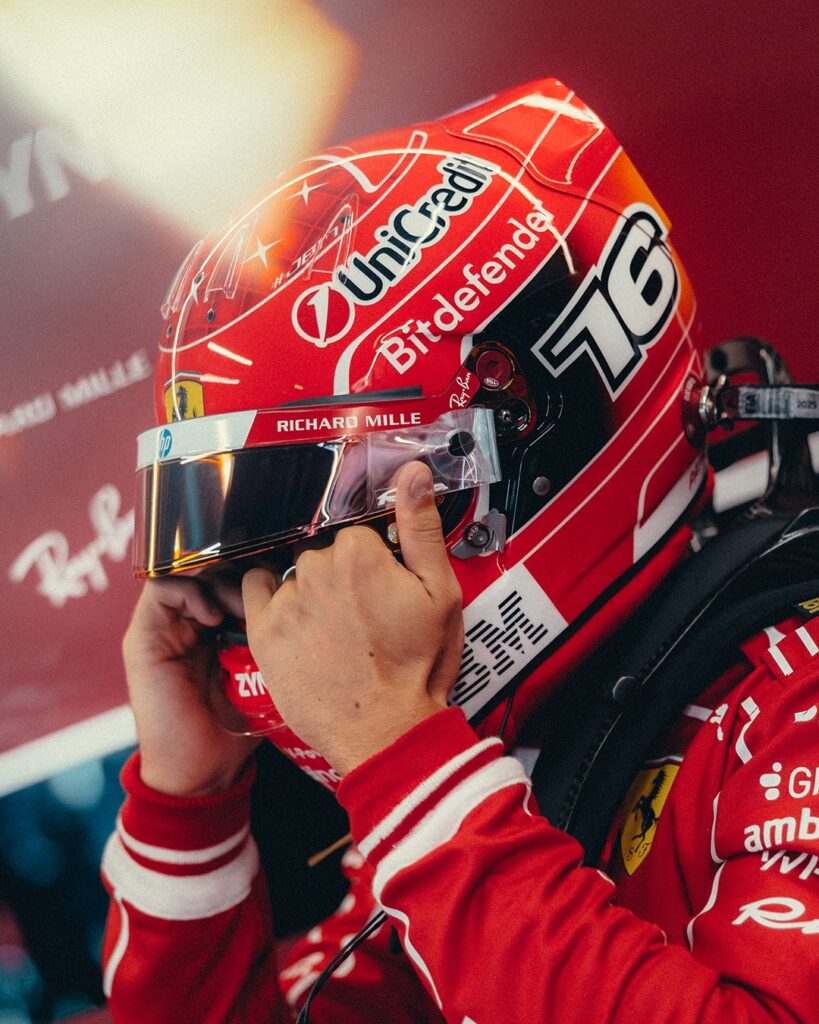
The Ferrari SF-26 raced at Barcelona in the team’s traditional scarlet livery, making Hamilton’s helmet the centerpiece of one of the most visually striking podium presentations of the season. Every collector who tracks race-worn and race-replica helmets understands immediately what a first-win livery means in terms of display significance — this is the color and graphic scheme associated permanently with victory number 106.
Hamilton’s helmet design for the 2025 season carries the prancing horse branding alongside his personal identity marks, a combination that had been building anticipation since his Ferrari debut. On a podium framed by Barcelona’s grandstands, with the scarlet car behind him, the visual record of that afternoon is already the kind of image that defines a collector era.
Full-size 1:1 display replicas of Hamilton’s Ferrari helmet capture exactly what was visible on television during those cooldown lap celebrations: the red shell, the livery details that identify this specific chapter of his career, and the scale that makes it a genuine exhibition-quality display piece rather than a scaled-down souvenir. A properly produced replica at 1:1 scale sits as the focal point of any F1 display, whether on a dedicated helmet stand or inside a sealed acrylic case.
For serious collectors, the Barcelona win creates a clear before-and-after marker. Any Hamilton Ferrari helmet associated with this race date carries the weight of that first win — a fact that will not diminish with time.
Strategy Dissected: Why the Three-Stop Worked
Hamilton’s three-stop strategy worked because Barcelona’s heat drove tyre degradation high enough to neutralize the apparent advantage of running fewer stops. The soft-tyre start that locked him into three stops was the key variable — while Russell and Antonelli managed their compounds to extend stints, Hamilton’s Ferrari could push at a pace the two-stop runners simply could not match in the closing laps.
The upgraded SF-26 package was central to this. Ferrari brought development items to Barcelona that gave Hamilton more confidence at the front of the car, directly addressing the kind of front-load deficit that was visibly affecting Russell by the end of his stints. The gap in pace during the final runs was not marginal — it was enough that, even before the virtual safety car, the outcome was trending toward Hamilton.
Alonso’s retirement on lap 40 collapsed what would have been a normal pit stop window into a free stop under VSC conditions. That timing converted a hard-fought strategic lead into a comfortable margin, removing the last scenario in which Mercedes might have manufactured an undercut or overcut. When Hamilton rejoined on fresh tyres with the VSC ending, the race was settled.
The result also raises a pointed question for Mercedes. With Hamilton now winning in a Ferrari that appears to have genuine pace, the dynamic of the championship fight shifts. Russell and Antonelli will face a Hamilton who has shed whatever lingering doubt comes from 31 winless attempts — and who described this victory as “hopefully the first of many.”
Collecting the Moment: Hamilton’s Ferrari Era in Display Form
A Lewis Hamilton Ferrari display helmet representing the Barcelona win is, factually, a collector piece tied to one of the defining moments of a generational career. The helmet — reproduced at full 1:1 scale as a display and collector replica — captures the exact livery worn during the race that ended a 31-attempt wait for a first Scuderia victory.
Display replicas at 1:1 scale are built to exhibition quality standards, meaning the dimensions match the original worn by the driver. The scarlet base coat, the prancing horse placement, the sponsor typography, and the visor configuration are reproduced to match race-day specification. These are display pieces and collector items, not certified for any protective or wearable use — their purpose is to document and honor a specific moment in the sport’s history.
Hamilton himself framed Barcelona as a milestone rather than a ceiling. “This is hopefully the first of many,” he said in parc ferme. For collectors, that statement opens a chapter rather than closing one — the first Ferrari win is a defined reference point, and every subsequent win in red will be measured against it. A display helmet from this period of Hamilton’s career sits at the start of that chapter.
The podium image — Hamilton on the top step, Ferrari red behind him, the Barcelona crowd in the background — will circulate in F1 media for years. The helmet at the center of that image, reproduced at exhibition quality for display, is the closest a collector can get to owning a piece of what happened on that afternoon in Catalonia.
“Grazie a tutti Maranello, thank you so much. You helped me achieve this dream and I can’t thank you enough. Thank you to everyone for pushing so hard back at home. I’m so proud of you.”
— Lewis Hamilton, cooldown lap team radio, Circuit de Barcelona-Catalunya
“I watched Ferrari have all their success on TV when I was younger and wondered what it would be like to win in this car. I’m forever grateful and this is hopefully the first of many.”
— Lewis Hamilton, parc ferme interview, Barcelona
FAQ
Q: What number win was Hamilton’s first Ferrari victory?
It was his 106th Formula 1 grand prix win overall, and his first in 31 attempts as a Ferrari driver. Hamilton described it in parc ferme as “something else” compared to his previous victories.
Q: Why did Hamilton use a three-stop strategy at Barcelona?
Hamilton started on soft tyres while most frontrunners chose harder compounds, which committed him to a three-stop race. Barcelona’s heat produced high tyre degradation, making the extra stop worthwhile because the SF-26 could run at full pace on fresh rubber while two-stop runners had to manage their tyres.
Q: What role did Fernando Alonso play in Hamilton’s win?
Alonso’s retirement on lap 40 triggered a virtual safety car that allowed Hamilton to take his final pit stop under VSC conditions — effectively a free stop that converted a strategic advantage into a decisive race lead.
Q: What makes a Lewis Hamilton Ferrari display helmet from this race significant for collectors?
It is directly linked to Hamilton’s first Ferrari win, his 106th overall — a defined milestone in a generational career. Full-size 1:1 display and collector replicas reproduce the scarlet Barcelona livery at exhibition quality scale, making them permanent reference pieces for this specific chapter of his career. These are display items only, not certified for protective use.
Q: What did Hamilton say after winning for Ferrari for the first time?
On the cooldown lap Hamilton said: “Grazie a tutti Maranello, you helped me achieve this dream and I can’t thank you enough.” In parc ferme he added that he had watched Ferrari’s success on television as a younger person and had always wondered what winning in that car would feel like.
Shop Lewis Hamilton Collection — find full-size 1:1 display and collector replica helmets celebrating Hamilton’s Ferrari era, including the scarlet livery from his historic 106th win at Barcelona. Exhibition-quality display pieces. Not certified for protective use.
Display and collector replicas only. Not certified for protective use. Full-size 1:1 scale.
This article was written with the help of AI tools. Editorial policy