Blog
On This Day: Michael Schumacher’s Final Unsportsmanlike Manoeuvre at Hungary 2010
 123Helmets Editorial Team
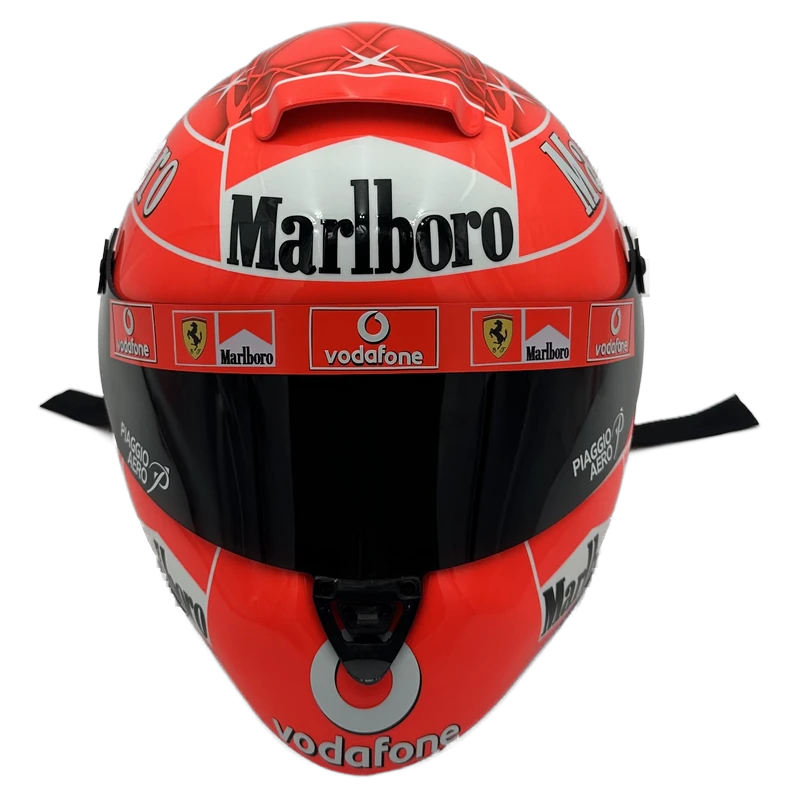
On This Day: Michael Schumacher’s Final Unsportsmanlike Manoeuvre at Hungary 2010
August 1, 2010. The Hungaroring bakes under a relentless summer sun, and on lap 70 of the Hungarian Grand Prix, a seven-time World Champion makes one of the most controversial defensive moves of his career. Michael Schumacher, racing for Mercedes in his comeback era, squeezes Rubens Barrichello against the pit wall at nearly 300 km/h — a manoeuvre that would earn him a ten-place grid penalty and become the final chapter in the long catalogue of Schumacher’s contested wheel-to-wheel decisions. For collectors of full-size 1:1 replica helmets, that 2010 Mercedes weekend remains one of the most visually striking of Michael’s comeback years, with the silver-and-red livery framing his unmistakable red, white and blue helmet design.
Key Takeaways
The Hungary 2010 GP marked the most contested defensive move of Schumacher’s Mercedes comeback era.
Michael’s 2010 helmet retained his classic red, white and blue colour blocks — a centrepiece for any display collection.
Barrichello won the wheel-to-wheel battle and finished 10th; Schumacher received a ten-place grid drop for Spa.
The Mercedes W01 silver livery with red accents makes 2010 helmet replicas instantly recognisable on a shelf.
The Setting: Budapest, Summer 2010
The Hungarian Grand Prix has always been a peculiar event on the Formula 1 calendar. Tight, twisty, dusty and famously hard to overtake on, the Hungaroring rewards qualifying pace and punishes mistakes. In 2010, the paddock arrived in Budapest with a championship that was already producing five different winners in the opening eleven races. Red Bull held the pace advantage, McLaren had momentum with Lewis Hamilton and Jenson Button, and Ferrari were rebuilding after a difficult start to Fernando Alonso’s debut season in red.
Mercedes GP, the works team that had absorbed the championship-winning Brawn outfit, was an entirely different story. The W01 was not the car Michael Schumacher had hoped for when he ended his three-year retirement. Nico Rosberg was generally outpacing him, and the headlines that had heralded the comeback in January were now sharper, more critical. Hungary was meant to be a quiet, points-gathering weekend before the summer break.
Qualifying and Strategy
Schumacher qualified 11th, Barrichello 12th — the two veterans of more than 600 combined Grand Prix starts separated by a tenth on the timing sheets. The race itself was disrupted by an early safety car, which scrambled strategies and brought the field back together. By the closing laps, Schumacher was running just ahead of his former Ferrari team-mate, defending tenth place — the final points-paying position in 2010.
Lap 70: The Manoeuvre That Defined the Comeback
It began innocuously enough. Barrichello, in the Williams FW32, had been hounding the silver Mercedes for several laps. The Brazilian was clearly faster in a straight line. Coming onto the main pit straight, Rubens pulled out of the slipstream and committed to a move down the inside — the right-hand side of the track, the side bordered by the concrete pit wall.
Schumacher saw him coming. And then, slowly, deliberately, he moved across. Not in a single block — that would have been a simple, clear infringement — but in a gradual squeeze that left Barrichello with rapidly diminishing room. Television cameras captured the Williams’ right-front wheel inches from the unforgiving concrete wall as Barrichello kept his foot in. Sparks. A gap of perhaps a wheel-width. And then Barrichello was through, into Turn 1, holding tenth place.
The Reaction in the Cockpit
Barrichello’s radio message after the move was unusually measured for a driver who had nearly been pitched into a pit wall at 290 km/h. In the post-race media pen, however, his words sharpened. He described the move as the most dangerous of his career and said openly that he had expected better from someone he had once called a friend and team-mate at Ferrari.
Schumacher, characteristically, was unrepentant in the immediate aftermath, suggesting the gap had always been there. The stewards disagreed. A ten-place grid penalty for the following Belgian Grand Prix at Spa-Francorchamps was issued — one of the harshest sanctions of Schumacher’s career and, notably, the last major sporting penalty he would receive in Formula 1.
The 2010 Mercedes Livery and Helmet — A Collector’s Perspective
For those who build display collections of full-size 1:1 replica helmets, the 2010 season holds a particular fascination. Schumacher’s helmet that year was a careful evolution of the design he had carried since the late 1990s: a deep red dome, a white band across the visor opening, and blue accent flashes. The Mercedes era added subtle changes — sponsor placements shifted, and the colour balance was adjusted to harmonise with the silver-and-petronas-teal team livery.
Why the 2010 Helmet Stands Out
Several details make a 2010 Schumacher exhibition-quality replica a centrepiece for any display:
- The red-white-blue tricolour is one of the most recognisable colour schemes in motorsport history.
- Mercedes-era sponsor logos — including the distinctive Petronas typography — differentiate it from the Ferrari-era helmets that dominate Schumacher collections.
- The matte and gloss contrast of the original finish translates beautifully into a collector-grade reproduction.
- Historical significance — this is the helmet design worn during the controversial Hungary defence, the Valencia battle with Alonso, and the emotional Spa weekend that followed.
On a display shelf, a 2010 Schumacher 1:1 replica pairs particularly well with a Rosberg Mercedes helmet of the same period, creating a side-by-side team contrast that captures the awkward, transitional nature of that comeback chapter.
Podium and Race Result
While the Schumacher–Barrichello incident dominated the headlines, the actual podium of the 2010 Hungarian Grand Prix was a Red Bull and McLaren affair. Mark Webber took victory after a brilliantly judged drive, his second win in three races, with Fernando Alonso second for Ferrari and Sebastian Vettel third after a controversial drive-through penalty for a safety car infringement.
Visual Highlights for Collectors
The 2010 Hungary podium remains a visually rich reference for helmet enthusiasts. Webber’s yellow-and-green Australian-themed lid against the dark blue Red Bull overalls; Alonso’s asymmetric Spanish flag design in front of the scarlet Ferrari; Vettel’s intricate, sponsor-laden Red Bull helmet — three completely different design philosophies on one rostrum. For collectors curating a 2010-season display, replicating that podium trio creates an immediately recognisable historical tableau.
Barrichello, who had effectively triggered the incident of the day, finished tenth and scored a single point. Schumacher crossed the line eleventh, classified outside the points, his ten-place grid penalty for Spa already looming.
The Wider Context: A Career’s Closing Argument
The Hungary 2010 manoeuvre cannot be separated from the long history of Schumacher’s wheel-to-wheel reputation. Adelaide 1994 against Damon Hill. Jerez 1997 against Jacques Villeneuve. Monaco 2006 and the parked Ferrari at Rascasse. Each of these incidents had defined chapters of his career, and each had been followed by intense debate about where the line between hard racing and unsporting conduct truly lies.
The Final Chapter
What made Hungary 2010 different was its placement in the narrative. This was not the dominant champion fighting for a title — this was the returning veteran fighting for tenth place. The stakes were dramatically smaller, but the instinct, observers argued, was identical. After Hungary, Schumacher’s remaining two seasons at Mercedes — through 2011 and 2012 — would feature impressive moments, including the Valencia 2012 podium, his only rostrum of the comeback. But there would be no repeat of the Hungary controversy. It stood, and stands, as the last entry in that particular ledger.
For the modern collector revisiting that era through full-size 1:1 replica helmets, the Hungary 2010 weekend is a fascinating focal point — a single race that condensed an entire career’s worth of debate into seventy laps under a Budapest sky.
Building a Comeback-Era Schumacher Display
If the Hungary 2010 story has captured your imagination, there are several ways to bring the era into a collector display:
Suggested Display Configurations
- The Comeback Trilogy: 2010, 2011 and 2012 Mercedes-era replicas side by side, showing the subtle livery evolution across three seasons.
- The Rivalry Pair: Schumacher 2010 alongside a Barrichello 2010 Williams replica — the two protagonists of the Hungaroring incident on the same shelf.
- Career Arc: A Benetton 1995 replica, a Ferrari 2000 or 2004 replica, and a Mercedes 2010 replica — three eras, one driver, one of motorsport’s most recognisable helmet designs evolving across fifteen years.
- The 2010 Grid: Webber, Alonso, Vettel and Schumacher full-size 1:1 display helmets representing the four protagonists of that strange, transitional season.
Each of these display configurations turns a shelf into a story — and the Hungary 2010 chapter, with all its controversy, is one of the most compelling stories in modern Formula 1 history.
“That was the most dangerous manoeuvre I’ve ever experienced. I could have hit the wall at full speed.”
— Rubens Barrichello, post-race media pen, Hungaroring 2010
“There was always a gap. I left him room — just the room he needed.”
— Michael Schumacher, post-race comments, Hungary 2010
FAQ
Q: What exactly happened between Schumacher and Barrichello at Hungary 2010?
On lap 70, Barrichello attempted to pass Schumacher down the main straight on the pit-wall side. Schumacher gradually moved across, squeezing the Williams against the concrete wall with only a wheel-width of room. Barrichello completed the pass but the move was deemed unsportsmanlike and Schumacher received a ten-place grid penalty for the next race at Spa.
Q: Why is the 2010 Schumacher helmet popular among collectors?
The 2010 helmet marks the Mercedes comeback era, combining Schumacher’s classic red-white-blue colour scheme with new Mercedes-era sponsor placements like Petronas. It is historically significant, visually distinct from his Ferrari helmets, and represents a transitional chapter in one of motorsport’s greatest careers — making it an attractive full-size 1:1 display piece.
Q: What was the result of the 2010 Hungarian Grand Prix?
Mark Webber won for Red Bull, with Fernando Alonso second for Ferrari and Sebastian Vettel third after a drive-through penalty. Barrichello finished tenth, scoring one point, while Schumacher was classified eleventh outside the points.
Q: Was this really Schumacher’s last major unsportsmanlike incident?
In terms of stewards’ penalties for unsporting conduct, the Hungary 2010 ten-place grid drop stands as the final major sanction of his career. His remaining seasons at Mercedes through 2011 and 2012 produced no comparable controversy.
Q: How can I create a Hungary 2010 themed helmet display?
A compelling configuration pairs a 2010 Schumacher Mercedes 1:1 replica with a 2010 Barrichello Williams replica to recreate the rivalry. Adding Webber, Alonso and Vettel helmets from the same season completes a podium-and-protagonists tableau that captures the entire race weekend on one shelf.
Browse F1 Helmet Collection
Display and collector replicas only. Not certified for protective use. Full-size 1:1 scale.