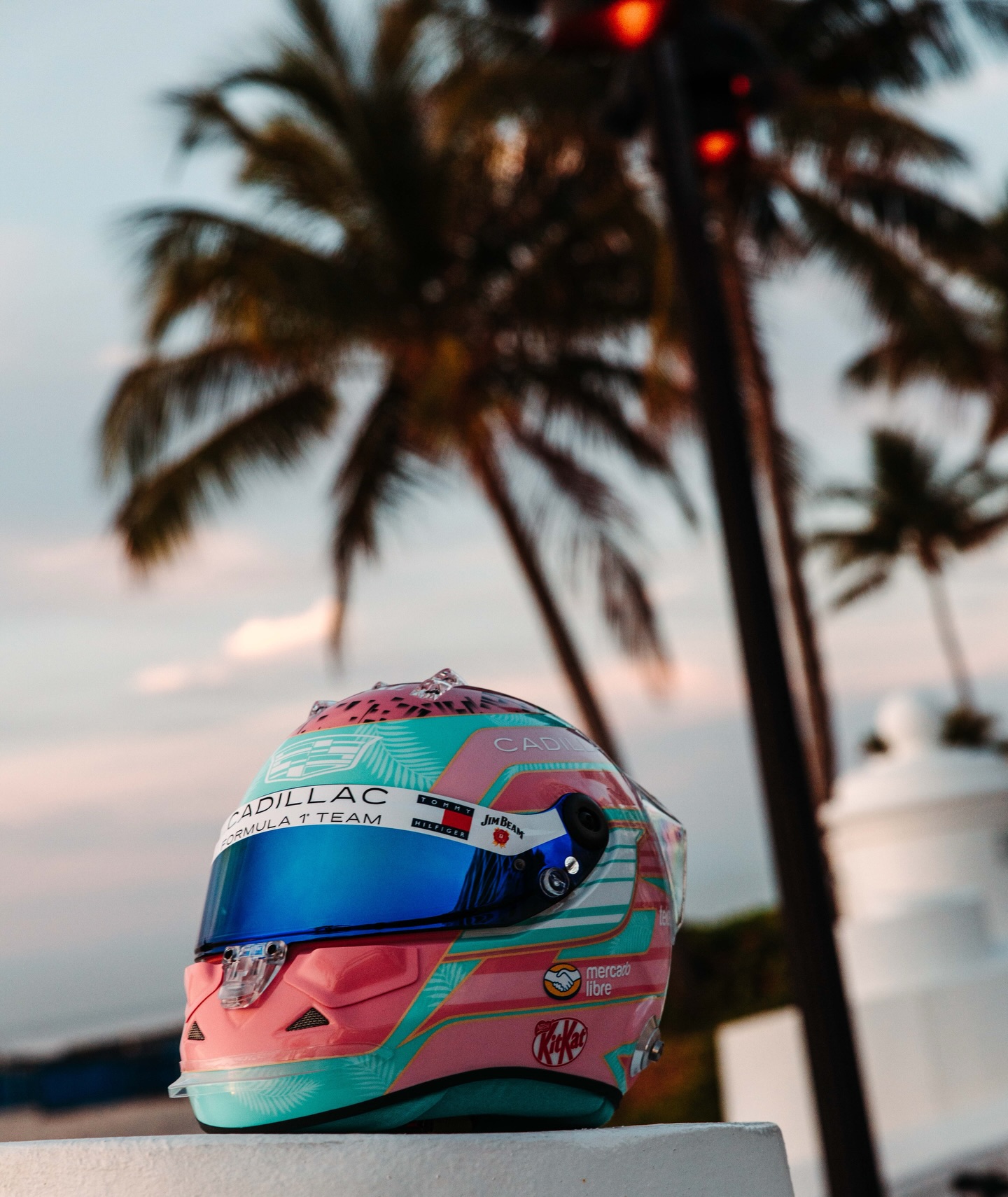
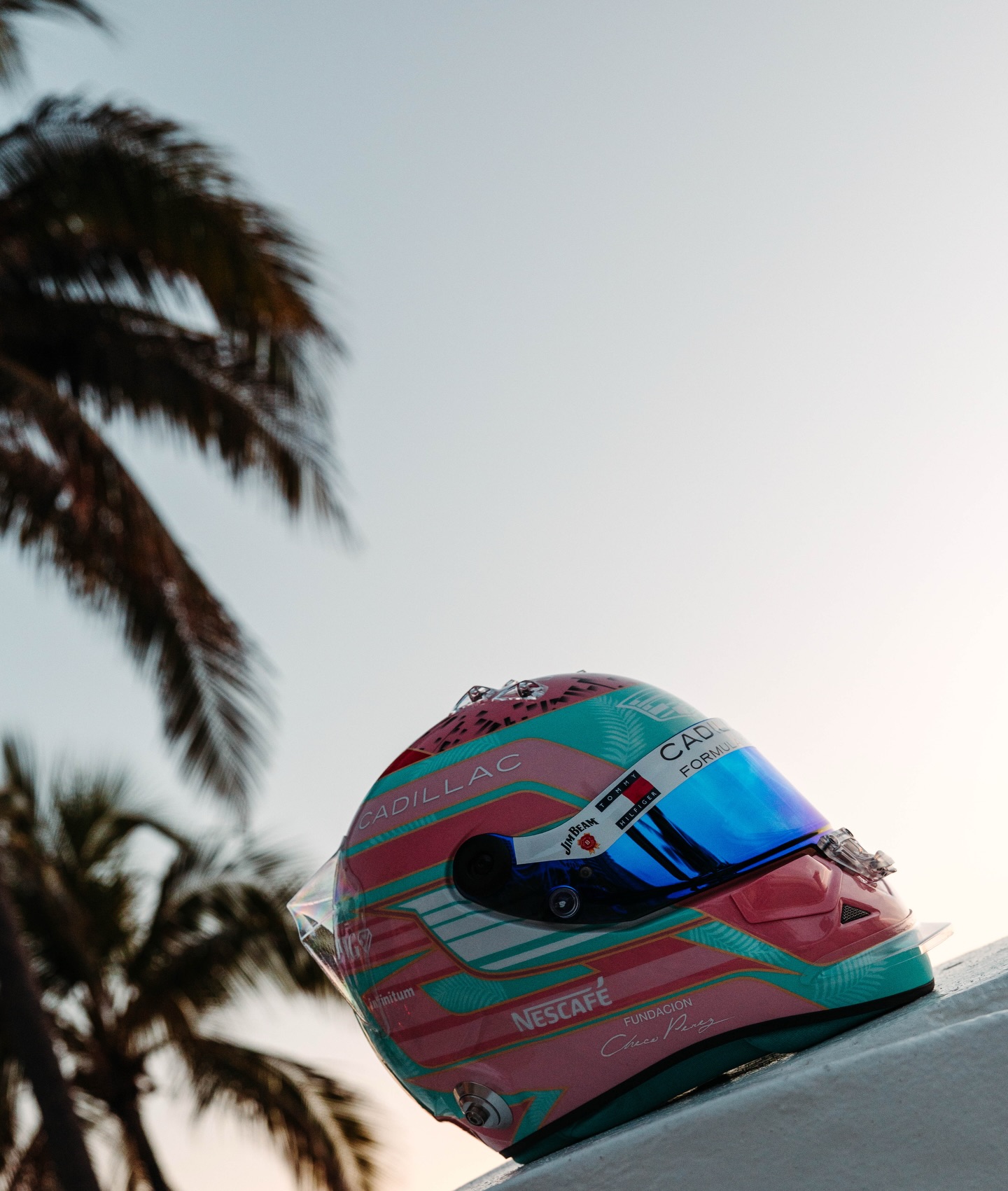
Sergio Pérez returns to the Miami International Autodrome paddock for race week 2026 with a brand-new Cadillac-era lid — and the design lands like a love letter to Puerto Vallarta, painted in coastal blues, sunset oranges and the unmistakable Mexican identity that has defined Checo’s career. This is the helmet reveal collectors have been waiting for since the Cadillac F1 program was first announced, and the Miami unveiling could not have been staged more cinematically.
Checo Pérez debuts a Cadillac-era Miami GP 2026 helmet inspired by his hometown of Puerto Vallarta, Jalisco.
The sponsor stack visibly integrates Cadillac and NESCAFÉ alongside Pérez’s signature personal marks.
Coastal palette — turquoise, sunset orange and white — references Bahía de Banderas and Mexican Pacific imagery.
Full-size 1:1 collector replicas of helmet reveals like this one are exhibition-grade display pieces, never intended for protective use.
A Race-Week Return Painted in Pacific Blues
When Sergio Pérez stepped back into the Miami paddock for the 2026 Grand Prix, he was not just returning as a driver — he was returning as the face of an entirely new American works team. Cadillac’s arrival on the Formula 1 grid had already generated months of speculation, and pairing the marque with Mexico’s most decorated modern F1 driver gave the Miami weekend a narrative weight unlike any other event on the calendar. The helmet he unveiled for race week did not waste the moment.
Photographed against the South Florida coastline and again on track during the build-up sessions, the new lid reads as a deliberate hometown tribute. Puerto Vallarta — the Pacific resort city in Jalisco where Pérez grew up — is referenced through a palette of turquoise, deep ocean blue and a warm sunset orange that bleeds across the crown. Palm-tree silhouettes and horizon lines appear as graphic motifs rather than literal illustrations, giving the design a modern, almost editorial finish that stands apart from the busier liveries elsewhere on the grid.
For collectors tracking helmet evolutions across Pérez’s career, this Miami 2026 piece is unmistakably a chapter break. Gone are the Red Bull-era color codes; in their place is a cleaner, more personal canvas built around Cadillac’s identity and Checo’s roots.
The Cadillac Identity Takes Shape
How the new sponsor stack reads on the shell
One of the most-watched details of any new-team helmet reveal is the sponsor architecture. Where do the primary marks sit? Which logos earn the crown, which take the chin, which fall to the rear? On the Miami 2026 lid, Cadillac’s wreath-and-crest is given prominence consistent with title-partner placement, integrated cleanly into the design rather than slapped over it. NESCAFÉ — a longtime personal partner of Pérez — also features visibly, reinforcing that even with a new team, Checo’s personal commercial identity travels with him.
A clean canvas for a new era
Cadillac’s brand language leans on heritage Americana with a modern luxury edge, and the helmet design appears to absorb that influence without losing Pérez’s Mexican character. The result is a hybrid: an American works-team aesthetic filtered through a distinctly Latin American driver identity. For display and exhibition purposes, this kind of sponsor-era transition helmet is exactly the type of piece that defines a collector’s shelf for decades — it marks the precise moment a driver’s career pivoted.
Puerto Vallarta on the Crown: Reading the Design
The coastal palette
The dominant color story is unmistakably coastal. Turquoise gradients evoke Bahía de Banderas, the bay that frames Puerto Vallarta. The orange wash across the upper shell reads as sunset light hitting the Sierra Madre — a familiar sight for anyone who has watched the sun fall behind the western mountains from Vallarta’s malecón. White and cream sections break up the saturation and give the sponsor blocks room to breathe.
Mexican identity, refined
Previous Pérez helmets have leaned heavily on the green-white-red of the Mexican flag, sometimes in bold tricolor blocks. This Miami 2026 design takes a more sophisticated route: the national identity is implied through cultural geography rather than flag iconography. It is Mexico expressed as place — specifically Pérez’s place — rather than Mexico expressed as symbol. That subtlety is what elevates the helmet from a livery into a personal statement, and it is precisely the kind of nuance that drives demand for full-size 1:1 collector replicas.
Personal marks and family references
Close inspection of reveal photography suggests the customary nods to Checo’s family — initials and small graphic dedications that have appeared across his helmets for years — remain present, though repositioned to suit the new layout. These details rarely make headlines, but they are the elements collectors zoom in on when evaluating an exhibition piece.
Why Miami Was the Right Stage for the Reveal
The U.S. market and Cadillac’s home race
Miami is, in every meaningful sense, Cadillac’s home Grand Prix. Debuting Pérez’s new helmet design here — rather than at a season opener or a more traditional European venue — sends a clear commercial signal. The American audience is the one Cadillac most wants to engage, and Miami’s Latin American demographic guarantees that Checo’s hometown tribute lands with a crowd that fully understands the references.
Momentum from Japan
Pérez arrived in Miami off the back of what he himself described as a positive weekend in Japan — a race in which he overcame early issues to record meaningful progress for the Cadillac program. That on-track momentum gave the Miami helmet reveal an extra charge: this is not a driver in retreat using a fresh paint job to distract from results. It is a driver building a new chapter and marking it with a design worthy of the moment.
The on-course crossover moment
Race week also produced a memorable crossover with golfer Scottie Scheffler — a track-meets-course content piece that put the new helmet in unusual contexts and broadened its visibility well beyond the core F1 audience. For helmet historians, those non-paddock appearances often become the defining images of a design’s life cycle.
Collecting the Miami 2026 Pérez Helmet
What makes a reveal helmet collectible
Reveal helmets — the very first design a driver wears in a new team’s colors — occupy a special tier in F1 memorabilia. They mark transitions, and transitions are what collectors prize. The Miami 2026 Pérez piece checks every box: new team (Cadillac), new era of regulations, new personal narrative (Puerto Vallarta tribute), and a high-visibility venue. Full-size 1:1 replicas of designs like this are display pieces in the truest sense — exhibition-grade objects built for shelves, cabinets, lit niches and dedicated collector rooms.
Display considerations
Because the palette runs warm and cool simultaneously, the helmet rewards directional lighting. A single warm spot on the crown brings the sunset orange forward; a cooler ambient fill emphasizes the turquoise. Collectors building a Pérez career display will find this lid pairs naturally with earlier Mexico GP commemorative helmets thanks to the shared cultural through-line, even though the color stories differ.
A note on framing
These are display and collector replicas only. They are not certified for protective use, are not intended for wear, and exist purely as full-size 1:1 representations of the on-track designs. That framing matters: it is exactly what allows the craftsmanship — the paint transitions, the sponsor placement, the typography — to be celebrated as art rather than equipment.
What the Reveal Tells Us About Checo’s 2026
Helmet reveals are never just about paint. They are statements of intent. By centering the Miami 2026 design on Puerto Vallarta — on home, on origin, on the place that made him — Pérez is signaling that this Cadillac chapter is being written on his own terms. After a year away from the grid, the return is not framed as a comeback for someone else’s program. It is framed as a continuation of his own story, with Cadillac as the new vehicle for it.
For the broader Cadillac F1 narrative, the helmet provides the team something money cannot easily buy: instant cultural credibility in Latin America, in the southern United States, and across the global Spanish-speaking F1 audience. That is a strategic asset, and it travels with Pérez every time he puts the lid on.
“Happy to be back in Miami!”
— Sergio Pérez, race week 2026
“Good progress every week. Miami next.”
— Sergio Pérez, post-Japan 2026
FAQ
Q: What is the inspiration behind Sergio Pérez’s Miami GP 2026 helmet? The design is widely read as a tribute to Pérez’s hometown of Puerto Vallarta, Jalisco. The turquoise, ocean blue and sunset orange palette references the Pacific coast, Bahía de Banderas and the Sierra Madre sunsets familiar to anyone from the region.
Q: Which sponsors are visible on the new Cadillac-era helmet? Cadillac is integrated as the team identity, while NESCAFÉ — a longtime personal partner of Pérez — also features visibly. Additional personal marks and family dedications appear in the customary positions Checo has used across his career.
Q: Is this helmet design considered collectible? Yes. Reveal helmets that mark a driver’s transition to a new team — especially a brand-new works team like Cadillac — are among the most sought-after pieces in F1 memorabilia. Full-size 1:1 replicas of such designs are prized as exhibition display items.
Q: Are 1:1 replica helmets safe for track or road use? No. Replica helmets sold for collecting and display are exhibition pieces only. They are not certified for protective use, are not intended to be worn, and exist purely as full-size visual representations of the on-track designs.
Q: How does this helmet compare to Pérez’s previous designs? Earlier Pérez helmets often used bold green-white-red Mexican tricolor blocking. The Miami 2026 lid takes a more refined approach, expressing Mexican identity through coastal geography and Puerto Vallarta references rather than literal flag imagery — a clear stylistic evolution.
Browse the full F1 helmet collection and explore exhibition-grade 1:1 collector replicas curated for serious display rooms.
Arvid Lindblad is the only true 2026 rookie; here is his helmet, plus the 2026 designs of the class of 2025 — Antonelli, Hadjar, Bortoleto and Bearman.
Lando Norris's Monza 2026 helmet pairs a navy shell with fluorescent yellow swirls in his signature colour, now available as a full-size 1:1 display replica.
Hamilton's Monza 2026 helmet pairs a yellow base with tricolore-recoloured HAM lettering and star clusters, a home-race design now available as a full-size 1:1 display piece.
Charles Leclerc's Monza 2026 helmet is an all-red design carrying seven stars in tribute to Michael Schumacher, now available as a full-size 1:1 display piece.
Antonelli's Monza 2026 helmet mixes Italian tricolore panels with a Valentino Rossi tribute by Drudi Performance, built as a one-off for the home Grand Prix.
Aston Martin introduces Eloise (@eloisefeelyy) to its TikTok Creator Collective, pairing her athlete-creator perspective with the team's 2026 identity.
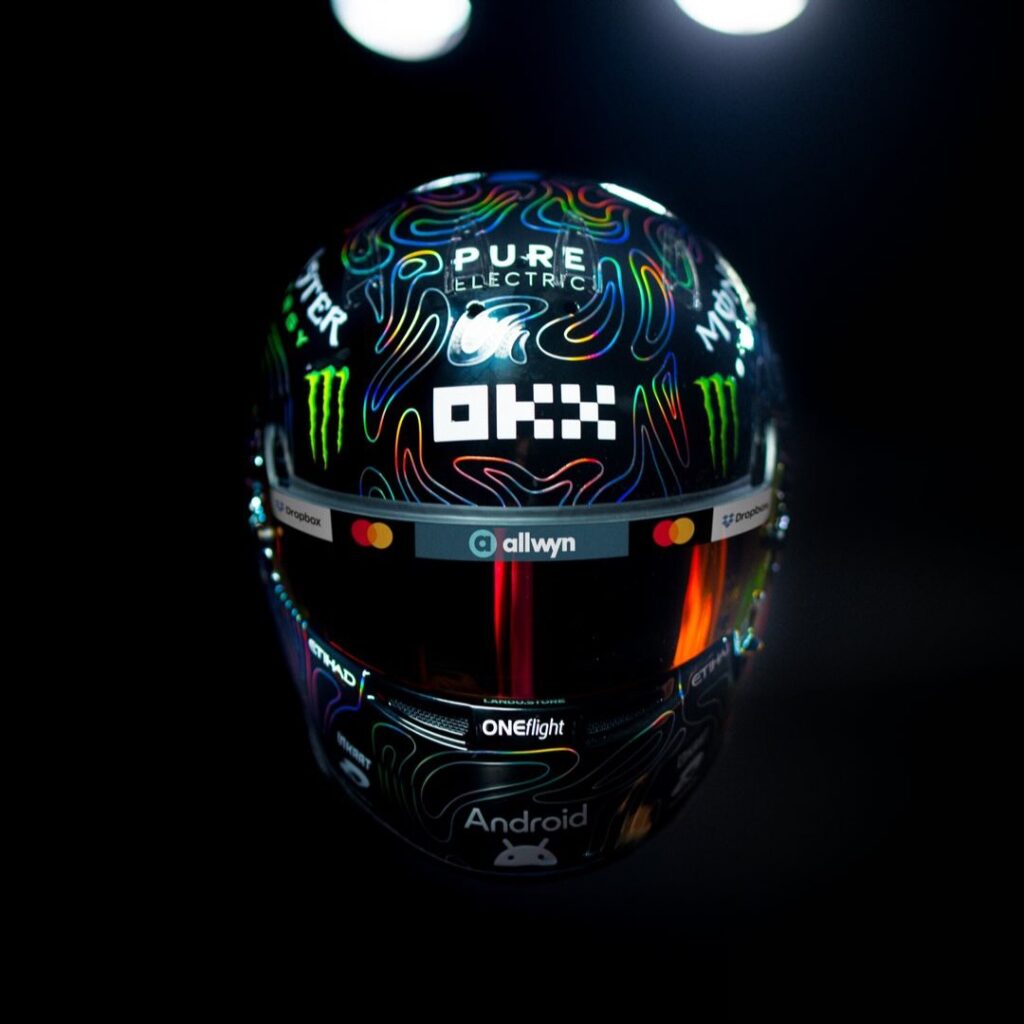
Lando Norris debuts a holographic, topographic-line McLaren helmet by JMD for the 2026 Dutch GP, revealed 19 August ahead of Zandvoort's sprint weekend.
To provide the best experiences, we use technologies like cookies to store and/or access device information. Consenting to these technologies will allow us to process data such as browsing behavior or unique IDs on this site. Not consenting or withdrawing consent, may adversely affect certain features and functions.
Functional
Always active
The technical storage or access is strictly necessary for the legitimate purpose of enabling the use of a specific service explicitly requested by the subscriber or user, or for the sole purpose of carrying out the transmission of a communication over an electronic communications network.
Preferences
The technical storage or access is necessary for the legitimate purpose of storing preferences that are not requested by the subscriber or user.
Statistics
The technical storage or access that is used exclusively for statistical purposes.The technical storage or access that is used exclusively for anonymous statistical purposes. Without a subpoena, voluntary compliance on the part of your Internet Service Provider, or additional records from a third party, information stored or retrieved for this purpose alone cannot usually be used to identify you.
Marketing
The technical storage or access is required to create user profiles to send advertising, or to track the user on a website or across several websites for similar marketing purposes.



 123Helmets Editorial Team