
Blog
Why Leclerc Fell P2 to P8: 2026 Austrian GP
 123Helmets Editorial Team

Charles Leclerc started from the front row at the 2026 Austrian Grand Prix on 28 June 2026 and finished eighth, 45.659 seconds behind winner George Russell. The gap came from two compounding problems: a 0.333s per-lap median pace deficit on the straights and a three-stop strategy that cost roughly 20 seconds of track position against the two-stop leaders. This is a sector-by-sector and stint-by-stint account of how that happened.
Key Takeaways
Leclerc’s median clean-lap pace was 1:11.995 — 0.333s per lap slower than Russell’s 1:11.662 over 71 laps, adding roughly 24 seconds in pure race pace alone.
Ferrari’s top speed was 315 km/h versus Russell’s 323 km/h: an 8 km/h straight-line deficit that shows up in Sectors 1 and 2, not in the twisty Sector 3 where Leclerc was actually 0.166s quicker.
Leclerc ran four stints on Medium–Hard–Hard–Soft while Russell, Verstappen and Antonelli all finished on two stops; the extra pit stop cost Ferrari approximately 20 seconds of track position.
Leclerc’s single fastest lap of 1:10.606 on lap 67 was marginally quicker than Russell’s best of 1:10.683, confirming peak pace existed — the problem was sustaining it across a full stint.
The Result and the Gap
Charles Leclerc finished eighth at the 2026 Austrian Grand Prix on 28 June 2026, 45.659 seconds behind race winner George Russell — a result that does not reflect his P2 starting position but is precisely explained by the numbers underneath it.
The top of the final classification looked like this: Russell first, Max Verstappen second at +1.611s, Kimi Antonelli third at +1.986s, Oscar Piastri fourth at +21.809s, Lewis Hamilton fifth at +26.393s, Isack Hadjar sixth at +29.399s, Lando Norris seventh at +31.505s, and Leclerc eighth at +45.659s. Hamilton, also in a Ferrari, finished fifth — ahead of his team-mate but still outside the top four.
A 45-second gap from a front-row start is large enough to demand a structured explanation. Two factors account for almost all of it: approximately 24 seconds of accumulated pace deficit at roughly 0.33 seconds per lap across 71 laps, and approximately 20 seconds lost through an extra pit stop. The arithmetic is not exact — traffic, safety-car timing and tyre warm-up all introduce noise — but those two numbers frame the story.
Median Race Pace: Ferrari Slowest of the Front Runners
Ferrari had the slowest median clean-lap pace of any front-running team at the 2026 Austrian Grand Prix: Leclerc’s figure was 1:11.995 and Hamilton’s was 1:11.927.
For context, Russell’s median was 1:11.662, Antonelli’s 1:11.707, and Verstappen’s 1:11.798. Translating those deltas into race distance: Leclerc was 0.333 seconds per lap slower than Russell and 0.129 seconds per lap slower than Verstappen. Over 71 racing laps, 0.333 seconds per lap compounds to roughly 23.6 seconds in raw pace — before strategy enters the picture.
Hamilton’s 1:11.927 was closer to the Red Bull reference, 0.265 seconds per lap off Russell’s benchmark, which is one reason he finished three places higher than Leclerc despite starting further back on the grid. The Ferrari SF-26 was not uniformly slow; it was slow in a specific, directional way that the sector data clarifies.
What the Lap-Time Distribution Shows
Median pace strips out outlier laps — safety-car periods, in- and out-laps, traffic — so it is the cleanest proxy for underlying car performance. Leclerc’s 1:11.995 median means that in normal conditions, on every representative lap, the Ferrari was giving back a third of a second to the leading Mercedes. At a circuit of 71 laps, that is not recoverable through driver management alone.
Sector Breakdown: A Straight-Line Problem, Not a Cornering One
On the fastest-lap comparison between Leclerc and Russell, Ferrari lost time exclusively on the straights: Sector 1 was +0.047s and Sector 2 was +0.042s in Russell’s favour, while Leclerc was actually faster through Sector 3 by 0.166 seconds.
Red Bull Ring’s Sector 3 is the most technical part of the lap — the tight hairpin complex and the final chicane sequence. Leclerc’s 0.166s advantage there confirms the SF-26’s mechanical grip and downforce through slow corners was competitive. Sectors 1 and 2 contain the main straight and the two DRS zones where raw straight-line speed determines the laptime delta.
The top-speed trace removes any ambiguity: Ferrari’s highest recorded speed in the race was 315 km/h; Russell reached 323 km/h. An 8 km/h gap at the speed trap is not a minor calibration difference — it is the signature of higher aerodynamic drag relative to the power unit’s output at that circuit. Whether the source is excess drag from the floor or beam-wing configuration, or a power unit deployment deficit on the straights, the effect on lap time is in Sectors 1 and 2, and it was consistent across the race distance.
Why This Matters for Race Pace (Not Just Qualifying)
In qualifying, a driver can partially offset a straight-line deficit by carrying more speed into the high-speed corners, gambling on a lower-drag setup. In a 71-lap race, the car runs the same aerodynamic balance throughout, so a straight-line drag penalty repeats on every single lap with no opportunity to compensate. That is why a deficit that might cost 0.1 seconds in a single qualifying lap inflates to a 0.333-second-per-lap penalty across a race stint: slow corner exit, slow straight, slower braking point, repeat.
Strategy: Three Stops Versus Two
Both Ferraris ran four stints and three pit stops at the 2026 Austrian Grand Prix, using a Medium–Hard–Hard–Soft sequence, while Russell, Verstappen and Antonelli all completed the race on two stops.
Each pit stop at the Red Bull Ring costs a driver approximately 20–22 seconds in lost track position at a circuit with a relatively short pit lane. One extra stop against the leaders therefore represents around 20 seconds of time that cannot be recovered on pace alone — particularly when, as established above, the car was already 0.333 seconds per lap slower in median terms.
The Soft tyre at the end of Leclerc’s final stint produced his fastest lap of the race: 1:10.606 on lap 67. Russell’s best was 1:10.683, set on his own fresh rubber. The 0.077-second margin in Leclerc’s favour on peak lap pace is meaningful — it shows the SF-26 had genuine speed available when the tyre was fresh and the fuel load was light. The Soft-tyre end-stint pace is also consistent with the theory that Ferrari’s degradation on the harder compounds forced the three-stop structure in the first place: if the Hard tyre had lasted longer, Ferrari might have matched the two-stop strategy of the leaders.
Strategy and Pace as Compounding Deficits
The two problems are not independent. A car that is slower in median pace takes longer to build a gap large enough to pit, which in turn makes it harder to run long stints cleanly. Ferrari’s higher straight-line drag likely contributed to increased tyre load at the end of the DRS zones on braking, which may have accelerated tyre wear. The strategy and the pace deficit are symptoms of the same aerodynamic configuration choice, not two separate failures.
Peak Pace Versus Sustained Pace
Leclerc’s fastest lap of 1:10.606 on lap 67 was quicker than Russell’s best of 1:10.683 — confirming that the SF-26 had peak lap-time potential that exceeded the race-winning Mercedes on the right tyre at the right fuel load.
This single data point is important context. It means the 2026 Austrian GP result should not be read as a sign that Ferrari’s car was categorically slower than Mercedes. On fresh Soft tyres with a depleted fuel load on lap 67 of 71, Leclerc found a lap the Mercedes could not match. The gap was 0.077 seconds, which is small but real.
The problem was translating that peak into a sustained median. A 0.333-second-per-lap median deficit against a 0.077-second single-lap advantage describes a car with a narrow performance window: quick when conditions are ideal — light fuel, fresh rubber, optimal temperature — and significantly slower when any one of those conditions deviates. The Austrian circuit’s reliance on straight-line speed compressed Ferrari’s competitive window further because the car’s advantage was cornering speed, and the lap-time premium from corners at this track is smaller than the premium from the straights.
One Race, One Circuit
It is worth stating clearly: this analysis covers one race at one circuit on one weekend. The Red Bull Ring’s layout — two long DRS straights, one technical final sector — exaggerates straight-line speed differences relative to circuits with more technical content. A circuit with a higher proportion of slow corners would weight the Sector 3 advantage more heavily and potentially produce a different result. This article describes what happened at Spielberg on 28 June 2026, not a verdict on the SF-26’s competitive level across the season.
The Arithmetic of 45.659 Seconds
The full 45.659-second gap between Leclerc and Russell at the 2026 Austrian Grand Prix is almost entirely accounted for by two measurable quantities: accumulated pace deficit and strategy loss.
At 0.333 seconds per lap over 71 clean laps, the median pace gap generates approximately 23.6 seconds. One extra pit stop against the two-stop leaders costs approximately 20 seconds of track position. Together: roughly 43.6 seconds, within 2 seconds of the actual 45.659-second gap. The residual difference sits inside normal variation from traffic, safety-car timing, and tyre temperature management — no invented cause is needed.
What makes Leclerc’s Austrian GP instructive as a case study is not that anything went dramatically wrong. There was no mechanical failure, no incident, no error on the pit wall that stands out as a single turning point. Instead, a moderate straight-line drag penalty, repeated on every lap of a 71-lap race, combined with the strategy consequence of higher tyre wear to produce a result that looks far worse than the car’s actual pace gap would predict from qualifying alone. A 0.333-second per-lap deficit sounds small; multiplied by 71 and compounded with a pit stop, it becomes a seven-place swing from a front-row start.
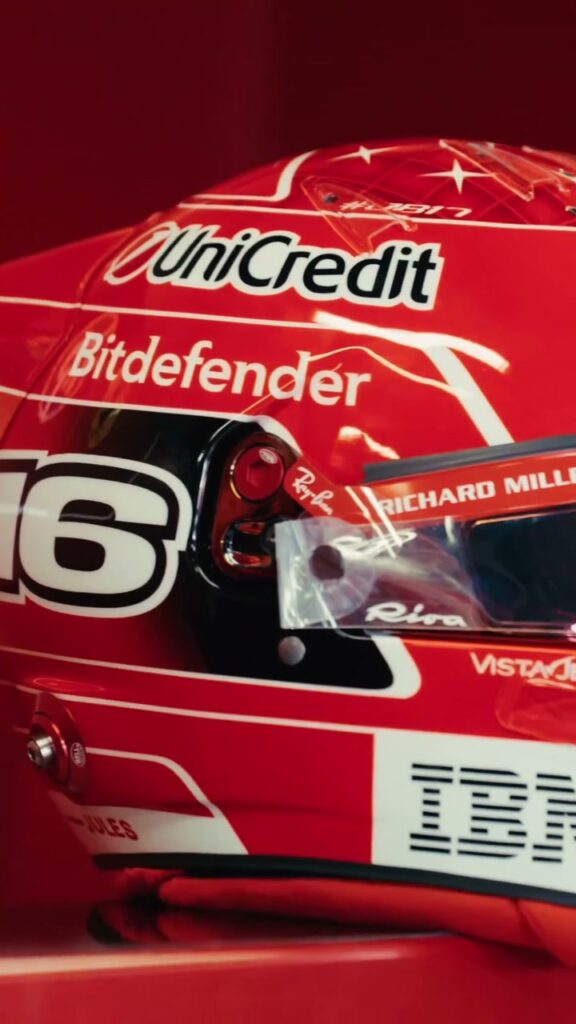
For collectors and close followers of the sport, this is precisely the kind of data that the SF-26’s 2026 livery will be associated with — a car fast enough for pole position laps and fastest laps, slow enough on sustained race pace at specific circuit types to fall outside the top five. The Leclerc and Ferrari collector pieces from this season carry that story in their design.
“George Russell boosted his 2026 Formula 1 world championship hopes by staying clear of Max Verstappen’s Red Bull and Mercedes team-mate Kimi Antonelli to win the Austrian Grand Prix.”
— The Race, 28 June 2026
FAQ
Q: Why did Leclerc finish P8 after starting P2 at the 2026 Austrian GP?
Two compounding factors explain the result: a 0.333-second-per-lap median pace deficit against race winner Russell, which accumulated to roughly 24 seconds over 71 laps, plus an extra pit stop compared to the two-stop leaders that cost approximately 20 seconds of track position. Together those two quantities account for nearly all of the 45.659-second final gap.
Q: Where did Ferrari lose time to Mercedes on the fastest-lap comparison?
Ferrari lost time on the straights: Sector 1 was +0.047s and Sector 2 was +0.042s in Russell’s favour. Leclerc was actually 0.166s quicker through Sector 3, the twisty final section. Ferrari’s top speed was 315 km/h versus Russell’s 323 km/h, confirming the deficit was aerodynamic drag on the straights, not cornering ability.
Q: What tyre strategy did Ferrari use at the 2026 Austrian Grand Prix?
Both Ferraris ran four stints with three pit stops, following a Medium–Hard–Hard–Soft sequence. Russell, Verstappen and Antonelli all finished on two stops, meaning Ferrari’s strategy cost roughly 20 seconds of track position from the extra pit stop alone.
Q: Did Leclerc set a competitive fastest lap at the 2026 Austrian GP?
Yes — Leclerc’s fastest lap of 1:10.606 on lap 67, set on fresh Soft tyres, was 0.077 seconds quicker than Russell’s best of 1:10.683. This confirms the SF-26 had genuine peak pace; the problem was sustaining that pace across a full stint, where the median fell to 1:11.995 against Russell’s 1:11.662.
Q: Is the 2026 Austrian GP result a verdict on Ferrari’s overall season competitiveness?
No — this analysis covers one race at one circuit on 28 June 2026. The Red Bull Ring’s two long DRS straights amplify straight-line speed differences more than most other circuits. Ferrari’s cornering advantage, visible in Sector 3, would carry more weight at a track with a higher proportion of technical corners. The data here describes what happened at Spielberg, not the SF-26’s competitive level across the full season.
Shop Charles Leclerc Collection
Display and collector replicas only. Not certified for protective use. Full-size 1:1 scale.