
Blog
2026 Austrian GP: Alonso Penalised, Piastri Summoned
 123Helmets Editorial Team
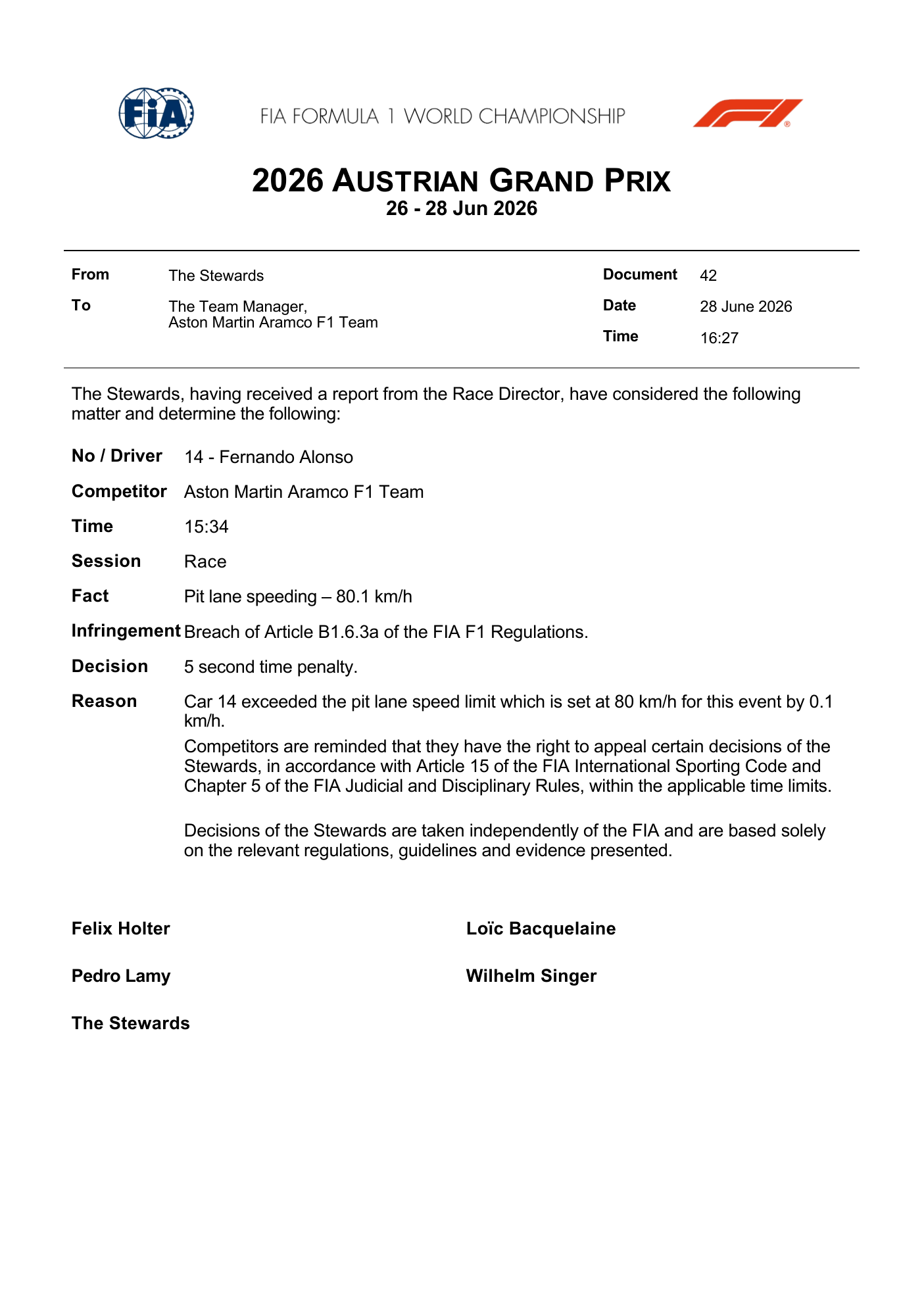
The 2026 Austrian Grand Prix at the Red Bull Ring on 28 June 2026 produced one of the busiest stewards dockets of the season. Fernando Alonso received a 5-second time penalty for exceeding the pit-lane speed limit by just 0.1 km/h, while Oscar Piastri was summoned post-race over allegedly slow reconnaissance laps — a summons that remained unresolved at the time of writing.
Key Takeaways
Document 42: Alonso (14, Aston Martin) received a 5-second time penalty for clocking 80.1 km/h in a pit lane limited to 80 km/h — a 0.1 km/h breach of Article B1.6.3a.
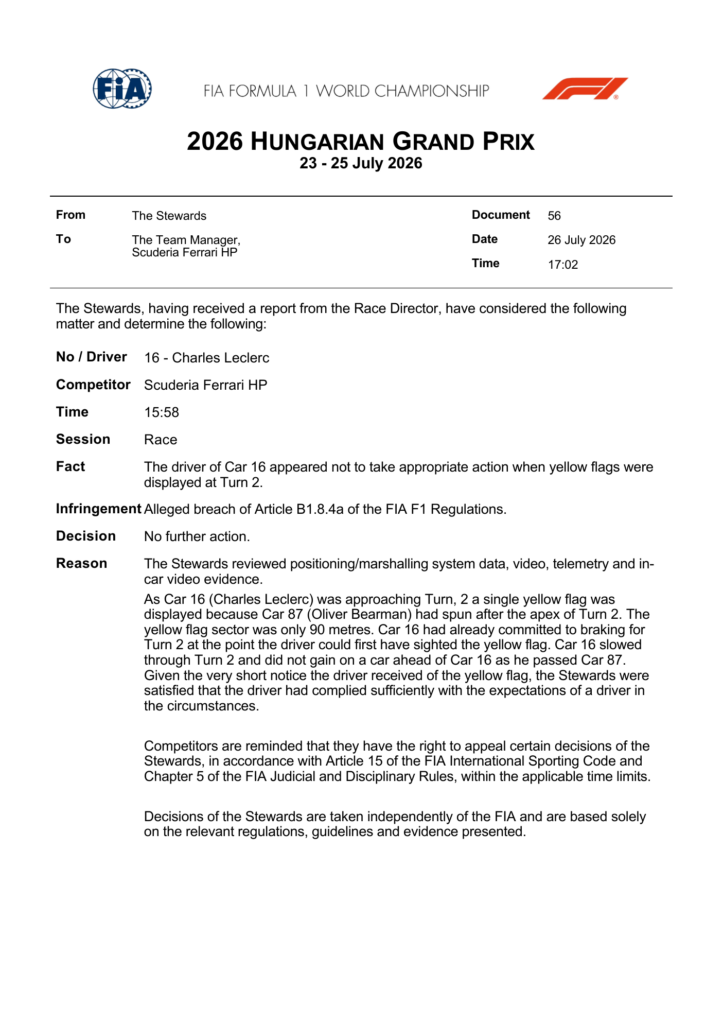
Document 43: Piastri (81, McLaren) was summoned at 17:10 for allegedly driving unnecessarily slowly during reconnaissance laps, a potential breach of Article 12.2.1.i of the International Sporting Code.
The 2026 Austrian GP weekend also saw deleted qualifying lap times (Documents 31 and 33) and a double-yellow flag review concerning George Russell’s pole position lap.
The outcome of the Piastri summons was unresolved at time of writing; collectors and fans should watch the official FIA bulletins for any penalty update.
Document 42 — Alonso’s 5-Second Penalty Explained
Fernando Alonso was given a mandatory 5-second time penalty on 28 June 2026 after onboard telemetry showed his car travelling at 80.1 km/h in the pit lane, against an event-specific limit of 80 km/h — a margin of exactly 0.1 km/h. The breach triggered Article B1.6.3a of the FIA Formula 1 Sporting Regulations, which sets the enforcement threshold for pit-lane speed infractions.
The stewards’ finding is contained in Document 42 of the official Austrian Grand Prix bulletin. Pit-lane speed limits exist to protect mechanics, officials, and any personnel working in the lane; even a fraction of a km/h above the defined ceiling constitutes a quantifiable breach under the regulations. The FIA’s timing loop systems — embedded in the pit-lane surface — record speed to one decimal place, which is precisely why a 0.1 km/h excess is detectable and actionable.
For Aston Martin Aramco, the penalty cost Alonso time in the final race classification. A 5-second addition is applied to the driver’s total race time, meaning its impact on final position depends entirely on the gap to the car immediately behind at the finish. Given how closely matched the 2026 midfield has been at the Red Bull Ring, fractions of this size matter significantly to constructors’ points.
Article B1.6.3a has been applied consistently across the 2026 season, and the Austrian GP stewards showed no discretion on the 0.1 km/h figure — the rule does not contain a tolerance band in its published text. Alonso’s Fernando Alonso helmet and Aston Martin livery have been among the most collected items of the 2026 season, and this penalty will become a footnote in the race’s documented history.
Document 43 — Why Piastri Was Summoned
Oscar Piastri, driving 81 for McLaren, was summoned to appear before the stewards at 17:10 on 28 June 2026 following an alleged breach of Article 12.2.1.i of the FIA International Sporting Code and the Race Director’s event note. The specific allegation was that Piastri drove unnecessarily slowly during the reconnaissance laps before the race.
Reconnaissance laps — the formation lap and any pre-race laps completed before drivers take the grid — are governed by restrictions in both the Sporting Regulations and the Race Director’s event notes distributed to all teams ahead of each grand prix. Article 12.2.1.i of the International Sporting Code covers a broad category of conduct deemed prejudicial to the interests of competition, including pace that disrupts the orderly preparation of the grid or creates a hazard.
The stewards’ summons does not constitute a finding of guilt; it is a formal instruction for the driver and team representatives to attend a hearing so that evidence can be examined. At the time of writing, the stewards had not published a decision on Document 43, and no penalty had been confirmed or ruled out. Collectors and followers of the sport should consult the FIA’s official bulletin page for any subsequent document updating this case.
Oscar Piastri had one of the most closely watched 2026 campaigns heading into Austria; his helmet designs have reflected McLaren’s papaya identity throughout the season. Whatever the stewards’ eventual verdict, Document 43 marks a formal regulatory moment in the 2026 Austrian GP record.
A Busy Weekend in the Stewards’ Room
The 2026 Austrian Grand Prix generated an unusually large volume of official stewards documents, with at least four separate matters reaching formal bulletin status before and after the race on 28 June 2026.
Documents 31 and 33 concerned deleted qualifying lap times. Under Article 26.3 of the Sporting Regulations, a lap time set while a driver fails to respect yellow flag conditions, track limits, or specific session rules can be deleted by the stewards. The identities of the drivers affected by Documents 31 and 33 sit within the official bulletins; what matters for context is that deletion of fast laps can reorder the qualifying grid and has downstream effects on race strategy and pit-stop windows.
The most high-profile pre-race controversy involved a double-yellow flag review of George Russell‘s pole position lap. A double-yellow flag sector requires all drivers to be prepared to stop; any lap time set without a demonstrable reduction in speed through a double-yellow zone is subject to review. The stewards examined telemetry and in-car footage from Russell’s lap — the result of that review shaped the official grid for Sunday’s race.
The Red Bull Ring’s compact 4.318 km circuit means that yellow flag zones affect a relatively large proportion of any given lap, making compliance reviews more common here than at longer venues. The stewards’ workload across qualifying (Documents 31, 33, and the Russell pole review) and the race itself (Documents 42 and 43) illustrates how regulatory attention has intensified at the circuit during the 2026 season.
How Pit-Lane Speed Rules Work in 2026 F1
The pit-lane speed limit for the 2026 Austrian Grand Prix was set at 80 km/h, as defined in the event notes issued by the Race Director ahead of race weekend. This is the standard limit applied at most conventional pit lanes on the calendar; some street circuits use a lower figure.
Enforcement relies on timing loops buried beneath the pit-lane surface at multiple measurement points. The FIA’s system records each car’s speed in real time as it crosses each loop, logging the figure to one decimal place. If any reading exceeds the stated limit — even by 0.1 km/h, as in Alonso’s case — the data is automatically flagged and referred to the stewards for review.
Article B1.6.3a does not include a published tolerance. Some sporting codes in other categories build in a small margin to account for instrumentation variance; the FIA’s published F1 regulations as applied at the 2026 Austrian GP contain no such buffer. Once the stewards confirm the telemetry reading, the 5-second penalty is prescribed — there is no discretion on the quantum of penalty at this threshold.
For teams, the practical lesson is straightforward: the speed limiter fitted to all 2026 F1 cars must be engaged at the pit-lane entry line and maintained throughout the pit lane. The 0.1 km/h excess recorded against Fernando Alonso suggests the limiter may have been released marginally before the exit line, or that a brief fluctuation exceeded the threshold at one of the internal measurement points. Teams review this data after every stop as part of standard debrief procedure.
Reconnaissance Lap Rules and Article 12.2.1.i
Article 12.2.1.i of the FIA International Sporting Code prohibits conduct that is prejudicial to the interests of motor sport, and in the race context it is regularly applied to pace offences during formation and reconnaissance laps. A driver who travels too slowly risks being caught by faster cars, disrupting the grid warm-up sequence, or — at worst — creating a hazard if the pace differential becomes extreme.
The Race Director’s event note for each grand prix specifies minimum pace expectations or procedural requirements for reconnaissance laps. Teams receive these notes well in advance of the race morning, and both driver and engineer are expected to know the relevant provisions. If a driver’s on-board GPS trace shows a pace materially below what the event note prescribes, the data is available for steward review after the race.
Penalties under Article 12.2.1.i for slow reconnaissance laps have historically ranged from reprimands (which accumulate toward grid penalties at three in a season) to time penalties depending on the severity and any safety implication. Because the Piastri summons was unresolved at the time of writing, no outcome can be reported here. The summons itself — issued at 17:10 on 28 June 2026 — is the documented fact; the verdict belongs in a subsequent bulletin.
For collectors following Oscar Piastri‘s 2026 campaign, Document 43 is one more entry in a race weekend that will be documented across replica helmets, livery records, and the broader archival history of this season.
Why These Decisions Matter for F1 Collectors
Race-day stewards decisions are part of the permanent record of any Formula 1 grand prix, and collectors who display replica helmets from the 2026 season are, in effect, preserving a snapshot of the sport at a specific regulatory and competitive moment. The 2026 Austrian Grand Prix on 28 June 2026 is now marked not only by its race result but by a set of formal FIA documents — 31, 33, 42, and 43 — that define what happened off the track as much as on it.
A full-size 1:1 display replica of Alonso’s 2026 helmet or Piastri’s McLaren lid captures the exact livery worn on the day these stewards decisions were issued. These are exhibition-quality collector pieces, produced at 1:1 scale for display purposes only. Their value as collector items is tied directly to the documented history of the season they represent.
The Red Bull Ring weekend of 28 June 2026 was, by any measure, one of the most regulation-dense events of the year. Five formal stewards documents across qualifying and the race, a pole lap under review, and two race-day proceedings give collectors and fans more than the usual amount of official history to reference when they place a 2026 Austrian GP helmet on a display shelf.
“The stewards determined Car 14 was travelling at 80.1 km/h in the pit lane against the 80 km/h limit, constituting a breach of Article B1.6.3a. A 5-second time penalty is imposed.”
— FIA Stewards Document 42, 2026 Austrian Grand Prix, 28 June 2026
“Car 81 is summoned to appear before the stewards at 17:10 for an alleged breach of Article 12.2.1.i of the International Sporting Code and the Race Director’s event note — driving unnecessarily slowly during the reconnaissance laps.”
— FIA Stewards Document 43, 2026 Austrian Grand Prix, 28 June 2026
FAQ
Q: What penalty did Fernando Alonso receive at the 2026 Austrian Grand Prix?
Alonso received a 5-second time penalty for exceeding the pit-lane speed limit. FIA Document 42 recorded Fernando Alonso travelling at 80.1 km/h against the 80 km/h limit — a 0.1 km/h breach of Article B1.6.3a of the FIA Formula 1 Sporting Regulations.
Q: Why was Oscar Piastri summoned after the 2026 Austrian GP?
Piastri was summoned at 17:10 on 28 June 2026 under Document 43 for allegedly driving unnecessarily slowly during reconnaissance laps, a potential breach of Article 12.2.1.i of the International Sporting Code and the Race Director’s event note. No outcome had been published at the time of writing.
Q: What happened with George Russell’s pole position at the 2026 Austrian Grand Prix?
Russell’s pole lap was subject to a stewards review related to double-yellow flag conditions. The stewards examined telemetry and footage to determine whether the lap was completed in compliance with the double-yellow flag rules; the result of that review shaped the official qualifying classification.
Q: What were Documents 31 and 33 at the 2026 Austrian GP?
Documents 31 and 33 covered deleted qualifying lap times, issued during or after the qualifying session at the Red Bull Ring on 28 June 2026. Lap deletion is applied when a driver fails to comply with yellow flag rules, track limits, or other session-specific requirements.
Q: Is the 2026 Austrian GP 80 km/h pit-lane limit a hard limit with no tolerance?
Yes, based on how Article B1.6.3a was applied in Document 42: the stewards penalised a 0.1 km/h excess with no published tolerance band. The FIA’s timing loops record speed to one decimal place, and the 5-second penalty was applied as soon as the reading exceeded 80 km/h.
Browse F1 Helmet Collection — display and collector replicas from the 2026 season, full-size 1:1 scale, exhibition quality. Not certified for protective use.
Display and collector replicas only. Not certified for protective use. Full-size 1:1 scale.
This article was written with the help of AI tools. Editorial policy