
Blog
Will Mercedes Rein In Its Drivers Now That Hamilton Is Back In The Fight?
 123Helmets Editorial Team
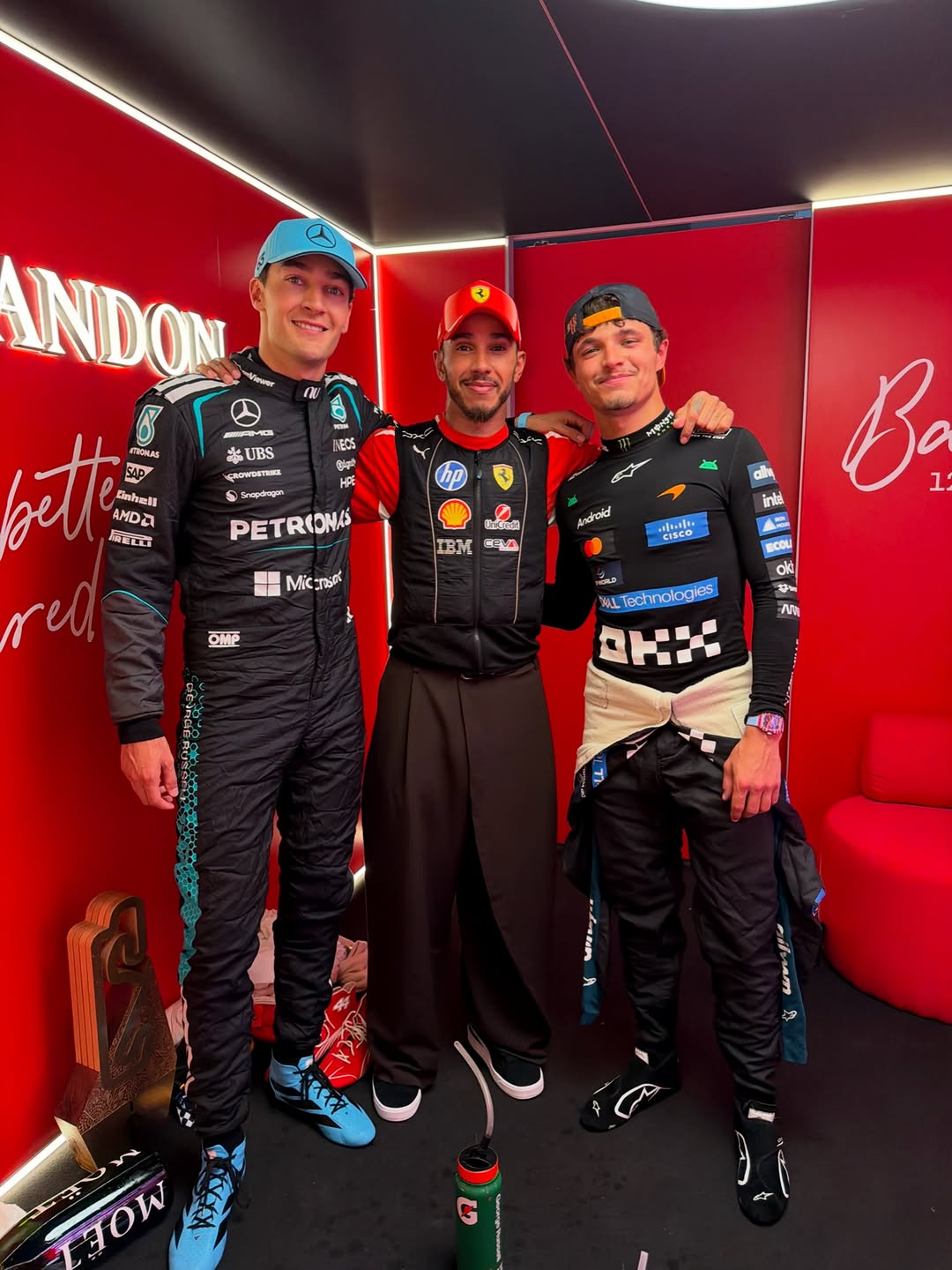
Lewis Hamilton sits 41 points behind championship leader Kimi Antonelli and is putting real pressure on Mercedes’ open-racing policy. Toto Wolff has acknowledged the team may need to intervene when a third-party rival enters the intra-team battle — and that shift in thinking carries direct design consequences for how the Silver Arrows story is told on collector-grade replica helmets.
Key Takeaways
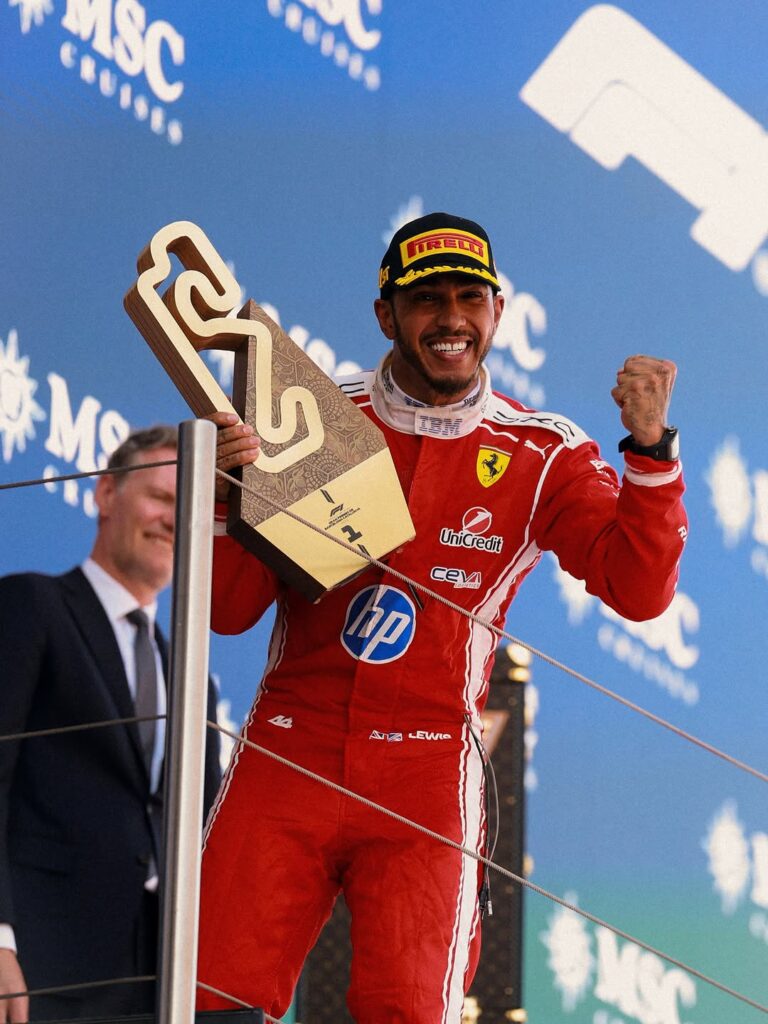
Hamilton sits 41 points behind Antonelli in the 2026 standings after Ferrari’s Barcelona upgrade swung momentum his way.
Wolff estimates Mercedes lost five or six seconds of race time in Barcelona through the Russell–Antonelli internal battle.
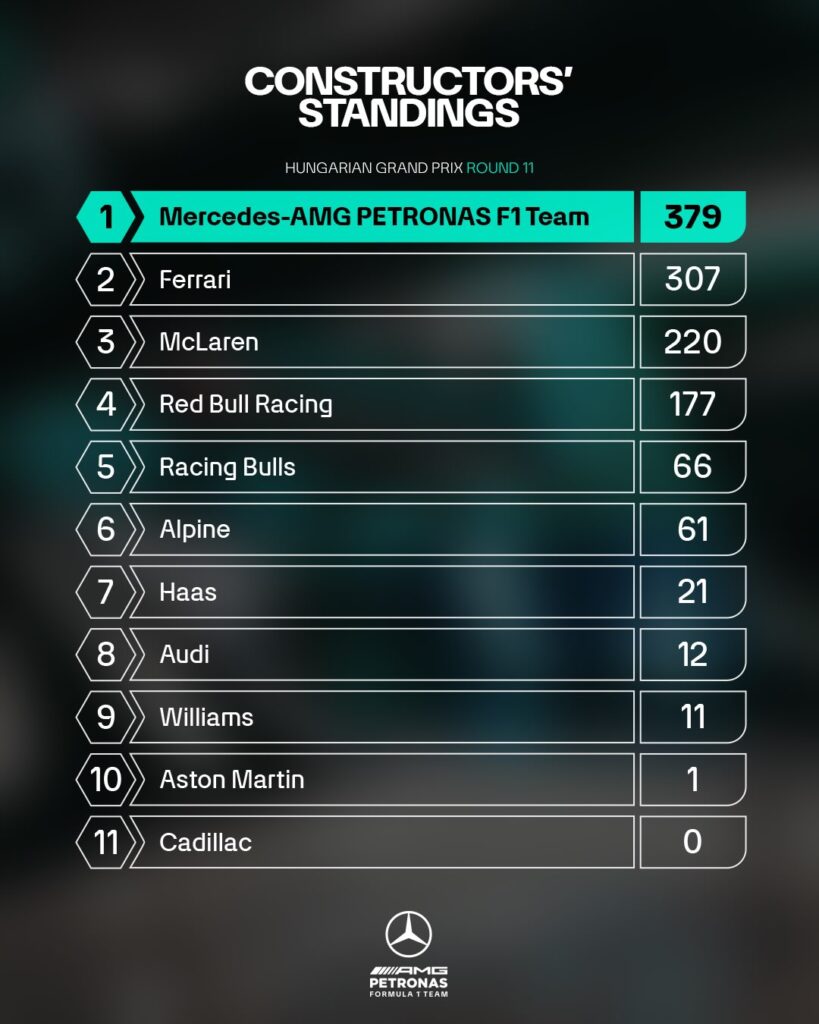
The team won the first six grands prix of 2026 before Hamilton and Ferrari ended the streak.
Full-size 1:1 display replica helmets document the exact livery and colourway worn at each turning-point race — Barcelona 2026 is already a historically significant round.
The Numbers Behind the Team-Orders Debate
Mercedes lost an estimated five or six seconds of race time at the 2026 Barcelona Grand Prix because George Russell and Kimi Antonelli were fighting each other rather than managing the gap to Lewis Hamilton’s Ferrari. That is the figure Toto Wolff put on the cost of the team’s hands-off policy, and it is the number that has reopened one of the oldest strategic arguments in Formula 1.
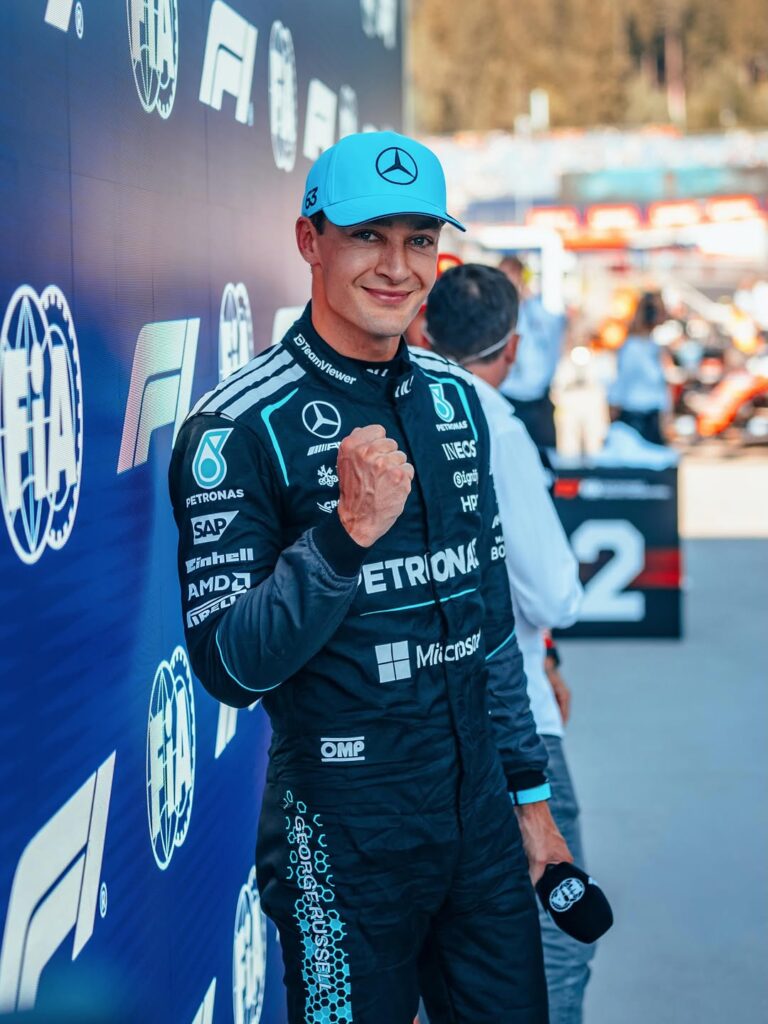
The arithmetic in the championship makes the discussion unavoidable. Hamilton now trails Antonelli by 41 points and sits nine points ahead of Russell. Those gaps are tight enough that every contested position between the two Silver Arrows cars carries genuine title implications. Antonelli still heads the standings, but with reliability problems already costing the team — Russell retired in Canada, Antonelli in Barcelona — the buffer that once made intra-team racing a luxury is shrinking fast.
Wolff has been direct: when the team’s two drivers are fighting a third rival rather than purely each other, the calculus changes. “When they are fighting each other it is fine, it can be very sporting,” he said, “but when you are fighting against another car, then sometimes you may have to let the faster one through.” Internal discussions are now scheduled to settle how the team responds in future races when Hamilton — or any external threat — enters the frame.
For collectors, the significance is immediate. The 2026 Barcelona round is already a documented inflection point: the race where Ferrari’s major upgrade package came good, where Mercedes’ winning streak ended, and where Wolff publicly acknowledged the team’s racing philosophy might need to change. Replica helmets carrying the exact livery from this moment sit at the intersection of sporting history and aerodynamic art.
Barcelona 2026 — Race Sequence That Changed the Tone
Antonelli qualified third at Barcelona and spent the opening phase running behind both Russell and Hamilton on the road. Ferrari’s decision to move Hamilton onto an alternative strategy created the scenario Wolff would later dissect: Antonelli gradually closing on his own team-mate around half-distance, Mercedes watching but choosing not to order Russell to yield.
The team did issue a caution to Antonelli — warning him not to risk contact — but stopped short of a position swap. Those lost seconds, Wolff’s estimated five or six, represent the difference between a potential race win and the result that actually materialised. Whether Antonelli genuinely had the pace to beat Hamilton on the day is Wolff’s belief; the open question is whether a cleaner run through traffic would have confirmed it.
The sequence matters to designers and collectors for a different reason. Each on-track confrontation between team-mates under a specific set of conditions generates a unique visual record — the helmet livery, the race number placement, the sponsor positioning. When Mercedes ran its first six wins of 2026, the Silver Arrows aesthetic was performing at its peak. Barcelona represents the first chapter of something new: a three-way championship with Hamilton as the external variable.
What the Strategy Shift Means on the Timing Screen
Team orders in Formula 1 are rarely announced in advance. They emerge from a real-time cost-benefit calculation: how many points does the slower car lose by yielding, and how many does the faster car gain? With a 41-point gap between Hamilton and Antonelli, Mercedes holding station costs the team nothing if Antonelli wins — but if Russell holds Antonelli up and Hamilton profits, the championship picture shifts measurably. Wolff’s willingness to discuss this publicly signals the team has already run those numbers.
Design Breakdown — The 2026 Mercedes Helmet Anatomy
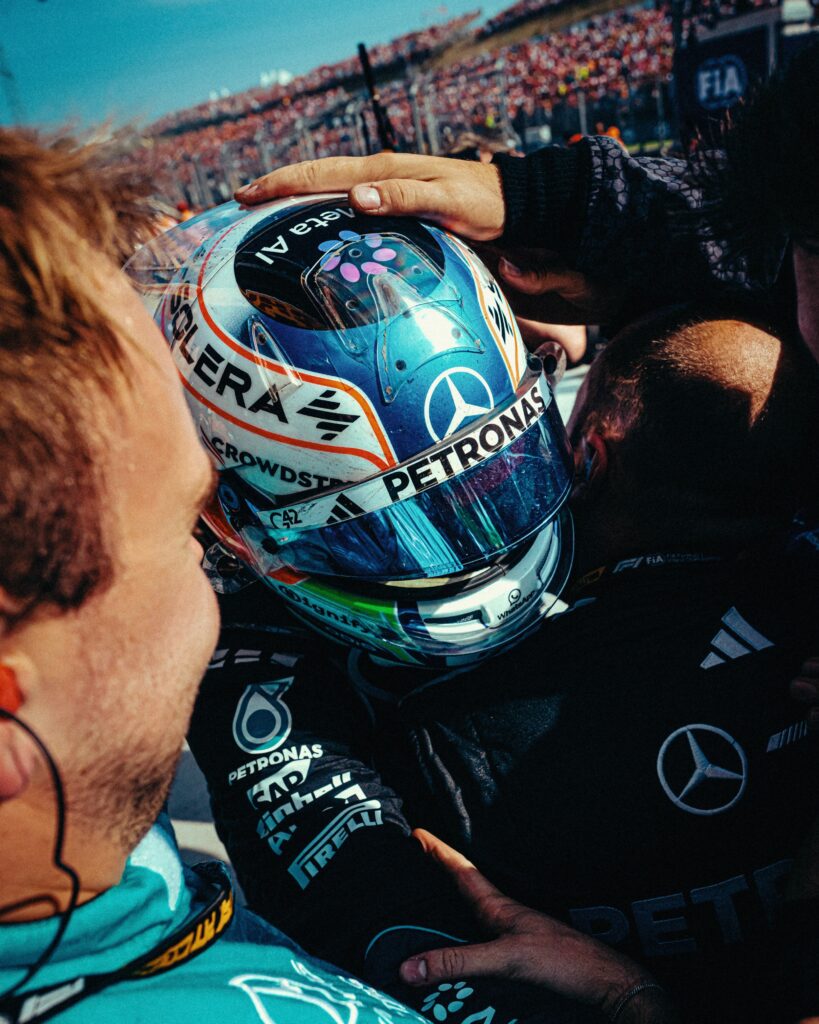
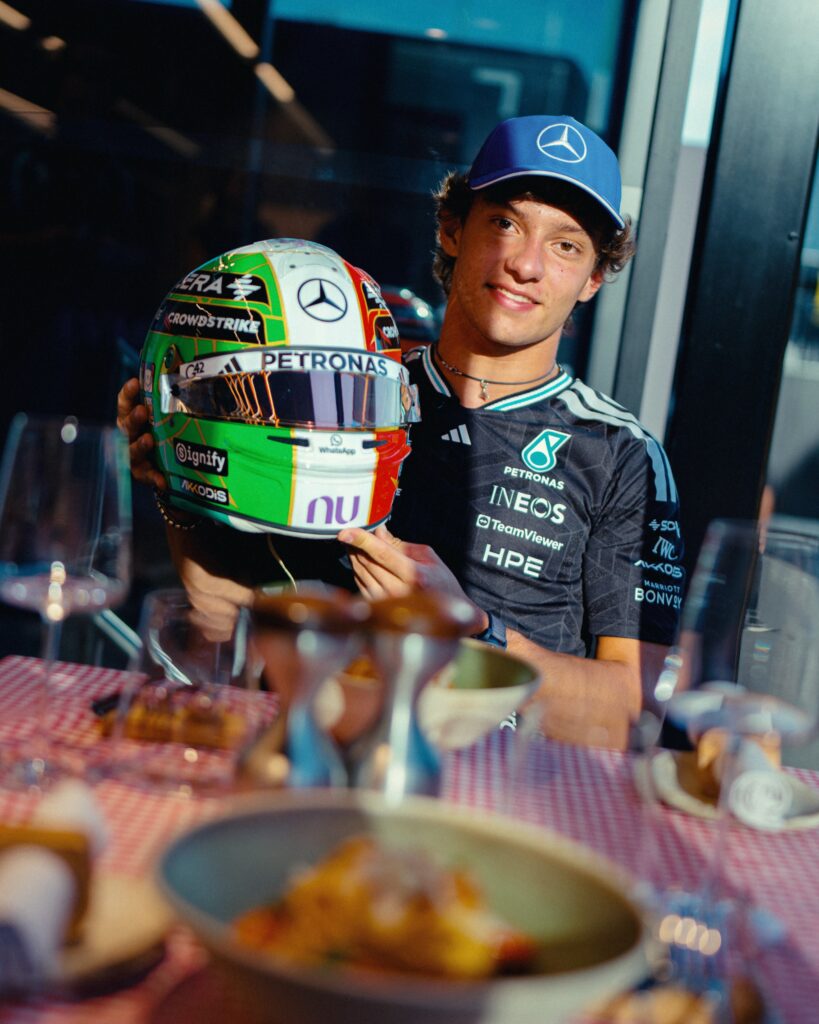
The 2026 Mercedes race helmet carries the long-form Silver Arrows livery: a base of deep metalite silver with the PETRONAS teal accent band running laterally across the lower third of the shell. On full-size 1:1 collector replicas, that teal band is reproduced at precisely the same width and angle as the original, using layered paint application that maintains the 26 mm band height consistent with the team’s current helmet specification guide.
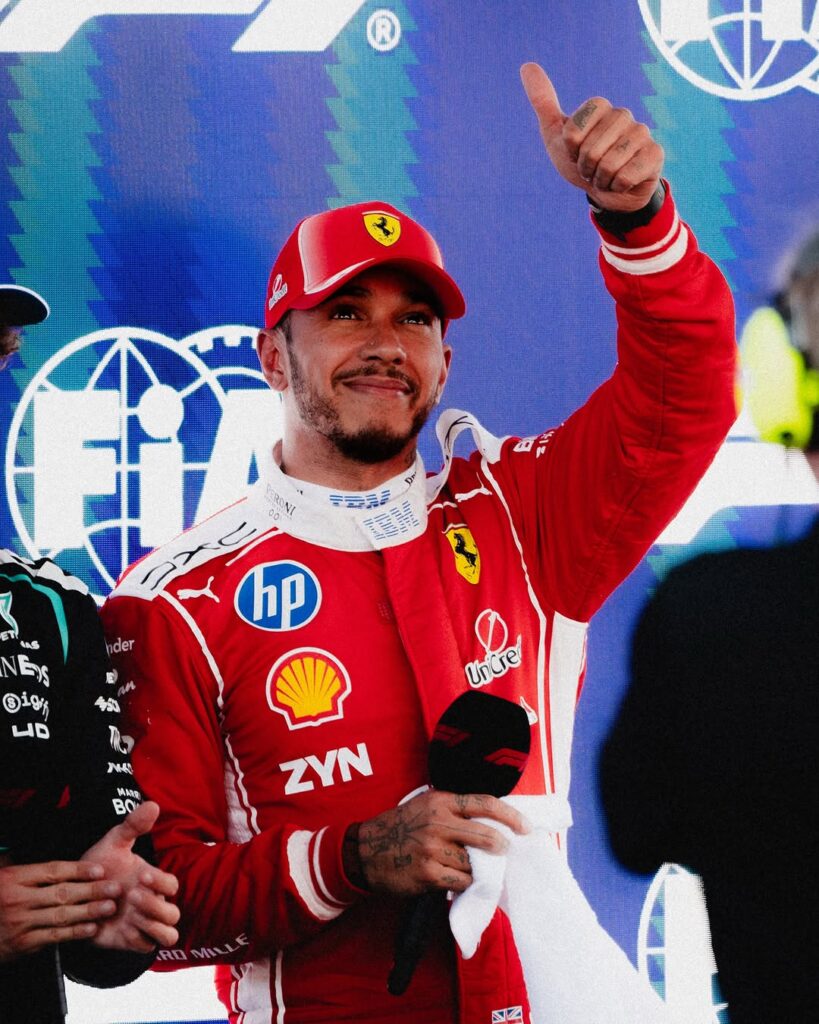
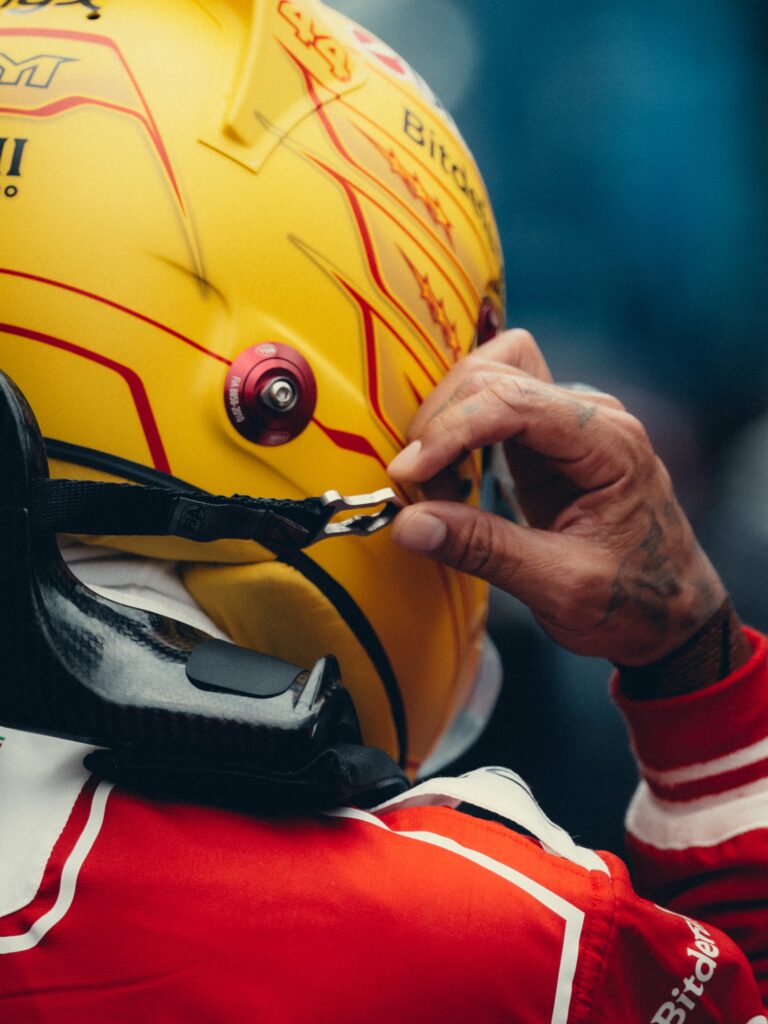
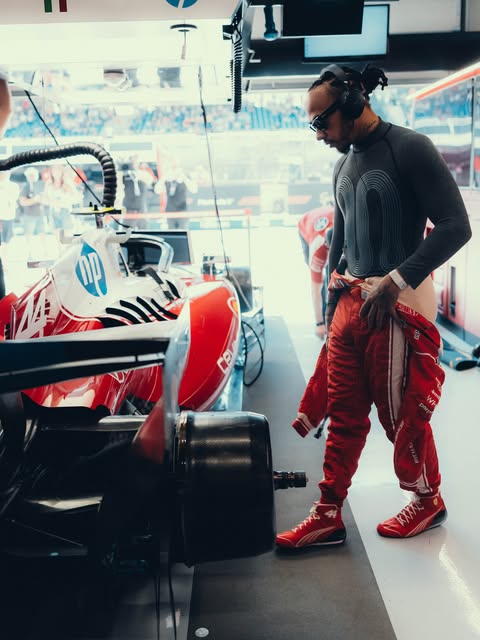
Hamilton’s own Ferrari helmets have moved in a different visual direction since his 2025 move — the Scuderia red base with his signature yellow sun motif — but the Mercedes design he wore through seven championship seasons remains one of the most collected liveries in the display replica market. The contrast between those two eras gives the 2026 season an unusual collector tension: Hamilton hunting down a Silver Arrows car while wearing Ferrari red.
Paint Layers and Surface Finish on Exhibition-Grade Replicas
Exhibition-quality full-size 1:1 replicas are constructed with a minimum of eight distinct paint and lacquer layers to achieve the depth of finish visible in paddock photographs. The outer clear coat, applied at approximately 0.3 mm thickness, replicates the high-gloss race-day surface rather than the slightly flatter appearance of a helmet after a race distance. The visor on display replicas is fixed at 3 mm polycarbonate, matching the visual profile of a race visor without any functional optical specification — these are display pieces only, not certified for any protective use.
The Mercedes teal colour — officially referenced as PETRONAS Teal in the team’s brand guidelines — is a specific mix that shifts slightly under different light sources. Collector replicas produced under licensed agreements match the team’s Pantone reference to within a tolerance that ensures the helmet reads correctly whether displayed under gallery lighting or in natural daylight. That precision is what separates a licensed exhibition replica from a generic souvenir.
Hamilton’s Return as a Championship Variable — The Collector Significance
Hamilton re-entering the championship fight from a third team transforms the 2026 season into a collector-grade narrative with no direct precedent in modern Formula 1. The last time a driver mid-contract change generated this level of cross-team rivalry documentation was arguably Michael Schumacher’s Ferrari era, when every race produced helmet designs that now anchor private collections worldwide.
The 2026 Ferrari helmet Hamilton wears carries the yellow visor strip and sun-disc motif he has refined across multiple seasons. On a full-size 1:1 display replica, the sun disc is rendered in 23-carat gold-effect metallic ink, applied by hand over the base red before the clear coat sequence. The overall shell height of a standard display replica is 35 cm from chin to crown, with a 27 cm front-to-back depth — proportions that match the visual weight of an FIA-compliant race helmet without carrying any safety specification.
What makes the 2026 mid-season moment specifically valuable to collectors is context. Hamilton at 41 points behind the leader is not a deficit that ends a championship — at modern scoring rates, it is recoverable across half a season’s racing. The Barcelona race, where Ferrari’s upgrade landed and Mercedes’ internal friction was exposed, is the documented starting gun for that recovery attempt. A replica helmet from this exact livery configuration — Ferrari red, sun motif, 2026 specification — marks the race where the numbers first aligned in Hamilton’s favour.
Why Race-Specific Context Elevates a Display Piece
Collector value in replica helmets is driven by specificity. A generic 2026 Hamilton replica captures the season. A replica tied by provenance documentation to the Barcelona round, the race where Wolff publicly acknowledged the team-orders question and Hamilton moved to within nine points of Russell, tells a defined story. Display pieces with that level of contextual grounding function as primary sources — physical records of a documented sporting moment — rather than decorative objects.
How the Mercedes Team-Orders Decision Gets Documented in Racing History
Team orders shape championship outcomes, and championship outcomes define the collector hierarchy of racing memorabilia. The most referenced team-order moments in Formula 1 history — from the 2002 Austrian Grand Prix to the 2010 German Grand Prix — are now fixed reference points that increase the documentation value of any physical object connected to those races.
The 2026 Mercedes situation is structurally different in one key respect: it is prospective. Wolff has signalled a potential change before it has been applied in a race. That means every subsequent Mercedes race, from the next round onwards, will be read against the backdrop of this discussion. If Mercedes does instruct a position swap, it becomes a documented event. If it does not, the decision to hold station also becomes part of the record.
For display replica collectors, this creates a clear acquisition logic: secure the helmet liveries from the races that bookend the decision. Barcelona 2026 is the before. Whatever race first sees Mercedes intervene — or explicitly choose not to — is the after. Full-size 1:1 exhibition replicas of both the Mercedes and Ferrari current-specification helmets, displayed together, represent the two sides of the same story: the team managing its own title fight, and the driver they once employed who is now the external threat forcing the conversation.
The weight of a standard full-size display replica shell is approximately 1.2–1.5 kg, which puts it in the range of the actual race helmet it represents. That physical presence — the scale, the weight, the surface finish — is what makes a well-produced replica a different category of object from a photograph or a trading card. It occupies space in the same way the original does. Placed on a shelf or in a display case, it is a permanent, three-dimensional record of a specific chapter in the sport.
What Collectors Should Prioritise Right Now
The single most time-sensitive acquisition decision for Hamilton collectors in mid-2026 is to secure the Ferrari livery from the current specification — the one that arrived at Barcelona as a genuine championship weapon — before the season produces a definitive outcome that shifts attention to a different configuration.
Championship contention cycles through phases. Right now, Hamilton’s 2026 Ferrari helmet represents an open question: can he close 41 points on Antonelli? That uncertainty gives the object narrative tension. Once the season resolves — whether Hamilton wins, finishes second, or drops out of contention — the same helmet becomes a historical document with a fixed meaning. Both states have collector value, but the window in which the object exists as an open story is finite.
The same logic applies to the Mercedes side of the pairing. Antonelli’s 2026 championship-leader helmet, in Silver Arrows specification with the teal PETRONAS accent, is the counterpart piece. Together, a Hamilton Ferrari replica and an Antonelli Mercedes replica from the 2026 season create a two-object display that captures the exact sporting tension Wolff was describing when he estimated those five or six lost seconds in Barcelona.
All replicas referenced here are full-size 1:1 display and collector pieces only. They carry no safety certification, no FIA homologation, and no protective specification. They are exhibition-quality objects designed for display, documentation, and collection.
“When they are fighting each other it is fine, it can be very sporting, but when you are fighting against another car, then sometimes you may have to let the faster one through.”
— Toto Wolff, Mercedes Team Principal, 2026
“That is something we will have to look at for future races when a new competitor comes in.”
— Toto Wolff, Mercedes Team Principal, 2026
FAQ
Q: How many points is Hamilton behind Antonelli in the 2026 championship?
Hamilton trails Antonelli by 41 points as of the 2026 Barcelona Grand Prix. He also sits nine points ahead of his former Mercedes team-mate George Russell, placing him second in the standings.
Q: Why is Toto Wolff reconsidering Mercedes’ open-racing policy?
Wolff estimates the Russell–Antonelli internal battle at Barcelona cost Mercedes five or six seconds of race time, which may have allowed Hamilton to benefit. With Hamilton now a genuine championship threat, holding station between the two Silver Arrows drivers carries a measurable points cost.
Q: What makes the 2026 Barcelona race significant for collectors?
Barcelona 2026 is the race where Ferrari’s major upgrade package came good, where Mercedes’ six-race winning streak ended, and where Wolff publicly acknowledged the team’s internal racing philosophy may need to change — making it a documented turning point in the championship narrative.
Q: What are the physical specifications of a full-size 1:1 display replica helmet?
A standard full-size 1:1 display replica weighs approximately 1.2–1.5 kg and measures 35 cm from chin to crown with a 27 cm front-to-back depth. The fixed display visor is 3 mm polycarbonate. These are collector and exhibition pieces only — not certified for any protective or race use.
Q: Which Hamilton helmet livery should collectors prioritise in 2026?
The current 2026 Ferrari specification — red base, gold-effect sun-disc motif, yellow visor strip — is the livery Hamilton is wearing as an active championship contender. Securing a full-size 1:1 display replica of this configuration while the season outcome is still open gives the object maximum narrative context as a collector piece.
Shop Lewis Hamilton Collection
Display and collector replicas only. Not certified for protective use. Full-size 1:1 scale.
This article was written with the help of AI tools. Editorial policy