
Blog
Hamilton at 41: Where He Now Ranks Among the Oldest F1 GP Winners
 123Helmets Editorial Team
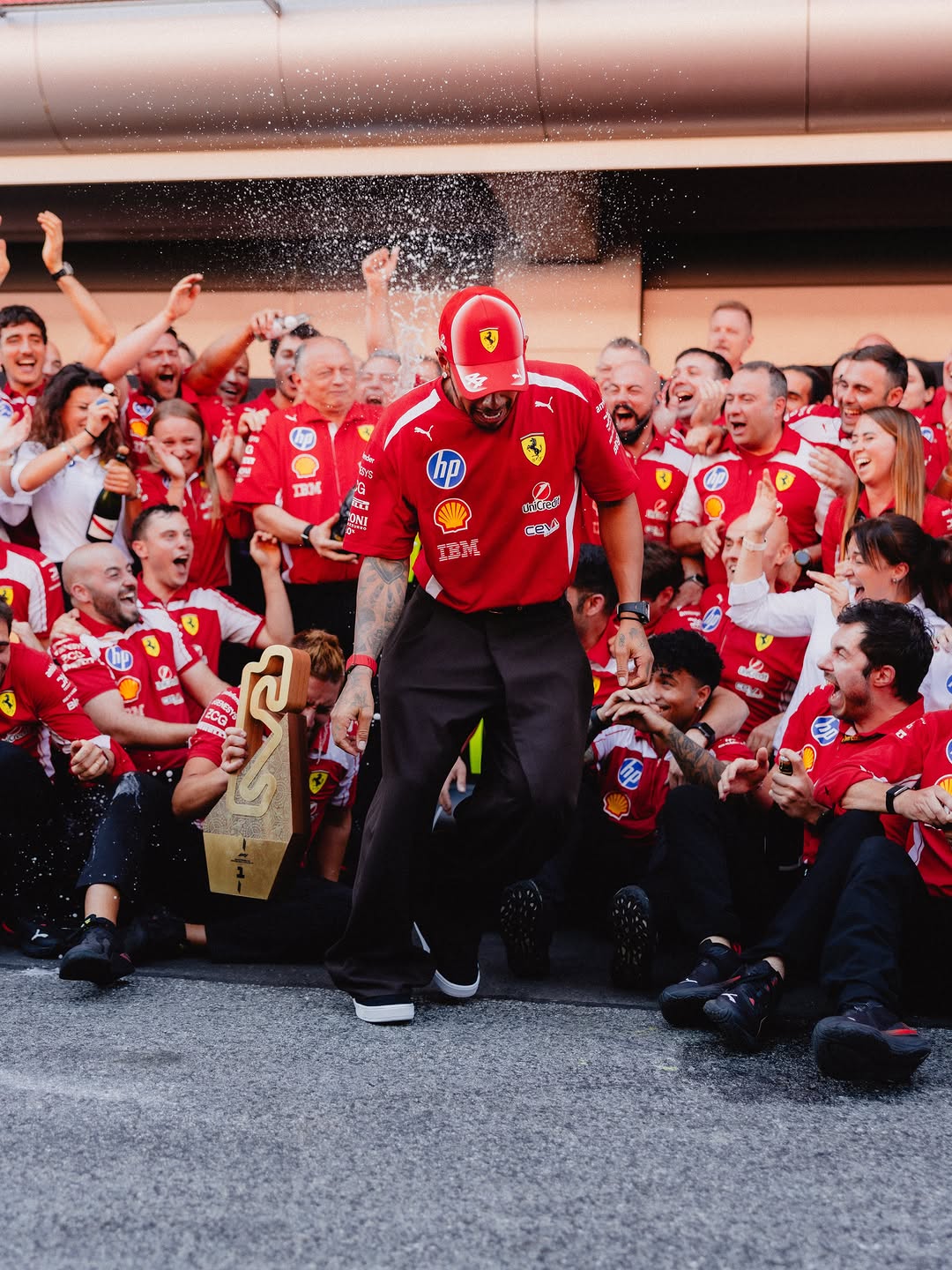
Lewis Hamilton won the 2026 Barcelona-Catalunya Grand Prix for Ferrari at 41 years old — his first win in his 40s and his maiden victory with the Scuderia. That result places him firmly on the short, remarkable list of the oldest drivers ever to stand on the top step in Formula 1. The red helmet, the Ferrari livery, the Montmeló podium: it is already one of the most display-worthy moments in the sport’s modern era.
Key Takeaways
Hamilton’s 2026 Barcelona win with Ferrari at age 41 is his first F1 victory in his 40s and his maiden win for the Scuderia.
Luigi Fagioli holds the all-time record as oldest GP winner, having competed for Alfa Romeo in the 1950–51 era at age 52.
Giuseppe Farina, the first F1 World Champion, remains the second-oldest race winner in history according to the historical record.
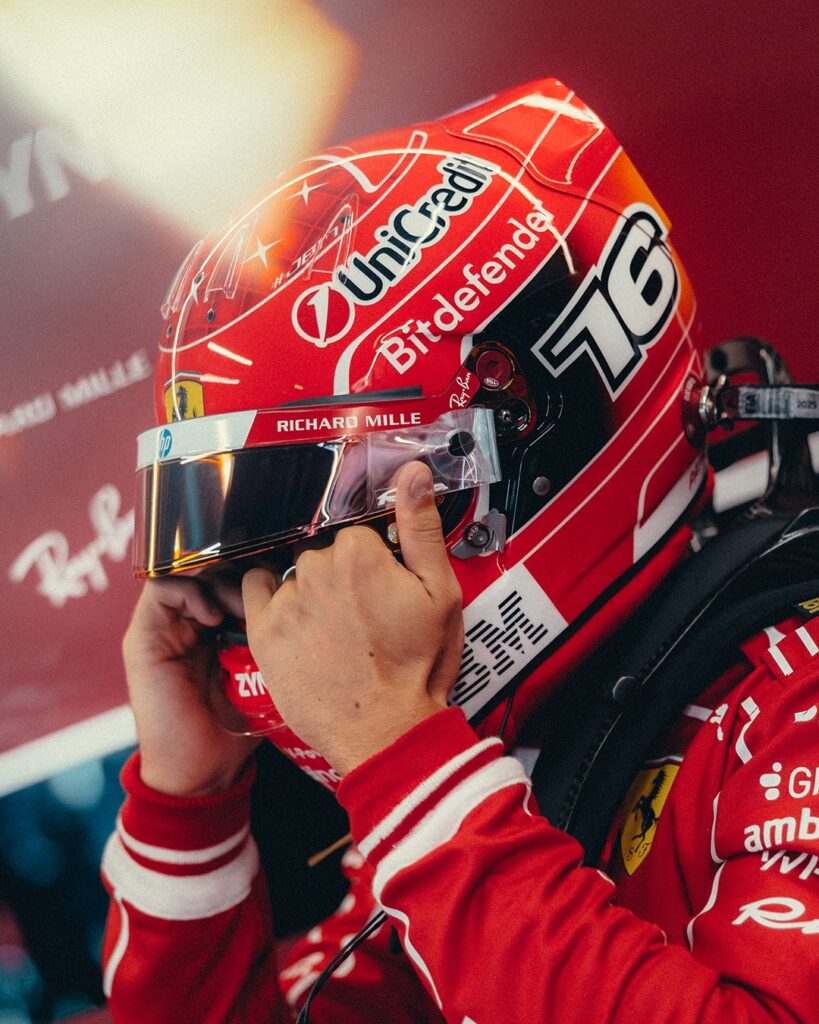
The Ferrari red-and-white 2026 livery on Hamilton’s race helmet represents one of the most collectible visual moments of the current season.
The Barcelona Win That Changed Hamilton’s Record Books
Lewis Hamilton won the 2026 Barcelona-Catalunya Grand Prix on Sunday, 14 June 2026, becoming the oldest Ferrari race winner in the modern era at the age of 41. It was simultaneously his maiden victory with the Scuderia and his first Grand Prix win since leaving Mercedes — a gap that had stretched across multiple seasons and generated enormous scrutiny around whether the seven-time champion still had the pace to reach the top step.
The win arrived at Circuit de Barcelona-Catalunya, a track where Hamilton has a historically strong record from his championship years with McLaren and Mercedes. What makes the result stand apart is the context: he achieved it in scarlet, wearing Ferrari colours for the first time in a race victory, under a Spanish sun, in front of a crowd that had watched decades of F1 history at that circuit. For collectors and enthusiasts, the helmet Hamilton wore that day — Ferrari red with the Prancing Horse on the chin — is the visual that defines his 2026 campaign so far.
The podium image, the champagne, the Ferrari garage eruption: each frame is already circulating as a reference point for display-quality replica helmets tied to this exact round of the season.
The Full Ranking: Oldest F1 Grand Prix Winners in History
Luigi Fagioli is the oldest driver ever to be classified as an F1 Grand Prix winner, having shared victory at the 1951 French Grand Prix for Alfa Romeo at the age of 52. Fagioli’s position at the top of this list is significant by a considerable margin — no other driver in the sport’s 76-year history has stood that close to his benchmark.
Fagioli made his championship debut in the inaugural 1950 season, collecting five podiums that year without a win. At the 1951 French Grand Prix, his team mate Juan Manuel Fangio started from pole position but was forced to retire with an engine failure 10 laps into the race. When Fagioli came in for his pit stop, Alfa Romeo instructed him to hand his healthy car over to Fangio, who went on to win. Fagioli was classified in 11th place on the road but was nevertheless credited with sharing first place — one of three such shared-victory classifications in early F1 history. The veteran, reportedly furious at the call, quit the sport immediately after and never drove a Grand Prix car again.
Second on the all-time list is Giuseppe Farina — ‘Nino’ — the first-ever Formula 1 World Champion. Farina won the 1950 title with Alfa Romeo, then moved to Ferrari. At the 1953 German Grand Prix at the Nürburgring, with team mate Alberto Ascari having qualified on pole, Farina was still pursuing race victories deep into what became the twilight of his career.
Where Hamilton Sits in the Rankings
Hamilton at 41 now places among the top tier of this historically short list. The exact position depends on precise birth dates and race dates, but the historical record confirms that Fagioli (52) and Farina are clear above him in age terms. Hamilton’s result at Barcelona 2026 means he joins a group that numbers fewer than ten drivers across more than seven decades of the world championship — a group defined not just by longevity but by the ability to produce race-winning performance at an age when most drivers have been retired for years.
The Ferrari Livery and Helmet: A Collector’s Perspective
Hamilton’s 2026 Ferrari race helmet is the most visually significant piece associated with this win, combining the Scuderia’s signature red base with the Prancing Horse emblem and Hamilton’s own design language — the tonal graphics he has used since his Mercedes years, now reinterpreted in scarlet and white. For full-size 1:1 replica collectors, this is precisely the kind of moment that drives demand: a historically significant race, a new team, a record-adjacent result, all concentrated into a single helmet worn on a specific Sunday.
A quality full-size display replica helmet at 1:1 scale typically replicates the external shell geometry to match the original, with visor thickness in the range of 3 mm for the display-grade polycarbonate face shield and an overall shell diameter that mirrors the race original. The interior of a display piece is finished to exhibition standard rather than race specification — the distinction is clear and intentional. These are collector items and display pieces, not certified for any protective use.
The Ferrari red used in the 2026 livery has evolved from the darker Rosso Corsa shades of earlier decades toward a slightly brighter, more orange-adjacent hue that photographs distinctly under race-day lighting. That specific tone is reproduced in high-fidelity replica paint processes, which typically involve multiple base and clear layers to achieve the depth visible in broadcast footage. A properly finished replica will hold that colour accurately under gallery or display-case lighting, making it a genuine exhibition-quality piece rather than a shelf toy.
The Podium Visual as a Display Reference
The Barcelona podium on 14 June 2026 gives collectors a precise visual reference: Hamilton centre, Ferrari red helmet raised, Montmeló grandstands behind. That image functions as both a historical document and a display context — a replica helmet representing this race sits most naturally alongside printed reference material from the event itself, whether race programmes, timing sheets, or high-resolution podium photography.
Why Age Records in F1 Matter More Than in Other Sports
Formula 1 is one of the few elite motorsport categories where reaction time, physical conditioning, and strategic racecraft must converge at the same moment — making a race win at 41 a more difficult physical achievement than it appears on a statistics sheet. The physical demands of a modern Grand Prix, with sustained G-forces through high-speed corners and neck loads that can exceed 5 kg lateral force on drivers’ heads during extended sequences, do not reduce with driver experience.
Hamilton’s ability to manage those demands at 41 — and to produce a winning result at a power-sensitive track like Barcelona, where the 2026 cars operate under revised aerodynamic regulations — reflects a level of physical maintenance and simulator-based preparation that few athletes in any discipline sustain past their late 30s. That is what makes his place on the oldest-winners list genuinely earned rather than circumstantial.
Fagioli’s record from 1951 was set in an entirely different physical era, when cockpit loads, tyre behaviour, and race distances were incomparable to the modern calendar. The fact that no driver in the intervening 75 years has come particularly close to age 52 at a race win tells its own story about how the sport has evolved — and how extraordinary Hamilton’s continued presence at the sharp end of the grid remains, regardless of which team’s helmet he is wearing.
Building a Hamilton Ferrari Display Around the 2026 Season
A full-size 1:1 replica of Hamilton’s 2026 Ferrari race helmet is the natural centrepiece for any display focused on this specific chapter of his career. The helmet is the single object that connects driver identity, team livery, and race-specific history in one tangible form — more so than a cap or a race suit section, both of which lack the three-dimensional presence that a helmet brings to a shelf or display case.
For collectors building a career-spanning Hamilton display, the 2026 Ferrari helmet represents a genuinely new category: it is the first Ferrari-liveried Hamilton helmet in any format, making it distinct from the seven years of Mercedes silver and the McLaren years before that. A side-by-side display of a 2008 McLaren replica, a 2017 Mercedes replica, and this 2026 Ferrari replica would document three distinct eras of the same driver’s career across three different constructor identities — a rare narrative arc in modern F1.
Display dimensions for a standard full-size replica helmet on a stand are approximately 29 × 25 × 35 cm footprint including the base, with a total display height of around 40 cm. That fits comfortably on a standard collector shelf or inside a 45 cm interior-height display case with room for a nameplate. The weight of a display-grade replica shell is typically around 1.2–1.5 kg without the stand, making it stable enough for open-shelf display without additional mounting hardware.
What Makes the Barcelona 2026 Version Specific
The race-specific detail that distinguishes a 2026 Barcelona Hamilton Ferrari helmet from a generic Ferrari replica is the combination of Hamilton’s personal helmet design with the race round number and circuit identification typically included on the interior or exterior detailing of event-specific editions. A collector replica tied to this exact Grand Prix — Round 9 of the 2026 season, 14 June 2026 — carries the historical specificity that drives long-term display value, because it references not just a driver and a team but a concrete, dateable moment in the sport’s record books.
The Legacy Moment: What the Barcelona Win Means for Hamilton’s Story
Hamilton’s 2026 Barcelona victory is the proof point that his move to Ferrari at the start of the season was not a farewell tour but a genuine competitive reset. Coming into 2026, the narrative around Hamilton centred on whether he could find race-winning pace in a new environment, with a new engineering team, after a period without victories at Mercedes. The Barcelona result answers that question directly.
The win also adds a layer to Ferrari’s own history. The Scuderia has seen great champions carry the Prancing Horse — Fangio, Lauda, Schumacher, Räikkönen — and Hamilton now adds a race win to that lineage in his first season with the team. For Ferrari supporters, the helmet Hamilton wore on 14 June 2026 is already a piece of that ongoing story.
From the perspective of historical ranking, Hamilton’s name now appears on a list that previously required a deep knowledge of 1950s F1 history to compile. Fagioli and Farina are not household names outside dedicated motorsport research circles. Hamilton’s presence on that same list, at 41 years old in 2026, connects the very first years of the world championship to its eighth decade — a span of motorsport history that very few individual careers have ever bridged in any meaningful statistical way.
For display collectors, that is the argument for the 2026 Ferrari Hamilton helmet above almost any other recent acquisition: it sits at the intersection of a living driver’s record-adjacent achievement and the deep historical roots of the sport itself. That combination does not appear often.
“Lewis Hamilton made headlines when he won the 2026 Barcelona-Catalunya Grand Prix for Ferrari on Sunday, marking his maiden victory with the Scuderia as well as his first triumph in his 40s.”
— Race report context, Barcelona-Catalunya Grand Prix 2026
“Luigi Fagioli holds this honour by quite a way, having made his debut in the championship’s inaugural 1950 season at the age of 52.”
— Historical F1 record, oldest Grand Prix winners list
FAQ
Q: How old was Lewis Hamilton when he won the 2026 Barcelona Grand Prix?
Hamilton was 41 years old when he won the 2026 Barcelona-Catalunya Grand Prix on 14 June 2026, making it his first F1 victory in his 40s and his maiden win with Ferrari.
Q: Who is the oldest driver ever to win an F1 Grand Prix?
Luigi Fagioli is the oldest driver ever classified as an F1 Grand Prix winner, having shared victory at the 1951 French Grand Prix for Alfa Romeo at the age of 52. He remains well clear of every other driver on the all-time list.
Q: Is the Hamilton Ferrari helmet available as a full-size display replica?
Yes — full-size 1:1 scale collector replicas of Hamilton’s 2026 Ferrari race helmet are available as display pieces. These are exhibition-quality collector items, not certified for any protective or racing use.
Q: What are the display dimensions of a full-size replica F1 helmet?
A standard full-size replica F1 helmet on a stand has a footprint of approximately 29 × 25 × 35 cm and a total display height of around 40 cm. The shell weight is typically around 1.45 kg without the stand.
Q: Why is the 2026 Ferrari Hamilton helmet significant for collectors?
It is the first Ferrari-liveried Hamilton helmet in any collector format, representing a historically new chapter in his career. The 2026 Barcelona win on 14 June 2026 gives it a specific, dateable race result — Hamilton’s entry into the top tier of the oldest F1 GP winners list — that underpins its long-term display significance.
Shop Lewis Hamilton Collection — find full-size 1:1 Ferrari replica helmets from the 2026 season, finished to exhibition quality for display and collecting. These are collector pieces only, not certified for protective use.
Display and collector replicas only. Not certified for protective use. Full-size 1:1 scale.
This article was written with the help of AI tools. Editorial policy