Blog
David Coulthard Hints Carlos Sainz Is ‘Eyeballing’ an Exit From Williams
 123Helmets Editorial Team
Thirteen-time F1 race winner David Coulthard has suggested that Carlos Sainz is actively sizing up his next opportunity beyond Williams, even as the Spaniard publicly reaffirms his commitment to the Grove team ahead of Monaco. The FW48’s step back in competitiveness has placed both drivers and their striking blue liveries under fresh scrutiny — and made this season’s helmet visuals a talking point for collectors watching the paddock closely.
Key Takeaways
David Coulthard, a 13-time F1 race winner, stated on the Up to Speed podcast that Sainz is ‘eyeballing’ his next opportunity beyond Williams.
The FW48 is acknowledged as less competitive than its 2025 predecessor, fuelling visible frustration for both Sainz and Alex Albon in the first half of the 2026 season.
Coulthard drew a clear distinction between the two drivers: Albon is ‘part of the DNA’ of Williams, while Sainz retains the ambitions of a front-running Ferrari race winner.
Sainz publicly reaffirmed his Williams commitment in Monaco, signalling the situation remains fluid rather than resolved heading into the second half of 2026.
Coulthard’s Verdict: Sainz Is Looking for a Way Back to the Front
Carlos Sainz is, in David Coulthard’s own words, “definitely eyeballing where his next opportunity lies” — a blunt reading from a man who won 13 Formula 1 grands prix across his career and knows what competitive hunger looks like from the inside. Speaking on the Up to Speed podcast, Coulthard laid out a situation that many in the paddock have been discussing quietly but few have stated so directly: Sainz arrived at Williams as a short-term solution after Ferrari signed Lewis Hamilton, and the longer the FW48 underperforms, the shorter that arrangement may become.
The context matters. Sainz won races with Ferrari. He was a consistent points scorer and occasional podium challenger at the sharp end of the grid. Williams, for all the genuine progress made in 2025, represents a different reality in 2026. Coulthard put it plainly: Sainz has “gone from Ferrari winning grands prix to Williams being happy scoring points.” That shift in expectation — from celebrating victories to celebrating a top-ten — is not a trivial psychological adjustment for any driver, let alone one of Sainz’s calibre.
Coulthard was careful to note that the frustration visible in the Williams garage is not Sainz’s alone. Both he and Alex Albon have shown the strain of a car that has not matched the promise of the previous season. But the nature of that frustration, Coulthard argued, is different for each man.
Albon vs. Sainz: Two Different Relationships With the Blue Livery
Alex Albon is, by Coulthard’s assessment, woven into the Williams identity in a way Sainz simply is not. The Thai-British driver recently passed the milestone of completing more grands prix than any other driver in Williams history — a record that speaks to loyalty and longevity rather than a transactional arrangement. “He’s embedded in that team. He’s part of the DNA and has consistently delivered,” Coulthard said, explaining why Albon’s frustration, while visible, is unlikely to translate into a departure.
That milestone — most starts ever for Williams — places Albon in the same breath as some of the team’s most storied names. For collectors and display enthusiasts, it is exactly the kind of landmark that gives a helmet replica permanent significance. A driver who holds a team record becomes part of that team’s permanent visual history, and the helmet worn across those races becomes an artefact of that continuity.
Sainz’s situation reads differently. His Williams chapter began in 2025 as a career recalibration, not a homecoming. The Spaniard brought immediate pace, helped lift the team’s results, and demonstrated that he could extract performance from machinery that did not always deserve it. But Coulthard’s point is that Sainz’s competitive ceiling was always set elsewhere, and the FW48’s regression has simply made that ceiling more visible. When a driver of Sainz’s standing talks about patience being tested, the paddock listens.
The FW48 Problem and What It Means for the 2026 Narrative
The FW48 is less competitive than the car it replaced — that much is now acknowledged openly within the team’s own circle. The 2026 regulatory overhaul introduced new technical parameters across the grid, and Williams, like several midfield outfits, has not yet found the optimal window within the new framework. The result is a car that leaves both drivers operating below the level they demonstrated in 2025, creating a gap between expectation and reality that grows more uncomfortable with each passing race.
For Sainz, who admitted that car performance tested his patience at the start of 2026, the frustration is structural rather than situational. It is not a single bad weekend or a strategy error — it is the cumulative weight of a season in which the tools available do not match the ambition. Coulthard acknowledged this directly, noting that the Williams name carries its own weight of expectation: “It’s Williams and that name in itself, we expect more.”
That expectation is part of what makes Williams helmets and livery pieces compelling as collector and display items. The name carries history — championship-winning history — which means any period of underperformance sits against a backdrop that fans know well. A display replica from the 2026 season captures a team at a crossroads: still carrying the iconic livery, still bearing names like Sainz and Albon, but navigating one of the most consequential regulatory transitions in the sport’s recent memory.
The Regulatory Transition Factor
The 2026 rules change is not a minor adjustment. Power unit regulations, aerodynamic philosophy, and weight targets all shifted simultaneously, producing a grid in which the competitive hierarchy has reshuffled in ways that will take multiple seasons to fully settle. Williams’ trajectory depends heavily on whether the team can close the development gap through the second half of 2026 and into 2027. Coulthard’s framing suggests that Sainz’s patience has a timeline attached to it — and that timeline may not extend indefinitely.
Monaco Commitment and the Collector Significance of Sainz’s Williams Helmet
Carlos Sainz publicly reaffirmed his commitment to Williams ahead of Monaco 2026, stating that both he and the team had aligned on a shared path forward as the ideal scenario. Monaco carries particular weight in this context — it is the race most associated with prestige, legacy, and the visual spectacle of Formula 1. A statement of intent made at Monaco carries more symbolic gravity than one made at a standard flyaway race.
For the collector market, the Monaco context is equally significant. Helmets associated with Monaco weekends — whether worn in practice, qualifying, or the race itself — carry a premium in the display replica space precisely because the circuit’s history is so layered. The combination of Sainz’s name, the Williams livery, and a Monaco backdrop creates a display piece that represents a specific, documented moment in a complicated career story.
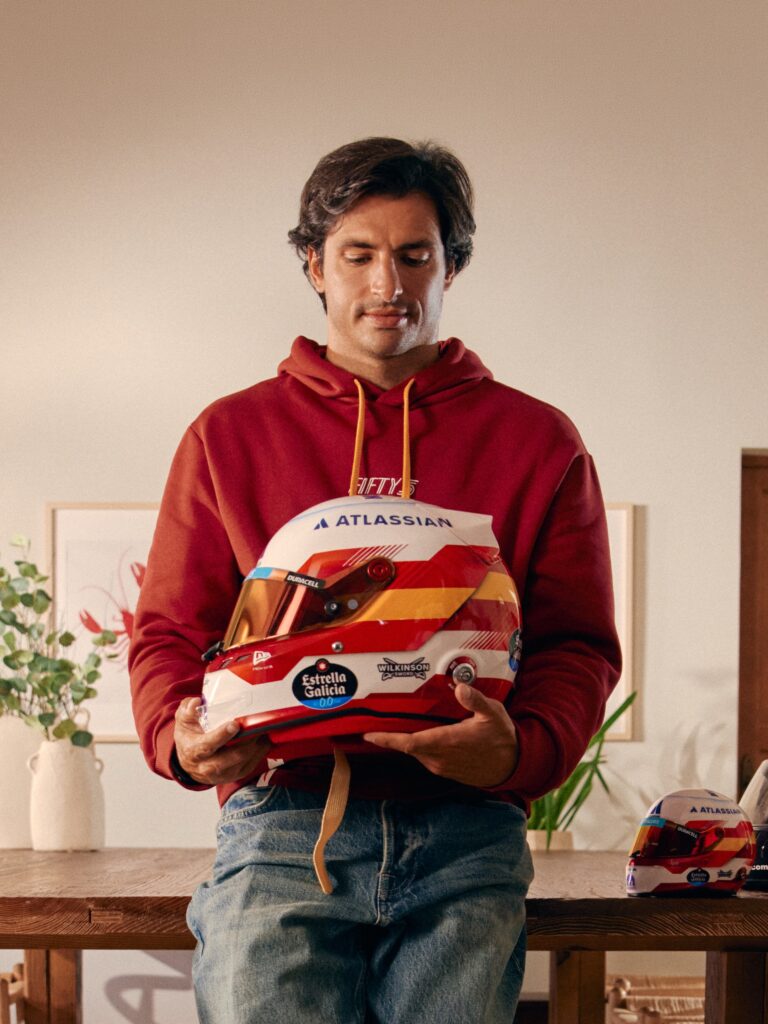
The full-size 1:1 replica format captures the exact dimensions and livery details of a race-weekend helmet — the kind of exhibition-quality piece that places a collector inside a specific chapter of the sport’s history. At a moment when Sainz’s future is genuinely uncertain, a display replica from his Williams period documents a chapter that may, in hindsight, prove to be a brief but consequential one. That narrative weight is precisely what separates a display piece from generic memorabilia.
Livery Details Worth Noting
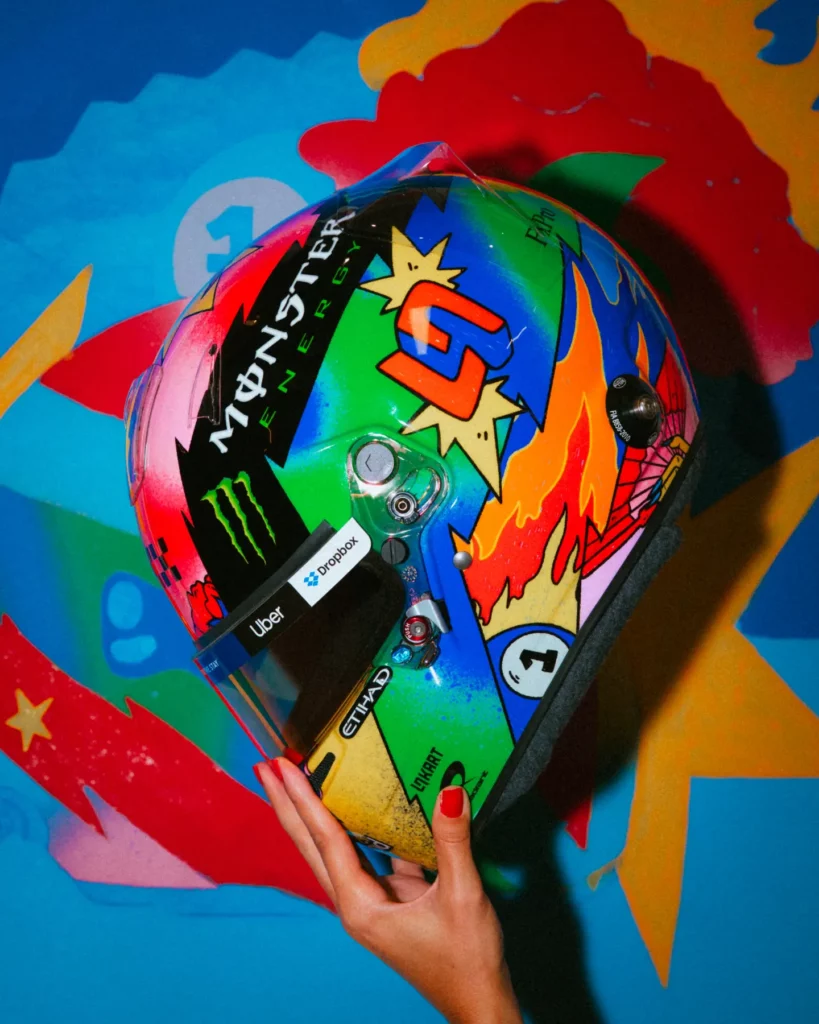
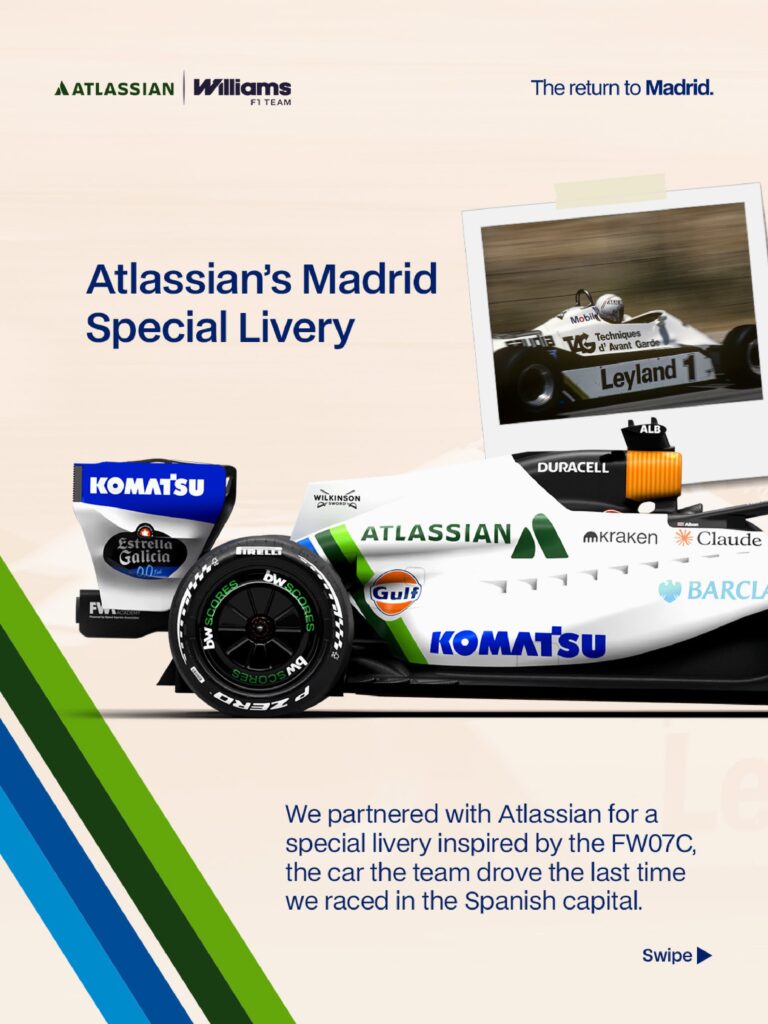
The Williams 2026 livery retains the deep blue and white colour scheme that has defined the team’s visual identity through its recent rebranding period. Sainz’s personal helmet design — distinct from the team livery but complementary in palette — features the kind of graphic layering that reproduces well at 1:1 full-size scale. These are display pieces built for exhibition quality, not protective use, and the detail fidelity at full scale makes the difference between a decorative item and a genuine collector piece.
What a Potential Sainz Departure Would Mean for the Helmet Legacy
If Sainz does leave Williams at the end of 2026, his tenure at the team will span two seasons — enough to define a distinct and collectible chapter, but short enough that every artefact from that period carries a finite, documented scope. In collector terms, a closed chapter is often more significant than an ongoing one: the complete set of helmets from a driver’s time at a specific team becomes definable, with a clear beginning and end.
Coulthard’s comments place that potential closure in a realistic light. He is not speculating frivolously — he is reading what he sees in the paddock and translating it for an audience that follows the sport closely. The framing is careful: Sainz has not asked to leave, the team has not signalled it wants him gone, and Monaco brought a public reaffirmation. But the subtext is clear enough that serious collectors are paying attention to what 2026 Williams helmets represent.
The historical parallel is instructive. Drivers who passed through Williams during transitional periods — before the team returned to competitiveness — occupy a specific place in the team’s visual history. Their helmets from those years document a period of rebuilding that the team’s supporters remember with a mixture of frustration and loyalty. Sainz’s 2025 season, in which he helped accelerate that progress, is already part of that record. Whether 2026 adds a further chapter depends on factors that neither he nor the team can fully control.
Display replicas built at 1:1 full-size scale capture exactly this kind of moment with exhibition-quality finish. They are collector items first and foremost — not certified for any protective use, but built to the dimensional and visual standard that makes them credible as permanent display pieces rather than shelf fillers.
The Broader Picture: Williams, Expectation, and a Name That Demands More
Williams is not simply a midfield team with a famous name — it is a team whose heritage sets a standard that current results are measured against every single race weekend. Seven constructors’ championships. Drivers’ titles for Nigel Mansell, Alain Prost, Damon Hill, and Jacques Villeneuve. Coulthard’s comment that “it’s Williams and that name in itself, we expect more” is not a criticism — it is a statement of what the badge means to the sport.
That expectation creates a particular kind of collector appeal. Williams helmets from any era carry the weight of that history, regardless of where the team sits in the current constructors’ standings. A 2026 Sainz Williams replica is not just a snapshot of a midfield driver navigating a difficult season — it is a piece of a much longer story about one of the sport’s most storied constructors trying to find its way back to the front.
Coulthard’s podcast comments, delivered with the directness of a former race winner who has no need to soften paddock reality, serve as a useful reference point for where that story stands in mid-2026. The team has made genuine progress. The drivers have delivered under difficult circumstances. But the gap between the Williams name and the Williams result remains visible, and the most competitive driver on the roster is, by credible assessment, already thinking about whether a longer wait is compatible with his own career timeline.
For collectors, that tension is exactly what makes a display piece from this period worth owning. It is not a victory trophy. It is a document of a moment — one that may resolve in either direction, but that will always mark a specific inflection point in two careers and one of the sport’s great team stories. Exhibition-quality full-size 1:1 replicas capture that moment with the fidelity it deserves.
“He’s definitely eyeballing where his next opportunity lies because he’s gone from Ferrari winning grands prix to Williams being happy scoring points. He wants to be back there again. And that journey for Williams is going to take a few years.”
— David Coulthard, Up to Speed podcast
“He’s embedded in that team. He’s part of the DNA and has consistently delivered.”
— David Coulthard on Alex Albon, Up to Speed podcast
“It’s Williams and that name in itself, we expect more.”
— David Coulthard, Up to Speed podcast
FAQ
Q: What did David Coulthard say about Carlos Sainz and Williams?
Coulthard said Sainz is ‘definitely eyeballing where his next opportunity lies’, speaking on the Up to Speed podcast in 2026. The 13-time race winner argued that Sainz, having moved from winning grands prix at Ferrari to scoring points at Williams, retains the competitive ambition to seek a more front-running drive when one becomes available.
Q: Is Carlos Sainz leaving Williams in 2026?
No confirmed departure has been announced as of Monaco 2026, where Sainz publicly reaffirmed his commitment to the team. Coulthard’s comments are a reading of Sainz’s competitive mindset rather than a reported negotiation — the situation remains open, with both parties stating their preference for a shared path forward.
Q: Why is the FW48 less competitive than the 2025 Williams car?
The FW48 has underperformed relative to its predecessor in the context of the 2026 technical regulation overhaul, which introduced new power unit and aerodynamic requirements simultaneously. Williams, like several midfield teams, has not yet optimised the car within the new framework, resulting in both Sainz and Albon operating below their 2025 performance levels.
Q: What makes a Williams 2026 helmet replica collectible?
A 2026 Williams helmet replica is collectible because it documents a specific and potentially brief chapter in both Carlos Sainz’s career and Williams’ ongoing rebuild — full-size 1:1 display replicas capture the exact livery and helmet graphics at exhibition quality. These are collector and display items only, not certified for any protective use, and their value lies in the narrative context they represent rather than any functional specification.
Q: How many F1 races has Alex Albon started for Williams?
Albon holds the record for the most grand prix starts by any driver in Williams history, a milestone he reached during the 2026 season. The exact number was celebrated within the team during the first half of 2026, as noted by David Coulthard on the Up to Speed podcast, though a precise total figure was not confirmed in the available source material.
Shop Williams Helmets — full-size 1:1 display replicas capturing every detail of the iconic blue livery. Collector and exhibition pieces only, not certified for protective use.
Display and collector replicas only. Not certified for protective use. Full-size 1:1 scale.
This article was written with the help of AI tools. Editorial policy