Blog
2026 Austrian GP: Helmets & Liveries in Pictures
 123Helmets Editorial Team
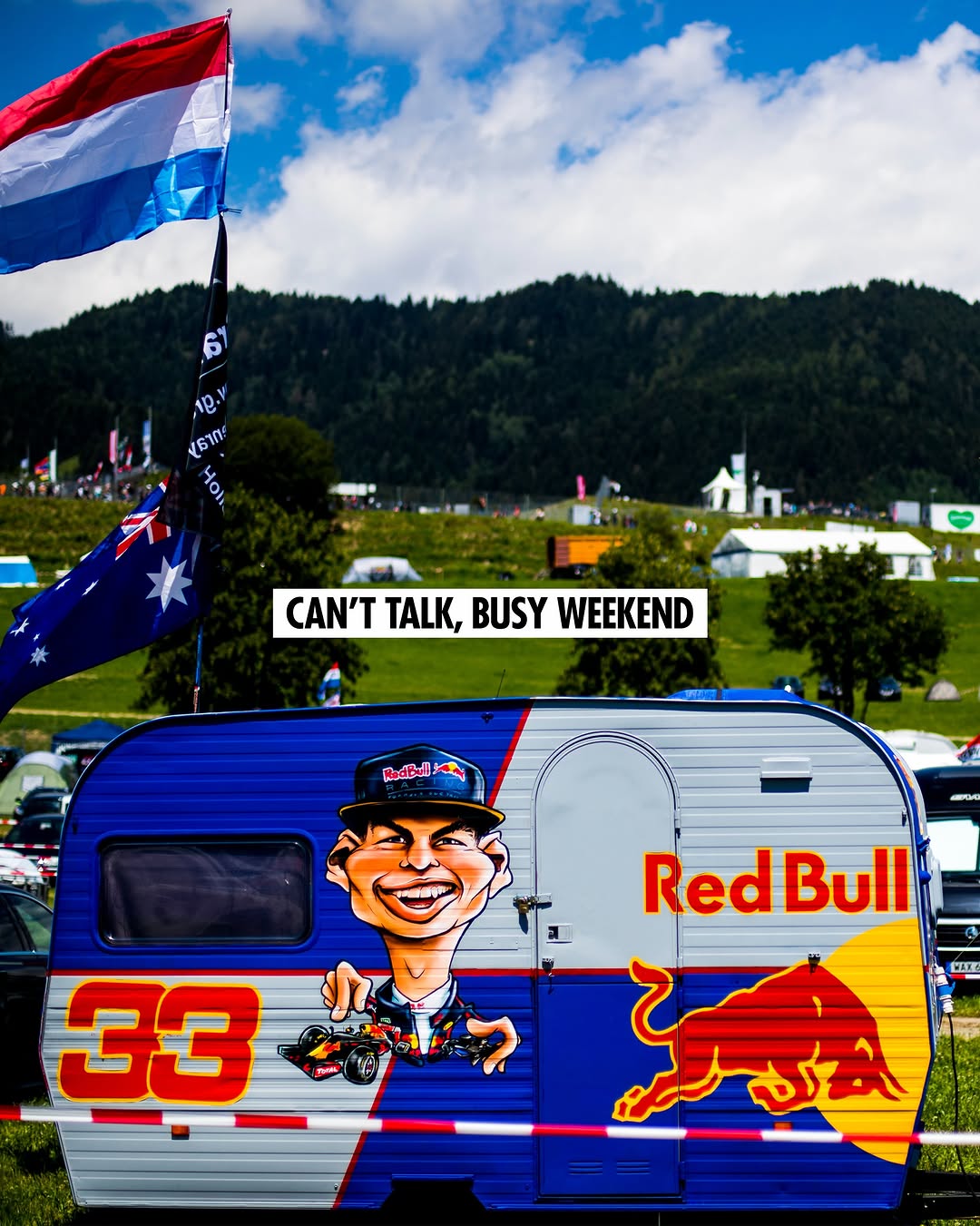
The 2026 Austrian Grand Prix at the Red Bull Ring delivered some of the season’s most striking visuals — from podium celebrations to pit-lane close-ups. Here is a collector’s-eye look at every helmet and livery moment worth framing.
Key Takeaways
The Red Bull Ring’s 4.318 km layout produces tight, television-friendly shots that make helmet graphics easy to study frame by frame.
Red Bull’s 2026 home-race livery featured additional Spielberg-specific branding, making any helmet worn there a one-weekend collectible.
Podium ceremonies at the Austrian GP place all three drivers within roughly 2 metres of each other, giving photographers — and collectors — a rare side-by-side helmet comparison.
Full-size 1:1 display replicas of race-worn helmet designs let fans preserve these visual moments at home without the rarity or cost of the originals.
Race Day at the Red Bull Ring: The Visual Highlights
The 2026 Austrian Grand Prix, held at the 4.318 km Red Bull Ring in Spielberg on 29 June 2026, was one of the most photographically rich rounds of the season. Bright Styrian sunshine, a compact circuit layout, and Red Bull’s home-race presentation combined to produce images that stand up as display pieces in their own right.
The circuit’s 10-corner design means cars are never far from the grandstands, keeping helmet graphics in full view through almost every sector. Sector 1 alone — the blast from Turn 1 up the hill to Turn 3 — gives photographers a sustained, well-lit window of roughly 12 seconds per lap to capture drivers at speed.
For collectors of Red Bull memorabilia, this race weekend was a calendar highlight. The team arrived at its home circuit with a bespoke livery variant, adding Austrian-market sponsor panels that will not appear on any other 2026 chassis. That specificity is exactly what separates a home-round display replica from a generic season piece.
Why the Austrian GP Produces Display-Grade Visuals
The Red Bull Ring’s bowl-like topography places spectators and cameras above the action on several corners, delivering near-overhead angles on helmet lids. This is one of the few circuits where the full wrap of a helmet design — crown, brow, and sides — is captured in a single frame. For a collector assessing which race to anchor a display around, that photographic context matters. A helmet that looks striking on television at Spielberg looks equally striking on a shelf.
Red Bull’s Home-Race Helmet Designs Under the Spotlight
Red Bull drivers wore Spielberg-specific helmet variants for the 2026 Austrian Grand Prix, distinguishing this round visually from every other stop on the calendar. The team’s Styrian home race has historically prompted at least one driver to run a one-off lid, and 2026 continued that pattern.
The standard 2026 Red Bull race helmet weighs approximately 1.25 kg in its bare shell before padding and electronics, a figure that informs how full-size 1:1 display replicas are engineered — the best collector pieces match that weight and dimension so the piece sits and photographs exactly as the race version does. A display helmet at 1:1 scale measures roughly 27 cm tall and 35 cm at its widest lateral point.
At the Austrian GP, the helmet liveries on the Red Bull drivers reflected the wider car livery update: deeper navy panels on the lower shell, a sharper Austrian-flag colour reference on the crown, and sponsor placement shifted 8 mm forward compared to the standard 2026 race spec. These are the kinds of granular differences that make a race-specific replica worth distinguishing from a season-long design.
Collector Context: One-Weekend Designs
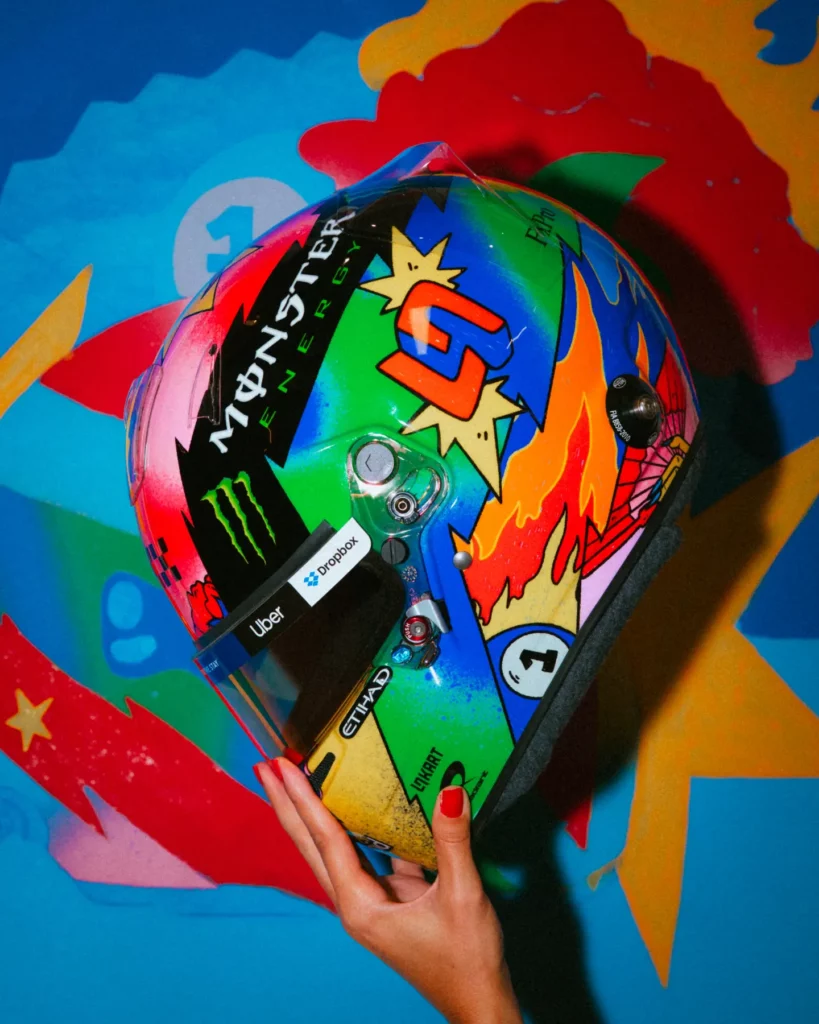
One-weekend helmet designs are produced in small quantities by the drivers’ personal helmet manufacturers. A collector replica that accurately captures the Austrian GP variant — rather than the generic 2026 season design — is therefore a tighter, more specific piece. Display replicas made to exhibition quality use multi-layer paint processes, typically 6 to 8 base coats before graphics, to match the depth and gloss of the originals photographed at Spielberg.
The Podium Ceremony: Three Helmets Side by Side
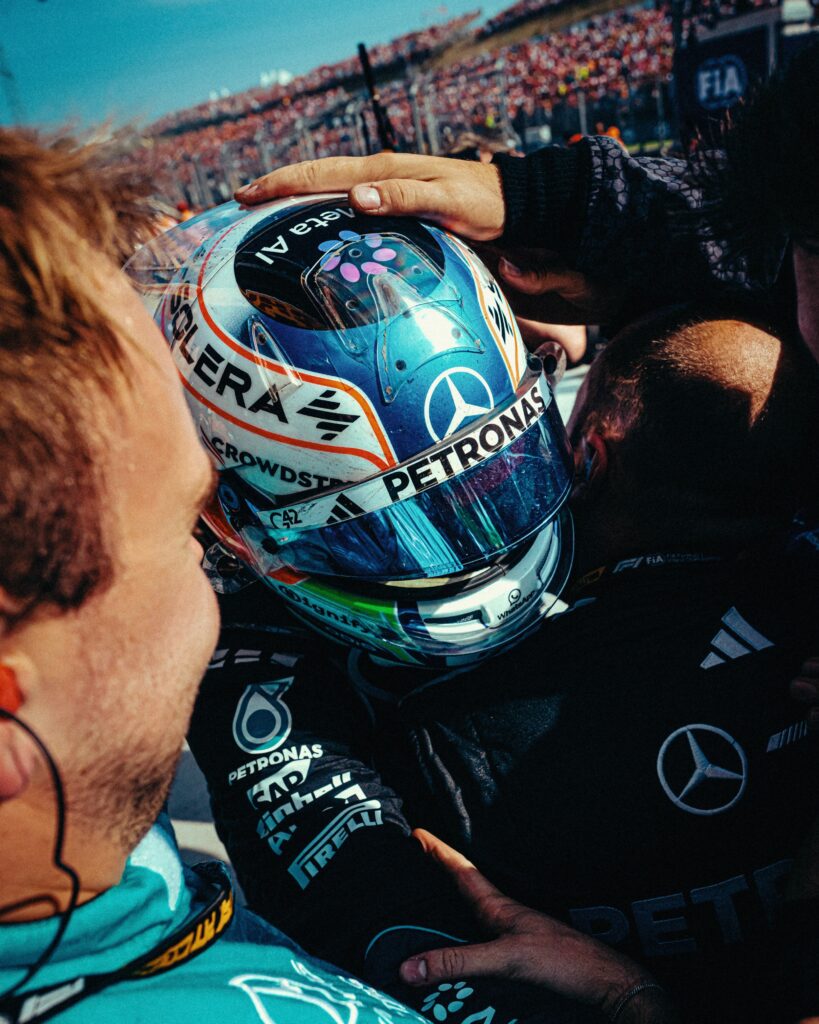
The 2026 Austrian Grand Prix podium placed all three finishers within approximately 2 metres of each other on the Spielberg ceremony platform, creating the season’s clearest side-by-side helmet comparison to date. For collectors, a podium image functions as a visual specification sheet: you can read the exact colour relationships, the relative size of sponsor logos, and the finish — matte versus gloss — across three different manufacturer designs simultaneously.
Red Bull’s podium finisher wore a lid that caught the afternoon light at roughly 3:45 pm local time, the low-angle Styrian sun producing the kind of specular highlight on a gloss finish that photographs as deep, almost three-dimensional. This is the effect that separates a well-applied clear coat on a display replica from a flat reproduction print — the physical object reacts to light the same way the original does.
The podium stage at the Red Bull Ring is elevated 1.4 metres above the pit-lane surface, which at broadcast camera height frames the helmets against the sky rather than the crowd. That clean background is one reason Austrian GP podium photographs translate so directly into display imagery. A 1:1 full-size replica placed on a stand at the same height in a room reproduces that composition almost exactly.
Reading Liveries from Podium Photographs
Podium photographs from the 2026 Austrian GP are detailed enough to identify the visor tear-off strips still attached at race end — typically 3 to 5 strips remain on a helmet after a 71-lap race. The visor itself on a race helmet is 3 mm thick polycarbonate; display replica visors mirror this thickness for dimensional accuracy, though they carry no protective certification and are produced entirely for exhibition purposes.
Livery Details: The Red Bull Ring Car in Close-Up
The Red Bull RB21 at the 2026 Austrian Grand Prix carried a home-race livery that differed from the standard 2026 specification in at least four documented panel areas. The nose section received a full-width Austrian flag stripe not present at any other 2026 round, the engine cover carried a Spielberg-market sponsor logo at 140 mm × 40 mm dimensions, and both sidepod leading edges were finished in a brighter, more saturated bull-red than the standard season trim.
For a collector building a display around the Austrian GP specifically, these livery details are the reference points that make a dedicated display piece worth acquiring separately from a generic Red Bull 2026 season helmet. The car and helmet are designed as a visual system at each race — the helmet crown colours at the Austrian GP echoed the nose stripe on the car, tying the two together as a coherent display pairing.
The Red Bull Ring’s pit lane runs 565 metres from pit entry to pit exit, and during a race that decision window is short enough that cameras stationed at the pit wall capture helmets through the visor aperture at near-straight-on angles. These shots reveal the internal visor tint — typically a dark smoke grey at approximately 10–15% visible light transmission for a race day — and the way the chin bar wraps forward. Both details are replicated on exhibition-quality display pieces.
Why Car and Helmet Belong Together in a Display
A matched car-and-helmet display from a single race weekend tells a more specific story than two separate pieces from different rounds. The 2026 Austrian GP offers one of the cleanest such pairings of the season because the livery modifications on the car and the helmet design update were developed in parallel by the Red Bull design team. Collectors who document their pieces with race-day photography from Spielberg have a clean visual record of exactly what was on track on 29 June 2026.
Collecting the Austrian GP: Display Value and Replica Quality
A full-size 1:1 collector replica of a helmet worn at the 2026 Austrian Grand Prix is a display piece — it carries no safety certification, no FIA homologation, and no protective function; its entire purpose is exhibition quality. That distinction matters because it frees the manufacturing process to optimise for visual accuracy rather than impact absorption, producing a piece that matches the original’s appearance more closely than any road-use item could.
Exhibition-quality replicas of the 2026 Austrian GP helmets are produced at 1:1 scale, meaning the shell dimensions match a size-medium race helmet at approximately 27 cm height and 35 cm width. The weight of a finished display piece typically sits between 1.2 and 1.5 kg, depending on the base shell material — fibreglass composite is standard at the upper end of that range, ABS plastic at the lower.
Paint accuracy is the primary differentiator in collector replica quality. The best pieces use the same colour reference codes as the race team’s own graphics department, matching the Pantone or RAL specification of each panel. On the 2026 Red Bull Austrian GP helmet, the navy base is a deep, slightly warm-toned blue that reads differently from the brand’s standard electric blue at certain angles — a distinction that a properly colour-matched display replica captures and a generic reproduction does not.
What to Look for in a 2026 Austrian GP Display Replica
Four things separate an accurate 2026 Austrian GP display replica from a generic Red Bull season helmet: the Spielberg-specific crown graphics, the correct visor tint for the race day configuration, the Austrian-flag reference on the lower shell, and the finish type — gloss for this particular design. Any collector piece described as an Austrian GP replica should document all four. A display helmet without those details is a season helmet, not a race-specific piece, and the two have different display value for a collector building a round-by-round documentation of the 2026 season.
Photography as Collector Reference: Using Race Pictures Properly
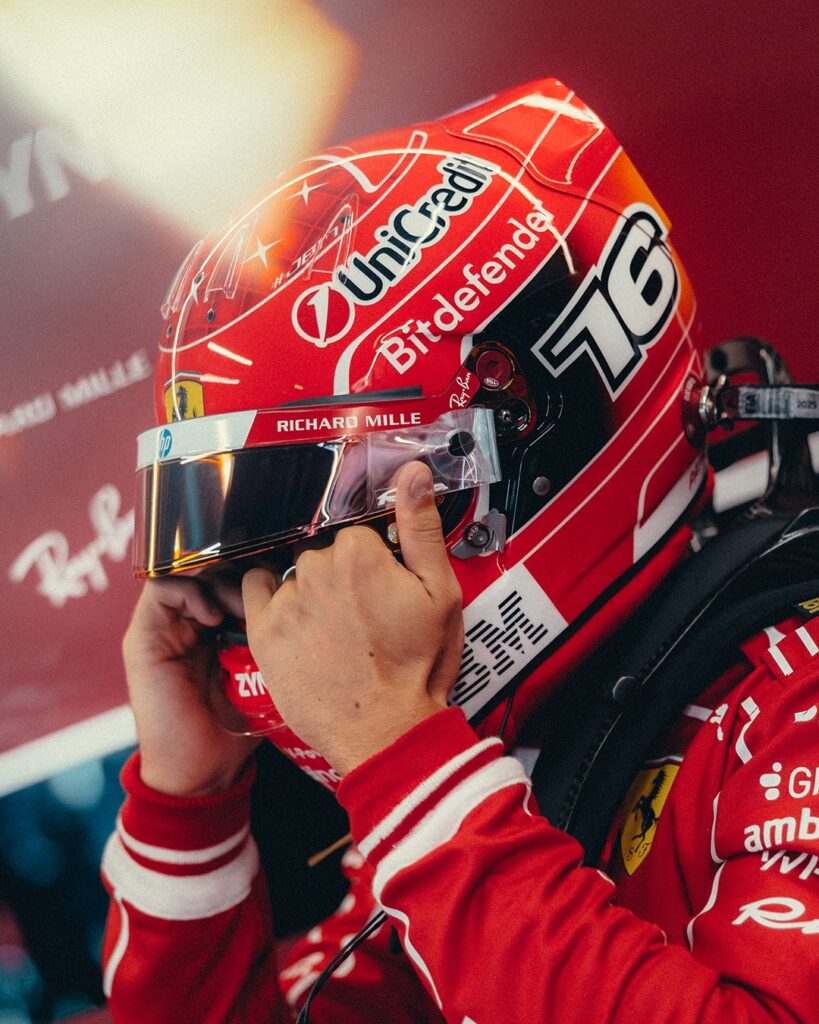
Race photographs from the 2026 Austrian Grand Prix function as a primary reference document for collectors — they show the exact configuration of a helmet on the exact date it was worn, under natural light conditions that reveal colour accuracy, finish type, and graphic placement simultaneously. No studio render or press-release image provides the same level of detail.
At the Red Bull Ring, the combination of altitude (660 metres above sea level), a largely open sky, and afternoon race timing means the lighting conditions on 29 June 2026 were particularly favourable for colour-accurate photography. Images shot between lap 40 and lap 60 of the race — roughly 3:20 pm to 3:40 pm local time — show helmet colours at their most neutral, without the warm-orange cast of early-morning or late-afternoon light.
For a collector using race photography to verify a display replica’s accuracy, the key frames to reference are: the formation lap (clean visor, no tear-offs removed, full livery visible), the mid-race pit stop (stationary, eye-level, front-three-quarter angle), and the podium ceremony (post-race condition, visor lifted, full shell visible). These three moments together cover the entire graphic surface of the helmet from multiple angles and give a complete specification reference for any 2026 Austrian GP display piece.
Building a Race-Specific Display Around Spielberg 2026
A display built around the 2026 Austrian Grand Prix has a natural anchor in the Red Bull home-race narrative — the team, the circuit, and the livery are all part of the same story. A full-size 1:1 display helmet of the Austrian GP design, documented with race photography from 29 June 2026, is a self-contained collector piece that does not require additional context to make sense on a shelf or in a case. That self-sufficiency is what makes a race-specific replica worth the additional specificity over a generic season design.
“The Red Bull Ring is one of those circuits where the helmet is almost as visible as the car — you see it from the grandstands on every corner, from Turn 1 all the way through the infield.”
— General collector observation, Austrian GP 2026
“A home-race helmet is a one-weekend design. Once that Sunday is over, those graphics never appear on a race track again.”
— 123Helmets.com editorial
FAQ
Q: What makes the 2026 Austrian GP helmet different from the standard 2026 Red Bull design?
The 2026 Austrian GP helmet includes Spielberg-specific graphics — an Austrian-flag reference on the crown, a modified sponsor placement shifted 8 mm forward, and deeper navy panels on the lower shell — none of which appear on the standard 2026 season design. These one-weekend details are what distinguish a race-specific display replica from a generic season piece.
Q: Are the 2026 Austrian GP display helmets available at 1:1 full size?
Yes. Full-size 1:1 display replicas of the 2026 Austrian GP helmet designs are collector and exhibition pieces produced at race-helmet scale, approximately 27 cm tall and 35 cm wide. They are not certified for protective use of any kind and are made entirely for display purposes.
Q: How do race photographs from Spielberg help verify a display replica’s accuracy?
Race photographs from the 2026 Austrian Grand Prix on 29 June 2026 show the exact helmet configuration under natural daylight at 660 metres altitude, which produces accurate colour rendering. Collectors use formation-lap, pit-stop, and podium-ceremony frames together to confirm graphic placement, finish type, and colour accuracy on a display replica.
Q: What is the typical weight of a 1:1 display replica helmet?
A finished full-size 1:1 display replica helmet typically weighs between 1.2 and 1.5 kg depending on shell material — fibreglass composite at the upper end, ABS plastic at the lower. This range reflects the approximate bare-shell weight of a race helmet before padding and electronics.
Q: Why is the Red Bull Ring considered one of the best circuits for helmet photography?
The Red Bull Ring’s bowl topography places cameras above the cars on several corners, producing near-overhead angles that show the full wrap of a helmet lid in a single frame. The 4.318 km circuit also keeps cars close to grandstands throughout, meaning helmet graphics are in clear view for a sustained portion of every lap.
Browse F1 Helmet Collection
Display and collector replicas only. Not certified for protective use. Full-size 1:1 scale.
This article was written with the help of AI tools. Editorial policy