
Blog
Aston Martin Warns of Tougher Races After Zandvoort Recovery
 123Helmets Editorial Team

Fernando Alonso turned an 18th-place qualifying slot into a ninth-place finish at the Dutch Grand Prix on 2026-08-23, but Aston Martin trackside chief Mike Krack says the AMR26’s short-straight strength at Zandvoort will not travel well to Monza and Baku.
Key Takeaways
Fernando Alonso finished ninth at the 2026 Dutch Grand Prix after qualifying 18th, using a one-stop strategy while most rivals ran two stops.
Aston Martin’s AMR26 recorded a best qualifying speed of 309.5km/h at Zandvoort, second-slowest on the grid, ahead of only Cadillac’s 309.4km/h.
Mike Krack says the AMR26’s race pace has been stronger than qualifying pace since the Hungarian Grand Prix, but only on tracks with shorter straights.
Monza and Baku, both featuring some of the longest straights on the 2026 calendar, are flagged by Aston Martin as tougher tests ahead.
How Alonso Turned P18 Into P9 at Zandvoort
Fernando Alonso converted a difficult Saturday into a solid points finish by running an opportunistic one-stop strategy while the majority of the field pitted twice. Qualifying 18th left Alonso with little to lose, and Aston Martin used that starting position to commit to a strategy split from the pack, banking on the AMR26’s cornering strength at Zandvoort to offset its lack of raw speed. The result was ninth place at the flag, finishing just ahead of a frustrated Pierre Gasly. It was a recovery drive built on patience rather than outright pace, and it highlighted a gap between the car’s single-lap performance and its ability to hold position across a full race distance.
Mike Krack, Aston Martin’s chief trackside officer, confirmed after the race that the team’s raceday pace has been consistently stronger than its qualifying pace since the Hungarian Grand Prix weekend. That trend held again at Zandvoort, where a circuit dominated by medium and slow corners let the AMR26’s chassis characteristics compensate for a straightline deficit that would be far harder to hide elsewhere.
Why Krack Says Tougher Races Are Coming
Mike Krack says Aston Martin’s short-straight advantage will not carry over to circuits like Monza and Baku, which feature some of the longest straights on the 2026 calendar. “So we will have tougher races to come, but I think that this is part of the game,” Krack said, framing the run of favorable circuits since Budapest as a temporary window rather than a sign of consistent competitiveness. His comment that the result “will depend more or less on how long the straights are” — a point he credited to Alonso himself — sums up the team’s current reality: strong through the corners, exposed on power.
Krack’s honesty about the limitation matters because it sets expectations for a stretch of the calendar where Aston Martin’s cornering gains may simply not be enough to offset a straightline shortfall. “You have races where you’re strong, and you have races where you’re less strong,” he added, acknowledging that the coming rounds will test how much of Zandvoort’s result was track-specific rather than a genuine step forward.
The Straightline Speed Problem Behind the Numbers
Aston Martin had the second-slowest car in qualifying straightline speed at Zandvoort, recording a best of 309.5km/h. That figure sat well below Alpine’s session-topping 331.7km/h and only narrowly cleared Cadillac’s 309.4km/h at the back of the field. The gap is notable because it came despite Honda’s long-awaited power unit upgrade, introduced specifically to address performance shortfalls that hampered the AMR26 earlier in the season.
Krack pointed to progress on the chassis side as the more reliable gain so far. “We get to know this package more and more,” he said, referring to the large aerodynamic and mechanical package introduced on the car. The chassis work has translated into genuine cornering pace, visible again at Zandvoort, but the straightline numbers show the power unit upgrade has not yet delivered the step Aston Martin needs on circuits where speed down the straights decides the result.
Podium Visuals and the Aston Martin Look at Zandvoort
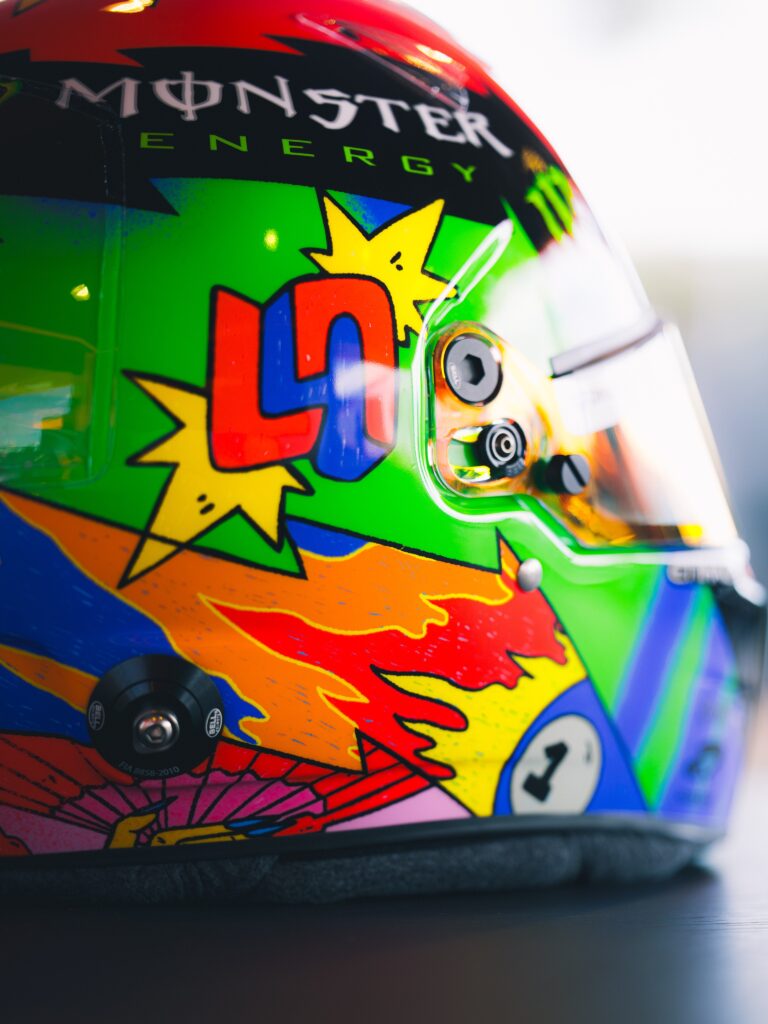
Zandvoort’s dune-backed straights and low afternoon light gave the Aston Martin green liveries a distinct look trackside, even from ninth on the grid rather than the podium. Fernando Alonso’s helmet design, carrying his familiar sharp geometric graphics and personal color scheme, stood out clearly in the paddock and on the grid against the team’s dark green branding — the kind of moment collectors look for when a driver overachieves relative to a difficult qualifying result.
For fans building a display collection, race weekends like this one — where a driver claws back nine grid positions through strategy and racecraft — are often the ones that end up defining a season narrative, even without a trophy. A full-size 1:1 replica of Alonso’s helmet from this stretch of the 2026 season captures that underdog storyline as a display piece rather than just a souvenir of a single result.
What Comes Next for Aston Martin
Aston Martin’s next real test of the AMR26’s straightline weakness arrives at circuits like Monza and Baku, both known for some of the longest straights on the 2026 calendar. Mike Krack has been explicit that the Honda-powered chassis, however sharp in the corners, will be exposed on tracks that reward outright speed over cornering grip. The team’s cornering gains since Budapest have produced solid results, but Krack’s own framing — races you’re strong in, races you’re less strong in — suggests Aston Martin expects a dip in form before the calendar potentially turns favorable again.
For Fernando Alonso, the challenge is converting whatever grid position qualifying delivers into another strategic recovery, as he did from 18th to ninth at Zandvoort. Whether the AMR26’s chassis strength can offset the straightline deficit at Monza and Baku will show whether Aston Martin’s progress is real gain or simply a function of favorable circuit layouts.
“Since Budapest we know that we’re a bit stronger in the race. So we will have tougher races to come, but I think that this is part of the game. You have races where you’re strong, and you have races where you’re less strong.”
— Mike Krack, Aston Martin Chief Trackside Officer
“We get to know this package more and more.”
— Mike Krack, Aston Martin Chief Trackside Officer
FAQ
Q: How did Fernando Alonso finish ninth at the Dutch Grand Prix?
Alonso qualified 18th but ran a one-stop strategy while most of the field pitted twice, letting the AMR26’s cornering strength at Zandvoort carry him to ninth place ahead of Pierre Gasly.
Q: Why does Aston Martin expect tougher races after Zandvoort?
Mike Krack says the AMR26’s recent race pace advantage depends on shorter straights, and upcoming circuits like Monza and Baku have some of the longest straights on the 2026 calendar, exposing the car’s straightline weakness.
Q: How slow was the Aston Martin AMR26 at Zandvoort?
Aston Martin recorded a best qualifying speed of 309.5km/h at Zandvoort, the second-slowest on the grid, behind Alpine’s 331.7km/h and just ahead of Cadillac’s 309.4km/h.
Q: Did Honda’s power unit upgrade fix Aston Martin’s speed problem?
Not yet — despite the introduction of Honda’s long-awaited power unit upgrade, Aston Martin still posted one of the slowest straightline speeds at Zandvoort, with Krack citing chassis progress as the more consistent gain.
Q: Is there a full-size Fernando Alonso helmet replica available?
Yes, 123Helmets.com offers a full-size 1:1 display replica of Fernando Alonso’s 2026 helmet design as a collector item for fans following his season with Aston Martin.
Shop Fernando Alonso Collection
Display and collector replicas only. Not certified for protective use. Full-size 1:1 scale.