Blog
Barcelona 2026 Spanish GP Preview: Podium Visuals, Helmet Liveries & Display-Worthy Moments to Watch
 123Helmets Editorial Team
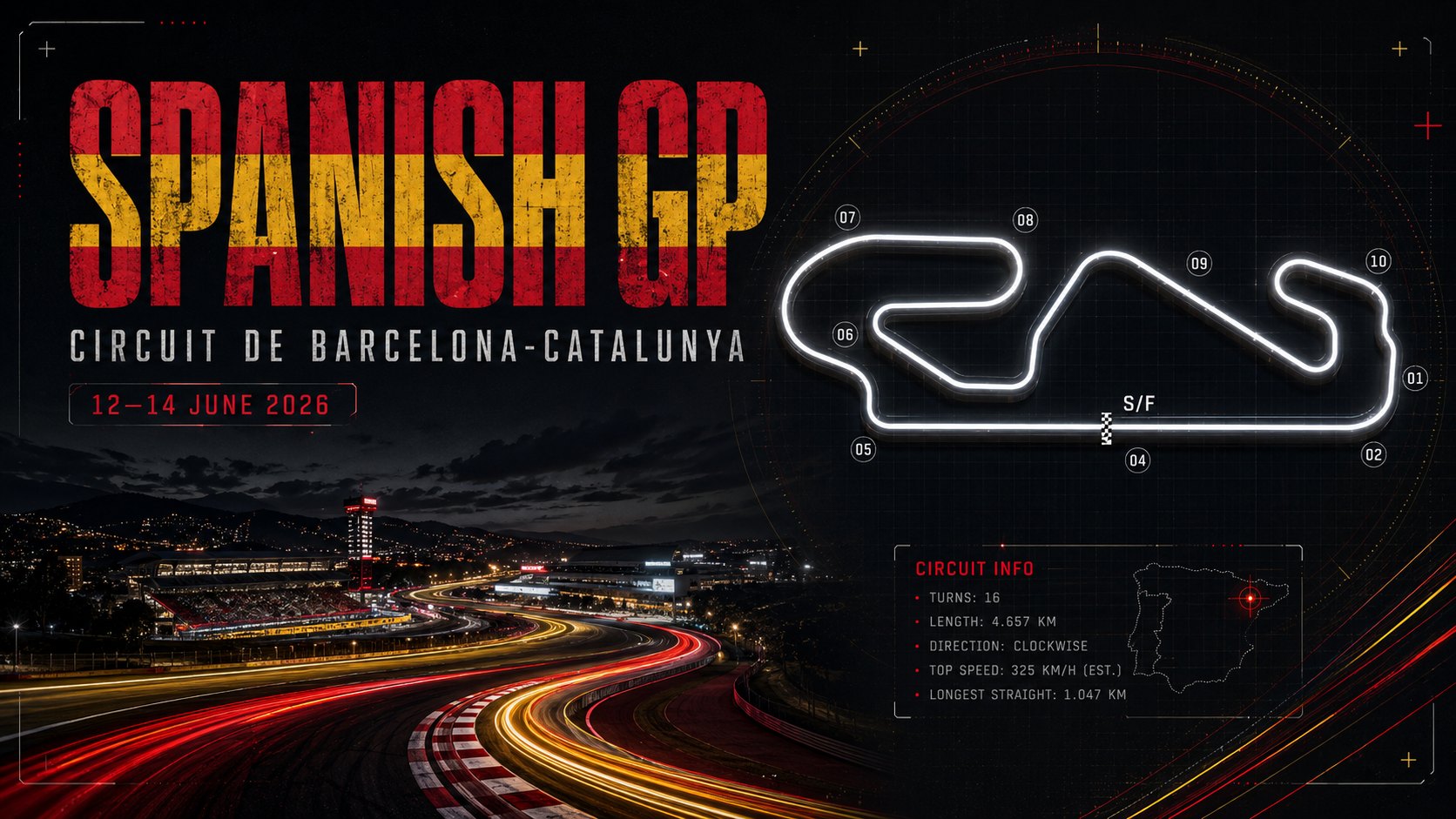
George Russell claims pole by 0.064 seconds over Lewis Hamilton at the Circuit de Barcelona-Catalunya, setting up one of the most visually striking front rows of the 2026 season — and some of the most display-worthy helmet moments a collector could hope to catalogue.
Key Takeaways
George Russell took pole position with a margin of just 0.064 seconds over Lewis Hamilton, making the front row the tightest split of the 2026 season so far.
Lewis Hamilton’s Q3 lap in Ferrari red marks one of the most visually significant front-row appearances of his career — a helmet livery shift that collectors are already tracking.
Charles Leclerc starts from 10th, meaning a recovery drive through the field could produce the kind of dramatic, freeze-frame podium moment that defines display-quality replica helmets.
The Circuit de Barcelona-Catalunya’s 66-lap race distance gives drivers maximum exposure across multiple overtaking zones, multiplying the number of visually iconic moments likely to reach the podium step.
The Front Row That Stopped the Paddock
Qualifying at Circuit de Barcelona-Catalunya on 2026-06-14 produced a front row that will be referenced for years. George Russell secured pole position, but the story of Q3 belonged to Lewis Hamilton. Driving for Ferrari in 2026, Hamilton set a final flying lap that came within 0.064 seconds of taking pole — the narrowest front-row gap of the season to date.
That 0.064-second split is not just a timing footnote. It means the two cars will launch side by side into Turn 1 with practically identical straight-line momentum, making the first corner of the Spanish Grand Prix one of the most anticipated moments of the entire European swing. For anyone tracking the visual history of F1, the image of a Mercedes silver helmet and a Ferrari red helmet separated by centimetres off the line is exactly the kind of frame that defines a collector season.
Russell lines up in P1 without his usual front-row companion. For the first time this season, Mercedes junior Kimi Antonelli is not alongside him — Hamilton has taken that slot, bringing with him a livery identity that the paddock is still processing. Two former teammates, now rivals, separated by less than a tenth of a second. The race starts at Circuit de Barcelona-Catalunya, a circuit that runs 66 laps in the dry and rewards clean air from the front.
Hamilton in Red: The Livery Story Every Collector Is Watching
When Lewis Hamilton confirmed his move to Ferrari ahead of the 2026 season, it triggered one of the biggest collector conversations in recent F1 history. The combination of Hamilton’s personal helmet design — typically featuring his signature yellow visor band and championship iconography — with Ferrari’s Scuderia red is a pairing that has never existed in the sport before 2026.
At Barcelona, that pairing is on the front row. Hamilton’s helmet at the Spanish Grand Prix carries the Ferrari branding alongside his own identity markers, creating a display piece that sits at the intersection of two of the sport’s most storied visual identities. Full-size 1:1 replica helmets capturing Hamilton’s 2026 Ferrari livery represent a specific, datable moment in F1 — the first season in which those two identities merged on track.
From a collector standpoint, the significance is concrete: this is the first Barcelona qualifying in which Hamilton has worn red. That specificity — circuit, year, livery combination — is precisely what gives a display helmet its long-term reference value. A full-size 1:1 exhibition-quality replica of Hamilton’s 2026 Spanish GP helmet is not a generic souvenir. It is a dated artefact of a very particular chapter in the sport’s visual history.
Visor Technology in Modern Display Replicas
The visor panel on modern collector replicas is typically rendered at 3 mm to 5 mm thickness to replicate the optical profile of a race-specification visor without any structural or protective function. Display pieces are not certified for any protective use — they are full-size 1:1 scale exhibition items only. The visual accuracy of the visor tint and the helmet’s overall geometry is what gives a collector piece its standing on a shelf or in a display case.
Leclerc From 10th: The Recovery Drive as Visual Theatre
Charles Leclerc starts the 2026 Spanish Grand Prix from 10th position. That is a significant deficit at a circuit where overtaking, while possible, demands timing and precision. The Circuit de Barcelona-Catalunya has 16 corners across its 4.657 km layout, and Leclerc will need to navigate traffic, manage tyre degradation across 66 laps, and find gaps that the midfield does not easily offer.
From a purely sporting perspective, a Leclerc recovery drive to the podium would rank among the more notable performances of the European season. From a collector perspective, it would also produce one of the more charged podium images of 2026 — the distinctive Ferrari red of Leclerc’s helmet, arriving at P3 or higher after starting so far back, alongside Hamilton in P1 or P2 in the same Ferrari livery. That is a podium photograph with unusual internal symmetry: two Ferrari drivers, two helmet designs, one team identity split across two very different race trajectories.
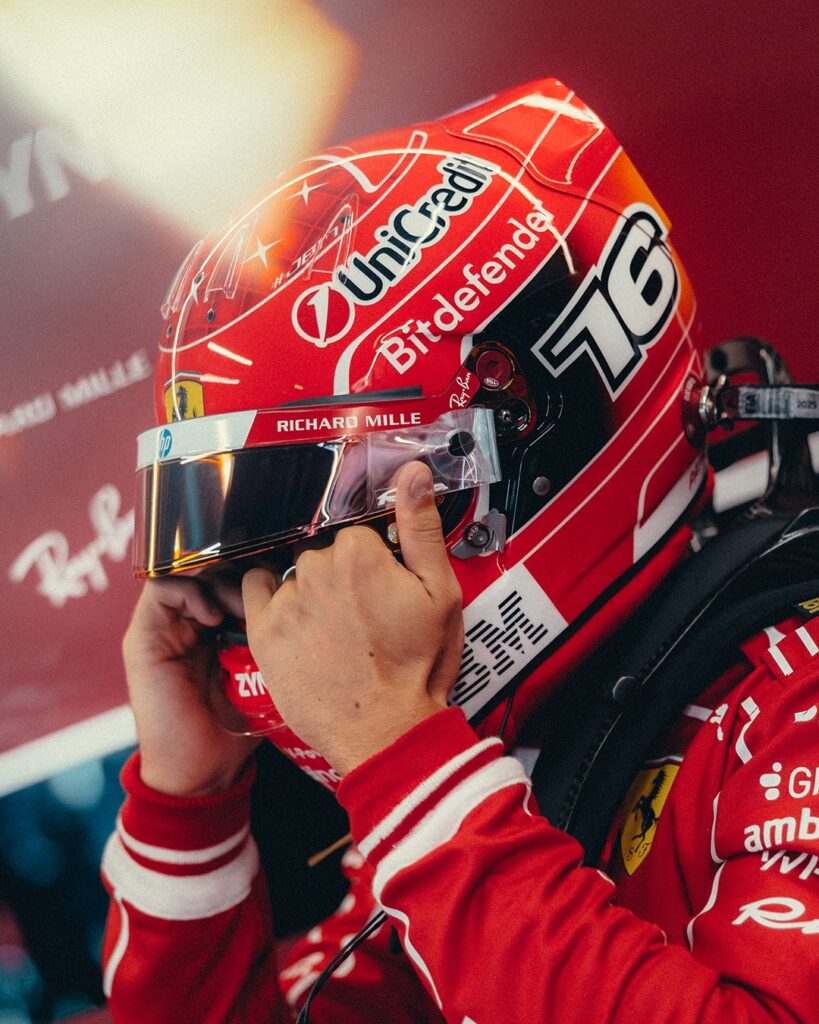
Leclerc’s helmet design has remained one of the more recognisable in the current grid — the Monegasque’s preference for clean geometry and bold colour blocking translates well to full-size 1:1 replica format. If he does make the podium from 10th, the 2026 Spanish GP becomes a very specific reference point for that design.
Russell Defending Pole: What 66 Laps at Barcelona Looks Like
George Russell has been on pole before in 2026, but this is the first time he faces a genuine off-the-line threat from a driver starting directly alongside him with comparable straight-line pace. Hamilton’s Q3 lap time was not the product of a different tyre strategy or a tow — it was a clean lap that fell 0.064 seconds short. That gap suggests the Ferrari and Mercedes are closely matched through Barcelona’s medium-speed sections, which makes Turn 1 a genuine decision point rather than a formality.
Russell’s helmet design in 2026 carries Mercedes’ continued evolution of its silver livery identity. The combination of Mercedes silver and Hamilton’s Ferrari red going wheel-to-wheel into Turn 1 at Circuit de Barcelona-Catalunya is a visual that did not exist before this season. For display collectors, the front-row pairing — Russell P1, Hamilton P2 — is itself a datable, specific configuration that a full-size 1:1 replica can reference precisely.
Barcelona’s 66-lap race distance is long enough that tyre management becomes a decisive factor. If Russell maintains clean air from the start, his pace advantage from pole should hold. If Hamilton gets alongside into Turn 1, the first stint strategy diverges and the race opens up — which means more podium permutations, more visually distinct outcomes, and more potential collector reference moments across the full race distance.
Kimi Antonelli and the Midfield Visual Story
Kimi Antonelli, Russell’s usual front-row companion in 2026, starts from further back this weekend after qualifying was reshuffled by Hamilton’s late lap. Antonelli’s helmet design — one of the fresher visual identities on the current grid given his rookie season status — will be working through traffic rather than leading from the front. Recovery drives by young drivers in distinctive helmets have historically produced some of the sport’s most referenced display moments, and Antonelli’s 2026 season is already establishing its own collector thread.
Podium Visuals and Why Barcelona Produces Display-Quality Moments
The Circuit de Barcelona-Catalunya podium has hosted some of the most photographed moments in recent F1 history. The circuit’s location, lighting conditions in June, and the backdrop of the Montmeló grandstands produce images with a specific quality that collectors and editors recognise. The 2026 Spanish Grand Prix adds a layer of visual interest that few Barcelona editions have matched: the genuine possibility of a Ferrari-Mercedes-Ferrari podium, or a Mercedes-Ferrari-Ferrari podium, with three helmet liveries that represent three distinct identity stories all landing on the same step within minutes of each other.
From a collector standpoint, the podium photograph is the anchoring reference for any display helmet. A full-size 1:1 replica of a driver’s helmet carries its full meaning when it can be placed against a specific race, a specific result, and a specific visual moment. The 2026 Spanish GP — with Russell on pole, Hamilton in Ferrari red 0.064 seconds behind, and Leclerc attempting to recover from 10th across 66 laps — has multiple pathways to producing exactly that kind of moment.
Display and collector replicas are full-size 1:1 scale items, not certified for any protective use. Their value is entirely in the accuracy of the visual representation — the paint layers, the livery geometry, the visor tint, the decal placement — and in the specificity of the moment they reference. Barcelona 2026 is shaping up to be a race with several such moments built into its structure before the lights even go out.
What to Watch When the Lights Go Out
The five moments most likely to produce display-quality visual references at the 2026 Spanish Grand Prix are well-defined before race day. The Russell-Hamilton duel off the line is the first. The subsequent pit window strategy, which at Barcelona typically opens between laps 18 and 22 in a standard one-stop, is the second — because the undercut battle between Ferrari and Mercedes will define whether Hamilton’s race goes long or short on the first stint.
Third is Leclerc’s progress through the field. If he reaches the top five by lap 30, the trajectory toward a podium becomes statistically plausible — and each overtake adds a frame to his 2026 Spanish GP visual record. Fourth is the final lap positioning, where the gap between the top three is often under two seconds at Barcelona and the podium photograph captures drivers at near-identical speed. Fifth is the podium ceremony itself, where the helmet comes off and the identity behind the visor becomes visible — the moment that full-size 1:1 display replica designers reference most closely.
The 2026 Spanish Grand Prix at Circuit de Barcelona-Catalunya runs across 66 laps of a 4.657 km circuit. The front row is separated by 0.064 seconds. Leclerc starts from 10th. Hamilton is in Ferrari red for the first time at this circuit. That is a specific, datable, visually rich set of conditions — exactly what collector-grade display pieces are built to reference.
“George Russell is back on pole position, but for the first time this season he isn’t lining up in P1 with team mate Kimi Antonelli by his side. Instead he has the fast-starting Lewis Hamilton alongside him after the Ferrari driver stunned with a final Q3 lap to miss out on pole by just 0.064s.”
— F1 Official Race Preview, Barcelona-Catalunya 2026
FAQ
Q: What was George Russell’s pole position margin at the 2026 Spanish Grand Prix?
Russell’s pole lap was 0.064 seconds faster than Lewis Hamilton’s Q3 time, making it the smallest front-row gap of the 2026 season to date.
Q: Why is Lewis Hamilton’s 2026 Barcelona helmet significant for collectors?
The 2026 Spanish Grand Prix is the first Barcelona qualifying in which Hamilton has competed in Ferrari red. A full-size 1:1 display replica of his 2026 Ferrari helmet at this race captures a unique livery combination that had never previously existed at this circuit.
Q: How many laps is the Circuit de Barcelona-Catalunya Spanish Grand Prix?
The Spanish Grand Prix at Circuit de Barcelona-Catalunya runs over 66 laps of the 4.657 km circuit layout.
Q: Where does Charles Leclerc start the 2026 Spanish Grand Prix?
Leclerc qualified in 10th position for the 2026 Spanish Grand Prix, meaning he faces a recovery drive through the field to reach the podium.
Q: Are the F1 helmet replicas at 123Helmets suitable for wearing or racing?
No. All helmets at 123Helmets.com are full-size 1:1 scale display and collector replicas only. They are not certified for any protective use and are intended exclusively as exhibition-quality display pieces.
Browse F1 Helmet Collection
Display and collector replicas only. Not certified for protective use. Full-size 1:1 scale.
This article was written with the help of AI tools. Editorial policy