
Blog
Bearman on Verstappen: Why the Haas Rookie Says He Must “Earn the Right” to Follow Max’s Example
 123Helmets Editorial Team
Bearman on Verstappen: Why the Haas Rookie Says He Must “Earn the Right” to Follow Max’s Example
Oliver Bearman has emerged as one of the most measured voices on the 2025 grid, and his recent comments about Max Verstappen reveal a rookie acutely aware of the line between admiration and imitation. The Haas driver acknowledged that while Verstappen’s racing style is an obvious benchmark, he must first “earn the right” to drive that way. For collectors and visual enthusiasts of the sport, the weekend also delivered another reminder of why Verstappen’s helmet program remains one of the most studied in modern F1 — a graphic identity that translates beautifully into full-size 1:1 display replicas.
Key Takeaways
Oliver Bearman openly cites Max Verstappen as a stylistic reference but insists respect must be earned through results.
Verstappen’s race weekend underlined the precision and aggression that define his on-track identity.
The Red Bull driver’s helmet livery continues to be one of the most coveted designs for 1:1 collector display replicas.
Bearman’s rise signals a new generation studying Verstappen’s craft — on track and in the details of presentation.
A Rookie’s Honest Admission
Oliver Bearman’s first full season in Formula 1 has been a study in composure. The young British driver, racing in Haas colours, has avoided the trap many rookies fall into: trying to do too much, too soon. When asked about modelling his racecraft on Max Verstappen — a driver whose aggressive precision has reshaped the modern definition of a complete F1 talent — Bearman did not deflect. He embraced the comparison, but with a caveat that revealed both maturity and self-awareness.
“You have to earn the right to race like that,” Bearman explained in the paddock, his words quickly travelling through the F1 media circuit. The phrase landed with weight because it acknowledged a truth often overlooked: Verstappen’s style is not simply a set of techniques to be copied. It is the product of years of results, of a championship pedigree, and of a reputation that allows him to operate at the edges of what stewards and rivals will tolerate.
Why Verstappen Is the Reference Point
For any driver entering Formula 1 in the mid-2020s, Verstappen is the inescapable benchmark. Four world titles, a record-breaking 2023 campaign, and a consistent ability to extract maximum performance from imperfect cars have positioned him as the standard against which all others are measured. Bearman’s choice of reference is therefore not flattery — it is logic.
What separates the Dutchman is not raw speed alone, but the combination of qualifying pace, race management, tyre intelligence, and overtaking ruthlessness. Bearman understands that adopting one element without the others would be incomplete, perhaps even reckless. “Earning the right” means building the credibility — through podiums, through finishing positions, through stewards trusting your judgment — to race the way Verstappen does.
The Race Weekend Recap
The Grand Prix itself provided context for Bearman’s remarks. Verstappen, starting from a front-row position, executed a launch that immediately demonstrated the qualities the rookie was describing. His first-lap defence was firm but clean. His mid-stint pace was relentless. And in the closing laps, when tyre management became the deciding variable, he extracted lap times that left the broadcast pit-wall feeds visibly recalibrating their projections.
Key Moments on Track
Three sequences defined the race from a Verstappen perspective. The first was an opening-lap wheel-to-wheel exchange where he held the racing line without contact — a textbook example of placing the car to make the pass impossible without forcing an incident. The second was a mid-race undercut window where Red Bull’s strategy team and Verstappen’s in-lap delivered a gap his rivals could not close. The third, and most visually striking, was a late-stint overtake completed around the outside of a medium-speed corner, the kind of move that belongs in any highlight reel.
For Bearman, watching from further back in the field, these moments are masterclasses. They are also the reason he framed his comments the way he did. To execute the late-race overtake, Verstappen relied on trust — trust in his own car placement, trust in his rival’s awareness, and trust accumulated through hundreds of similar situations. That trust is the “right” Bearman refers to.
Haas and the Long Game
Bearman’s own race was a quieter affair, focused on points consolidation and tyre data. Haas continues to develop, and the rookie’s role is to extract the maximum without compromising the team’s longer-term programme. His post-race analysis, however, returned repeatedly to Verstappen’s drives — not with envy, but with the focused observation of someone taking notes.
The Helmet: A Display Icon in Motion
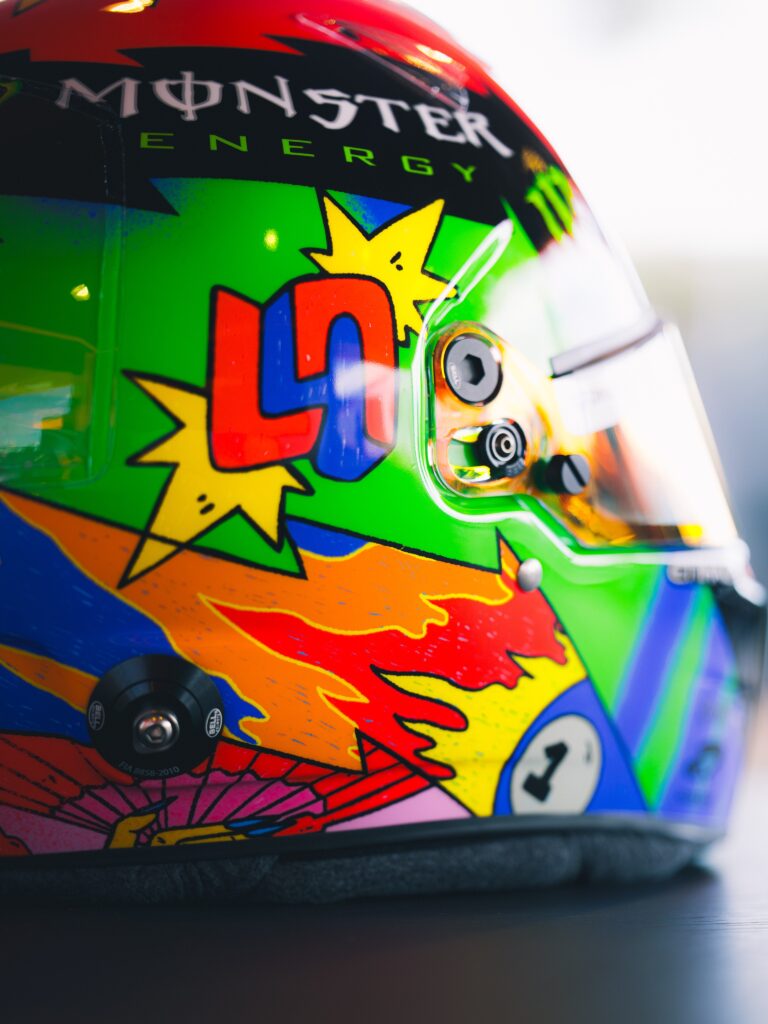
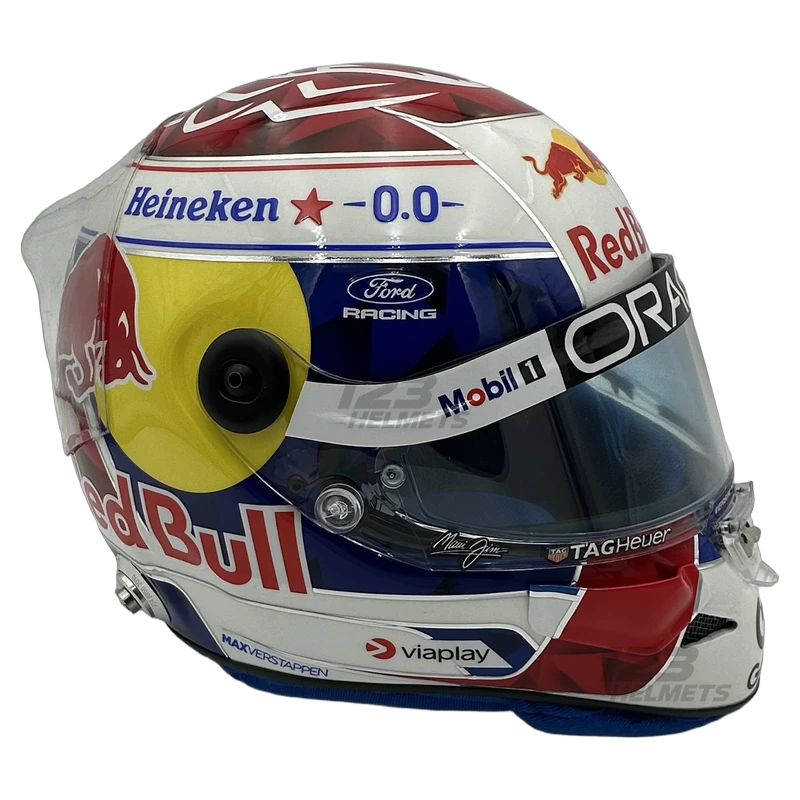
Beyond the racing, the weekend offered another reminder of why Verstappen’s visual identity is so coveted by collectors. His helmet — with its signature combination of dark base, bold lion motifs, and the Dutch tricolour accent — remains one of the most recognisable graphic compositions in modern Formula 1. When the broadcast cameras zoomed in during the formation lap, the design read instantly, even at speed.
Why the Livery Translates So Well to 1:1 Replicas
Helmet designs are created for two audiences: the high-speed television viewer and, increasingly, the collector who will study the piece up close. Verstappen’s livery succeeds on both counts. The macro elements — the lion, the broad colour fields, the number — provide instant recognition from a distance. The micro details — the sponsor placements, the gradient transitions, the matte and gloss finishes — reward close inspection.
For full-size 1:1 collector display replicas, this dual readability is essential. A helmet that looks striking on screen but flat on a shelf is a disappointment. Verstappen’s design avoids that pitfall entirely. Mounted under a glass display case or positioned on a lit shelf, the helmet operates as a sculptural object — an exhibition-quality piece that anchors any F1 collection room.
Podium Visuals and Display-Worthy Moments
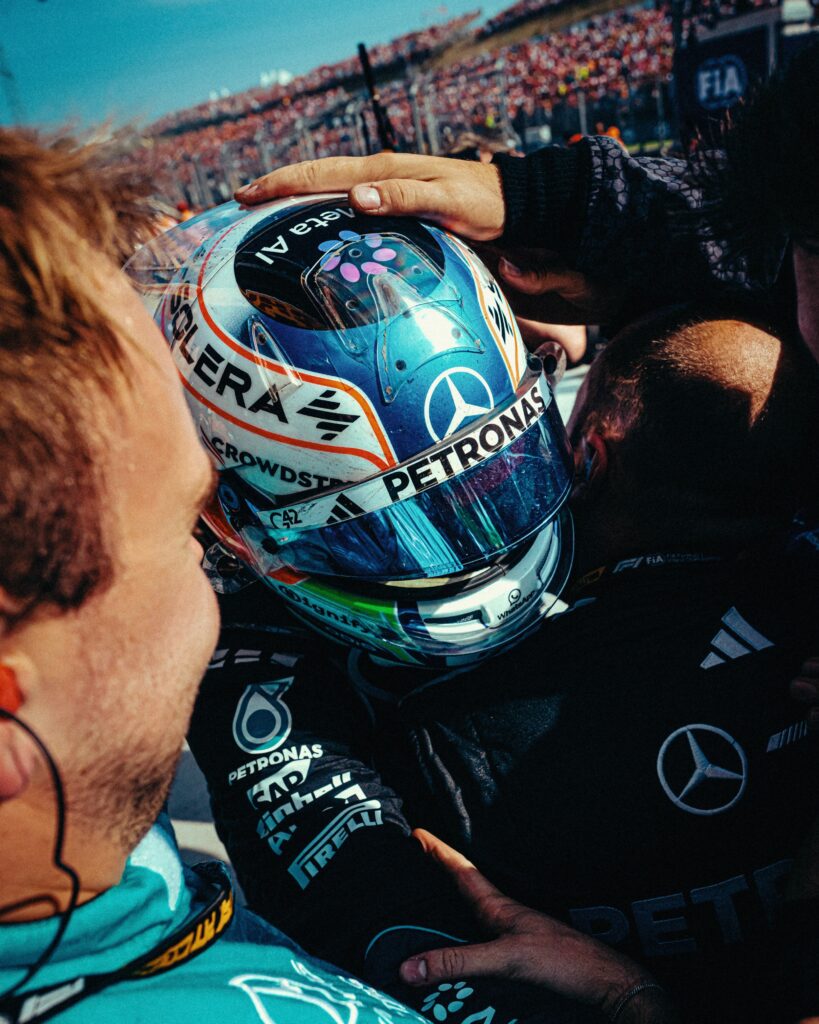
The podium ceremony added another layer. The helmet, held aloft or placed on the cool-down rack, became a focal point of the broadcast composition. These are the frames collectors freeze, print, and reference when arranging their display pieces. A 1:1 replica positioned alongside a podium photograph creates a curatorial narrative — the moment captured, then physically represented in three dimensions.
The Verstappen Method: What Bearman Is Studying
If Bearman wants to eventually “earn the right” to race like Verstappen, what exactly is he studying? The answer is more layered than commentary suggests.
Qualifying Commitment
Verstappen’s single-lap pace is built on a willingness to commit to corner entries at speeds that leave no margin. This is not bravado — it is calibration developed over years of testing, simulator work, and race-by-race feedback loops. Rookies who try to replicate this commitment without the underlying calibration tend to find the barriers quickly.
Race-Day Patience
One of the most underappreciated elements of Verstappen’s racing is his patience. He rarely throws away positions chasing moves that are not yet available. He waits, he pressures, and he strikes when the geometry is favourable. Bearman has already shown glimpses of this discipline, which is perhaps why his comments about Verstappen carry credibility.
Communication and Feedback
Verstappen’s radio communication — direct, technical, occasionally blunt — drives car setup in real time. His engineers respond to specific inputs rather than vague impressions. This is a learned skill, and Bearman, working closely with Haas’s engineering group, is clearly building his own version of this dialogue.
Why This Matters for Collectors
Stories like Bearman’s reverence for Verstappen are not just paddock narratives — they shape how a generation of fans relates to drivers and, by extension, to the objects that represent them. When a respected young driver publicly identifies Verstappen as the standard, it reinforces the cultural weight of Verstappen’s identity, including his helmet program.
The Collector’s Perspective
For those building serious F1 display collections, the four-time champion’s helmets — represented in full-size 1:1 replica form — are anchor pieces. They are the items around which other helmets, scale models, and memorabilia are arranged. A Verstappen replica on a dedicated shelf, lit from above, framed by photographs from the corresponding season, becomes the centrepiece of a room.
The current Bearman storyline adds another layer of context. Collectors who follow the sport closely understand that today’s rookies become tomorrow’s champions, and that the helmets they admire now will appear in collections for decades. Verstappen’s design, already iconic, gains additional cultural weight every time a driver like Bearman publicly cites him as a benchmark.
Display Ideas
For owners of Verstappen 1:1 replicas, the weekend offers fresh inspiration for presentation. Pair the helmet with a printed podium photograph. Position it at eye level for maximum impact. Use directional lighting to bring out the matte-to-gloss transitions in the livery. These are the details that turn a collector item into an exhibition-quality display piece.
What Comes Next
Bearman’s season continues, and so does the learning curve. His comments about Verstappen are unlikely to be the last time he references the Dutchman — and that is not a weakness. The greatest drivers in history have always studied the benchmark of their era. Senna studied Prost. Hamilton studied Schumacher. Verstappen, by his own admission, studied multiple champions before becoming one himself.
For Verstappen, the race weekend was another data point in a career that continues to redefine what consistency at the front of the grid looks like. His helmet, his livery, his presentation — all of it remains a touchstone for the collector community, and the demand for full-size 1:1 display replicas of his designs reflects that enduring relevance.
Bearman will earn his right in time. The fact that he understands he has to is, perhaps, the clearest sign that he eventually will.
“You have to earn the right to race like that.”
— Oliver Bearman, on modelling his approach after Max Verstappen
FAQ
Q: What did Oliver Bearman say about Max Verstappen?
Bearman acknowledged Verstappen as a stylistic reference but stated that he must first “earn the right” to race in that aggressive, precise manner — through results, experience, and credibility built over time.
Q: Why is Verstappen’s helmet design so popular with collectors?
The design combines instantly recognisable macro elements — the lion motif, bold colour fields, the Dutch tricolour — with refined micro details that reward close inspection, making it ideal for full-size 1:1 collector display replicas.
Q: What makes Verstappen’s racing style difficult to imitate?
It blends qualifying commitment, race-day patience, tyre intelligence, ruthless overtaking, and direct engineering communication. Copying one element without the others tends to produce inconsistent or risky results.
Q: How should collectors display a Verstappen 1:1 replica helmet?
Position it at eye level under directional lighting, ideally framed by photographs from the corresponding season. The matte-to-gloss transitions and detailed graphics benefit from focused illumination, turning the piece into an exhibition-quality centrepiece.
Q: Is Bearman likely to challenge Verstappen in the future?
Bearman is still in his rookie phase with Haas, but his self-awareness and observational discipline suggest a long-term trajectory. Whether he eventually challenges Verstappen will depend on machinery, opportunity, and continued development.
Shop Max Verstappen Collection
Display and collector replicas only. Not certified for protective use. Full-size 1:1 scale.