
Blog
Komatsu Shuts Down Ocon Row Reports: Inside the Haas Storm and Its Collector-Worthy Helmet Story
 123Helmets Editorial Team
Komatsu Shuts Down Ocon Row Reports: Inside the Haas Storm and Its Collector-Worthy Helmet Story
Ayao Komatsu didn’t mince words. Asked about widespread reports of a deepening rift between Haas and Esteban Ocon, the team principal dismissed the noise as “absolute bull****” — and in doing so, reframed an entire weekend’s narrative. For collectors tracking the visual identity of the 2025 grid, the moment matters: it cemented Ocon’s place in the Haas garage, and with it the continuity of one of the most distinctive driver-team helmet pairings on the grid.
Key Takeaways
Komatsu publicly dismissed reports of a Haas-Ocon dispute as completely false, defusing paddock speculation.
Ocon’s helmet design continues to evolve within the Haas color story, creating fresh display-worthy variants for collectors.
The weekend showcased Haas’s monochrome-and-red livery against Ocon’s signature lid — a high-contrast pairing built for exhibition shelves.
Full-size 1:1 replica helmets capture the helmet’s exact graphics, making this era of Ocon’s career a strong collector focus.
Komatsu’s blunt rebuttal and what it really means
When Ayao Komatsu stepped in front of the microphones, he had a choice: deflect, downplay, or detonate. He chose detonation. Labelling the swirl of rift reports as “absolute bull****,” the Haas team principal made clear there was no festering dispute, no behind-the-scenes ultimatum, and no fracture between the American squad and its French driver. In a sport where speculation often outweighs substance, Komatsu’s directness was, in itself, the story of the weekend.
For paddock observers, the timing mattered. Reports had built through the build-up to the grand prix, fed by anonymous quotes and the usual grid-silly-season churn. By shutting it down on the record — and in language no PR team would have signed off — Komatsu transformed a low-grade rumour into a clearly delineated team position.
Why the response carries weight
Komatsu has built a reputation for plain speaking since taking the principal role. That track record gives his denials credibility. When he says there is no row, the paddock tends to listen, because his previous comments — whether on performance, strategy, or driver management — have generally aligned with what later played out on track.
The on-track context
The grand prix itself unfolded as a complicated, points-hunting weekend for Haas. Ocon worked through a setup that was clearly being refined session by session, with the team chasing balance over qualifying pace. None of that on-track activity matched the picture painted by the rift reports, which spoke of disengagement. If anything, the radio traffic and garage body language suggested an unusually collaborative weekend.
Ocon’s helmet: a collector’s focal point
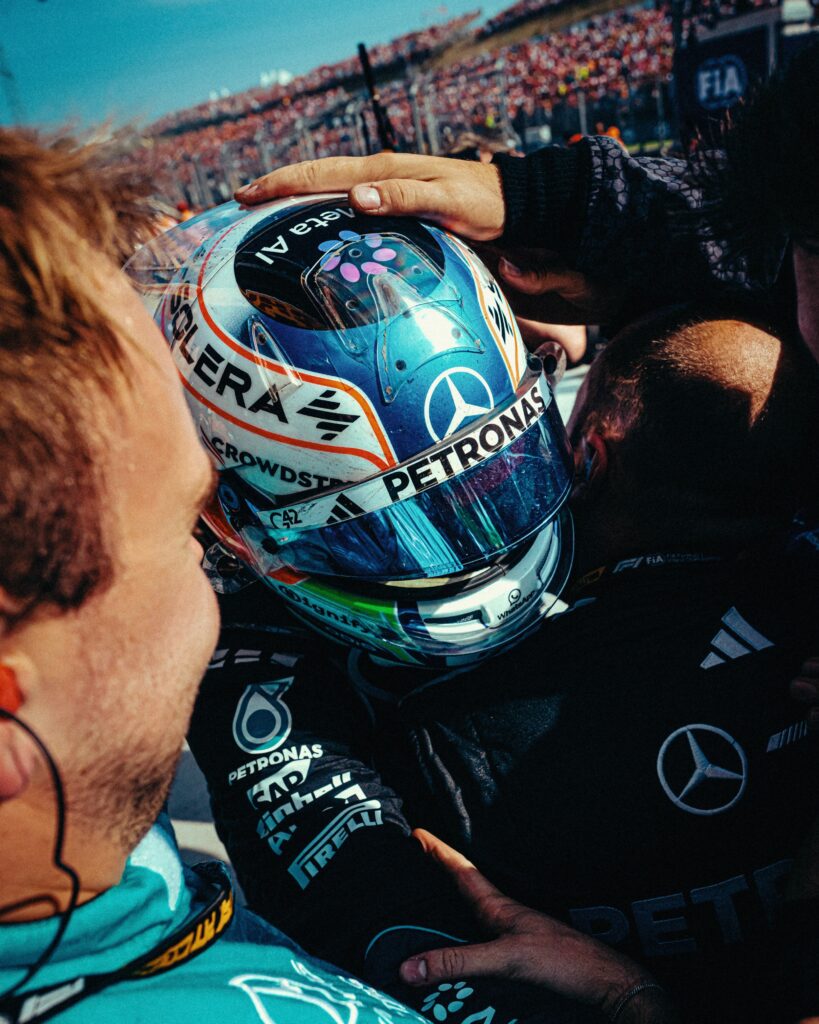
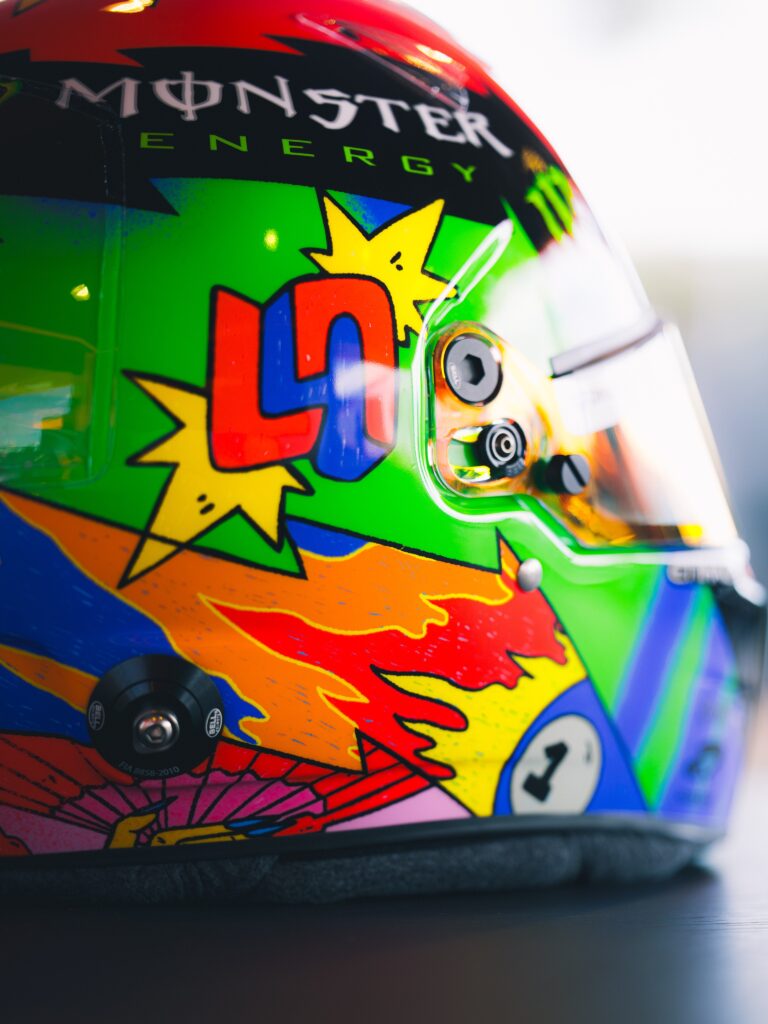
Esteban Ocon’s helmet has always been one of the more graphically considered designs on the grid. The base architecture — a layered interplay of blues, whites, and accent reds — has carried through multiple team changes, evolving rather than reinventing each season. For collectors, that continuity is gold: it creates a recognisable through-line that connects his junior career, his Renault and Alpine years, and now his Haas chapter.
What makes it display-worthy
Three elements stand out when you place an Ocon 1:1 replica on a shelf under proper lighting. First, the crown graphic — a stylised pattern that catches light differently depending on angle, ideal for rotating display plinths. Second, the visor surround and aero flicks, which on a full-size replica reveal the precision of the paint masking. Third, the chin bar, where his name and personal motifs sit in clean typography against a darker field — a detail that photographs beautifully for collectors documenting their displays.
Pairing with the Haas livery
The 2025 Haas car runs a predominantly white, black, and red identity. Ocon’s helmet, with its cooler blue base, creates a deliberate visual tension against the warmer team palette. On a display stand beside a scale chassis or alongside team memorabilia, that contrast is what makes the piece pop. It’s the kind of pairing that exhibition designers actively engineer — and here it happens organically, simply because driver identity and team identity refuse to blur into one another.
For anyone building a themed shelf around the current Haas era, the Ocon lid is the centrepiece. It tells you, at a glance, exactly which season you’re looking at, and exactly which driver wore it.
Race recap: a weekend defined by margins
Strip away the off-track noise and the grand prix itself was a margins race for Haas. Practice running pointed to a car that could live in the lower midfield on long runs but struggled to extract a single-lap peak. Ocon spent the Friday sessions methodically working through aero and mechanical changes, and the radio traffic was the kind of granular, problem-solving dialogue that suggests a driver and engineer in lockstep — not a relationship under strain.
Qualifying and Sunday
Qualifying produced a result that reflected the car’s true ceiling rather than its peak potential. Ocon extracted what was there, then turned attention to the race. Sunday became a study in tyre management and traffic navigation — a discipline Ocon has long been respected for. The Haas didn’t have the outright pace to challenge for headline positions, but the execution was clean.
Visual highlights for the display crowd
For collectors and helmet enthusiasts, certain visual beats define a weekend. The grid walk shot — helmet on, visor down, surrounded by the team’s red-trimmed garage equipment — is one. The pit-lane exit shot, with the helmet’s crown graphic catching the low sun, is another. And on the cool-down lap, the moment Ocon lifts the visor and you can read the inner detailing — the small dedications, the lining graphics — those are the frames that get screen-grabbed and printed and tucked beside 1:1 replicas on display shelves around the world.
Why this era of Ocon belongs in a serious collection
Driver-team eras have a shelf life, both literally and figuratively. The Ocon-Haas chapter is still being written, but its visual identity is already settled enough to recognise as a discrete period. That makes it the ideal moment for collectors to lock in a full-size 1:1 replica that represents this specific phase — before livery tweaks, sponsor shifts, or design refreshes change the picture for next season.
Three reasons it’s a smart display choice
First, narrative weight. Komatsu’s blunt defence of his driver this weekend will be remembered as one of the small moments that defined the team’s character in this period. Owning a replica from this era anchors your collection to that story.
Second, design quality. The current helmet design is one of the more mature in Ocon’s career — confident, restrained, and graphically sophisticated. It rewards close inspection, which is exactly what a 1:1 collector item is designed to do.
Third, contrast and curation. If your collection already includes helmets from Alpine-era Ocon, adding the Haas-era piece creates a visual lineage on the shelf. You can see the design language evolve while the core identity holds — a curatorial story that’s genuinely interesting to walk a visitor through.
Display tips
For exhibition-quality presentation, mount the helmet at eye level on a rotating plinth. Use directional warm lighting from above and slightly forward — this brings out the metallic flakes in the base coat and avoids harsh reflections on the visor. Keep the unit away from direct sunlight to preserve the paint finish over years of display.
The bigger picture: Haas, stability, and the next chapter
What Komatsu’s outburst really signalled was stability. A team principal who feels secure in his driver line-up — and confident his driver feels the same — doesn’t need to soften his language. The bluntness was the point. It told the paddock, the media, and the fans that the Haas-Ocon relationship is functional, productive, and not up for renegotiation in the press.
What collectors should watch next
Helmet designs tend to evolve subtly through a season — special-event liveries for home races, anniversary tributes, charity collaborations. Keep an eye on the calendar for any one-off Ocon designs that could become particularly limited collector pieces. The mainline design will continue to dominate the season, but variants are where rarity is built.
For now, though, the weekend’s lasting image is twofold: Komatsu at the microphone, refusing to play the game, and Ocon on track, lid gleaming under the floodlights, doing the job the team principal had just so emphatically defended. Both belong in the visual record of this season — and one of them belongs, in full-size 1:1 replica form, on a serious collector’s shelf.
“There is no row. The reports are absolute bull****.”
— Ayao Komatsu, Haas Team Principal
“A driver’s helmet is the most personal object in motorsport — and the most rewarding to display in 1:1 scale.”
— 123Helmets Editorial
FAQ
Q: What did Komatsu actually say about the Ocon reports?
Ayao Komatsu rejected the rift reports in unusually direct language, calling them “absolute bull****” and making clear there is no dispute between Haas and Esteban Ocon.
Q: Is the Ocon Haas-era helmet a good collector piece?
Yes — as a display item and full-size 1:1 replica, it represents a distinct chapter of Ocon’s career with a mature, graphically refined design that contrasts beautifully with the Haas livery.
Q: How should I display a full-size 1:1 F1 replica helmet?
Place it at eye level on a stable plinth, use directional warm lighting from above and slightly forward, and avoid direct sunlight to preserve the paint finish over time.
Q: Are these helmets suitable for protective or wearable use?
No. The pieces we cover are display and collector replicas only — exhibition-quality 1:1 items intended for shelves, cabinets, and curated displays, not for any protective or wearable purpose.
Q: Why does Ocon’s helmet design change between teams?
Drivers evolve their personal designs over time, adjusting colours and accents to harmonise — or deliberately contrast — with each new team’s livery, which is part of what makes era-specific replicas so collectible.
Browse the full-size 1:1 collector helmet range and bring the visual story of this F1 era onto your display shelf.
Display and collector replicas only. Not certified for protective use. Full-size 1:1 scale.