Blog
As It Happened: All the Action from FP1 in Canada — A Visual Feast for Helmet Collectors
 123Helmets Editorial Team
As It Happened: All the Action from FP1 in Canada — A Visual Feast for Helmet Collectors
Montreal’s Circuit Gilles Villeneuve roared back to life under crisp Quebec skies, and Free Practice 1 delivered exactly the kind of session collectors live for: special liveries glinting against the concrete walls, bespoke helmet designs catching the sun on the back straight, and the kind of low-grip drama that makes every camera angle worth framing. From a display and exhibition perspective, FP1 in Canada is rarely just a warm-up — it is a parade of one-off art on wheels and on heads, and this edition was no exception.
Key Takeaways
Montreal FP1 traditionally showcases bespoke one-off helmet designs, making it a key session for collectors tracking display-worthy liveries.
Low-grip Friday conditions in Canada highlight helmet detailing on slow-speed in-car shots — ideal reference material for 1:1 replica appreciation.
The Wall of Champions backdrop offers some of the most photogenic frames of the year for helmet and livery photography.
FP1 telemetry runs are short, but the visual catalogue produced is enormous — a goldmine for exhibition-quality replica research.
Montreal Sets the Stage: Why FP1 in Canada Matters to Collectors
There is something uniquely cinematic about the Canadian Grand Prix weekend, and it begins the moment cars roll out for FP1. The Circuit Gilles Villeneuve, threaded through Île Notre-Dame, is a semi-permanent venue where painted curbs, manicured grass and that unmistakable hairpin combine to create a backdrop that flatters every helmet design and every chassis livery. For collectors of full-size 1:1 replica helmets, Friday morning in Montreal is essentially a curated photo shoot: drivers debut new visors, fresh top-plate artwork, and occasionally entire one-off Canadian-themed lids that will become the most-coveted display pieces of the season.
FP1 itself is a technical session — engineers chase aero numbers, drivers re-learn the brake points into Turn 10, and tyre warm-up procedures dominate the radio traffic. But for those of us who watch through the lens of helmet artistry and livery storytelling, the practical purpose fades into the background. What remains is a 60-minute showcase of craftsmanship, sponsorship integration, and personal symbolism, all rendered in airbrush and clearcoat.
The Visual Identity of a Friday
Friday liveries in Montreal often carry subtle differences from the rest of the weekend: matte testing decals, sensor arrays, and pitot tubes that vanish by qualifying. These transient details are catnip for collectors who appreciate the engineering theatre of the sport. The helmets, by contrast, tend to be at their most pristine on Friday morning — fresh from the painter, untouched by visor tear-offs, and photographed under the soft Quebec light that makes metallics absolutely sing.
The Opening Twenty Minutes: Helmets Hit the Track
When the green light flicked on at the end of the pit lane, the first cars to peel out gave us our initial helmet reveals of the weekend. The early laps in Montreal are always cautious — drivers ease into the rhythm of a low-grip surface that has spent eleven months hosting cyclists, joggers and the occasional snowplough. That slow build-up benefits the cameras enormously. On-board footage during installation laps captures helmet detailing with unusual clarity: the chrome edges of a top stripe, the gradient fade of a sunset graphic, the hand-painted signatures tucked just behind the visor mechanism.
Standout Lid Moments
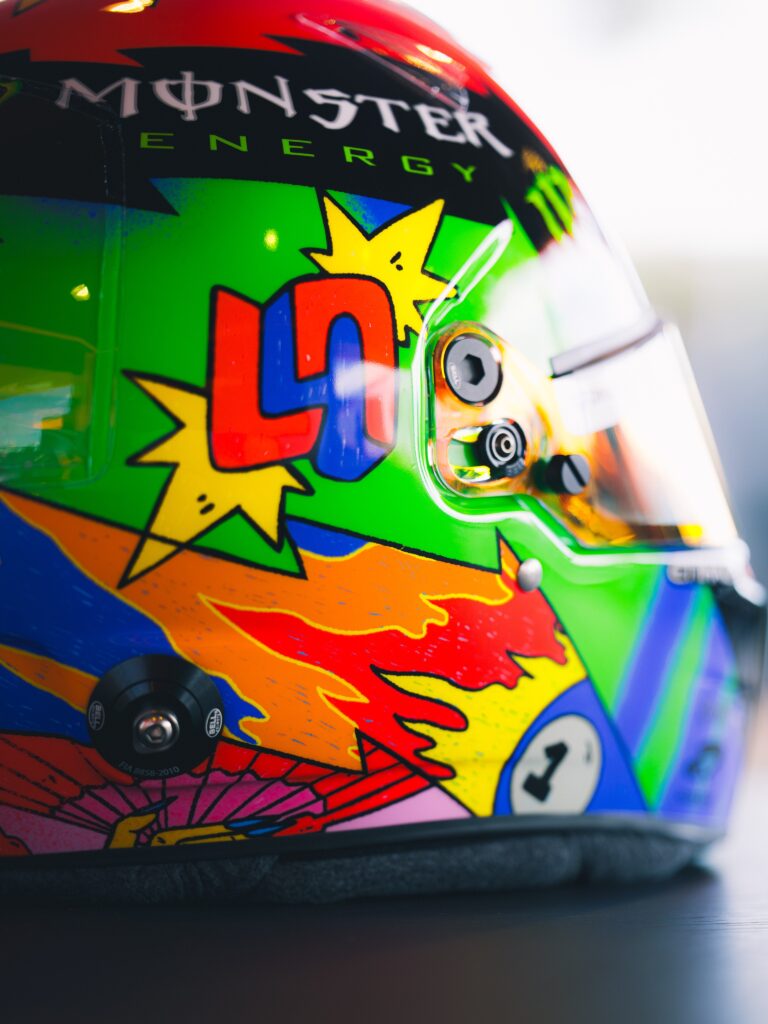
Several drivers used FP1 to debut their Canadian one-off helmets — a tradition that has grown into one of the most anticipated visual rituals of the calendar. Maple leaf motifs, references to Gilles Villeneuve’s iconic red-and-yellow, and tributes to Canadian sponsors all featured prominently. From a 1:1 replica standpoint, these designs are gold: bold enough to read clearly on a display shelf, intricate enough to reward close inspection, and tied to a specific moment in time that gives the piece narrative weight.
What Makes a Helmet Display-Worthy?
Three factors elevate a Friday helmet from interesting to exhibition-quality. First, contrast — designs that pop against neutral backgrounds photograph better and showcase beautifully under gallery lighting. Second, asymmetry — top-plate art that differs from side panel art rewards the viewer who walks around a 360-degree display stand. Third, story — a helmet that references a specific race, country or anniversary becomes a conversation piece, not merely an object.
Mid-Session Drama: Lock-Ups, Long Runs and Livery Close-Ups
By the half-hour mark, FP1 had settled into its familiar rhythm: aero rake runs for the engineers, longer stints for the drivers chasing baseline data, and the inevitable parade of lock-ups at the chicane before the pit straight. Montreal’s surface punishes hesitation, and we saw the customary smoke plumes from front-left tyres as drivers explored the limits of late braking. These moments, while routine for the teams, produce some of the most dramatic photography of the entire season — and they happen to frame the front of the car (and the driver’s helmet, through the halo) in extraordinary detail.
Sidepod Art Under the Microscope
The mid-session period is when broadcast directors love to cut to close-up tracking shots of cars exiting the hairpin. These angles flatter sidepod liveries, exposing the layered sponsor logos, the carbon weave peeking through the paint, and the subtle livery variations between team cars. For collectors who appreciate full-livery context around their helmet displays, these shots are reference material of the highest order. A 1:1 helmet replica gains immeasurable depth when it sits alongside a printed grid of the corresponding car at the same event.
The Wall of Champions Beckons
No FP1 in Canada is complete without at least one cautious wiggle near the Wall of Champions — the final chicane where Damon Hill, Michael Schumacher and Jacques Villeneuve famously parked their cars in 1999. The wall itself, painted with the bold “Bienvenue au Québec” greeting, is arguably the most photogenic piece of concrete in motorsport. Helmets framed against that backdrop, even in the slow build-up of a Friday practice, become instantly iconic in still photography.
The Final Push: Soft Tyre Runs and the Helmet Glamour Shots
As the chequered flag approached, several teams sent their drivers out on the softest available compound for a representative qualifying simulation. These runs are short — typically a single flying lap with a build-up and a cool-down — but they generate the day’s headline lap times and, more importantly for our purposes, the day’s best helmet glamour shots. The on-board camera footage from a fully committed flying lap captures the driver’s lid at maximum dynamic load: head twitching against G-forces, visor catching the low Quebec sun, gloved hands flashing into frame at every gear change.
Reading the Timing Screens Through a Collector’s Lens
The actual lap times from FP1 rarely predict the weekend’s pecking order. Fuel loads, engine modes and tyre strategies vary so wildly that the timing screens are essentially decorative on a Friday morning. What they do tell us, however, is which drivers were comfortable enough to push — and a comfortable driver is a driver willing to show off the helmet design with confident, committed body language on the in-car feed. For replica collectors building reference libraries, these are the frames to bookmark.
The Cooldown Lap Ritual
The final minutes of any FP1 session bring us the cooldown lap parade: drivers cruising back to the pits, visors flipped up, gloves held aloft to acknowledge the marshals. These intimate moments are where helmet details become most accessible to the camera. Chinbar artwork, signature lines, and the personal touches that distinguish a driver’s lid from a generic team design — all of it laid bare for the slow-motion replays that close out the broadcast.
Display Inspiration: Building a Canadian GP Helmet Vignette
If FP1 in Canada has inspired you to expand your display collection — and it should — there are a few principles worth considering when constructing a Canadian Grand Prix vignette around full-size 1:1 replica helmets. These are pure collector and exhibition pieces, designed for shelves, lit cabinets and dedicated display rooms, and the way they are presented matters as much as the helmets themselves.
Lighting and Background
Replica helmets reward directional lighting. A single warm spotlight at roughly 45 degrees brings out metallic flake, candy coats and pearl finishes far more effectively than overhead ambient lighting. Pair this with a neutral matte backdrop — charcoal grey or deep navy works beautifully — and the helmet becomes the unambiguous focal point of the display.
Pairing and Storytelling
A single helmet on a stand tells one story. Two helmets from the same driver across different eras tell a far richer one. Three helmets, arranged chronologically, become a miniature exhibition. Consider pairing a Canadian one-off lid with a season-standard design from the same driver to highlight the artistic departure that a special-event helmet represents. The contrast is the conversation.
Documentation and Context
Every serious collector knows that the helmet is only half the display. Framed photography from the event, printed timing sheets, and contextual placards explaining the significance of the design transform a shelf into an exhibit. Friday practice sessions in Montreal — with their photogenic backdrops and pristine helmet conditions — are an exceptional source of imagery for exactly this kind of curated presentation.
What FP1 Tells Us About the Weekend Ahead
Predicting a Canadian Grand Prix from FP1 alone is a fool’s errand — the track evolves dramatically over three days, weather can swing from glorious sun to lake-effect downpour, and the qualifying order rarely mirrors Friday morning’s timesheets. But what FP1 reliably tells us is which helmet designs will dominate the weekend’s photography, which liveries will populate the headline images, and which moments will be remembered in the visual archive of the season.
The Long View for Collectors
Every great display piece begins with a moment in time. The 1:1 replica helmets that anchor serious collections all trace their lineage back to specific weekends, specific sessions, and often specific photographs. FP1 in Canada has produced more than its share of these defining moments over the years — and based on the visual feast it delivered today, this edition will be no exception. The painters, designers and engineers who craft these helmets work months in advance for precisely this payoff: their work, illuminated by Montreal sun, immortalised in broadcast frames, and ultimately translated into exhibition-quality replicas that will live on shelves and in cabinets for decades.
That, ultimately, is what FP1 means to us. Not the lap times. Not the long-run pace deltas. The art. The story. The pieces that will one day become the centrepiece of someone’s display.
“Montreal has always been a designer’s race — the helmets that debut here become the helmets people remember all year.”
— Collector commentary, 123Helmets editorial desk
FAQ
Q: Why are Canadian Grand Prix helmets considered especially collectible?
Montreal has a long tradition of drivers debuting one-off, Canadian-themed helmet designs that reference the host country, the legacy of Gilles Villeneuve, or local sponsors. These special-edition designs are often produced in very limited artistic runs, making the corresponding 1:1 replica display pieces particularly sought-after by collectors building event-specific vignettes.
Q: What makes FP1 footage so valuable for helmet replica enthusiasts?
Free Practice 1 typically features helmets in pristine, fresh-from-the-painter condition before tear-offs, dust and on-track debris accumulate. The session also includes longer cooldown laps and slower installation runs, giving broadcast cameras extended opportunities to capture detailed close-ups of artwork, signatures and visor configurations — valuable reference material for appreciating display-grade replicas.
Q: How should I display a Canadian GP replica helmet at home?
For exhibition-quality presentation, place the full-size 1:1 replica on a dedicated stand at roughly eye level, illuminate it with a single warm directional light at 45 degrees against a neutral matte backdrop, and contextualise the piece with framed photography from the event. These helmets are pure collector and display items, intended for shelves, cabinets and dedicated display rooms.
Q: Are these helmets suitable for any kind of wear or use?
No. The replicas discussed throughout this article and offered in our collection are display and collector items only. They are full-size 1:1 scale exhibition pieces designed exclusively for presentation, not for any protective or wearable application.
Q: What is the Wall of Champions and why does it appear in so many helmet photos?
The Wall of Champions is the concrete barrier on the exit of the final chicane at Circuit Gilles Villeneuve, famously claiming three world champions in qualifying for the 1999 Canadian Grand Prix. Painted with the bold ‘Bienvenue au Québec’ greeting, it has become one of the most photogenic backdrops in motorsport, frequently framing dramatic helmet and livery shots throughout every Canadian Grand Prix weekend.
Explore one-off Canadian GP designs, classic championship lids and modern era artwork — all rendered as full-size 1:1 exhibition replicas. Browse F1 Helmet Collection at /shop/ and build the display your collection deserves.
Display and collector replicas only. Not certified for protective use. Full-size 1:1 scale.