Blog
Ferrari Must Back Hamilton for 2026 Title
 123Helmets Editorial Team
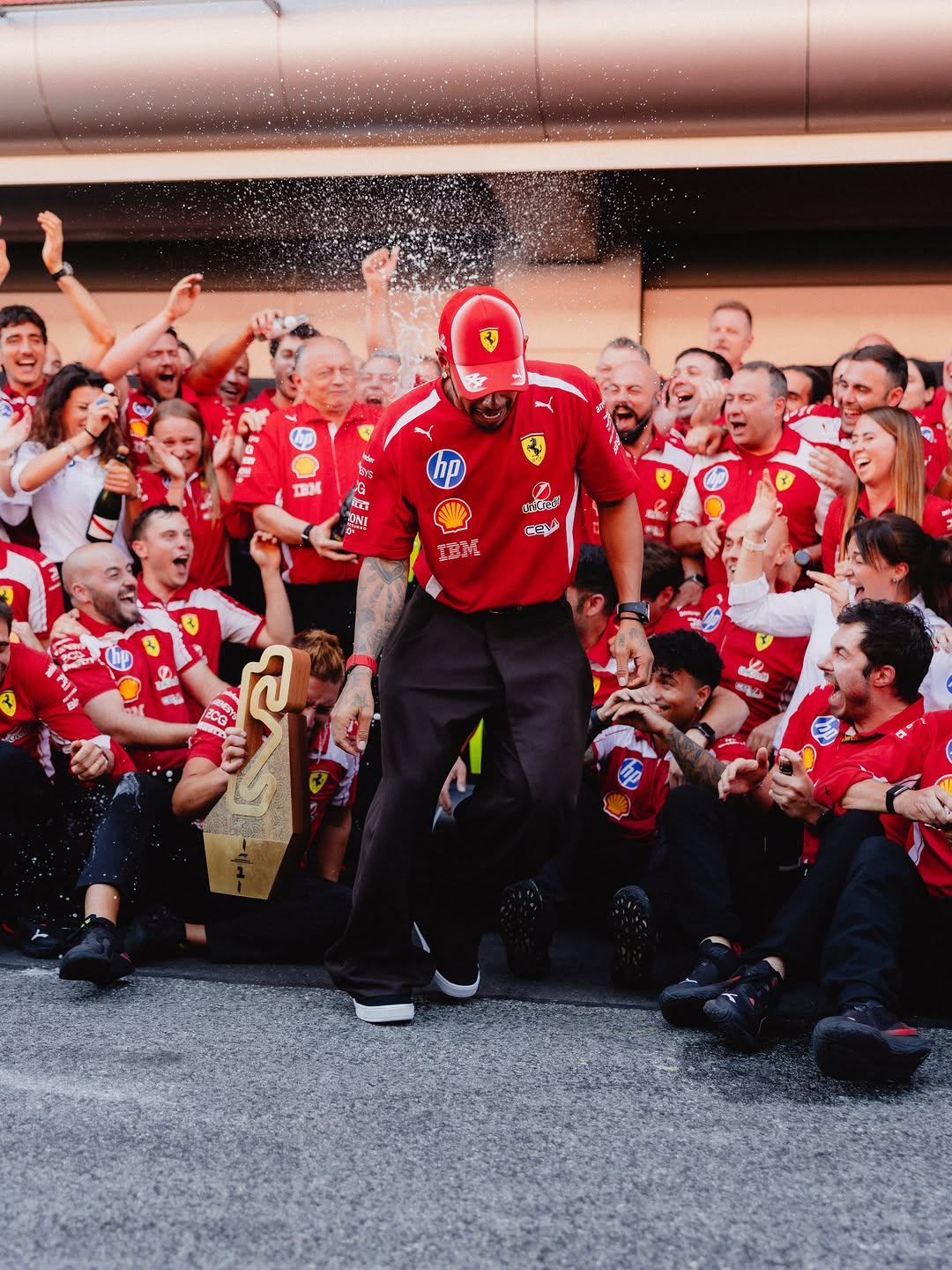
Jacques Villeneuve says Ferrari must commit fully to Lewis Hamilton after his Barcelona victory opened a 40-point gap over Charles Leclerc — and the numbers make the case impossible to ignore.
Key Takeaways
Lewis Hamilton won his first race as a Ferrari driver at the 2026 Barcelona-Catalunya Grand Prix, ending a significant win drought.
The Barcelona victory opened a 40-point gap between Hamilton and Charles Leclerc in the drivers’ championship standings.
Jacques Villeneuve argues Ferrari can — and should — prioritise Hamilton because Leclerc sits too far back to mount a realistic title challenge.
The Barcelona podium moment is already being commemorated in full-size 1:1 display replica helmets, capturing Hamilton’s iconic Ferrari-red livery debut season.
The Barcelona Breakthrough: Hamilton’s Ferrari Win by the Numbers
Lewis Hamilton claimed his first Grand Prix victory as a Ferrari driver at the 2026 Barcelona-Catalunya Grand Prix, a result that immediately reshaped the championship picture. The win did two things at once: it ended Hamilton’s run without a victory and pushed him 40 points clear of team-mate Charles Leclerc in the drivers’ standings — a gap that 1997 Formula 1 world champion Jacques Villeneuve describes as the deciding factor in how Ferrari must now manage its season.
Barcelona’s Circuit de Catalunya has historically rewarded mechanical balance and tyre management over a single qualifying lap, making race-pace execution the defining skill across its 66 laps. Hamilton’s ability to convert pole-contending pace into race wins — a skill refined across seven world championships — was on full display. The result was not just a data point in a season-long spreadsheet; it was a statement about what this version of Hamilton can still do inside a Ferrari cockpit.
For collectors and display enthusiasts, the Barcelona 2026 race weekend immediately becomes a reference moment: the exact livery, the Ferrari red, the SF-26 car number, and the helmet graphic Hamilton wore at Catalunya are the design details that define a generation-defining chapter in his career. A full-size 1:1 replica helmet documenting this race carries all of those markers in a single display piece.
Villeneuve’s Verdict: Why Ferrari’s Choice Is Simple
Jacques Villeneuve’s position is direct — Ferrari must prioritise Hamilton because the mathematics of the championship leave no room for ambiguity. Speaking on the Sky Sports F1 Show, the 1997 champion made the case plainly: Leclerc sits far enough back in the standings that continuing to treat both drivers equally would effectively hand the championship to a rival team.
“Lewis knows how to win, and he knows what it takes. And if he gets a sniff of it, there won’t be any quarter. And I think that’s where he can make the difference. Ferrari has to focus on Lewis if they want a small chance of winning.”
Villeneuve drew a direct contrast with Mercedes, where he argued the team cannot afford to choose between Kimi Antonelli and George Russell because neither driver holds a commanding lead. Ferrari’s situation is different. The 40-point gap between Hamilton and Leclerc is not cosmetic — in a season where championship margins are measured in single-race points swings, 40 points represents roughly two race victories’ worth of separation.
Villeneuve also addressed Leclerc’s trajectory at Ferrari, noting that the Monégasque driver entered the team on the back of what he described as an average season at Sauber, was handed a contract the size of a world champion’s deal, and was never forced to construct the internal political and technical coalition around him that a title contender needs. “He was quick and that was plenty,” Villeneuve said, “because the perception was, ‘Well, that’s a car that cannot win a championship anyway.'” That perception no longer applies in 2026.
Hamilton’s Helmet at Barcelona: The Display-Worthy Details
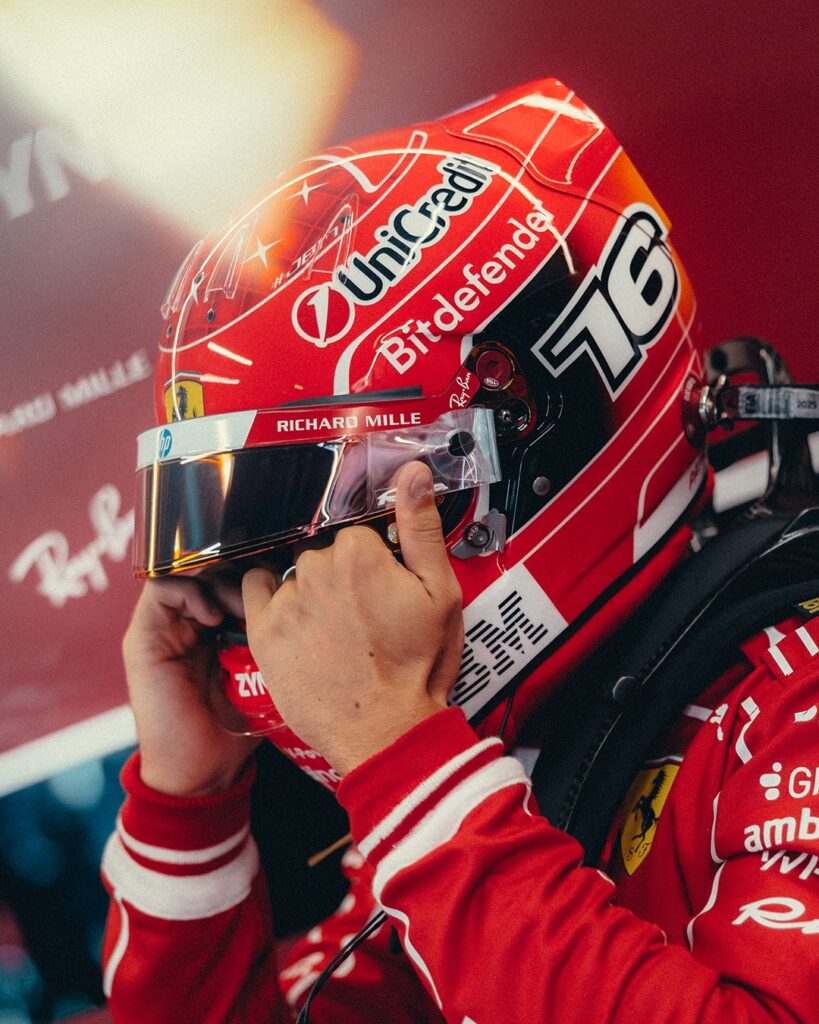
Hamilton’s Barcelona 2026 race helmet is one of the most display-worthy designs of his Ferrari era, combining the scarlet SF-26 team identity with his personal signature graphics in a way that marks a genuine visual departure from his Mercedes years. For collectors, the transition from silver to red is not cosmetic — it represents a complete graphic system rebuild, from base colour to sponsor placement to visor tint specification.
Full-size 1:1 display replica helmets of Hamilton’s Ferrari designs are built to the outer dimensions of a race-specification lid, typically around 29 × 25 × 35 cm for the shell footprint, with visor panels reproduced at 3 mm thickness to match the optical profile of a competition visor. The weight of a well-constructed display replica sits at approximately 1.2–1.5 kg — heavy enough to feel authentic on a display stand, light enough for shelf or cabinet mounting without specialist fixings.
The Barcelona podium context adds another layer of collector value. Podium moments create a fixed timestamp: the exact date (2026), the circuit, the race number, and the finishing position are all encoded into the provenance of any replica associated with that event. A display piece tied to Hamilton’s first Ferrari win carries a narrative that no subsequent replica can replicate, because there is only one first win. That is the logic that drives collector demand for race-specific editions rather than generic season helmets.
Paint layer count on premium display replicas typically runs to 8–12 application stages to achieve the depth and gloss of a race helmet’s exterior finish. The Ferrari red used in the 2026 livery requires a specific base coat sequence to prevent the underlying primer from shifting the hue toward orange under certain lighting conditions — a detail that separates exhibition-quality replicas from lower-tier versions.
The Leclerc Factor: What a 40-Point Gap Means Strategically
A 40-point gap in Formula 1 is the equivalent of two race wins, and at the 2026 regulation cycle’s midpoint it is the kind of deficit that forces a team into a structural decision. Charles Leclerc’s position in the standings is not a crisis, but it is not a platform for a championship campaign either. Villeneuve’s analysis — that Ferrari is “in a position to be able to choose” — reflects how team orders work in practice at the sharp end of the grid.
Ferrari has historical precedent for backing one driver over another. The Scuderia’s management of Michael Schumacher’s title campaigns across the early 2000s remains the reference model for how a team can commit its resources to a single driver when the numbers support it. The 2026 situation is structurally similar: one driver ahead, one driver behind, and a car capable of winning races.
For Leclerc, the 40-point deficit to Hamilton means that any strategic call favouring the British driver — pit stop sequencing, development token allocation, tyre specification requests — becomes harder to argue against from within the team. Villeneuve’s point about Leclerc never having “built” the team infrastructure around him matters here: internal advocacy requires accumulated capital, and that capital is harder to spend when you are the trailing driver.
From a collector’s standpoint, this intra-team dynamic also shapes which driver’s memorabilia carries greater narrative weight in 2026. Championship contenders generate more reference moments — pole laps, podium finishes, fastest laps — and each of those moments anchors a specific helmet or replica to a documented race result rather than a generic season.
Why the 2026 Ferrari Helmet Era Is Already Collector History
Hamilton’s move to Ferrari at the start of 2026 was the single most-discussed driver transfer in Formula 1 since at least the mid-2010s, and the Barcelona victory has now given that transfer its defining chapter. The combination of the driver — seven-time world champion, statistically the most decorated in the sport’s history — and the team — the oldest and most historically significant constructor in Formula 1 — produces a collector context that does not require qualification.
Display replica helmets tied to Hamilton’s Ferrari era will be referenced by two distinct data points going forward: pre-Barcelona (the setup, the adaptation, the early-season learning) and post-Barcelona (the confirmed race-winner, the title contender, the driver Ferrari is being told to build around). The May 2026 Barcelona race is the dividing line, and replicas produced to document it carry that timestamp permanently.
For anyone building a Formula 1 display collection, the question is not whether Hamilton’s 2026 Ferrari helmet is significant — it is how to identify which replica captures the correct livery specification for the Barcelona race weekend specifically, including the correct visor tint, sponsor positioning, and shell colour batch. Exhibition-quality, full-size 1:1 collector pieces built to those exact specifications are the standard that serious display collections require.
The 2026 season is still running, and the championship outcome remains open. But the Barcelona Grand Prix has already secured its place in the permanent record of the sport: Hamilton’s first Ferrari win, a 40-point lead, and a former world champion publicly telling the Scuderia that the choice is easy. That is the kind of story that display helmets exist to commemorate.
“Lewis knows how to win, and he knows what it takes. And if he gets a sniff of it, there won’t be any quarter. Ferrari has to focus on Lewis if they want a small chance of winning.”
— Jacques Villeneuve, 1997 F1 World Champion, Sky Sports F1 Show
“The decision is easy to make because Charles Leclerc is quite far back. He was quick and that was plenty — because the perception was, ‘Well, that’s a car that cannot win a championship anyway.'”
— Jacques Villeneuve, Sky Sports F1 Show
FAQ
Q: Why is Jacques Villeneuve saying Ferrari should prioritise Hamilton?
Villeneuve says Ferrari should back Hamilton because Hamilton leads Leclerc by 40 points in the drivers’ standings — a gap that makes Leclerc’s title chances significantly smaller. Unlike Mercedes, where neither Antonelli nor Russell holds a commanding lead, Ferrari has a clear number-one contender and Villeneuve argues the team should commit resources accordingly.
Q: When did Lewis Hamilton win his first race as a Ferrari driver?
Hamilton won his first Grand Prix as a Ferrari driver at the 2026 Barcelona-Catalunya Grand Prix. The victory ended his win drought and established him as Ferrari’s lead championship contender for the 2026 season.
Q: What makes a Hamilton Ferrari replica helmet worth collecting after Barcelona?
The Barcelona 2026 race is Hamilton’s first Ferrari win, making it a fixed historical reference point. Full-size 1:1 display replica helmets tied to this event document the exact livery, visor specification, and race date of a demonstrably singular moment — there is only one first Ferrari win, and replicas built to commemorate it carry that provenance permanently.
Q: How accurate are the dimensions on a 1:1 display replica helmet?
A full-size 1:1 display replica is built to match the outer shell dimensions of a race-specification helmet — typically around 29 × 25 × 35 cm for the shell footprint — with visor panels at approximately 3 mm thickness and an overall weight of around 1.2–1.5 kg. These are exhibition-quality display and collector pieces only, not certified for any protective or road use.
Q: How far ahead is Hamilton of Leclerc in the 2026 championship?
Following the Barcelona Grand Prix, Hamilton leads Leclerc by 40 points in the drivers’ standings. Villeneuve describes this as the key figure that justifies Ferrari formally prioritising Hamilton’s title campaign over equal team treatment.
Shop Lewis Hamilton Collection
Display and collector replicas only. Not certified for protective use. Full-size 1:1 scale.
This article was written with the help of AI tools. Editorial policy