Blog
Ferrari Unleashes SF-26 Upgrades at Barcelona GP
 123Helmets Editorial Team
Ferrari arrived at the Circuit de Barcelona-Catalunya with its most significant aerodynamic overhaul since Miami, targeting the front wing, floor, and diffuser of the SF-26 in a direct push to close the gap on Mercedes. The upgrades represent a coherent package — each element designed to work with the others — and they give collectors and fans one of the most visually striking livery moments of the 2026 season so far.
Key Takeaways
Ferrari’s headline Barcelona upgrade centres on an evolved SF-26 front wing with a raised lower surface, redesigned footplate vanes, and an additional dive plane on the endplate.
The floor revision includes reduced keel volume, redesigned leading-edge profiles, claws, and winglet optimisation at the rear corners — all coordinated with a reshaped sidepod.
Ferrari last brought a major upgrade package to Miami in early May 2026; Barcelona marks only the second major development push of the current season.
McLaren, Mercedes, Red Bull, and Williams each introduced smaller, targeted updates at Barcelona, underlining how competitive the mid-season development race has become.
What Ferrari Changed on the SF-26 in Barcelona
Ferrari’s Barcelona upgrade package is the most extensive aerodynamic revision the SF-26 has received since the Miami Grand Prix in early May 2026. The headline item is a long-awaited evolution of the front wing: the new nose carries a revised shape with a raised lower surface, a redesigned footplate with a different vane arrangement, and an additional dive plane grafted onto the endplate. The wing elements themselves have been optimised to improve aero load distribution, and the integration of the straight-mode actuator into the nose has been refined.
The significance of a front-wing change at this level cannot be overstated. Every aerodynamic decision made at the nose propagates downstream — affecting the wake over the front tyres, the airflow into the sidepods, and ultimately the balance the driver feels mid-corner. Ferrari’s stated aim is to make the SF-26 easier to keep balanced, which translates directly into driver confidence and lap-time consistency across a race stint.
Further back on the car, Ferrari has restructured the front section of its floor. The team described the changes as “reduced keel volume, redesigned front floor leading edge profiles and claws, front floorboard elements optimisation (horizontal and vertical ones).” The winglets at the rear corners of the floor have also been revised, and the diffuser has received targeted tweaks. To ensure these floor changes work in concert rather than in isolation, Ferrari reshaped the sidepod accordingly — a sign that this is a genuinely integrated package rather than a collection of bolt-on parts.
Why Barcelona Is the Right Circuit for This Package
The Circuit de Barcelona-Catalunya is F1’s most established aerodynamic test venue, used by every team for pre-season testing and as a reference point for simulation correlation throughout the year. Its mix of high-speed corners, a long main straight, and the slow-speed final chicane means a car must perform across a wide range of aerodynamic demands — making it the ideal location to validate a front-wing and floor upgrade simultaneously.
Ferrari’s timing is deliberate. The team’s Miami package largely worked as intended but could not contain Mercedes’ early-season form. By returning to a circuit where both the team and its simulation tools have decades of data, Ferrari can measure the real-world gain from these upgrades against known benchmarks. Any discrepancy between tunnel predictions and track performance becomes visible quickly at Barcelona, which is precisely why teams save significant developments for this round.
The SF-26’s revised floor geometry — with its redesigned leading-edge claws and reduced keel volume — is particularly relevant at Barcelona, where ground-effect cars generate substantial downforce through the high-speed Turn 3 and the sustained load of Turns 7 and 8. More downforce extracted from the floor at those points means less drag-inducing wing angle required elsewhere, which pays back on the 1.047 km main straight.
The Rival Upgrades Ferrari Is Racing Against
Ferrari is not the only team developing at Barcelona, and understanding the competitive context matters for assessing how much ground the red cars can actually recover. McLaren’s Barcelona update is limited to a new front-wing endplate designed to improve aerodynamic flow toward the rest of the car — a focused, single-component change rather than the multi-element overhaul Ferrari has brought.
Mercedes added small winglets to its rear wing in pursuit of aerodynamic efficiency, a detail-level change that signals the team is refining rather than rebuilding. Red Bull revised its existing front-wing geometry and produced a more powerful flap configuration as an option, retaining flexibility to run the stronger flap if conditions at Barcelona demand it. Williams, not unlike Mercedes, made minor rear-wing adjustments to add downforce in an efficient manner.
The pattern is clear: Ferrari has brought the largest single upgrade package of any team at this race. That is both an opportunity and a pressure point. A larger package means more potential gain, but also more variables that need to correlate with simulation data. If the new front wing and floor work together as modelled, Ferrari’s development rate will have clearly outpaced its rivals in this window. If correlation is partial, the team faces the task of understanding which element is underperforming before the next race.
Podium Visuals and the Helmet Collector Angle
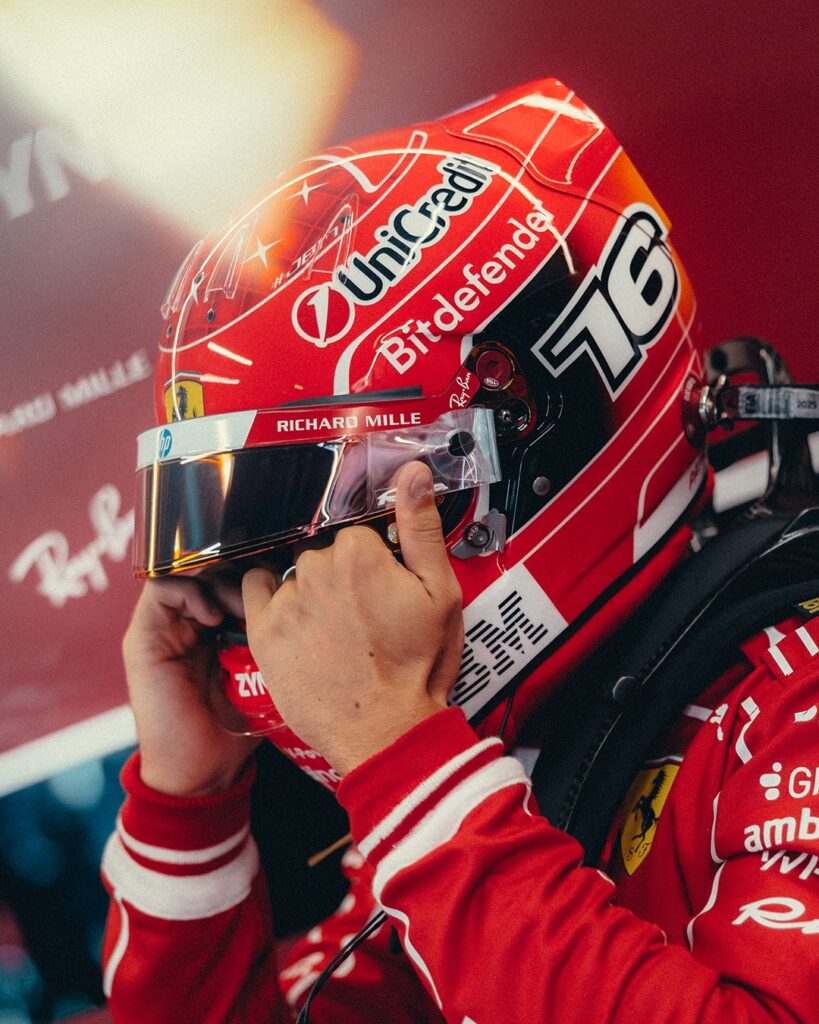
From a collector’s perspective, the Barcelona upgrade cycle produces some of the most visually distinct helmet and livery combinations of the season. Ferrari’s 2026 red — the same deep Rosso Scuderia applied over the SF-26’s revised bodywork — reads differently against the reshaped sidepod and the new front-wing geometry, creating a subtly altered silhouette that dedicated display collectors will recognise immediately.
Any Ferrari helmet worn by the team’s drivers at Barcelona captures a specific moment in the car’s development history: the first race where the revised nose and floor combination appeared in competition. Full-size 1:1 replica helmets produced to exhibition quality allow collectors to place that moment on a shelf or display case permanently. At 1:1 scale, the helmet replicates every paint layer and graphic detail associated with the driver’s on-track appearance — making it a direct visual record of a particular point in the season’s technical story.
The podium ceremonies at Barcelona, held on the pit-straight stage with the Circuit de Barcelona-Catalunya grandstands as a backdrop, are among the most photographed moments of the European season. A display-quality replica helmet sourced from this race weekend carries the visual identity of one of F1’s most data-rich and historically significant circuits, paired with a Ferrari livery update that fans will associate with the team’s mid-season charge on Mercedes.
Why the SF-26 Livery at Barcelona Stands Out
The combination of Ferrari’s updated bodywork and the classic red-and-white livery against Barcelona’s distinctive circuit backdrop makes the 2026 Spanish GP one of the standout collector moments of the current season. For display purposes, a full-size 1:1 replica helmet from this race represents a freeze-frame of Ferrari’s most ambitious upgrade moment between Miami and the summer break.
Ferrari’s Development Timeline in 2026
Ferrari introduced its first major 2026 upgrade package at Miami in early May, making Barcelona the second significant development milestone for the SF-26 this season. The two-month gap between the Miami and Barcelona packages reflects both the resource demands of building an integrated aero update and the team’s decision to choose a high-confidence testing venue for its second push.
The SF-26 launched in February 2026 as Ferrari’s latest attempt to build a car capable of sustained championship competition. Its design philosophy centres on maximising ground-effect downforce while managing the aero wake that high-downforce floors generate over the rear tyres — a balance that teams across the grid are still working to optimise under the current technical regulations.
By targeting both the front wing and the floor at the same race, Ferrari is making an argument about system-level performance rather than incremental point gains. The two components are aerodynamically linked: the front wing’s wake influences the floor’s inlet conditions, and the floor’s efficiency determines how much wing angle the car needs to carry. An upgrade that improves both simultaneously, if it correlates correctly, can produce a step change in overall lap-time performance that neither update could deliver alone.
The next scheduled opportunity to assess whether the Barcelona package has moved Ferrari closer to Mercedes will come at the following round, where the SF-26 will carry its updated specification to a circuit with a very different aerodynamic character — providing a second data point on whether the gains are genuine and transferable.
Collecting the Ferrari Barcelona Upgrade Moment
Full-size 1:1 replica helmets associated with Ferrari’s Barcelona 2026 weekend are exhibition-quality display pieces that document one of the team’s most technically significant race appearances of the season. As collector items, they capture the visual identity of a driver on the weekend Ferrari debuted its revised SF-26 front wing and floor — a combination that may prove to be the turning point in the team’s 2026 campaign.
Display replicas at 1:1 scale reproduce the helmet’s geometry, graphic layout, and colour matching at the same dimensions as the item worn in the paddock. For a Ferrari piece from Barcelona 2026, that means the deep Rosso Scuderia shell, the sponsor placement, and the driver-specific graphic elements that distinguish each athlete’s lid. These are collector items and display pieces only — not certified for any protective use.
For fans who follow Ferrari’s technical development as closely as its race results, a replica helmet from Barcelona 2026 is a precise artefact. It does not represent a generic Ferrari season — it represents the specific race where the team brought its most comprehensive aerodynamic revision since Miami, on the circuit F1 treats as its universal benchmark. That specificity is what separates a display piece tied to a documented race event from a generic collector item.
“The new nose should improve the aero wake over the front tyres and make it easier to keep the car balanced.”
— Ferrari SF-26 Barcelona upgrade technical summary, 2026
“Reduced keel volume, redesigned front floor leading edge profiles and claws, front floorboard elements optimisation — horizontal and vertical ones.”
— Ferrari official technical description, Barcelona Grand Prix 2026
FAQ
Q: What upgrades did Ferrari bring to the 2026 Barcelona Grand Prix?
Ferrari introduced an evolved SF-26 front wing with a raised lower-surface nose, redesigned footplate vanes, and a new endplate dive plane, alongside a revised floor featuring reduced keel volume, new leading-edge profiles, optimised claws and winglets, diffuser tweaks, and a reshaped sidepod. It was the team’s most extensive aerodynamic package since Miami in early May 2026.
Q: Why did Ferrari choose Barcelona for its major 2026 upgrade package?
Barcelona is F1’s most thoroughly mapped aerodynamic circuit, used as a simulation correlation reference by every team. Ferrari chose it because decades of data allow engineers to measure real-world gains from new components against known benchmarks, reducing uncertainty when validating a multi-element package affecting the front wing and floor simultaneously.
Q: How does the Ferrari Barcelona 2026 upgrade compare to what rivals brought?
Ferrari’s Barcelona package was the largest single-race upgrade of any team at the event. McLaren brought only a new front-wing endplate; Mercedes added small rear-wing winglets; Red Bull revised existing front-wing geometry with an optional stronger flap; Williams made minor rear-wing downforce adjustments. No other team matched the scope of Ferrari’s front-wing and floor combination.
Q: Are the Ferrari Barcelona 2026 replica helmets safe to wear?
No — these are full-size 1:1 collector and display replicas only, produced to exhibition quality. They are not certified for any protective use and carry no FIA, Snell, ECE, or DOT homologation. They are intended exclusively as display pieces and collector items.
Q: What makes a Ferrari Barcelona 2026 helmet worth collecting?
A 1:1 replica helmet from Barcelona 2026 documents the specific race weekend where Ferrari debuted its most significant SF-26 aerodynamic revision of the mid-season — a package targeting both the front wing and the floor on the circuit F1 uses as its universal performance benchmark. That combination of technical milestone and iconic venue makes it a precise collector artefact rather than a generic season piece.
Shop Ferrari Helmets — full-size 1:1 display replicas capturing the SF-26 era in exhibition quality. Every piece is a collector item, not certified for protective use.
Display and collector replicas only. Not certified for protective use. Full-size 1:1 scale.
This article was written with the help of AI tools. Editorial policy