Blog
Ferrari’s New Engine & Fuel Update: Austria 2026
 123Helmets Editorial Team
Ferrari is set to introduce the third version of its 067/6 power unit at the 2026 Austrian Grand Prix, pending FIA approval, pairing a steel-alloy cylinder head with a new Shell fuel developed in Hamburg to close the horsepower gap to Mercedes.
Key Takeaways
Ferrari’s 067/6 V3 power unit uses a steel-alloy cylinder head, allowing combustion temperatures above 115 °C — up from the previous 100 °C intake limit.
The update arrives under ADUO (Additional Development and Upgrade Opportunities) regulations and requires FIA approval before race deployment in Spielberg.
Shell’s Hamburg laboratory co-developed the new fuel specifically for this higher-temperature, higher-pressure combustion configuration.
Lewis Hamilton’s 2026 Barcelona victory underlined Ferrari’s ongoing push to close the performance deficit to Mercedes at the front of the grid.
What Ferrari Is Bringing to Austria
Ferrari is shipping the third version of its 067/6 power unit to Spielberg, where it will run the updated engine pending FIA approval for the 2026 Austrian Grand Prix. This is the most significant internal combustion upgrade the Scuderia has fielded this season, combining structural changes to the cylinder head with a freshly homologated fuel compound developed jointly with Shell.
The upgrade falls under the ADUO framework — Additional Development and Upgrade Opportunities — which grants teams a defined window to introduce performance-related changes to their power unit during the season. Ferrari’s engineers, led by Enrico Gualtieri’s engine department, have used that window to push two connected technologies at once: the geometry and material of the cylinder head, and the fuel chemistry that feeds it.
Until Spielberg, the package must clear official FIA approval before it can turn a single lap in anger. The team will nonetheless have the hardware in Austria, ready to run the moment clearance arrives. That logistical confidence signals how sure Ferrari is of the package’s compliance.
The Steel-Alloy Cylinder Head Explained
Ferrari’s updated power unit advances the concept of a steel-alloy cylinder head, allowing combustion chamber temperatures to run significantly higher than the aluminium designs used across the rest of the field. Aluminium would suffer structural failure at the temperatures Ferrari is now targeting; steel alloy does not.
In the current specification, intake air enters the intercooler at temperatures exceeding 100 °C — already far above the conventional 60–70 °C range seen in standard designs. From the Austrian Grand Prix onward, that intake temperature limit rises to over 115 °C. The higher temperature translates directly into higher pressure inside the combustion chamber.
The physics here are straightforward. At greater temperature and pressure, a far higher proportion of fuel particles combust completely rather than partially. More complete combustion means more of the fuel’s chemical potential energy is converted into mechanical work rather than lost as heat, unburned hydrocarbons, or emissions. The result is a power gain that comes from efficiency, not from burning more fuel.
For helmet and livery collectors, this technical story plays out visually on track: expect Ferrari’s Scuderia red to be carrying more pace in Spielberg than it has at any point in the 2026 season so far.
Shell Hamburg and the New Fuel Formula
Shell’s laboratory in Hamburg co-developed the new fuel specifically to work with Ferrari’s higher-temperature combustion configuration, making the fuel and the engine inseparable parts of a single engineering brief. The two components were designed together, not adapted to each other after the fact.
The collaboration between Enrico Gualtieri’s engine group and Shell’s Hamburg chemists produced a compound that has now cleared the FIA homologation process. Under current regulations, fuel must be registered and approved before it can be used in competition, so this is not a last-minute addition — the approval path was built into the development calendar.
Quantifying exactly how much of the expected power gain comes from the fuel versus the engine hardware is difficult, according to Ferrari’s own assessment. The two are interdependent: the fuel was formulated to combust optimally at temperatures the steel-alloy head makes possible, and the head was designed with this fuel’s properties in mind. Separating the contribution of each in dyno terms is not straightforward, and Ferrari has not published specific horsepower figures.
What is clear is the direction: Ferrari aims to reduce the internal combustion engine deficit to Mercedes, which has set the benchmark in this area through the 2026 season.
The Gap to Mercedes and Hamilton’s Barcelona Win
Lewis Hamilton’s victory in Barcelona gave Mercedes a notable boost in 2026, reinforcing the gap that Ferrari’s Austria upgrade is directly aimed at closing. Hamilton, now racing in the Mercedes silver on the Lewis Hamilton page, demonstrated in Spain that Mercedes’ internal combustion engine remains ahead of Ferrari’s on outright power.
The Barcelona result meant Ferrari arrived at the Austrian Grand Prix planning stage with urgency. The Spielberg circuit, with its long straight sections and high-speed corners, is a layout where raw power output is exposed more directly than at tighter, lower-speed venues. Running an uncompetitive power unit at the Red Bull Ring carries a heavier penalty than it might at a stop-and-go circuit.
For Hamilton, who moved to Ferrari for 2026, the Austrian round represents a genuine opportunity. If the 067/6 V3 clears FIA approval and performs to expectation, the gap that was visible in Barcelona could narrow meaningfully at a track where the power unit deficit has historically been most visible in sector times.
Kimi Antonelli at Mercedes and George Russell are likely to arrive in Spielberg expecting their ICE advantage to persist. Whether Ferrari’s update changes that calculus is the core technical narrative of the 2026 Austrian Grand Prix weekend.
Helmet and Livery Highlights Worth Collecting
Ferrari’s Scuderia red livery at the 2026 Austrian Grand Prix carries particular collector significance because it arrives at the moment of a power unit step-change — the kind of weekend where the visual record of the car on track becomes historically meaningful. Full-size 1:1 display replica helmets from this period capture that story in physical form.
Hamilton’s helmet design for the 2026 season reflects his first full year in Ferrari colours, a transition that makes his race-specific lids among the most sought-after display pieces in current F1 collecting. A full-size 1:1 replica of his Austria 2026 specification sits at 29 × 25 × 35 cm display footprint and represents the helmet worn at the race where Ferrari attempted its most significant power unit upgrade of the season.
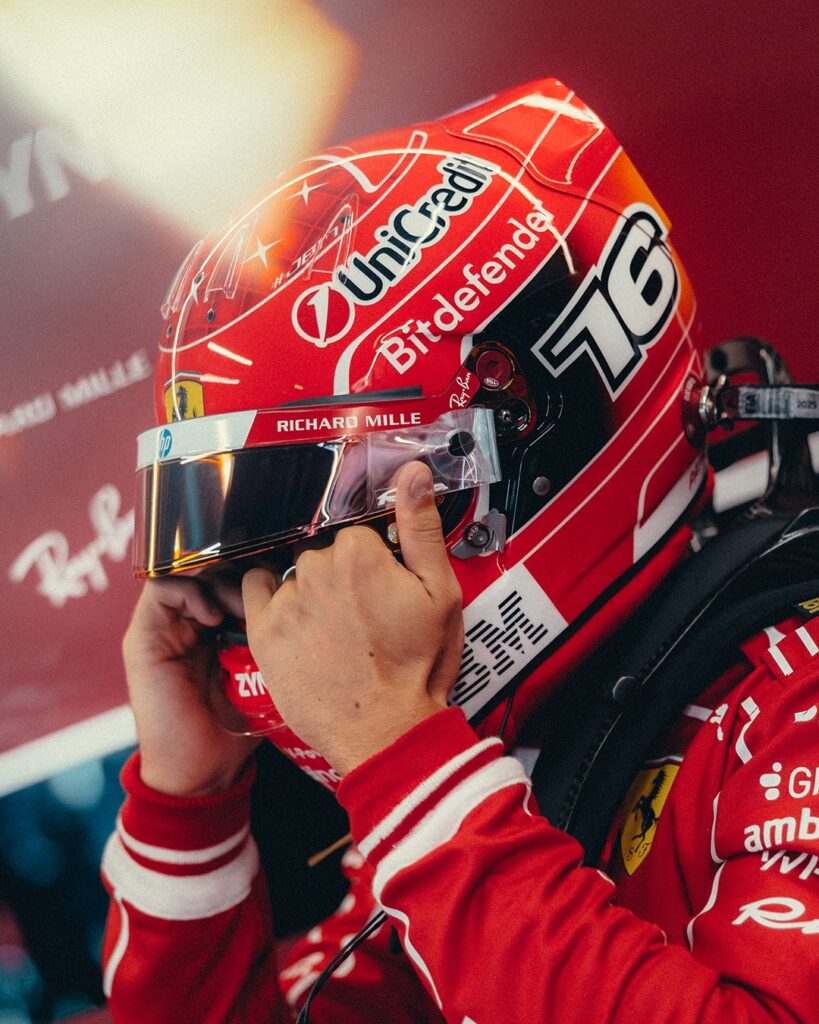
Charles Leclerc’s helmet designs have also evolved across the 2026 season, with Spielberg variants noting the Austrian GP branding that Ferrari runs on the livery. The white and red graphic balance on the Scuderia cars in Austria — framed against the backdrop of the Red Bull Ring’s green hillsides — produces some of the most photogenic podium and pitlane imagery of the European calendar.
For display collectors, the Austria round marks one of the clearest moments to anchor a helmet to a specific technical and sporting event. The 067/6 V3 introduction, if approved, becomes part of the historical context attached to any replica produced from this race weekend. That context is what separates a display piece tied to a generic race from one connected to a genuine turning point in a season.
Why the Austrian GP Livery Stands Out
Ferrari’s Austrian specification features the full red livery with Shell and Santander branding in high-visibility positions. The Spielberg venue’s geography — with grandstands stacked on the hillside above the circuit — means broadcast angles show the full upper surface of the car and helmets more clearly than almost any other venue on the calendar. Podium shots from the Red Bull Ring are among the cleanest full-car images produced across a season, making them a natural reference for display replica collectors who want to document exactly what a helmet looked like on a specific weekend.
What the Austria Update Means for the 2026 Season
Ferrari’s 067/6 V3 introduction at the 2026 Austrian Grand Prix is the most consequential mid-season engine move the Scuderia has made this year, and the outcome in Spielberg will shape how the team approaches the remainder of the European phase of the calendar. The upgrade targets the specific weakness — internal combustion output — that has cost Ferrari most visibly against Mercedes through the first half of 2026.
The ADUO framework means this is a legitimate, regulation-sanctioned step rather than a development freeze exception. Ferrari planned this upgrade into its homologation calendar and the Shell fuel development ran in parallel. The coordination between the Hamburg laboratory and Enrico Gualtieri’s team in Maranello represents months of aligned work arriving at a single deployment point.
If the FIA grants approval before Friday practice at Spielberg, Ferrari will have a clear read on the upgrade’s real-world performance against Mercedes by Saturday qualifying. Lap time comparisons at the Red Bull Ring — a 4.318 km circuit where power unit output is decisive in multiple sectors — will give the engineering team its first competitive data from the new specification.
For collectors tracking the 2026 season through display helmets and livery replicas, Austria 2026 marks a clear chapter break. The Ferrari story before and after this power unit introduction is a distinct narrative, and the physical objects — helmets, scale models, replica lids — that correspond to this specific weekend carry that division with them into any collection.
“The higher temperature and pressure inside the combustion chamber will allow a much greater proportion of the fuel particles to burn, producing fewer emissions while achieving a significantly more efficient combustion process.”
— Ferrari technical briefing, 2026 Austrian Grand Prix build-up
“Using a steel alloy rather than aluminium for the cylinder head allows combustion chamber temperatures to be significantly higher than usual; with aluminium, structural failures would have been inevitable at the same temperatures.”
— Ferrari power unit technical overview, 2026
FAQ
Q: What is Ferrari’s new engine update for the 2026 Austrian Grand Prix?
Ferrari is introducing the third version of its 067/6 power unit at the 2026 Austrian Grand Prix, featuring an advanced steel-alloy cylinder head that allows combustion chamber intake temperatures above 115 °C, up from the previous limit of over 100 °C. The update is deployed under ADUO regulations and must receive FIA approval before use in competition.
Q: Why does Ferrari use a steel-alloy cylinder head instead of aluminium?
Steel alloy allows the cylinder head to withstand combustion temperatures that would cause structural failure in an aluminium head. Ferrari’s design targets intake temperatures exceeding 115 °C, compared to the 60–70 °C range typical of conventional aluminium designs, enabling more complete fuel combustion and greater power output.
Q: What role did Shell’s Hamburg laboratory play in the Ferrari engine upgrade?
Shell’s Hamburg laboratory co-developed the new fuel compound specifically for Ferrari’s higher-temperature combustion configuration, working alongside Enrico Gualtieri’s engine department in Maranello. The fuel was formulated and homologated as an integrated part of the same engineering programme that produced the 067/6 V3 hardware.
Q: Are the Ferrari helmets from the 2026 Austrian GP available as collector replicas?
Yes — full-size 1:1 display replica helmets representing the 2026 Austrian Grand Prix specification are collector and display pieces. These replicas are not certified for protective use; they are exhibition-quality display items produced at full scale to document the helmet designs worn by Ferrari drivers at Spielberg in 2026.
Q: What does ADUO mean in Formula 1 engine development?
ADUO stands for Additional Development and Upgrade Opportunities, an FIA regulatory framework that permits teams to introduce defined performance-related changes to their power unit during the season. Ferrari’s 067/6 V3 falls within the ADUO allocation, making it a legitimate mid-season upgrade rather than an exemption from the standard development freeze.
Shop Ferrari Helmets — explore full-size 1:1 display replica helmets from the 2026 season, including Austrian Grand Prix specifications.
Display and collector replicas only. Not certified for protective use. Full-size 1:1 scale.
This article was written with the help of AI tools. Editorial policy