Blog
Gasly’s Fake Monaco Podium Celebration: The Story Behind the Sarcasm
 123Helmets Editorial Team
Pierre Gasly crossed the Monaco finish line shouting ‘fucking P3’ and punching the air — all while knowing his podium was already gone. Two pitlane speeding penalties, each by fractions of a km/h, turned one of the most emotionally charged laps in his decade-long career into a bittersweet display of defiance.
Key Takeaways
Gasly received two separate five-second time penalties for exceeding Monaco’s 60 km/h pitlane limit by just 0.1 km/h and 0.4 km/h respectively.
He was already aware of both penalties during the late-race red flag stoppage — his race engineer confirmed the situation before the restart.
The sharp entry angle of the Monaco pitlane is widely suspected to have compressed the measuring distance between speed sensors, artificially inflating calculated pit speeds.
Despite dropping from P3 to P7, Gasly’s helmet livery and cooldown-lap theatrics created one of the most visually memorable — and display-worthy — moments of the 2026 Monaco weekend.
A Celebration Built on Full Knowledge, Not Ignorance
The internet moved fast. Broadcast footage of Gasly screaming ‘fucking P3’ and shaking his fist at the barriers while still on his cooldown lap sparked immediate speculation that Alpine’s pitwall had failed to communicate the penalty situation to their driver. The reality, as Gasly himself confirmed, was the opposite.
‘I knew the situation when we stopped for the red flag and I just tried to push as hard as I could to maximise the end result, knowing the penalty was going to be applied,’ Gasly stated after the race. During the extended red flag stoppage — called to repair the Monaco street circuit surface — broadcast cameras had already caught him throwing his towel in frustration as the second five-second time hit was confirmed to him. He knew. The celebration was sarcasm, grief, and ten years of effort channelled into a single lap.
That emotional complexity — the man in the cockpit performing joy he doesn’t feel — is precisely what made the moment stick. For collectors and display enthusiasts, the visual of Gasly’s helmet cutting through the barriers of a sun-lit Monaco circuit on that cooldown lap represents something rarer than a straightforward podium finish: it captures the exact instant where genuine anguish and deliberate theatrics collided in one of motorsport’s most theatrical venues.
The 0.1 km/h and 0.4 km/h That Cost a Podium
The margins involved in Gasly’s penalties are almost absurd in their smallness. Monaco’s pitlane enforces a 60 km/h speed limit, and stewards recorded Gasly exceeding it twice: once by 0.1 km/h, and once by 0.4 km/h. Each infraction carried a five-second time penalty, giving him a combined ten seconds added to his race time. In the compressed post-red-flag classification — where the entire field bunched up — that was enough to drop him from third to seventh.
‘I don’t think there is anything that could hurt me more right now,’ Gasly said. ‘It’s 10 years I’m fucking working my ass off for this type of moment. We did everything right today standing on that podium in front of all the fans that turned up.’
He was adamant the penalties were unjust, insisting he had pressed the pitlane speed limiter in time. The prevailing technical explanation centres on the geometry of the Monaco pit entry: the sharp angle at which cars cross the pitlane entry line is thought to shorten the measured distance between the sensors used to calculate speed, which can produce artificially elevated readings. Several other drivers were penalised at the same event, lending weight to the theory that the circuit’s geometry — not individual driver error — was the root cause.
Whether that argument ultimately holds with the stewards or not, the sporting result stands: Gasly finished P7 on the road after penalties, robbed of the kind of Monaco podium that only comes around a handful of times in any driver’s career.
Ten Years in the Making: Why Monaco Hurt More Than Most
Gasly’s career has never lacked for drama. He was dropped from Red Bull Racing back to Toro Rosso mid-season 2019, rebuilt his reputation at what became AlphaTauri, scored a remarkable race win at Monza in 2020, and eventually moved to Alpine for 2023 as a fresh chapter. But Monaco — 78 laps around the narrow, unforgiving streets of the Principality — has never given him the podium finish his performances have occasionally threatened to deliver.
The Frenchman’s ‘heartbroken’ description after this race wasn’t hyperbole. A decade of professional F1 racing is roughly 200 grands prix worth of risk, preparation, and physical output. To arrive at a genuine third-place finish in Monaco — perhaps the single race that resonates most profoundly with public imagination — and have it extracted by a measurement discrepancy of less than half a kilometre per hour is a particular kind of pain that goes beyond statistics.
‘This is the type of moment that, for me, can’t be taken away from us by unfair reasons,’ Gasly said. ‘What’s going on right now is not right and hopefully they can make the right choice.’
The Alpine team shared his frustration. On lap 66, as cars came in under the red flag, the sequence of events that would deny Gasly began to crystallise — two pit entries, two sensor readings, two five-second penalties that together outweighed everything he had built over the course of the afternoon.
The Helmet and Livery: Visual Identity in Monaco’s Light
For display collectors, Monaco always delivers the strongest visual case for a season helmet. The circuit’s proximity to spectators, the low-speed corners that give cameras extended dwell time on cockpit detail, and the sheer density of colour in the paddock backdrop combine to showcase helmet liveries more clearly than almost any other round on the calendar.
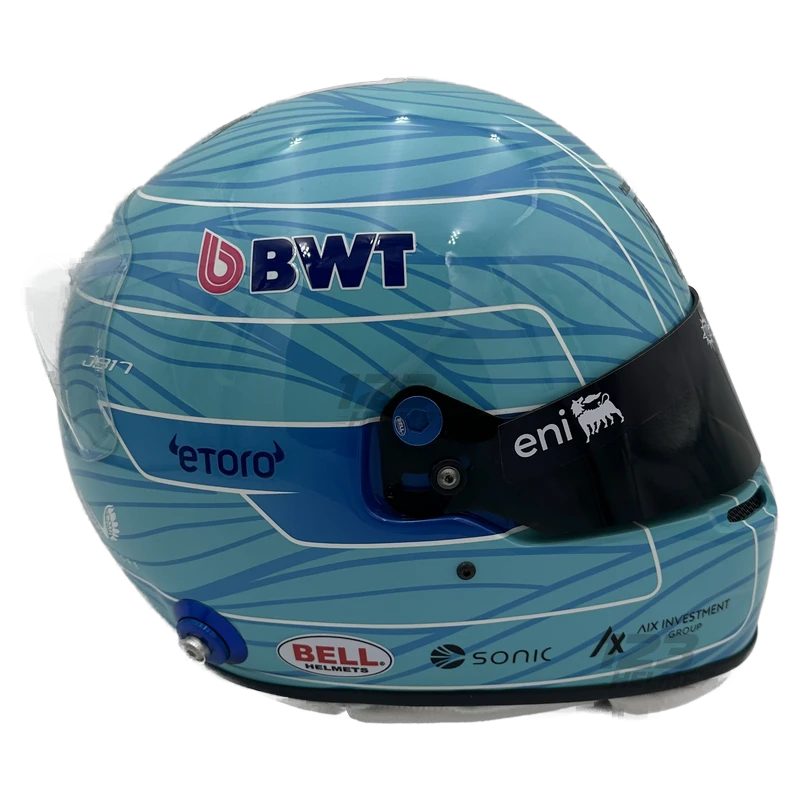
Gasly’s 2026 Alpine lid follows the team’s red and blue colour language, with white graphic elements that photograph cleanly under the bright Mediterranean light that characterises Monaco race day. The cooldown lap, in particular, placed the helmet front and centre: no celebration barrier rush with mechanics obscuring the shot, just the car rolling through the tunnel exit and along the harbourfront with Gasly’s fist in the air.
Full-size 1:1 replica display helmets capture precisely this kind of visual narrative. A collector piece at 1:1 scale replicates the helmet’s geometry, visor angle, and livery colour accuracy down to the graphic placement — the kind of detail that separates a genuine exhibition-quality item from a scaled souvenir. The Monaco 2026 edition of Gasly’s helmet is particularly significant as a display piece because the race it represents is defined not by a clean podium photograph, but by one of the sport’s more emotionally raw cooldown-lap moments.
Display pieces with this level of contextual weight — tied to specific, documentable race events — tend to be the ones that hold their place in a collection long after the season ends. The Monaco GP is 78 laps of history regardless of the final classification sheet.
What the Penalty Structure Reveals About Monaco’s Circuit Design
The fact that multiple drivers were caught by pitlane speeding penalties at Monaco 2026 shifts the conversation from individual error to systemic geometry. The theory circulating among engineers and analysts is specific: Monaco’s pit entry features an unusually sharp crossing angle relative to the pitlane sensor placement. When a car cuts across the entry line at that angle, the effective measured distance between the entry and exit sensors is compressed. The same physical speed produces a higher calculated value because the denominator in the speed calculation — distance — has been artificially reduced by the geometry.
If accurate, this means a driver pressing the limiter button at the legally correct moment could still register an overspeed. Gasly’s infractions of 0.1 km/h and 0.4 km/h are consistent with the kind of marginal error this geometry would produce rather than genuine inattention at the limiter button.
The FIA has not formally confirmed this explanation, and the stewards applied the penalties under the regulations as written. But the sheer number of drivers penalised at a single race circuit suggests that the 2026 Monaco pitlane deserves a closer look before the next visit to the Principality. For Gasly, that review — however thorough it eventually proves — comes too late to restore the podium finish he stood on the cooldown lap believing, in some defiant corner of his mind, was still his.
A Moment Frozen in Display: Why This Race Belongs in Any Gasly Collection
Not every race that belongs in a collection ends with a trophy. Some of the most compelling display pieces in F1 history reference moments defined by injustice, near-misses, or defiance rather than clean victories. Gasly’s Monaco 2026 helmet sits squarely in that category.
The full-size 1:1 collector replica of the lid he wore that afternoon — the same livery visible on that cooldown lap, the same colour language that Alpine ran through the streets of Monte Carlo — functions as an exhibition-quality record of a race that will be discussed for years. Not because Gasly won, but because of how he lost, and what he chose to do about it in those final few hundred metres before the chequered flag memory fades into the record books.
For any serious collector of Alpine or Gasly memorabilia, the 2026 Monaco GP represents a chapter that is impossible to skip. The display piece is the physical anchor for that story — a 1:1 scale artefact that holds the visual identity of a driver who spent ten years working toward exactly the kind of moment Monaco 2026 almost, and devastatingly, gave him.
As a display piece rather than a protective item, the replica helmet is designed for exhibition and collection purposes only — not certified for any form of road, race, or track use. Its value is entirely in what it represents: the colour, the form, and the specific race narrative it carries into whatever space it occupies.
“It’s 10 years I’m fucking working my ass off for this type of moment. We did everything right today standing on that podium in front of all the fans that turned up. This is the type of moment that, for me, can’t be taken away from us by unfair reasons.”
— Pierre Gasly, post-race Monaco GP 2026
“I knew the situation when we stopped for the red flag and I just tried to push as hard as I could to maximise the end result, knowing the penalty was going to be applied.”
— Pierre Gasly, post-race Monaco GP 2026
FAQ
Q: Why did Gasly celebrate if he already knew about his Monaco penalty?
Gasly confirmed he was informed of both five-second penalties by his race engineer during the red flag stoppage. His cooldown-lap celebration was a deliberate, sarcastic act of defiance — he called out ‘fucking P3’ knowing the result would be overturned, not because he was unaware of the situation.
Q: How much did Gasly exceed the Monaco pitlane speed limit?
Stewards recorded two separate violations. The first was 0.1 km/h over Monaco’s 60 km/h pitlane limit; the second was 0.4 km/h over the same limit. Each carried a five-second time penalty, combining to drop him from P3 to P7 in the final classification.
Q: Why were so many drivers penalised for pitlane speeding at the same race?
The leading theory is that Monaco’s sharp pit entry angle compresses the effective measured distance between the sensors used to calculate pit speed. A shorter measured distance produces a higher calculated speed for the same actual vehicle speed, potentially triggering marginal infractions even when drivers activate the limiter on time.
Q: What makes the Gasly Monaco 2026 helmet significant as a display piece?
The helmet was worn during one of the most emotionally charged races of Gasly’s career — a genuine third place stripped by two minimal speed violations after ten years in F1. Full-size 1:1 collector replicas of this livery capture the specific visual identity of a moment that will remain part of the sport’s history. These are display and collector items only, not certified for protective use.
Q: What is a full-size 1:1 replica F1 helmet?
A full-size 1:1 replica is a collector and display item produced at real-life scale, matching the helmet’s geometry, visor angle, and livery graphics. It is an exhibition-quality piece intended for display purposes only — it carries no safety certification and is not suitable for road, race, or track use.
Shop Pierre Gasly Collection
Display and collector replicas only. Not certified for protective use. Full-size 1:1 scale.
This article was written with the help of AI tools. Editorial policy