Blog
Sainz on Hamilton’s Ferrari Breakthrough 2026
 123Helmets Editorial Team
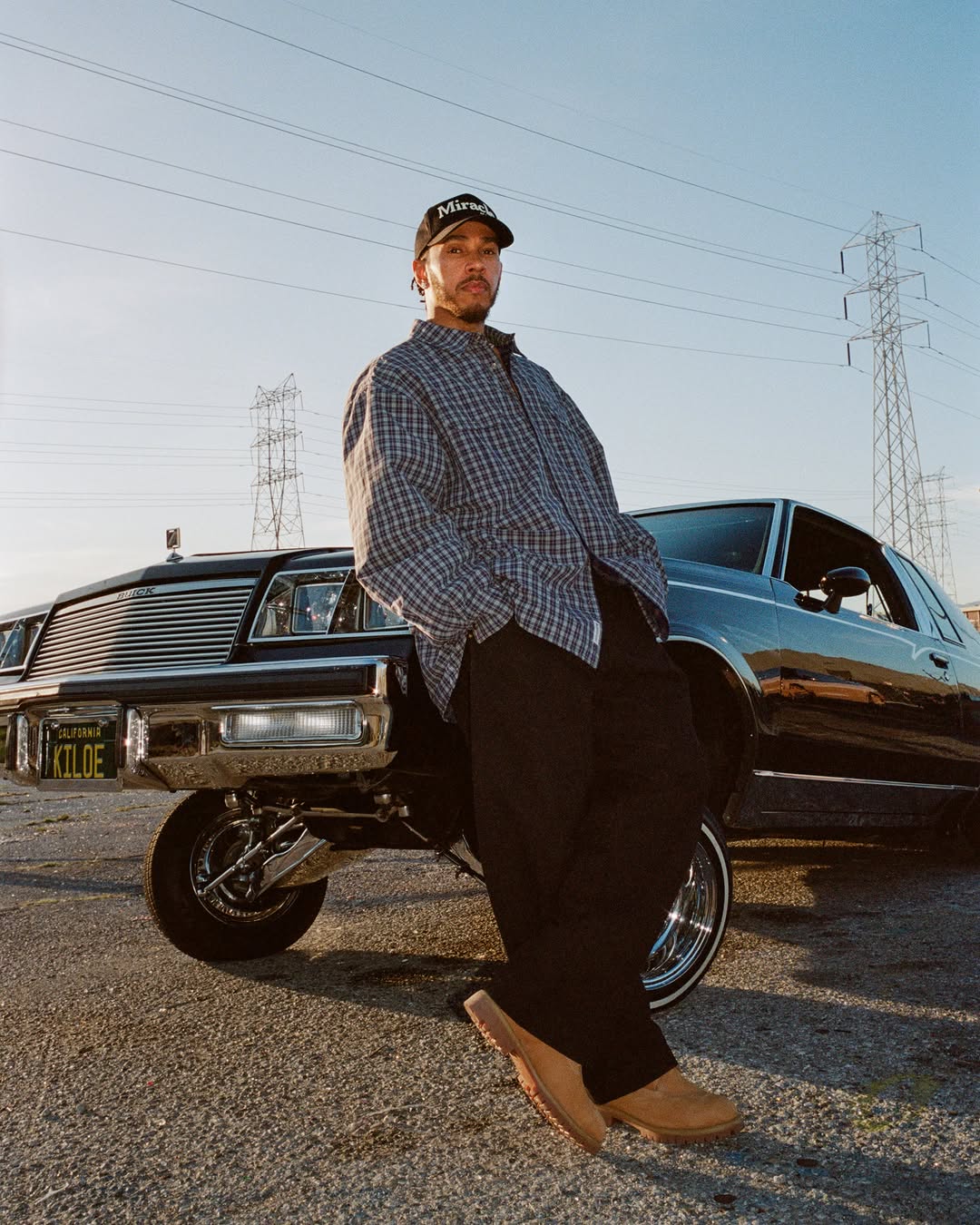
Lewis Hamilton finally broke through for Ferrari in Barcelona, taking his first win for the Scuderia after one-and-a-half years at the team. Carlos Sainz had a sharp theory on why it happened — and what it means for how we read a driver’s career.
Key Takeaways
Hamilton’s Barcelona win was his first for Ferrari, arriving one-and-a-half years after joining the team in 2026.
Sainz argues that car-driver compatibility — not talent gaps — explains why drivers can look slow at one team and dominant at another.
The 2026 regulation overhaul produced a Ferrari that appears to match Hamilton’s natural driving characteristics, echoing the 2022 season’s shake-up at the top.
Hamilton’s red Ferrari helmet and livery from his 2026 Barcelona podium are already among the most display-worthy moments of the current season for collectors.
Hamilton’s First Ferrari Win Arrives in Barcelona
Lewis Hamilton took his first Ferrari victory at the 2026 Spanish Grand Prix in Barcelona, ending a wait of one-and-a-half years since joining the Scuderia. The win arrived not in isolation — Hamilton had already stood on the podium three times earlier in the 2026 season before Barcelona — but it carried a different weight. A race win for a team that had not yet seen him at the top step was a symbolic line crossed.
At 41 years old, Hamilton is the oldest race-winner on the 2026 grid, and his Barcelona result moved him to second place in the Formula 1 Drivers’ Championship. The timing matters for anyone tracking the visual arc of his Ferrari chapter: the red-and-white SF-26 livery, the distinctive Ferrari-red helmet shell Hamilton has raced in since 2026-01, and the parc fermé moment in Barcelona all combine into a collector image that encapsulates one of the sport’s most-watched career moves in recent memory.
Those who follow F1 display replicas closely will note that Hamilton’s 2026 helmet design — worn during his first Ferrari win — immediately joins a short list of historically significant lids, alongside his seven championship-winning designs from the Mercedes era. A full-size 1:1 collector replica of the Barcelona-spec helmet captures the exact graphic language of that podium moment.
Sainz’s Theory: Car Fit, Not Talent, Drives the Narrative
Carlos Sainz believes Hamilton’s Ferrari breakthrough is best explained by regulation-driven car characteristics matching a driver’s natural style, not by any sudden improvement in the driver himself. Speaking to the Spanish press after the Barcelona race on 2026-06-22, Sainz was direct: “In the end, it shows that this sport has no secrets. I think we all have a very high level of talent, but with different driving characteristics. Some cars suit us, others don’t.”
Sainz knows this dynamic from the inside. He raced for Ferrari before Hamilton arrived, and he watched — and experienced — how a car’s mechanical behaviour could flatly contradict a driver’s instincts. His argument is not that Hamilton was previously struggling because of deficiency; it is that the machinery produced under the 2026 technical regulations happens to align with what Hamilton does naturally at the wheel.
The theory carries weight because Sainz applies it to himself first. He does not use Hamilton’s case as a one-way critique. Instead, he frames car-driver fit as the dominant variable in how the sport’s external audience reads performance — a variable that can make a world-class driver look ordinary or look unbeatable depending entirely on the hardware beneath him.
The 2022 Parallel: When Regulations Reset Everything
The closest historical parallel Sainz draws is 2022, the last time Formula 1 introduced a sweeping regulation overhaul comparable to the 2026 changes. That year, Ferrari produced one of the fastest cars on the grid from race one. Charles Leclerc won two of the opening three rounds and led the championship. Sainz, by contrast, took time to feel at home in the same machinery.
“Something similar happened to me in 2022,” Sainz said. “At the start of the year, I had a Ferrari that I really didn’t like. Then I managed to adapt, and in 2023 and 2024 I think I performed at a very high level.”
The 2022 Ferrari was built around a new aerodynamic concept — ground-effect floors returning to the sport after decades away. The car demanded a specific approach to corner entry and weight transfer that did not match Sainz’s then-current instincts. Once he recalibrated over the course of that season, his results followed. The same recalibration logic, Sainz implies, is now working in Hamilton’s favour in 2026: the new-regulation Ferrari appears to reward exactly what Hamilton already does.
For display replica collectors, the 2022 parallel is also visually interesting. Sainz’s 2022 Ferrari helmet — worn during that initial adaptation period — is documented as a transitional design. Hamilton’s 2026 Barcelona lid is the opposite: a moment of arrival rather than adjustment, and a more natural centrepiece for an F1 display shelf.
What Car-Driver Fit Does to a Career’s Story
Sainz’s most pointed observation is about how car-driver compatibility can rewrite a driver’s entire career narrative from the outside. “Suddenly you join a team with a car that doesn’t suit you, and you spend three years unable to adapt, or the car never adapts to you, and you can look completely useless,” he said. “Then you move to a team where the car is perfectly suited to your style and suddenly you look like a god.”
This is not abstract philosophy for Sainz — it is something he lived through in the early months of 2022, and something he watched Hamilton navigate across the 2026 season’s opening rounds. Hamilton had already spoken publicly about pushing Ferrari’s engineers to adjust the car’s setup philosophy during the development period of the SF-26. Whether those interventions mattered, or whether the 2026 regulation framework simply handed him a car that felt natural from the first shakedown, is a question Sainz’s theory does not resolve — and arguably does not need to.
What the theory does establish is a frame for understanding the 2026 season’s opening chapter. Hamilton’s three podiums before Barcelona were not flukes or team-order gifts. They were the output of a driver whose physical inputs happen to align with the feedback loop the SF-26 generates. The Barcelona win is the clearest data point yet that the alignment is real.
For the collector market, this narrative arc has direct value. A display replica tied to Hamilton’s first Ferrari win is not simply a red helmet on a shelf — it is a physical object connected to a specific, documented moment where a seven-time champion proved the fit was genuine. That provenance is what separates a contextually meaningful replica from generic memorabilia.
The Visual Identity of Hamilton’s 2026 Ferrari Helmet
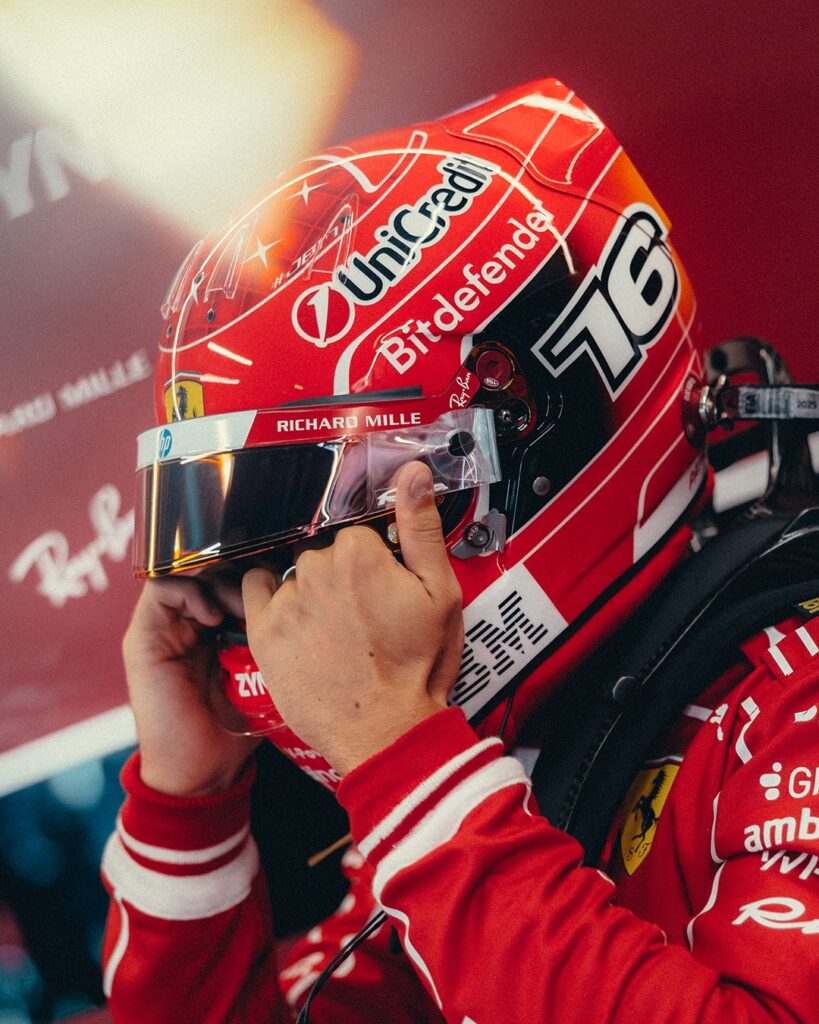
Hamilton’s 2026 Ferrari helmet is a deliberate departure from the predominantly white and purple designs he wore during his Mercedes years, shifting into Ferrari’s institutional red as the primary shell colour while retaining personal graphic elements he has carried across multiple seasons. The Barcelona-race version — worn during his first Ferrari victory on 2026-06-22 — features a gloss red base with gold detailing, a visor tint consistent with his 2026 European-race specification, and Ferrari branding integrated into the chin and crown panels.
Full-size 1:1 display replicas of this design are produced at the exact 1:1 scale of the race helmet’s exterior shell. The collector piece is an exhibition-quality display item, not certified for any protective use. As a display piece, it sits at the intersection of the 2026 season’s most documented visual moment and Hamilton’s broader career as the sport’s most-decorated driver by championship count.
The Ferrari red shell also makes the 2026 Hamilton helmet immediately distinguishable from the rest of his career catalogue on a display shelf — a meaningful point for collectors who hold multiple eras of his designs. The contrast between the silver Mercedes lids of the 2014–2024 period and the current red Ferrari specification is one of the starkest visual transitions any driver has made in the sport’s modern era.
Hamilton’s move to Ferrari on 2025-02-01 — confirmed publicly in early 2024 — was among the most-discussed team changes in F1 history. The 2026 Barcelona helmet is the first race-winner’s lid of that chapter, which gives the display replica a clear anchor point for any collection built around significant career milestones.
What the Barcelona Win Means for the 2026 Championship
Hamilton’s Barcelona victory moved him to second place in the 2026 Drivers’ Championship, with three additional podiums already banked earlier in the season. The result confirms that the 2026 Ferrari is a consistent front-running car, not a circuit-specific outlier — and that Hamilton is extracting its performance ceiling at the moments that matter most.
For Ferrari as a constructor, the implications are equally direct. The SF-26, designed under the 2026 technical framework, has produced a race winner at a driver who had not yet won for the team despite one-and-a-half years of effort. Whether that reflects Hamilton’s adaptation, the car’s regulation-driven character, or both simultaneously, the scoreboard result is the same: Ferrari is in the championship fight in 2026 with one of the most marketable drivers in the sport’s history at the wheel.
Sainz’s car-fit theory, articulated at Barcelona, offers the most concise public explanation available for the trajectory. It does not diminish Hamilton’s work or Ferrari’s engineering. It places both within a structural reality that every driver in the paddock understands — that the regulations written in a technical document in Geneva or Paris ultimately shape which drivers look slow and which look like champions, sometimes more than the talent differential between them.
For display collectors, the 2026 season through Barcelona represents the most visually coherent chapter yet of Hamilton’s Ferrari story. The red helmet, the Scuderia livery, the parc fermé, and the championship position all cohere into a single narrative that a full-size 1:1 replica can anchor on any wall or shelf dedicated to the sport’s current era.
“In the end, it shows that this sport has no secrets. I think we all have a very high level of talent, but with different driving characteristics. Some cars suit us, others don’t.”
— Carlos Sainz, post-race press, Barcelona 2026
“Suddenly you join a team with a car that doesn’t suit you, and you spend three years unable to adapt, or the car never adapts to you, and you can look completely useless. Then you move to a team where the car is perfectly suited to your style and suddenly you look like a god.”
— Carlos Sainz, Barcelona 2026
FAQ
Q: When did Lewis Hamilton win his first race for Ferrari?
Hamilton won his first Ferrari race at the 2026 Spanish Grand Prix in Barcelona on 2026-06-22, one-and-a-half years after joining the team.
Q: What is Carlos Sainz’s theory about Hamilton’s Ferrari success in 2026?
Sainz argues that the 2026 regulation-era Ferrari suits Hamilton’s natural driving style, explaining the breakthrough without attributing it to sudden talent improvement. He draws on his own 2022 experience, when the regulation-reset Ferrari initially did not suit him either.
Q: How many podiums did Hamilton have before his Barcelona win in 2026?
Hamilton had three podiums in the 2026 season before the Barcelona victory, which was his first race win for Ferrari.
Q: Is the Lewis Hamilton 2026 Ferrari helmet replica certified for road or track use?
No. The 1:1 full-size replica is a display and collector piece only. It is not certified for any protective use — no FIA, Snell, ECE or DOT rating applies. It is intended as an exhibition-quality display item.
Q: Why is the 2026 Hamilton Ferrari helmet historically significant for collectors?
It is the helmet design worn during Hamilton’s first Ferrari race win, marking the most consequential milestone of his post-Mercedes career to date. The shift from his silver Mercedes-era designs to a red Ferrari shell also makes it one of the most visually distinct transitions in his collector catalogue.
Shop the Lewis Hamilton Collection — full-size 1:1 display replicas of Hamilton’s most iconic helmet designs, including his 2026 Ferrari livery. Exhibition-quality collector pieces, not certified for protective use.
Display and collector replicas only. Not certified for protective use. Full-size 1:1 scale.
This article was written with the help of AI tools. Editorial policy