Blog
From the Archive: When Niki Lauda Led an F1 Driver Strike in 1982
 123Helmets Editorial Team
From the Archive: When Niki Lauda Led an F1 Driver Strike in 1982
South Africa, January 1982. Before a single wheel turned at Kyalami, Niki Lauda gathered every Formula 1 driver into a Johannesburg hotel ballroom and refused to leave. What followed became one of the most extraordinary acts of solidarity in motorsport history — a story we revisit through the lens of helmets, liveries and the display-worthy moments that still resonate with collectors today.
Key Takeaways
Niki Lauda organised the 1982 driver strike at Kyalami, locking 30 drivers in a hotel ballroom in protest against Super Licence clauses.
The red-and-white Lauda helmet from this period remains one of the most iconic display pieces of early-1980s F1 collecting.
Alain Prost won the 1982 South African GP for Renault, with the yellow-and-black RE30B livery becoming a defining visual of the turbo era.
The episode reshaped driver-team relations and turned Kyalami 1982 into a landmark moment for F1 historians and replica collectors.
The Ballroom Standoff: How the Strike Began
The 1982 Formula 1 season was supposed to open with fanfare. Instead, it opened with silence — the silence of an empty Kyalami paddock while thirty of the world’s best drivers sat shoulder to shoulder on the floor of the Sunnyside Park Hotel in Johannesburg, refusing to practise.
The trigger was a revised Super Licence document issued by FISA. Buried inside was a clause that effectively bound a driver to a single team, restricting his freedom to negotiate with rivals. For Niki Lauda, who had returned to the sport that very season with McLaren after two years away, the wording was unacceptable. He read it, set it down, and began making phone calls.
Within hours, the Austrian had convinced his peers — from world champion Nelson Piquet to the young Alain Prost, from Gilles Villeneuve to Keke Rosberg — to board a single bus and disappear into the city. They slept on mattresses dragged across the ballroom floor. Lauda, by then a two-time world champion, acted as spokesman, negotiator and unofficial union leader.
A united grid, a divided paddock
Team principals were furious. Bernie Ecclestone, then running Brabham, paced the paddock. Enzo Ferrari, watching from Maranello, threatened replacements. Yet the drivers held firm for nearly thirty hours, emerging only when assurances were given that the contentious clauses would be revisited. The race went ahead. The story, however, never faded.
Lauda’s Helmet: The Red Cap That Became a Symbol
If one image distils the 1982 strike, it is Lauda walking out of that hotel, his face calm, his presence unmistakable. And if one object distils Lauda himself, it is the red cap and the matching plain red helmet with a single white band that he wore throughout his McLaren return.
Unlike the elaborate designs of his contemporaries, Lauda’s helmet was famously austere. A solid red shell. A white horizontal stripe. The Parmalat sponsorship logo, sold as advertising space because Lauda understood the commercial value of his own forehead long before anyone else on the grid. It was minimalism as personality — a refusal to decorate, a refusal to flatter.
Why the design endures for collectors
For collectors of full-size 1:1 display replicas, the appeal is precisely this restraint. The Lauda helmet is instantly recognisable from across a room. It photographs beautifully under directional lighting. It pairs with virtually any cabinet finish, from walnut to brushed steel. Where other helmets of the era shout, this one simply states a fact: I am here.
As an exhibition piece, the 1982 specification — with its early Bell shell profile and period-correct visor tear-offs — sits at the intersection of design history and motorsport folklore. It is the helmet of the man who stopped Formula 1 in its tracks.
The Race Itself: Prost, Renault and the Yellow-Black Statement
Once the strike resolved, the South African Grand Prix delivered a race that has become a quiet classic of the turbo era. Alain Prost, in the Renault RE30B, qualified fifth but stormed through the field after an early puncture, eventually winning by more than fifteen seconds.
The Renault livery of that season — yellow, black and white in geometric blocks, with the ELF and Gitanes branding crisply applied — is a livery that rewards close inspection. It is purposeful rather than pretty, the visual language of a manufacturer that genuinely believed turbocharging would win championships.
Prost’s helmet: the blueprint of a career
Prost’s helmet at Kyalami 1982 already showed the design DNA he would carry for the rest of his career: a white base, a blue band across the forehead, red and a touch of yellow accenting the sides. Compared to Lauda’s monastic red, Prost’s lid felt French in the best sense — clean, geometric, considered. On a display shelf, the two helmets together tell the entire story of the weekend: the agitator and the winner, the veteran and the heir.
Podium visuals worth framing
The podium itself — Prost flanked by Carlos Reutemann and René Arnoux — produced a tableau of helmets and overalls that any serious archive room would treasure. Reutemann’s Williams blue, Arnoux’s matching Renault yellow, and the South African sun catching every visor at the same low angle.
Why the Strike Still Matters to F1 Historians
It is easy, four decades later, to underestimate what Lauda achieved at Kyalami. Driver solidarity in 1982 was not a given. The grid was a collection of fierce individualists, often barely on speaking terms, divided by nationality, sponsor and ego. That Lauda persuaded all of them to act as one, and to hold the line for nearly a day and a half, was a feat of leadership that no commercial agreement on its own could explain.
The legacy in modern F1
Modern driver representation — the GPDA in its current form, the regular driver briefings, the unified statements on safety and scheduling — traces a direct line back to that ballroom floor. When today’s drivers speak collectively about calendar length or sprint formats, they are using a microphone Lauda first switched on in Johannesburg.
For collectors, this historical weight transforms the artefacts. A 1982-spec Lauda helmet is not simply a beautiful object. It is a document. It belongs to the same lineage as a signed Senna visor or a Schumacher Ferrari cap — items where the design and the moment are inseparable.
Building a Display: The 1982 Kyalami Shelf
For enthusiasts assembling a themed cabinet around this single weekend, the building blocks are unusually rich. Three helmets define the narrative: Lauda’s red McLaren lid, Prost’s white-and-blue Renault, and either Piquet’s blue Brabham or Villeneuve’s red-and-black Ferrari to round out the strike’s most prominent voices.
Lighting and arrangement tips
Full-size 1:1 replica helmets reward thoughtful presentation. Warm 3000K spot lighting flatters the matte and gloss contrasts of period paintwork. A slightly elevated central plinth for the Lauda helmet — given its symbolic role — creates immediate visual hierarchy. Pair each helmet with a small framed period photograph and a brief typed caption. Resist the urge to overcrowd; three helmets, well lit, will always outperform six in a row.
The Hamilton connection
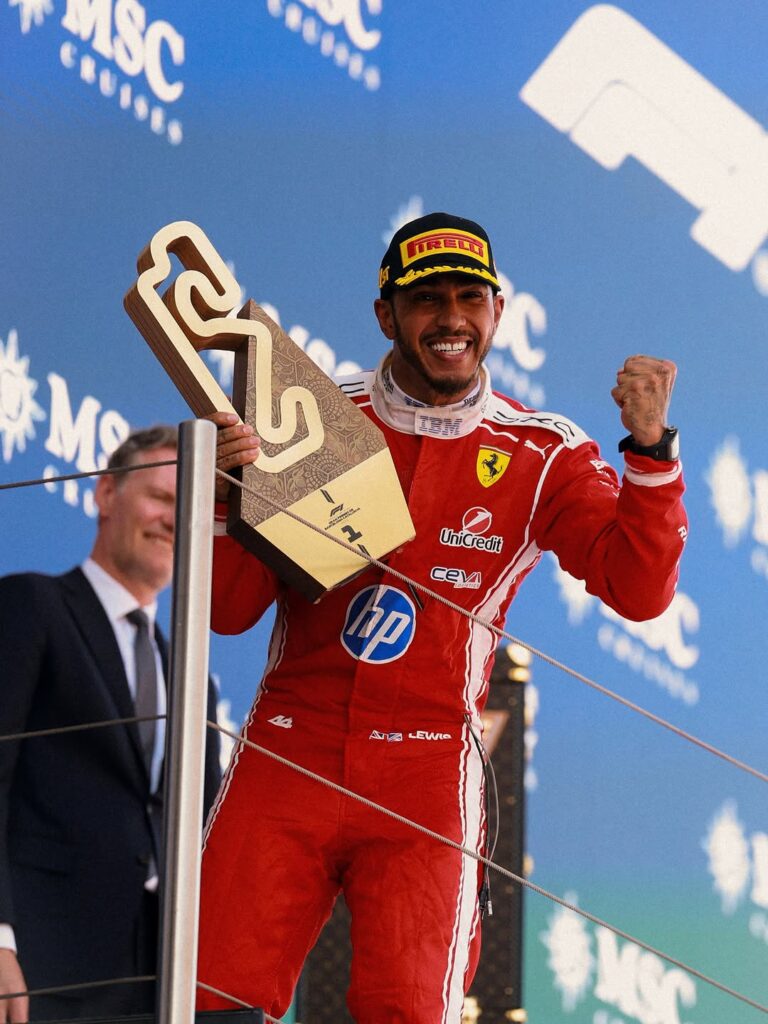
For collectors who follow the through-line of driver activism in Formula 1, the modern parallel sits with Lewis Hamilton. The seven-time champion’s willingness to speak collectively, to challenge governance and to use his platform echoes — in a very different era and on very different issues — the spirit of what Lauda did in 1982. A display that places a Hamilton replica helmet alongside a Lauda 1982 piece is not a stretch. It is a conversation across forty years of the sport.
Final Lap: An Archive Worth Revisiting
The 1982 South African Grand Prix is remembered for two things: the strike that preceded it and the Renault that won it. Both are stories told through helmets and liveries as much as through lap times. Lauda’s red shell. Prost’s blue band. The yellow-and-black Renault. The dust of a Kyalami afternoon settling on a podium that nearly never happened.
For the modern collector, these are not nostalgic curios. They are the vocabulary of a sport that still argues, still negotiates and still produces moments worth preserving in 1:1 scale. Some weekends matter for who won. This one mattered for who refused to drive — and for the quiet, red-helmeted man who made that refusal possible.
“We didn’t strike because we wanted more money. We struck because a driver has to remain a free man.”
— Niki Lauda, recalling the 1982 standoff
“Niki simply locked the door and said nobody leaves. That was the whole negotiation.”
— A team manager present at Kyalami 1982
FAQ
Q: What caused the 1982 Formula 1 driver strike?
The drivers objected to clauses in the revised Super Licence that they felt restricted their freedom to negotiate with different teams. Niki Lauda interpreted the language as binding drivers too tightly to a single employer and rallied the grid in response.
Q: Where did the drivers stay during the strike?
All thirty drivers were taken by bus to the Sunnyside Park Hotel in Johannesburg, where they slept on mattresses on the ballroom floor for nearly thirty hours while Lauda negotiated on their behalf.
Q: Who won the 1982 South African Grand Prix once the race finally happened?
Alain Prost won for Renault in the RE30B, despite an early puncture, finishing ahead of Carlos Reutemann and René Arnoux in a race that became a defining early statement of the turbo era.
Q: Why is the 1982 Lauda helmet so popular among collectors?
Its minimalist design — a solid red shell with a single white band and the Parmalat logo — makes it instantly recognisable and visually striking as a full-size 1:1 display piece. The historical weight of the 1982 season adds further appeal.
Q: How does the Lauda strike connect to modern drivers like Lewis Hamilton?
Lauda’s leadership at Kyalami established a template for collective driver action that today’s GPDA and outspoken figures like Lewis Hamilton continue. A display pairing 1982 and modern Hamilton replicas highlights this through-line of driver advocacy.
Shop Lewis Hamilton Collection
Display and collector replicas only. Not certified for protective use. Full-size 1:1 scale.
This article was written with the help of AI tools. Editorial policy