Blog
Leclerc’s Monaco Q3 Crash: What It Means for the Grid and the Helmet Legacy
 123Helmets Editorial Team

Charles Leclerc had provisional pole in his hands at Monaco before a brush with the Tabac wall ended Q3 early. The SF-26 driver starts fourth on Sunday — and the red helmet that nearly claimed pole at home is already one of the season’s most display-worthy pieces.
Key Takeaways
Leclerc topped Q1 and held provisional pole in Q3 before losing the rear at Tabac and touching the wall, ending his lap.
Dirty air entering Turn 12 unsettled the SF-26’s rear on entry — not a recurrent mechanical issue, Leclerc confirmed.
A separate, ongoing braking inconsistency linked to tyre temperature has troubled Leclerc across both Montreal and Monaco.
Ferrari’s Friday pace — locking out the top two in both practice sessions — did not carry over to Saturday’s qualifying result.
The Lap That Almost Was
Saturday qualifying at Monaco delivered one of the most bittersweet moments of Charles Leclerc’s 2026 season so far. After a subdued first run in Q3, the Monegasque driver pieced together what he described as a genuinely strong lap — improving through sector one and reaching provisional pole position ahead of the field’s final attempts.
Then came Tabac.
“I was very much on the edge, and I think it was a very good lap until then,” Leclerc said after the session. “But I never finished it, so it’s a bit needless to say that. But, yeah, it was a good lap.”
The crash at Tabac — one of Monaco’s most demanding flat-out right-handers — brought the session to a premature close and left Leclerc classified fourth on the grid. Kimi Antonelli, Max Verstappen, and Lewis Hamilton all ultimately improved to go faster, but Leclerc never got the chance to respond. The SF-26 kissed the barrier and the lap was gone.
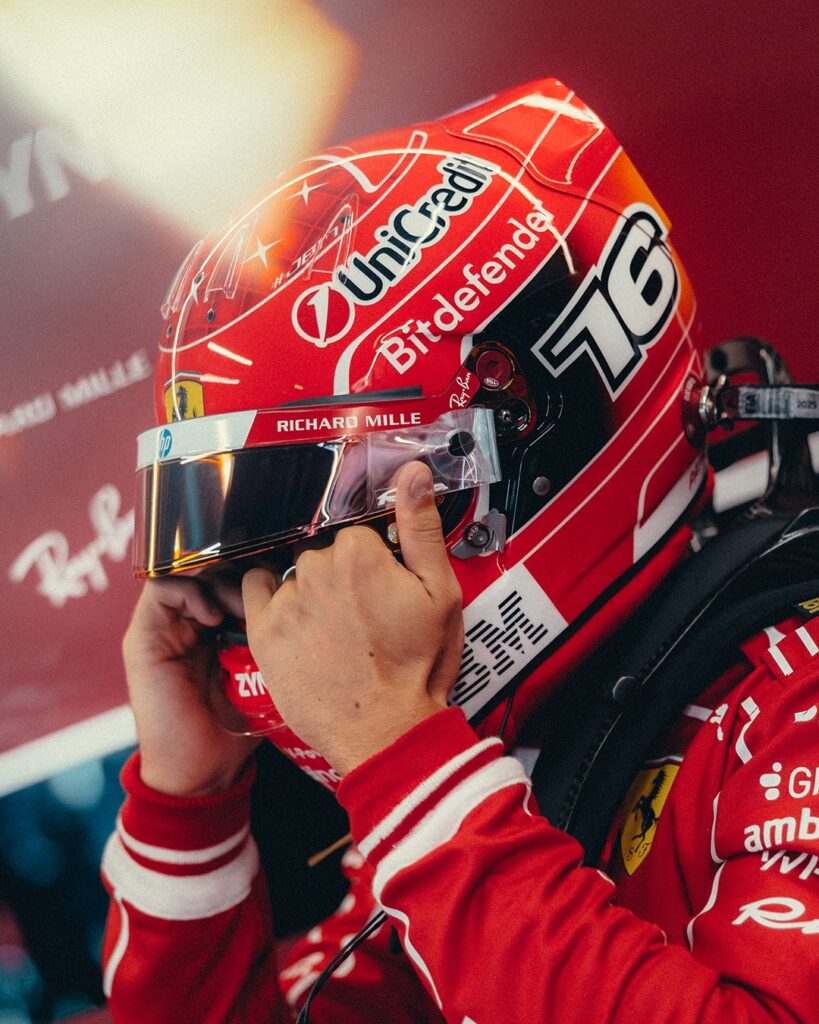
For anyone collecting a full-size 1:1 replica of the Leclerc Monaco helmet — one of the most striking red-on-red liveries Ferrari has produced for a street circuit — that qualifying session now carries an extra layer of story. The helmet that nearly grabbed pole at the driver’s home race is a display piece with genuine emotional weight.
Dirty Air at Turn 12: What Caused the Crash
Leclerc was careful to separate the Tabac accident from the wider mechanical difficulties he has been experiencing this season. The cause, he explained, was more circumstantial: a pocket of dirty air disturbed the SF-26’s rear just as he arrived at Turn 12’s entry.
“I had a little bit of dirty air in that lap where I lost it in Turn 12,” he said. “I don’t know, there was no traffic in itself, it was just dirty air. It made me lose a little bit the rear in entry, and I touched the wall.”
At Monaco, where the barriers are rarely more than a few centimetres from the car, losing rear grip at a corner like Tabac gives a driver almost no recovery margin. The lap distance from the pit exit to Tabac covers some of the tightest sections of any circuit on the calendar, and arriving at that point in a genuinely fast qualifying lap means everything is working at the absolute limit.
The distinction matters: this was not the same issue that has been troubling Leclerc across multiple race weekends. It was a specific, session-contextual event — one that happened to occur at the worst possible moment of a lap that could have delivered pole position at his home circuit.
Friday’s Promise That Saturday Couldn’t Match
Ferrari arrived at Monaco with genuine pace. The Scuderia locked out the top two positions in both Friday practice sessions, a result that pointed to a car well-suited to the principality’s demands. Leclerc then topped Q1, reinforcing the impression that a pole run was a realistic goal.
The gap between Friday and Saturday is a familiar story in Formula 1, but at Monaco it carries sharper consequences. Starting fourth rather than first on a circuit where overtaking is so difficult is a significant sporting loss. For Leclerc, racing at home, the gap between provisional pole and a grid slot two rows back is particularly stark.
The Deeper Problem: Braking Inconsistency Across Multiple Rounds
Beyond the Tabac accident, Leclerc flagged a separate and more persistent concern — one that has followed him from the Canadian Grand Prix through to Monaco. The Ferrari driver described the SF-26’s braking behaviour as “extremely inconsistent” and directly linked it to tyre temperature, alongside what he described as “another issue” he declined to detail publicly.
“The thing is that I’m definitely not knowing what I’m having,” Leclerc said. “At the moment it’s a bit of a discovery whenever I get on the brakes, and I don’t want to go too much into the detail and I won’t go into more detail than what I’ve said.”
He continued: “But it’s been extremely inconsistent and I’ve just been struggling massively. Whether it was in Montreal or here, especially when tyres are just not in the right window.”
For a driver whose car confidence is closely tied to rear stability and predictable braking — as Leclerc has demonstrated across his career — an inconsistency of this kind at a circuit where the walls punish any loss of control is a serious technical challenge. Ferrari’s engineers will have a clear priority heading into Sunday’s race setup.
The acknowledgement that this issue stretches back to Montreal — the Circuit Gilles Villeneuve race — confirms this is not a Monaco-specific setup problem. It is a recurring characteristic of the SF-26 in certain tyre temperature conditions, and Leclerc’s candid admission that he is still learning what to expect when he brakes speaks to the unpredictability involved.
Fourth on the Grid at Home: The Race Outlook
Starting fourth at Monaco is not necessarily a race-ending position. The circuit’s layout means the opening few corners can reshuffle the order — particularly at Sainte Dévote, where contact and positioning battles are routine on lap one. Leclerc will be watching for any opportunity as the field compresses into the first corner sequence.
The SF-26 demonstrated genuine pace on Friday, and whatever braking inconsistency troubled Leclerc in qualifying may respond differently to race conditions, where tyre management and thermal windows settle into more predictable patterns over longer stints. Ferrari’s strategy team will be aware that track position is worth more at Monaco than at almost any other circuit, and the pit wall will be looking for any safety car or VSC window to manufacture an undercut opportunity.
Antonelli takes pole — a result that adds its own historical footnote to a weekend already full of narrative. Hamilton and Verstappen occupy the rows ahead of Leclerc as well, making the prospect of a race win genuinely difficult without attrition or strategic intervention. Still, Leclerc has shown before that Monaco and patience can combine to deliver results when the race unfolds in unexpected directions.
A Grid Position That Makes Sunday Harder — Not Impossible
The Monaco Grand Prix has produced enough surprising race outcomes over the decades that fourth place on the grid, while clearly not where Leclerc wanted to be, does not close the door entirely. Ferrari’s pace on the longest runs across Friday will tell the team something about tyre degradation rates, and if the medium and hard compounds perform well in race trim, the strategic picture could shift as the 78-lap distance plays out.
The Monaco Helmet as a Collector Piece
Every Formula 1 season produces a handful of qualifying moments that become permanently associated with a specific helmet design. Leclerc’s 2026 Monaco qualifying session — the provisional pole, the dirty air, the Tabac wall — is already one of them.
Ferrari’s red-dominant Monaco livery for the SF-26 era continues a tradition of helmet designs that carry the principality’s visual identity: the red and white of the Scuderia against the backdrop of a circuit that Leclerc has raced since childhood. A full-size 1:1 replica of the Leclerc Monaco helmet captures that intersection of personal history and sporting drama in a way that a generic display piece cannot.
Our exhibition-quality collector replicas are produced at exactly 1:1 scale, matching the dimensions worn by Leclerc during race weekends. These are display items — not certified for road or track use — designed to sit in a cabinet, on a shelf, or as a centrepiece of an F1 collection. The finish detail on the red shell, the Ferrari Scuderia wordmark placement, and the visor tint are all reproduced to exhibition standard.
For collectors who follow Leclerc’s career specifically, the 2026 Monaco qualifying weekend already has the texture of a chapter worth commemorating. The near-pole at his home race, the honest post-session explanation, and the grid position that makes Sunday’s race a genuine challenge — all of it is bundled into the visual shorthand of that helmet sitting on the grid, four rows back from where he wanted to be.
Collector replica helmets tied to specific race weekends tend to carry more meaning when the weekend itself has a clear narrative arc. Monaco 2026 — Leclerc, provisional pole, Tabac, fourth — is exactly that kind of story.
Ferrari’s Monaco Weekend in Context
Ferrari’s 2026 Monaco campaign arrived with expectations shaped by strong Friday numbers. Locking out both practice sessions at a circuit as specific as Monaco is a meaningful indicator — the car’s low-speed mechanical grip and downforce balance were clearly well-matched to the demands of the principality’s slow corners and tight walls.
The gap to that performance level on Saturday — Leclerc fourth, the braking issue unresolved, the crash ending what might have been the definitive lap of qualifying — represents a missed window. Ferrari needed pole at Monaco more than at most circuits precisely because of how difficult it is to recover track position in the race. Starting from the front is not merely an advantage here; it is close to a prerequisite for victory.
Sunday will answer questions that Saturday raised. If the SF-26’s race pace matches or exceeds what Friday suggested, Ferrari may yet leave Monaco with a strong result. But the margin for error is thin, and the braking inconsistency Leclerc described — one that has persisted from Montreal to Monaco — will need a resolution before it costs the team more than a qualifying position.
For now, Leclerc lines up fourth, the provisional pole a footnote to a session that ended at Tabac, and Sunday’s 78-lap race around the streets of his home city still very much open.
“I was very much on the edge, and I think it was a very good lap until then. But I never finished it, so it’s a bit needless to say that. But, yeah, it was a good lap.”
— Charles Leclerc, post-qualifying, 2026 Monaco Grand Prix
“It’s been extremely inconsistent and I’ve just been struggling massively. Whether it was in Montreal or here, especially when tyres are just not in the right window.”
— Charles Leclerc, on the SF-26 braking issue, 2026 Monaco Grand Prix
FAQ
Q: Why did Leclerc crash in Monaco Q3?
Leclerc lost rear grip at Turn 12 (Tabac) due to a pocket of dirty air that unsettled the SF-26 on corner entry. He touched the wall and ended his lap early, despite holding provisional pole at the time.
Q: What grid position does Leclerc start from in the 2026 Monaco Grand Prix?
Leclerc starts fourth, after Kimi Antonelli, Max Verstappen, and Lewis Hamilton all improved on their final Q3 laps while Leclerc’s session ended with the Tabac crash.
Q: Is Leclerc’s Monaco crash related to the braking problem he mentioned?
No. Leclerc confirmed the Tabac crash was caused by dirty air rather than the braking inconsistency. The braking issue — linked to tyre temperature — is a separate, recurring problem that has affected him across both Montreal and Monaco.
Q: What is the 123Helmets Leclerc Monaco collector helmet?
It is a full-size 1:1 scale display replica of Charles Leclerc’s Monaco race helmet, produced to exhibition quality. It is a collector item only — not certified for protective, road, or track use.
Q: How did Ferrari perform in Friday practice at Monaco 2026?
Ferrari locked out the top two positions in both Friday practice sessions, suggesting strong car-to-circuit fit. That pace did not fully carry over to Saturday qualifying, where Leclerc ended up fourth on the grid.
Shop Charles Leclerc Collection
Display and collector replicas only. Not certified for protective use. Full-size 1:1 scale.
This article was written with the help of AI tools. Editorial policy