
Blog
Leclerc’s Monaco Heartbreak: Three Brakes Gone at Antony Noghes
 123Helmets Editorial Team
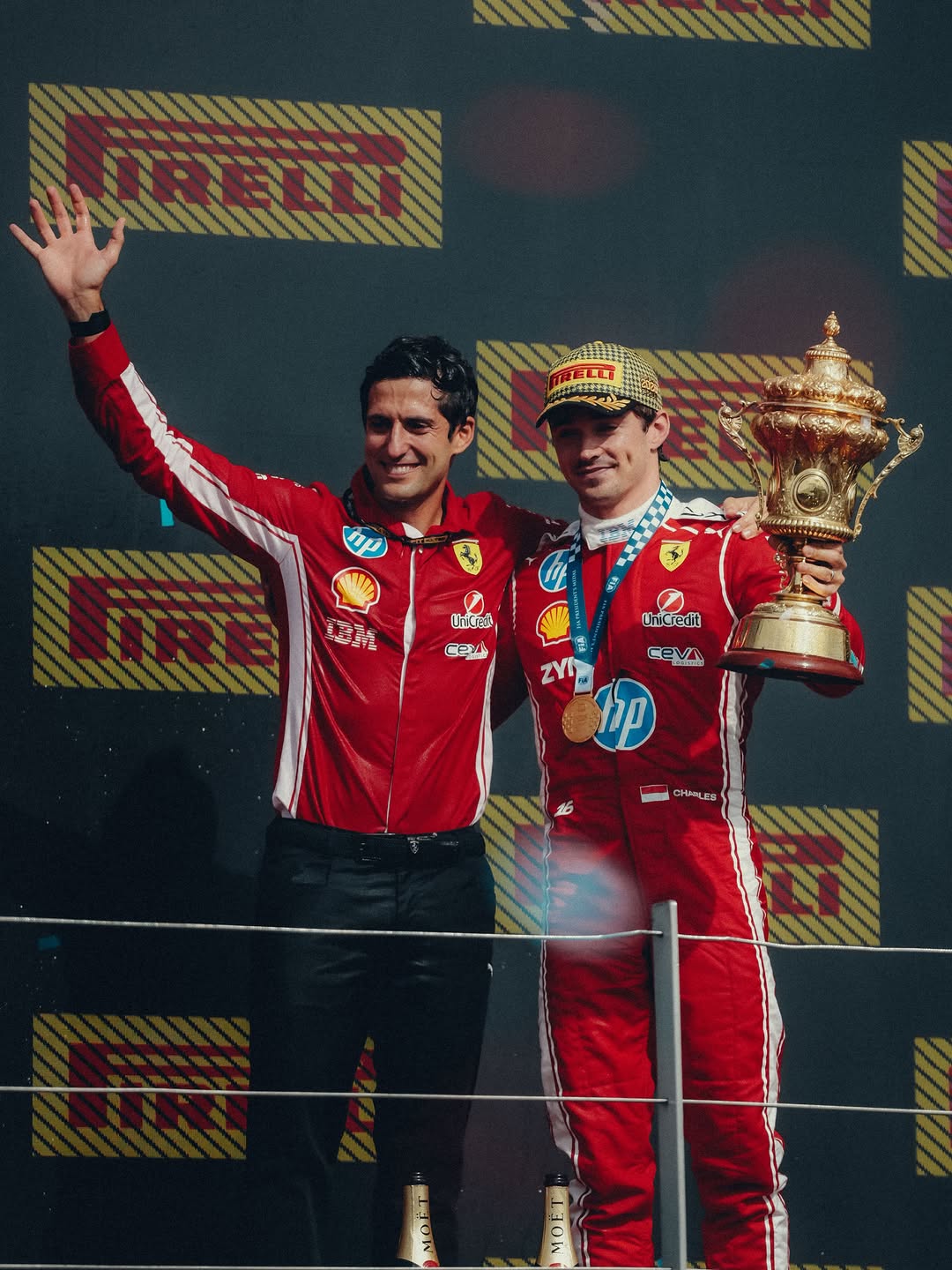
Charles Leclerc’s home race ended against the barriers at Antony Noghes while running third — and the Monegasque had a stark explanation on the radio: three of his four brakes had simply stopped responding. For collectors tracking the 2025 Ferrari livery and Leclerc’s red-and-white Monaco lid, the visual story of this weekend is one of frustration, a damaged front wing, and a helmet design that deserves a quieter fate on a display shelf.
Key Takeaways
Leclerc was running P3 when three of his four brakes stopped responding after a safety car phase.
Only the front-left was fully working; the front-right was at half capacity and both rear brakes registered zero deceleration on data.
Ferrari already has an in-house fix — Leclerc will switch to Lewis Hamilton’s brake configuration from the next race onward.
The 2025 Monaco helmet and SF-25 livery remain standout collector pieces, with the home-race red-and-white design among the most requested 1:1 replicas of the season.
A Home Race That Unravelled at Antony Noghes
Charles Leclerc started the Monaco Grand Prix weekend with the kind of pressure only a home driver understands. Running third in the closing stages, on the streets where he grew up, the Monegasque was on course for another podium in front of the Principality crowd. Then, at Antony Noghes — the final right-hander that opens onto the start-finish straight — the Ferrari slid wide and met the barrier. The front wing was destroyed, the floor took a hit, and the race was over.
What made the moment unusual was Leclerc’s immediate radio message. There was no apology, no admission. “I’m not even going to take the blame,” he told his engineer. The reason became clear within the hour.
“Out of the four brakes, I had three brakes not working,” Leclerc explained afterwards. “The front left was working well, the front right was half working, and the two rear brakes were not working at all. And when I say at all, it’s that on data, there’s no deceleration at all. It’s like the calipers were not even in the car.”
For a circuit where braking zones define every corner, losing 75% of the braking system is not a small problem. It is, in Leclerc’s own word, “a nightmare”.
The Technical Picture: When the Safety Car Triggered the Failure
A Problem That Got Progressively Worse
According to Leclerc, the issue did not appear at the start of the race. It surfaced after a safety car intervention and then deteriorated. “As soon as I did the safety car, three of my four brakes stopped working,” he said. “I could never switch them on again, nothing was working anymore. I tried to do many actions in the car to try and help it.”
The data confirmed his account. With both rear calipers registering zero retardation, the rear axle was effectively along for the ride. Only the front-left was doing its job properly, with the front-right contributing partial bite. On a street circuit where braking from over 290 km/h into the chicane and Mirabeau is a defining act, that imbalance was unmanageable.
The Unavoidable Crash
Leclerc described the final lap as a choice between two crashes. “The only solution I had was to not brake in the last corner, but I would have crashed in Turn 1. There was just no solution.” He chose Antony Noghes — the slower impact, the better outcome for the chassis, and a corner where the gravel-free run-off meant only a wall to greet him.
Ferrari Has an Answer
The silver lining came quickly. “The only thing I can say is that we have the solution in-house, and I’ll go to the Lewis configuration from next race onward, which hopefully will be a step,” Leclerc said. Hamilton has been running a different brake specification for several rounds, and Leclerc will now adopt the same package. Ferrari is still investigating the exact root cause, with brake wear — a long-standing Monaco challenge given how often drivers are on the pedal — listed as one possible factor.
The 2025 Monaco Helmet: A Display Piece Worth the Spotlight
Red, White, and the Monegasque Crown
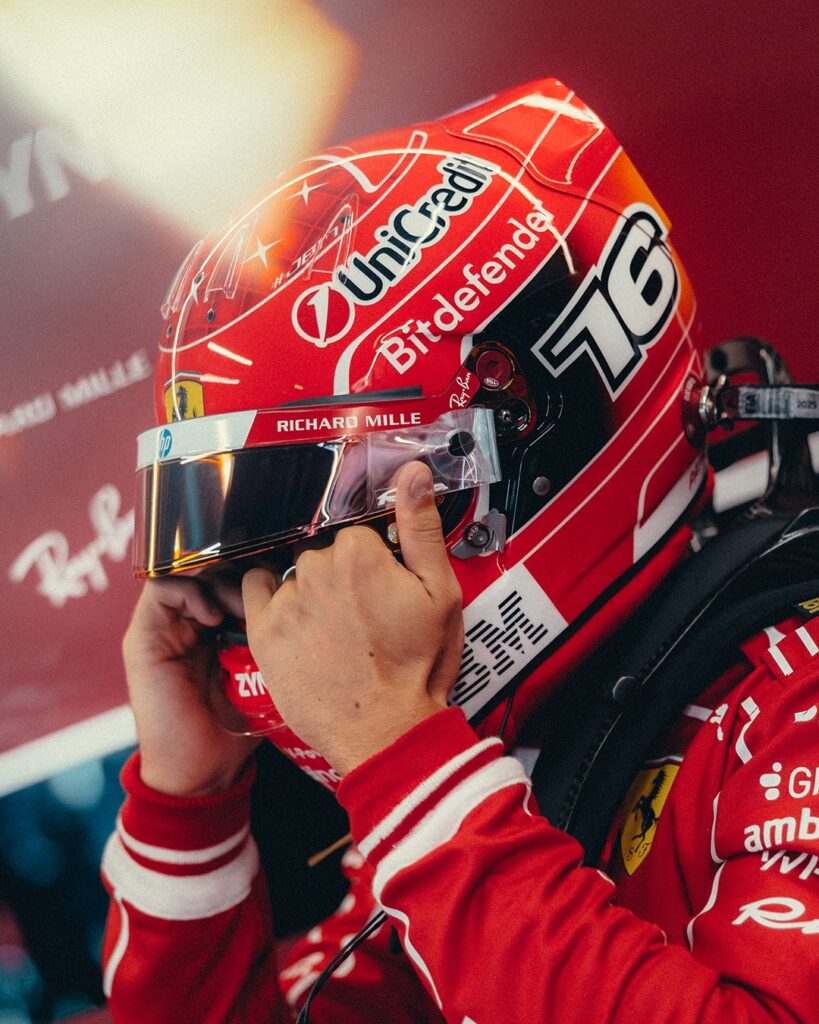
Leclerc’s 2025 Monaco helmet continues the tradition he started in 2021 — a special design reserved for the streets he calls home. The dominant red base ties directly to the SF-25 livery, with white panels framing the crown and the Monegasque coat of arms positioned prominently. The number 16 sits on the rear in a stylised serif, and the visor surround carries a contrasting white border that catches television cameras under the tunnel lighting.
As a full-size 1:1 collector replica, this helmet is one of the strongest display candidates of the season. The shell is reproduced to exact dimensions for exhibition use, the paint is applied in multiple layers to match the depth of the original livery, and the visor tear-off tabs are reproduced for visual authenticity. It is a display piece, not a wearable item, and it earns its place under a glass dome or on a lit shelf.
Why Collectors Want the Crashed-Race Lid
Counterintuitively, helmets from races that ended in retirement often hold strong appeal for collectors. The story attached to the design — a home race, a podium lost, a technical failure that wasn’t the driver’s fault — adds narrative weight to the object. The 2025 Monaco design will be remembered for that radio message as much as for the paint scheme itself.
SF-25 Livery: How Ferrari Looked on the Streets
The SF-25 carried Ferrari’s familiar Rosso Corsa with the matte and gloss contrast that has defined the team’s 2025 visual identity. The yellow Scuderia shield sits on the airbox, the white sponsor blocks run along the sidepods, and the engine cover features the deeper red shade that distinguishes this season from 2024. For display-quality models and helmet pairings, the Monaco weekend offered the cleanest visual reference of the car so far — wide-angle shots through the tunnel, low light at the swimming pool section, and the harbour backdrop at Tabac.
Pairing a 1:1 Leclerc Monaco helmet with a scale SF-25 model creates a coherent exhibition arrangement. The colour codes match, the era is consistent, and the story — Monaco 2025, the brake failure, the radio message — gives the display a clear caption.
What This Means for the Rest of the Season
A Configuration Switch That Could Reset the Year
Leclerc’s move to the Hamilton brake configuration is more than a one-race fix. It signals that Ferrari has two distinct braking philosophies inside the garage and that the team now believes one of them is clearly the right path. If the switch delivers the step Leclerc is hoping for, the second half of the season could look very different from the first.
The Helmet Remains on Display
Whatever happens in the championship, the 2025 Monaco helmet has already secured its collector status. The design is fixed in race history, the radio message is part of the story, and the full-size 1:1 replica gives collectors a way to keep the weekend in view — minus the barrier impact.
“Out of the four brakes, I had three brakes not working. The front left was working well, the front right was half working, and the two rear brakes were not working at all. On data, there’s no deceleration — it’s like the calipers were not even in the car.”
— Charles Leclerc, post-race Monaco GP
“The only solution I had was to not brake in the last corner, but I would have crashed in Turn 1. There was just no solution.”
— Charles Leclerc explaining the Antony Noghes impact
FAQ
Q: What caused Charles Leclerc’s Monaco GP crash?
A brake system failure. Three of his four brakes stopped responding after a safety car phase — the front-right was at half capacity and both rear brakes registered zero deceleration on data. Only the front-left was fully working.
Q: Was Leclerc blamed for the crash?
No. He stated on team radio that he would not take the blame, and the technical data supported him. Ferrari confirmed a brake configuration issue and has an in-house solution ready.
Q: What is the ‘Lewis configuration’ Leclerc will switch to?
It is the brake specification that team-mate Lewis Hamilton has been running. Ferrari operates two distinct brake philosophies, and Leclerc will adopt Hamilton’s package from the next race onward.
Q: Is the 2025 Leclerc Monaco helmet available as a collector replica?
Yes. The red-and-white home-race design is reproduced as a full-size 1:1 display replica with multi-layer paint, exhibition-grade finish, and accurate visor surround detailing. It is a display piece only, not certified for protective use.
Q: What makes the Monaco crash helmet interesting for collectors?
The story. A home race, a podium position lost, a technical failure outside the driver’s control, and a radio message that made headlines. Helmets tied to memorable race narratives often become the most requested display pieces of a season.
Shop Charles Leclerc Collection
Display and collector replicas only. Not certified for protective use. Full-size 1:1 scale.
This article was written with the help of AI tools. Editorial policy