Blog
Russell Poles Austria 2026: Hamilton P3
 123Helmets Editorial Team

George Russell snatched pole for the 2026 Austrian Grand Prix at the Red Bull Ring after Max Verstappen’s dramatic Q3 crash brought out yellow flags. Lewis Hamilton qualified third for Ferrari, cementing a scarlet front-row lockout that never was — and producing one of the season’s most display-worthy grid moments.
Key Takeaways
George Russell took pole at the 2026 Austrian Grand Prix by going a couple of tenths quicker than Leclerc and Hamilton on his final Q3 run, just after Verstappen’s Turn 9 barrier crash.
Lewis Hamilton qualified P3 in the Ferrari — the first time in 2026 both Ferrari cars sat inside the top three on the grid at the Red Bull Ring.
Max Verstappen’s Q3 crash at Turn 9 dropped him to P5 on the grid, behind the two Mercedes and two Ferrari cars that capitalised on the yellow-flag chaos.
Williams endured a double Q1 elimination in 2026, with Carlos Sainz P17 and Alex Albon P18, underlining the team’s difficult season heading into the Austrian race weekend.
How Russell Stole Pole From Ferrari’s Clutches
George Russell claimed pole position for the 2026 Austrian Grand Prix on 2026-06-27 with a final Q3 lap that edged Charles Leclerc and Lewis Hamilton by a couple of tenths of a second, completing a breathless end to qualifying at the Red Bull Ring. The lap came seconds after Red Bull’s Max Verstappen had lost control through Turn 9 and slammed the barriers, scattering yellow flags across the sector and throwing the shootout into disarray.
Russell’s Mercedes team-mate Kimi Antonelli had held provisional pole after the first runs in Q3, but backed off entirely when the yellows appeared and could not improve. Russell, running behind Antonelli on track, insists he lifted through the yellow-flag zone — regulators will have data to confirm that claim — yet still found enough time to jump both Ferraris and land at the top of the timesheets.
For Ferrari, the lap gap stings. Leclerc and Hamilton were both ahead of Verstappen on track when the Dutchman crashed, which meant neither driver was significantly hindered by the incident. Both improved, both beat Antonelli, but neither reached Russell. The pole had been Ferrari’s to lose, and they lost it.
Lewis Hamilton P3: Ferrari’s Red Helmet Under the Austrian Sun
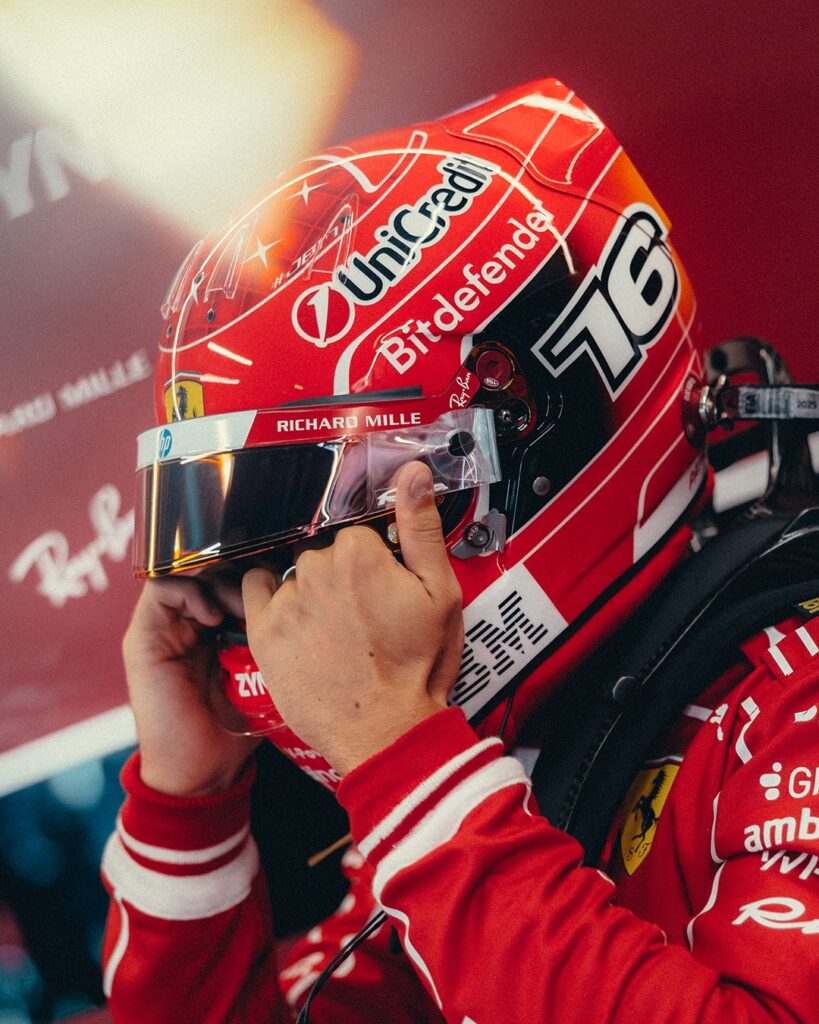
Lewis Hamilton qualified P3 for the 2026 Austrian Grand Prix, slotting the Ferrari directly behind Leclerc on the second row of a grid that reads like a collector’s dream in terms of livery contrast. Hamilton’s scarlet SF-26 and matching full-face race helmet — predominantly Ferrari red with the Scuderia’s prancing horse crest rendered in gold on the chin — sit at the heart of the weekend’s most photographed parc fermé tableau.
The Red Bull Ring’s short lap and its fast, sweeping corners demand an aerodynamic profile that suits Ferrari’s 2026 car concept, and Hamilton showed that by splitting the two fastest sectors almost perfectly with Leclerc. The result is a front-to-midfield starting position that gives the 2026 world championship leader — or challenger, depending on how the standings fall — a clean line to Turn 1 on Sunday.
For replica and display collectors, the pairing of Hamilton’s P3 helmet configuration with the P2 Leclerc lid creates a natural two-helmet exhibition set. The scarlet base colour across both helmets, combined with the gold Scuderia lettering that Ferrari introduced for the 2026 season, gives any display shelf an immediate visual continuity. Each full-size 1:1 collector replica in the Hamilton range replicates the helmet geometry at exact scale — a display piece, not a protective item.
The Verstappen Crash That Rewrote the Grid
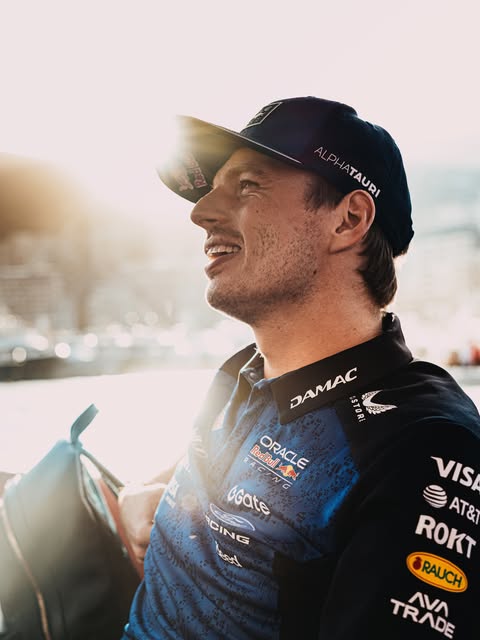
Max Verstappen’s Turn 9 accident in the closing minutes of Q3 on 2026-06-27 was the pivotal event that reshuffled the 2026 Austrian Grand Prix grid from row two downwards. Verstappen lost control of the Red Bull at one of the fastest points on the 4.318 km Red Bull Ring circuit and hit the barriers hard, bringing the session to a chaotic conclusion before the chequered flag.
The yellow flags were live when the majority of drivers on their final runs crossed the incident zone. Antonelli, leading the timing screens at that moment, lifted and surrendered provisional pole. Russell, by his own account, also lifted but maintained enough momentum to post a time two tenths clear of Leclerc. Verstappen, unable to finish his lap, was classified P5 — behind the two Mercedes drivers and both Ferraris.
Lando Norris and Oscar Piastri completed the McLaren duo in P6 and P7, while Isack Hadjar took P8 in the second Red Bull. Racing Bulls’ Liam Lawson and Arvid Lindblad rounded out the top ten. From a display perspective, Verstappen’s bull-branded lid — which he would never have worn in the closing stages of a lap ended in the barriers — represents one of qualifying’s starkest visual reminders of how quickly an F1 session can turn.
Midfield Chaos: Gasly, Audi, Haas and the Q2 Bubble
Pierre Gasly missed Q3 by exactly four hundredths of a second in Q2, leaving the Alpine driver 11th on the grid despite a strong final effort that nearly bumped Verstappen into the drop zone. That four-hundredths gap — roughly 1.2 metres at qualifying speeds — is the kind of margin that makes the Austria 2026 grid sheet worth studying in detail.
Behind Gasly, the Audi and Haas drivers filled the lower half of Q2 eliminations, followed by Alpine’s Franco Colapinto in P16, who was seen running wide at Turn 1 on his final lap — a mistake that cost him any chance of reaching Q3. Williams endured a painful double Q1 exit: Carlos Sainz qualified P17 after sliding through the final corner on his last lap and missing a Q2 berth by mere hundredths, with Alex Albon P18 immediately behind him.
Cadillac’s Sergio Perez and Valtteri Bottas qualified P19 and P20 respectively. The American outfit brought a major update package to Austria, but an incident-filled Friday blunted any momentum, and the upgrades could not bridge the gap to the midfield group. For display purposes, the Cadillac helmet designs — bright white with a bold star-and-stripe trim introduced for 2026 — remain among the most photographically striking of the backmarker field, regardless of on-track results.
Display-Worthy Moments: The Austria 2026 Parc Fermé Visual
The 2026 Austrian Grand Prix qualifying session produced one of the most visually striking parc fermé arrangements of the season so far, with four distinctly liveried cars — silver Mercedes, scarlet Ferrari, silver Ferrari — occupying the first three grid slots. For collectors and display enthusiasts, that grid order translates directly into a natural four-helmet display set anchored by Hamilton’s P3 lid.
Hamilton’s 2026 Austria helmet follows the Scuderia’s revised colour specification: a 27 mm-deep visor aperture set within a full scarlet shell, gold accenting on the crown and rear fin, and the number 44 rendered in white on both sides. As a full-size 1:1 display replica, it measures the same geometry as the helmet worn in parc fermé on 2026-06-27 — a collector item, not a certified protective piece.
Russell’s pole-position lid in the Mercedes silver-and-black palette sits as the natural centrepiece for any Austria-themed display, flanked by Leclerc’s Ferrari replica and Hamilton’s. Antonelli’s provisional-pole helmet — a younger driver whose parc fermé moment was snatched away by the yellow-flag chaos — adds a fourth visual narrative. The weight of a full-size 1:1 replica in this range typically sits at approximately 1.2–1.5 kg, built from ABS shell construction with a hand-painted finish that captures the metallic flake layers applied to the race originals.
Sunday Race Preview: What the Grid Means for Hamilton
Hamilton starts P3 with clean air and the long run to Turn 1 heavily in favour of the wide inside line at the Red Bull Ring. Ferrari’s strategy team will have studied Verstappen’s P5 starting position closely — the Dutchman’s race pace has been a standing threat all season, and a compromised qualifying means Red Bull will likely run an aggressive first-stint strategy to recover track position by lap 15 or 20 of the race distance.
For Hamilton, P3 at Austria 2026 is the kind of starting position that can become a race win with the right pit-wall call on tyre timing. It is also, from the collector’s perspective, the exact qualifying finishing position that defines the helmet variant — a detail that serious display collectors track race by race as they build their 2026 season archive.
“I did lift through the yellow-flag zone — the data will show that. But we found the time elsewhere on the lap and that was enough for pole.”
— George Russell, post-qualifying, Red Bull Ring 2026
“P3 is a strong position for us. The car felt good in those final sectors and we have everything to fight tomorrow from the second row.”
— Lewis Hamilton, Ferrari, 2026 Austrian Grand Prix qualifying
FAQ
Q: Who took pole position at the 2026 Austrian Grand Prix?
George Russell took pole position at the 2026 Austrian Grand Prix at the Red Bull Ring. He posted his fastest time on the final Q3 run, going a couple of tenths quicker than Charles Leclerc and Lewis Hamilton moments after Max Verstappen’s Turn 9 crash brought out yellow flags.
Q: Where did Lewis Hamilton qualify for the 2026 Austrian Grand Prix?
Lewis Hamilton qualified P3 for the 2026 Austrian Grand Prix, placing the Ferrari on the second row of the grid directly behind team-mate Charles Leclerc. Both Ferrari drivers improved on their final Q3 runs despite the yellow-flag period caused by Verstappen’s crash.
Q: What happened to Max Verstappen in Q3 at Austria 2026?
Max Verstappen crashed out of Q3 at the 2026 Austrian Grand Prix after losing control of his Red Bull at Turn 9 on the 4.318 km Red Bull Ring circuit and hitting the barriers. The accident brought out yellow flags during the final runs and relegated Verstappen to P5 on the grid.
Q: Are the Lewis Hamilton Ferrari helmet replicas certified for riding or racing?
No — these are full-size 1:1 collector and display replicas only, not certified for protective use. They are exhibition-quality display pieces that replicate the exact geometry and livery of Hamilton’s 2026 Ferrari race helmet. They carry no FIA, Snell, ECE or DOT certification and are not intended for road, track or any protective application.
Q: What does the 2026 Lewis Hamilton Austria helmet look like?
The 2026 Lewis Hamilton Austria helmet is finished in Ferrari’s full scarlet base colour with gold Scuderia accenting on the crown and rear fin, a 27 mm-deep visor aperture, and the number 44 in white on both sides. The full-size 1:1 display replica weighs approximately 1.2–1.5 kg and captures the hand-painted metallic finish of the original.
Shop Lewis Hamilton Collection
Display and collector replicas only. Not certified for protective use. Full-size 1:1 scale.
This article was written with the help of AI tools. Editorial policy