
Blog
Longest Winning Careers in F1 History
 123Helmets Editorial Team
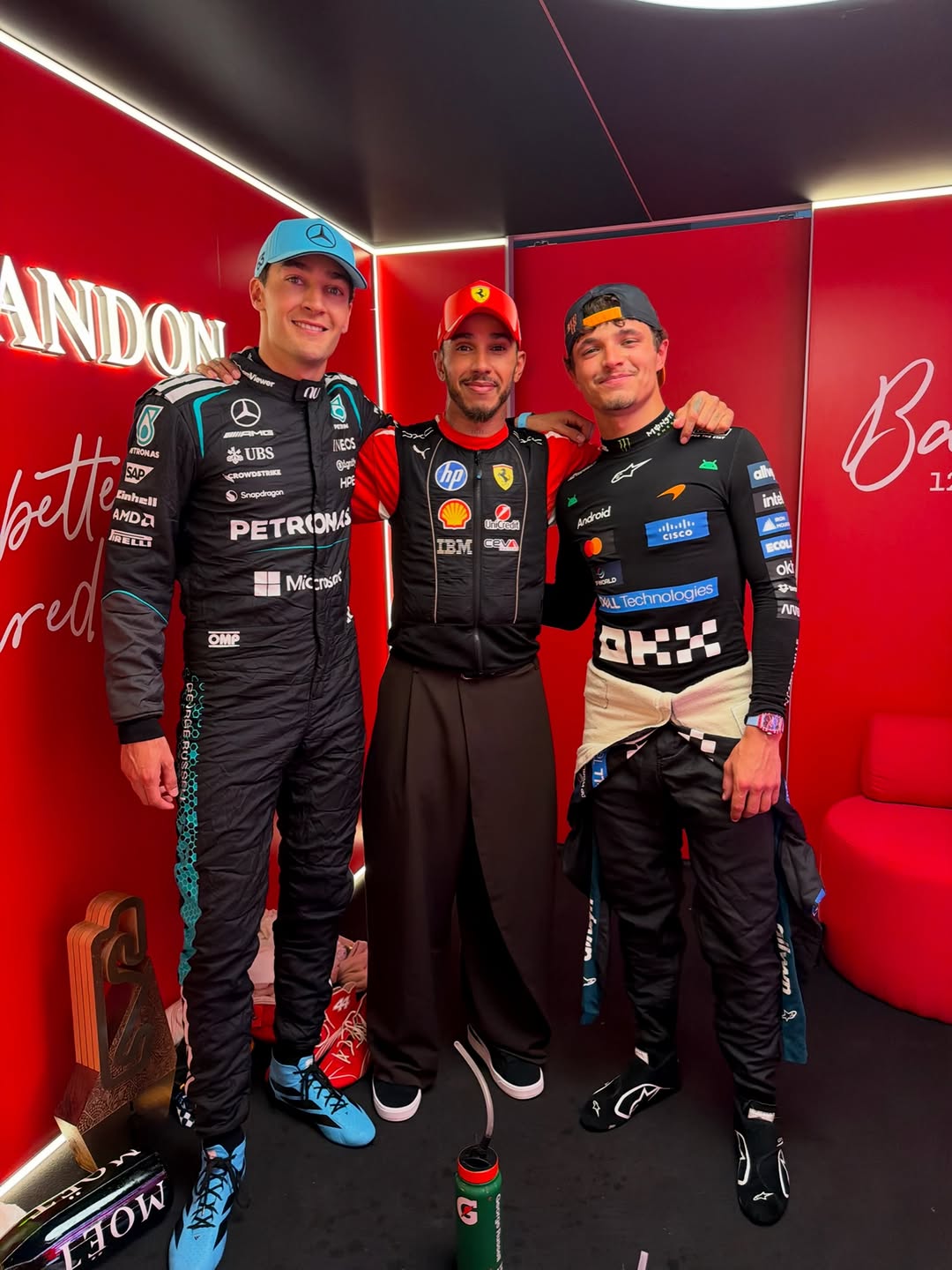
Lewis Hamilton’s win at the 2024 Barcelona-Catalunya Grand Prix extended his own record as the longest winning career in Formula 1 history — a span measured not just in trophies but in helmet liveries, team colours, and podium moments worth preserving in full-size 1:1 replica form.
Key Takeaways
Lewis Hamilton holds the longest winning career in Formula 1 history, stretching across multiple teams and helmet eras — each podium a display-worthy moment.
Riccardo Patrese’s six victories spanned a full decade, from Brabham in Monaco 1982 to Williams in Japan 1992.
Gerhard Berger’s first and last wins were also the first and last wins for the Benetton team — a symmetry that makes both helmet eras collector landmarks.
Jack Brabham’s final win came in South Africa in 1970, closing an 11-year winning career that covered three world titles and his own eponymous constructor.
Hamilton’s Record: A Winning Career No One Else Has Matched
Lewis Hamilton‘s victory at the 2024 Barcelona-Catalunya Grand Prix made him the holder of the longest winning career in Formula 1 history — a record he had already set and then pushed further with every subsequent win. No other driver on the grid, active or retired, spans as many seasons between a first and most recent Grand Prix victory.
For collectors, that record translates into something tangible: a sequence of full-size 1:1 display helmet replicas that tracks one driver across McLaren silver, Mercedes black, Mercedes silver, and now Ferrari red — each livery marking a distinct chapter of the same historic story. The Barcelona podium is the latest chapter, and it will not be the last.
What makes Hamilton’s record genuinely hard to contextualise is the sheer number of regulatory, team, and competitive shifts he has won through. From the V8 era to the turbo-hybrid era, from Bridgestone to Pirelli, from rival Alonso to rival Verstappen — the wins kept coming. That kind of sustained excellence across more than 15 seasons of winning is what separates the record from everything else in the sport’s history.
Display replicas of Hamilton’s helmets across those eras — particularly the transition pieces between major livery changes — are among the most sought-after exhibition items in the collector market. A full-size 1:1 replica standing at approximately 29 × 25 × 35 cm captures the visual weight of each chapter exactly as it appeared on track.
Riccardo Patrese: A Decade Between First and Last
Riccardo Patrese’s winning career spanned exactly 10 years, from his maiden victory at Monaco in 1982 to his final win in Japan in 1992 — a gap that held the record for longevity before Hamilton surpassed it.
Patrese’s Monaco win came under chaotic circumstances. Racing for Brabham, he benefited from late-race attrition that removed several leading contenders — including, briefly, Patrese himself, who stalled and had to be push-started. The Italian recovered to take the win, collecting the first of his 6 Grand Prix victories in one of the sport’s most dramatic finales.
After that Monaco triumph, Patrese’s second and third wins were separated by a full 7 seasons — a gap within a gap that illustrates just how uneven his winning record was. His later victories came with Williams, driving alongside Nigel Mansell during the team’s dominant FW14B period.
From a helmet and livery perspective, Patrese’s career is a study in contrasts. The Brabham Parmalat-era helmet sits visually worlds apart from the Canon Williams livery of the early 1990s. Both represent exhibition-quality display moments — and both tell a story about a driver who kept finding himself at the front across an entire decade of Formula 1.
Patrese also held the record for the most Grand Prix starts for 15 years, which means his name is woven through the sport’s record books in ways that go well beyond his win tally.
Gerhard Berger: Benetton’s First and Last Win
Gerhard Berger’s winning career carries a neat historical symmetry: his first and last Formula 1 victories were also the first and last wins for the Benetton team.
The first came in Mexico City in 1986. Berger executed a no-stop race strategy in an era when pit stops were not mandatory — a calculated gamble that paid off and announced Benetton as a serious force. That Mexico City win remains one of the more unusual strategic victories of the mid-1980s, and Berger’s helmet from that period carries the bold, sponsor-heavy aesthetic of the era.
After winning stints with Ferrari and McLaren, Berger returned to Benetton for the 1996 season. In 1997, following personal tragedy — he missed 3 Grands Prix due to illness and the death of his father — he returned to claim victory in Germany, starting from pole position.
That German win closed Benetton’s win record at exactly the same moment it closed Berger’s. For collectors, it means any Berger Benetton helmet from 1986 or from the 1997 German Grand Prix weekend represents a piece that sits at the intersection of two histories simultaneously. Full-size 1:1 display replicas of either era carry that double significance on the shelf.
Berger’s overall winning career stretched approximately 11 years — shorter than Patrese’s decade-plus, but richer in narrative detail per win than almost any other driver on this list.
Jack Brabham: Three Titles, One Eponymous Team, Eleven Years
Jack Brabham’s first Formula 1 win came at Monaco in 1959, driving for Cooper at the opening round of the season — the start of the first of his 3 World Championship titles.
Brabham founded his own constructor in 1962 and continued racing at the front of the grid for the remainder of that decade. His final win came at the South African Grand Prix at the start of 1970, giving him a winning career that stretched from 1959 to 1970 — 11 years at the sharp end of Formula 1.
What makes Brabham’s record particularly striking is that his final title came in 1966, driving his own car — making him the only driver in history to win a World Championship in a car bearing his own name. The visual identity of those Brabham cars, and the helmets Brabham wore across three different constructors, represent some of the most historically significant display pieces in the collector market.
Brabham retired after the 1970 season, meaning his South African win was his farewell — a clean, dignified exit that few drivers manage. A full-size 1:1 replica of his late-1960s helmet, rendered in the era’s relatively simple graphic language, stands as a collector item that connects directly to one of the sport’s founding figures.
What These Records Mean for Helmet Collectors
The drivers with the longest gaps between first and last wins are, almost by definition, the drivers whose helmet histories span the most visual ground — and that makes them the most compelling subjects for display collections.
Hamilton’s record is the clearest example. A collector tracking his winning helmets from the McLaren MP4/23 era in 2008 through to the 2024 Ferrari period is tracking one of the sport’s great aesthetic journeys: from chrome McLaren silver to an all-black Mercedes designed as a social statement to Scuderia red. Each helmet weighing approximately 1.2–1.5 kg in full-size 1:1 replica form sits as a standalone exhibition piece, but arranged chronologically they tell a story no single trophy could.
Patrese’s and Berger’s helmets offer something different — the visual shock of discontinuity. A Brabham-era Patrese helmet next to a Williams-era Patrese helmet from 10 years later looks like two different careers. That contrast, displayed at 1:1 scale with accurate livery reproduction, is precisely what makes the long-gap winners so interesting to exhibit.
Brabham’s helmets carry the weight of the sport’s early history, when graphic design was simpler but constructors were still defining what an F1 car — and an F1 identity — could look like. For serious collectors, any display piece from that era is also a piece of the sport’s visual DNA.
The takeaway for anyone building a thematic display collection is straightforward: the drivers with the longest winning careers give you the most material to work with, and the most history per square centimetre of shelf space.
The Podium Visual: Why Display Moments Matter
Podium moments from long winning careers carry more visual weight than those from short, concentrated title runs — because the helmet on the podium has changed, the team colours have changed, and the driver’s face tells a longer story.
Hamilton’s Barcelona podium in 2024 is a specific example. The Ferrari red of the 2024 livery — his first season with the Scuderia — against the backdrop of his seventh World Championship number made the visual package on that podium unlike anything seen before in the sport. A full-size 1:1 display replica of the Ferrari-era Hamilton helmet captures that exact moment in physical form: approximately 29 × 25 × 35 cm, with the livery detail reproduced to exhibition standard.
Berger’s Germany 1997 podium has a similar quality. A driver in his 12th season of Formula 1, returning from personal tragedy, winning from pole in his final competitive season — the helmet he wore that day carries the full weight of that narrative. Displayed alongside his 1986 Mexico City win replica, the two pieces bracket an entire career.
For Brabham and Patrese, the podium visuals are now accessible primarily through archive photography — which makes the physical replica the only way a collector can engage with those moments in three dimensions. A 1:1 scale replica of Brabham’s 1970 South African helmet brings a piece of that history off the page and onto the shelf, where it can be appreciated as the display piece it is.
These are not safety items. They are not certified for any protective use. They are exhibition-quality collector replicas — and the podium moments they represent are among the sport’s most historically significant.
“Patrese’s maiden win came for Brabham in Monaco in 1982, when he triumphed in a race where several contenders hit strife in the closing laps. His last win came with Williams in Japan — a full decade later.”
— 123Helmets Editorial Archive
“Berger’s first and last victories were also the first and last victories for the Benetton team — a symmetry that makes both helmet eras collector landmarks.”
— 123Helmets Editorial Archive
FAQ
Q: Who holds the record for the longest winning career in Formula 1 history?
Lewis Hamilton holds the record for the longest winning career in Formula 1 history. His 2024 Barcelona-Catalunya Grand Prix victory extended a winning span that began with McLaren in 2007 and now continues with Ferrari — covering more than 15 seasons of Formula 1.
Q: How many years separated Riccardo Patrese’s first and last Formula 1 wins?
Exactly 10 years separated Patrese’s first and last wins. He won his maiden Grand Prix at Monaco in 1982 driving for Brabham, and his final victory came in Japan in 1992 driving for Williams — a span of one full decade.
Q: What is the significance of Gerhard Berger’s wins for the Benetton team?
Berger’s first win in Mexico City in 1986 was also Benetton’s first Formula 1 victory, and his final win in Germany in 1997 was also Benetton’s last. His winning career with the team bookends the entire Benetton win record — a historical symmetry unique in the sport.
Q: Are these Hamilton and classic-era helmets certified for racing or road use?
No. These are full-size 1:1 collector and display replicas only. They carry no safety certification — not FIA, Snell, ECE, or DOT — and are not designed or intended for road, track, or any protective use. They are exhibition-quality display pieces.
Q: What dimensions should I expect from a full-size 1:1 replica F1 helmet?
A standard full-size 1:1 replica F1 helmet measures approximately 29 × 25 × 35 cm and weighs around 1.2–1.5 kg. These dimensions match the physical scale of a race helmet exactly, making them accurate display and exhibition pieces at true 1:1 scale.
Shop Lewis Hamilton Collection
Display and collector replicas only. Not certified for protective use. Full-size 1:1 scale.
This article was written with the help of AI tools. Editorial policy