Blog
McLaren’s 1000th GP: Häkkinen Bronze Statue Unveiled
 123Helmets Editorial Team
McLaren marked its 1000th Formula 1 grand prix with the unveiling of a bronze statue of two-time world champion Mika Häkkinen at its Woking headquarters — a display-worthy moment that places the Flying Finn permanently alongside Bruce McLaren, Ayrton Senna, and four other legends on the factory Boulevard.
Key Takeaways
Sculptor Paul Oz crafted the Häkkinen bronze, depicting the moment he celebrated his maiden title at the 1998 Japanese Grand Prix at Suzuka.
The statue stands on McLaren’s factory Boulevard beside the title-winning MP4/13 and joins five other legends: Bruce McLaren, James Hunt, Niki Lauda, Alain Prost and Ayrton Senna.
McLaren’s 1000th grand prix milestone makes it the second-oldest and second-most successful team in F1 history, according to CEO Zak Brown.
Lando Norris and Oscar Piastri attended the unveiling alongside Häkkinen, Zak Brown and team principal Andrea Stella — linking the team’s 1998 championship heritage directly to its 2024–25 title campaign.
A Bronze Landmark on the Boulevard
McLaren’s factory Boulevard in Woking now holds six bronze statues of Formula 1 champions, with Mika Häkkinen the newest addition. Crafted by celebrated motorsport sculptor Paul Oz, the piece depicts Häkkinen at the moment he secured his first World Championship at the 1998 Japanese Grand Prix in Suzuka — one of the most emotionally charged scenes in modern F1 history. The statue stands directly alongside the car that delivered the title: the championship-winning MP4/13.
For any collector or display enthusiast, the context matters as much as the sculpture itself. Häkkinen’s 1998 livery — the iconic silver and black Marlboro-era McLaren — remains one of the most recognisable colour schemes in the sport. That specific visual identity, born from the 1998 Suzuka weekend, is precisely what makes helmet and livery replicas from this era so sought after as display pieces. The bronze captures the raw, unguarded joy of a driver who had come agonisingly close to the title before — including a near-fatal crash at Adelaide in 1995 — finally lifting the trophy.
Häkkinen himself was present for the unveiling alongside McLaren Racing CEO Zak Brown, team principal Andrea Stella, and current drivers Lando Norris and Oscar Piastri. The gathering compressed more than five decades of McLaren history into a single afternoon on the Boulevard.
Häkkinen in His Own Words: Suzuka 1998
The 1998 Japanese Grand Prix at Suzuka was the race that defined Mika Häkkinen’s legacy, and he described it in direct, unhesitating terms at the statue unveiling. “Wow… Good memories! This is me in Suzuka, when I won my first World Championship, the beginning of something very special,” Häkkinen said, standing in front of the sculpture. “When you spend your whole life racing, there is pressure on you to win a World Championship, and you never know whether you are going to. That day in Suzuka, before the race, I just remember thinking, ‘okay, let’s do this, let’s go for it’. An amazing moment. Thank you all.”
Those words carry weight for collectors because they anchor the physical object — whether a bronze statue or a 1:1 full-size replica display helmet — to a specific emotional and competitive truth. The 1998 season ran to 16 rounds, and Häkkinen clinched the Drivers’ Championship at round 16 in Suzuka, edging Michael Schumacher by 14 points in the final standings. He then repeated the feat in 1999, winning his second title by 2 points over Eddie Irvine at the same circuit, the Suzuka International Racing Course in Japan.
The MP4/13 that sits beside the statue was the machine that carried Häkkinen to 8 race wins in that 1998 season. As a display reference point, the West-liveried silver and black colourway of that car — mirrored on his helmet throughout the campaign — is the defining visual of the Häkkinen era at McLaren.
McLaren’s 1000th Grand Prix: The Numbers Behind the Milestone
McLaren’s 1000th Formula 1 grand prix is a statistical landmark that fewer than two teams in history have reached, and CEO Zak Brown placed it in explicit context at the celebration. “More than 100 Formula 1 teams have come and gone since McLaren made its debut,” Brown said. “We are the second-most successful team in history and the second oldest.”
McLaren entered Formula 1 in 1966, meaning the team has operated across nearly six full decades of the World Championship. Reaching 1000 grands prix across that span — with seasons ranging from 10 races in the late 1960s to the current 24-race calendar — reflects a consistency very few organisations in any sport can claim. The team has accumulated 20 Constructors’ Championship titles alongside its 12 Drivers’ Championships across that history, though the exact race-by-race record from the source context confirms the 1000-race figure as the organising fact for these celebrations.
Brown’s statement also pointed inward: “That all comes down to the DNA Bruce McLaren instilled in this team. It is unbelievably special to work here, and it’s important for us all to take a moment to enjoy that, because we are the ones in the room at this moment in time, and we are the ones making history happen.” That line — “the ones making history happen” — has a particular resonance when Norris and Piastri are standing in the same room as a statue of the man who won McLaren’s last Drivers’ title, in 1999, 25 years before the current drivers began their own championship push.
For display collectors, a 1000-race milestone from a team of this standing is the kind of provenance marker that elevates any McLaren replica helmet from shelf decoration to genuine historical artefact. Each piece references a continuous thread running from Bruce McLaren’s original 1966 car to the current papaya and carbon livery.
The Boulevard of Champions: Six Statues, One Legacy
McLaren’s factory Boulevard in Woking now holds six bronze statues, one for each world champion driver in the team’s history: Bruce McLaren, James Hunt, Niki Lauda, Alain Prost, Ayrton Senna, and now Mika Häkkinen. Each statue is a permanent, exhibition-quality display piece within a working factory — the same principle that underpins the collector replica market, where a full-size 1:1 display helmet functions as a standalone tribute to a specific driver, season, and livery.
The choice of sculptor Paul Oz is significant. Oz is known within motorsport circles specifically for high-fidelity figurative work — pieces that prioritise accuracy of pose and expression over stylisation. The Häkkinen statue depicts the 1998 Suzuka celebration moment, which means the pose, the racing suit design, and the helmet colourway are all anchored to a single, documentable event. That precision is what separates commemorative display work from generic decoration.
James Hunt’s statue, for context, references his 1976 title season; Senna’s captures moments from his three championship campaigns between 1988 and 1991. Prost’s covers his 1986 McLaren title year. Each bronze effectively functions as a permanent display marker for the helmet and livery worn during those championship moments — which is why replica helmets from those exact seasons remain the most requested display pieces in the collector market. The 1998 Häkkinen West-liveried silver helmet, worn at Suzuka, sits in that same category.
Livery and Helmet Legacy: What the 1998 McLaren Means for Collectors
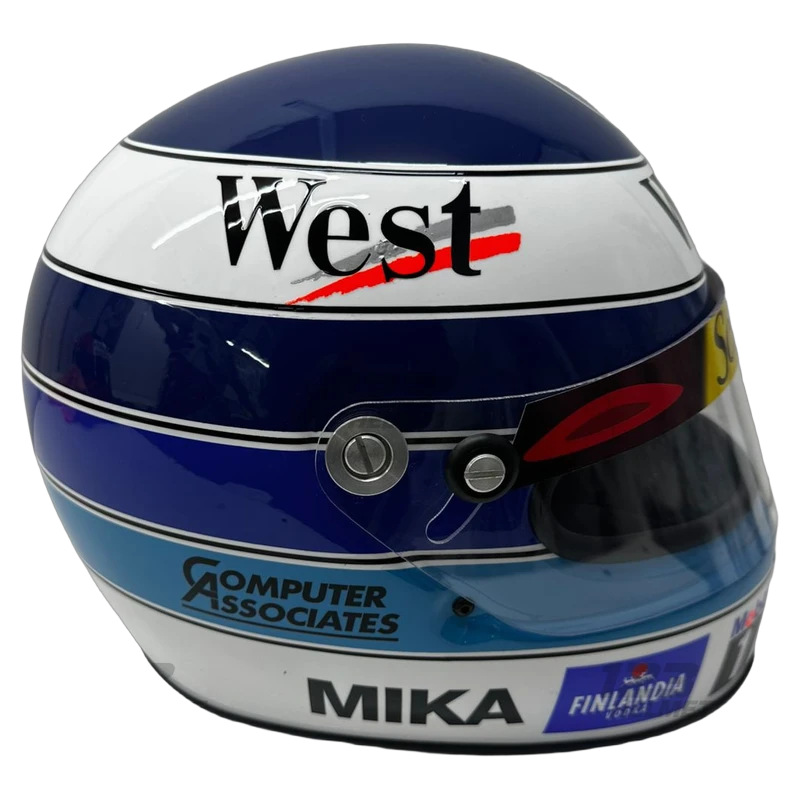
The 1998 McLaren MP4/13 livery — silver-white with black detailing under the West tobacco sponsorship branding — is one of the most replicated colour schemes in F1 collector history, and Häkkinen’s championship-winning helmet from that season carries the same visual weight. As a full-size 1:1 display replica, a Häkkinen 1998 helmet captures not just a driver but a precise technical and aesthetic moment: the season McLaren ran the first fully legal narrow-track car under revised regulations introduced for 1998, which reduced car width from 2,000 mm to 1,800 mm.
The regulation shift to 1,800 mm-wide cars in 1998 gave McLaren a technical advantage that translated directly into Häkkinen’s 8 wins from 16 races. That specific regulatory context — which shaped the car’s proportions and therefore the visual silhouette collectors associate with the era — is embedded in every replica of that livery. A display piece referencing the 1998 McLaren is referencing all of that: the regulation change, the technical dominance, and the Suzuka title clinch.
Häkkinen’s helmet design during 1998 used a predominantly white base with yellow and blue graphic elements — a clean, high-contrast scheme that photographs well under display lighting and reads clearly at the 1:1 full-size scale. For collectors building a McLaren-themed display, pairing a 1998 Häkkinen replica helmet with the papaya and carbon replica worn by Lando Norris or Oscar Piastri in the current season creates a direct visual line between the team’s last championship era and its present title challenge — exactly the narrative McLaren’s 1000th race celebration was designed to make tangible.
Team principal Andrea Stella described the moment as “an incredible honour” — a straightforward acknowledgment that the statue programme is as much about preserving identity as it is about recognising past results. Every full-size 1:1 collector replica helmet operates on the same logic: it is a display-grade object that preserves a specific visual identity for an indefinite future, independent of the season that produced it.
Norris, Piastri, and the Continuation of McLaren’s Story
Lando Norris and Oscar Piastri standing at the Häkkinen statue unveiling placed the team’s current drivers in direct visual and historical alignment with its most recent Drivers’ Championship winner — a man who last raced in F1 at the 2001 Japanese Grand Prix. The 23-year gap between Häkkinen’s final race and the current McLaren driver pairing underlines how long the team waited to return to genuine championship contention, and how much the current papaya livery era means within the team’s own internal narrative.
Norris, who came into the 2024 season as McLaren’s lead championship contender, and Piastri, who claimed race wins in 2024 as part of the team’s Constructors’ title push, are the drivers most likely to appear on the Boulevard in bronze form if the current competitive trajectory holds. For collectors, their current race helmets — particularly the specific livery variants worn during race wins and podium finishes — carry that same latent commemorative value that Häkkinen’s 1998 Suzuka helmet now holds in bronze.
The McLaren papaya orange and carbon black livery introduced across the 2023–2024 seasons is already regarded within the collector community as one of the most display-ready colour schemes the team has run since the West silver era. At 1:1 full-size scale, the contrast between the papaya base and the carbon fibre texture detail is immediately legible as a display piece — it reads as McLaren from across a room, which is the fundamental requirement of any exhibition-quality replica.
The 1000th grand prix celebration, anchored by the Häkkinen bronze, is ultimately a statement about continuity. McLaren has existed through 1000 races, 6 world champion drivers, and more than 100 rival teams that no longer exist. A collector replica helmet from any point in that timeline — whether a 1998 Häkkinen silver or a 2024 Norris papaya — is a physical piece of that continuity, made permanent in full-size 1:1 display form.
“Wow… Good memories! This is me in Suzuka, when I won my first World Championship, the beginning of something very special. That day in Suzuka, before the race, I just remember thinking, ‘okay, let’s do this, let’s go for it’. An amazing moment. Thank you all.”
— Mika Häkkinen, at the bronze statue unveiling, McLaren Woking HQ
“More than 100 Formula 1 teams have come and gone since McLaren made its debut. We are the second-most successful team in history and the second oldest. That all comes down to the DNA Bruce McLaren instilled in this team.”
— Zak Brown, McLaren Racing CEO, 1000th Grand Prix Celebration
FAQ
Q: Where is the Mika Häkkinen bronze statue located?
The Häkkinen bronze statue stands on the Boulevard at McLaren’s factory headquarters in Woking, England, beside the championship-winning MP4/13 from the 1998 season. It joins statues of Bruce McLaren, James Hunt, Niki Lauda, Alain Prost, and Ayrton Senna.
Q: Who sculpted the Häkkinen statue for McLaren?
Paul Oz, a motorsport sculptor known for figurative precision work, created the bronze. The piece depicts Häkkinen celebrating his maiden World Championship win at Suzuka in 1998.
Q: Which grand prix milestone did McLaren celebrate with this unveiling?
McLaren’s 1000th Formula 1 grand prix was the milestone being marked. CEO Zak Brown noted that McLaren is the second-oldest and second-most successful team in F1 history, having operated since its debut in 1966.
Q: What makes the 1998 McLaren Häkkinen helmet a significant collector display piece?
The 1998 Häkkinen helmet references the season McLaren ran the first 1,800 mm-wide car under revised regulations, won 8 races from 16, and clinched the Drivers’ Championship at Suzuka. As a full-size 1:1 display replica, it captures that complete technical and competitive context in a single visual object.
Q: Are McLaren replica helmets certified for road or track use?
No — McLaren replica helmets from 123Helmets.com are display and collector items only, produced at full-size 1:1 scale for exhibition purposes. They are not certified for protective use and are not intended for road, race, or track use of any kind.
Shop McLaren Helmets — full-size 1:1 display replicas honouring every era of McLaren’s 1000-race history, from Häkkinen’s 1998 silver to Norris’s current papaya. Collector and exhibition quality only.
Display and collector replicas only. Not certified for protective use. Full-size 1:1 scale.
This article was written with the help of AI tools. Editorial policy