Blog
Monaco Grand Prix: How Drivers and Strategists Tackle the 3.337 km Street Circuit
 123Helmets Editorial Team
The Monaco Grand Prix remains the most demanding 78-lap chess match on the calendar. Tight barriers, a 3.337 km layout, and a pit lane that rewards perfect timing turn every helmet design and every strategy call into a piece of motorsport theatre worthy of any display shelf.
Key Takeaways
Monaco’s 3.337 km layout forces strategists into a single-stop window that often opens between laps 30 and 45.
Qualifying is worth roughly 80% of the race result — pole position has converted to victory in a high majority of recent editions.
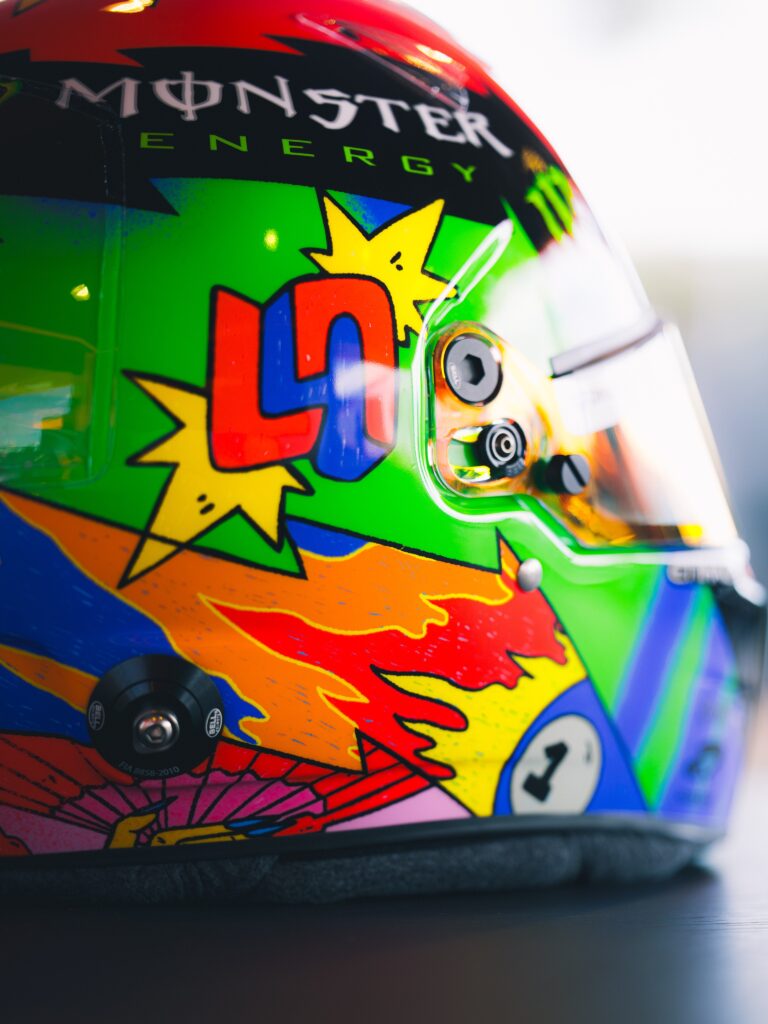
Drivers commission special one-off helmet liveries for Monaco more than for any other round on the calendar.
Podium helmets from Monaco are the most sought-after items for 1:1 collector display, often featuring gold leaf, chrome, and hand-painted detail.
A 3.337 km Puzzle Built for Specialists
Monaco is the shortest circuit on the calendar at 3.337 km, run over 78 laps for a total race distance of 260.286 km. Average speeds sit around 160 km/h, far below Monza or Spa, yet the mental load on the driver is the highest of the season. There are 19 corners squeezed between Armco barriers, and the racing line is rarely wider than 9 metres.
The reason Monaco still matters — beyond the glamour of the harbour — is that it isolates pure driver craft. Telemetry shows top drivers brushing the barriers at Massenet and Tabac with margins under 30 mm. That precision is why the helmets worn at Monaco end up as the most prized 1:1 replica display pieces in any private collection.
Why qualifying decides almost everything
Overtaking attempts at Monaco have historically been rare. Sector 2, from Mirabeau down through the Loews hairpin (the slowest corner in F1 at roughly 48 km/h), offers no realistic passing window. Strategists arrive on Thursday already knowing that grid position carries more weight here than at any other event.
Saturday: The Lap That Sets the Weekend
Qualifying at Monaco is a sequence of out-laps, tyre prep, and a single shot at a 1:10 to 1:11 bracket lap. Drivers describe the perfect Q3 run as four corners they remember and fifteen they don’t — total commitment from Sainte Dévote to the swimming pool chicane.
Helmet design for the qualifying spotlight
Because television cameras frame the cockpit so tightly through the tunnel exit and the Nouvelle Chicane, drivers and their designers treat Monaco as a runway. Recent grids have featured:
- Hand-applied gold leaf accents on the crown
- Chrome bases finished in up to 14 paint layers
- Hidden tributes to family, sponsors, or past Monaco winners under the visor strip
- Custom visor tear-off tabs in metallic finishes
For collectors, these one-off Monaco lids are the centrepiece of any 1:1 exhibition-quality display. The detail work — sometimes 40+ hours per helmet from a specialist painter — only reads properly at full scale.
Race Day Strategy: One Stop, One Window
Modern Monaco races are almost always one-stop. With pit lane loss around 22 seconds and overtaking on-track close to impossible, the strategist’s job is to find clean air on the undercut or stretch the first stint long enough to inherit position when others box.
The undercut versus the overcut
The undercut works when fresh tyres can gain 1.5 to 2.0 seconds in a single lap on cold rubber. The overcut, more common at Monaco, exploits the difficulty of warming new tyres on out-lap — a driver staying out 5 to 10 laps longer than a rival often emerges ahead after the stop. Both calls depend on tracking gaps to the nearest 0.1 of a second across the field.
Safety car probability
Monaco has the highest safety car probability of the season, historically above 60%. Strategy engineers build their pit windows around this. A well-timed safety car between laps 30 and 45 can flip a midfield car onto the podium — exactly what happened in several recent editions and exactly why these podium helmets become legendary display items.
Sector by Sector Through the Helmet Cam
To understand why Monaco helmets are so collectable, it helps to picture what the driver sees from inside the lid.
Sainte Dévote to Massenet
Sainte Dévote is taken in third gear at around 130 km/h, then the climb up Beau Rivage hits 290 km/h before Massenet, a blind left at 160 km/h. The driver’s head is loaded laterally — visor down, peripheral vision filled with white Armco.
Casino, Mirabeau, Loews
Casino Square is the photogenic section. Helmet liveries shine here under the buildings’ shadows, then the descent through Mirabeau into the Loews hairpin slows the car to roughly 48 km/h. At that speed, broadcast cameras capture every paint layer in detail.
The Tunnel
From shadow to sunlight in under 2 seconds at 280 km/h. Drivers run a tinted visor strip — typically 70 mm deep — to manage the light change. The tunnel is where helmet design meets function in the most visible way.
Nouvelle Chicane, Tabac, Swimming Pool
Heavy braking from 290 km/h to 90 km/h at the chicane, then the rhythm of Tabac and the swimming pool complex — high-commitment direction changes with barrier kisses measured in millimetres.
The Podium: Why Monaco Helmets Define a Collection
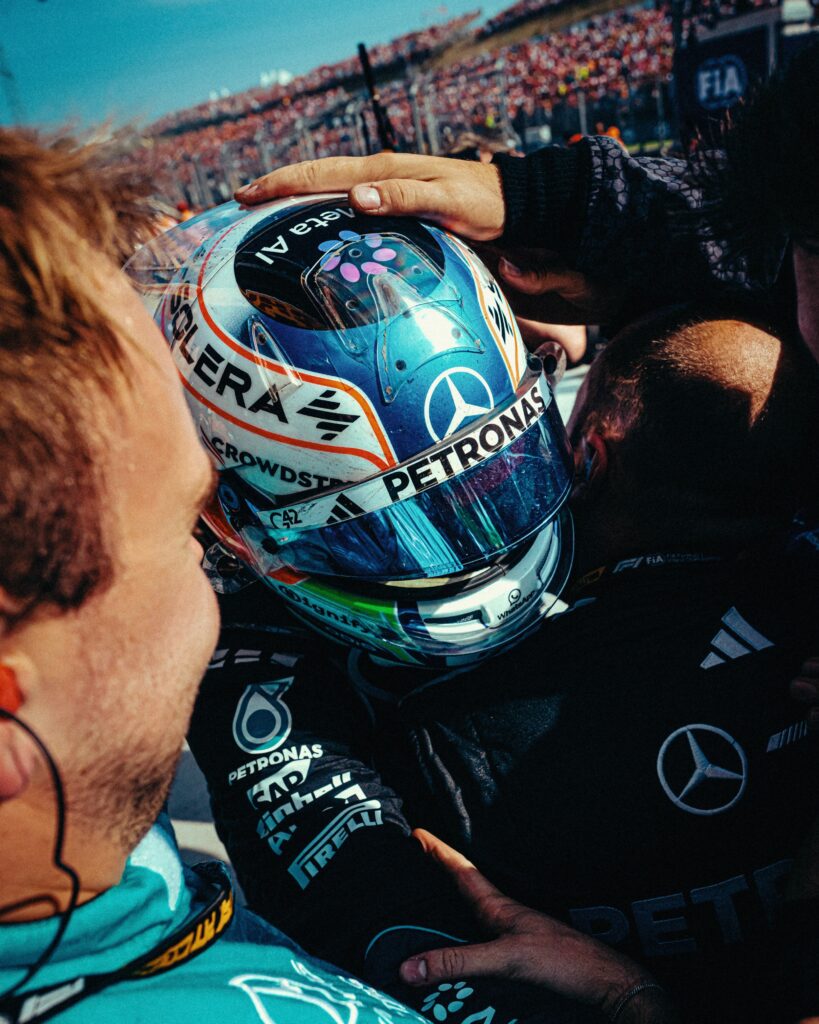
Climbing the steps to the royal box on Sunday afternoon, with the trophy presented by the Monégasque royal family, is the single most photographed podium ceremony in motorsport. The helmet held under the driver’s arm in those photographs becomes the reference image for every 1:1 replica that follows.
What collectors look for
An exhibition-quality Monaco replica should reproduce:
- Full-size 1:1 shell dimensions (typical outer length around 27 cm, width 23 cm)
- Visor depth and tint accurate to the race-day specification
- Tear-off tabs, aero winglets and camera mount positions
- Sponsor decals applied in correct paint order, not as stickers
- Display weight close to the original (1.3 to 1.5 kg range)
These details only matter at full scale. A 1:2 mini misses the proportion entirely. A true 1:1 collector item, mounted on an angled plinth with the visor at eye level, transforms a room.
Livery details that don’t read on TV
Many Monaco helmets carry messages painted in 4 mm script under the chinbar or inside the rear winglet — tributes that broadcast cameras miss but a display piece reveals when handled. That hidden craft is the reason serious collectors prioritise Monaco lids above all others.
Building a Monaco-Themed Display
A Monaco-focused shelf works best with three to five 1:1 helmets representing different eras of the race. Suggested arrangement:
- One classic 1970s or 1980s open-face style at the back, raised 15 cm
- Two modern closed-cockpit era lids at mid-height
- One current-season Monaco one-off at the front, lit from above with 3000K warm LED
Spacing of 35 to 40 cm between helmets lets each livery breathe. A matte black backing wall reduces reflections on chrome and gold leaf finishes. UV-filtered acrylic covers protect paint from fading — Monaco helmets often use pigments that shift in colour under direct sunlight, so display lighting matters as much as the helmets themselves.
“Monaco is the one weekend where the helmet matters as much as the car. Everyone watches the podium photographs for years afterwards.”
— F1 helmet painter, industry interview
FAQ
Q: How long is the Monaco Grand Prix?
The race covers 78 laps of the 3.337 km circuit, for a total distance of 260.286 km — the shortest race distance on the calendar.
Q: Why do drivers commission special helmets for Monaco?
Television coverage at Monaco focuses tightly on the cockpit through the tunnel and chicane sections, and the podium ceremony is the most photographed of the year. Drivers use the visibility to showcase one-off liveries, often with gold leaf, chrome, and hand-painted tributes.
Q: What makes Monaco helmets so popular with collectors?
Monaco one-offs typically feature more paint layers, more hand-applied detail, and more hidden tributes than standard-season helmets. At full-size 1:1 scale on a display plinth, these details read clearly and turn the helmet into an exhibition piece.
Q: How important is qualifying at Monaco?
Overtaking on track is extremely difficult, so grid position carries more weight than at any other race. Strategists treat Saturday’s session as roughly 80% of the race result.
Q: What size should a 1:1 Monaco display helmet be?
A true full-size 1:1 collector replica should have outer dimensions close to 27 cm in length and 23 cm in width, with a display weight in the 1.3 to 1.5 kg range. Anything smaller is a miniature, not a 1:1 display piece.
Browse F1 Helmet Collection
Display and collector replicas only. Not certified for protective use. Full-size 1:1 scale.