
Blog
Monaco Pitlane Penalties Explained: Why Piastri, Hamilton and Four Others Were Caught by 0.1 km/h
 123Helmets Editorial Team

The 2025 Monaco Grand Prix delivered drama on track and a peculiar paperwork storm off it. Six drivers, including Oscar Piastri, were handed pitlane speeding penalties — and in four of those cases the infringement was a microscopic 0.1 km/h. Here is what really happened on the entry kink at Sainte Dévote, and why this weekend produced some of the most display-worthy helmet liveries of the season.
Key Takeaways
Six drivers were penalised for pitlane speeding in Monaco, with four infringements measured at exactly 0.1 km/h above the limit
The FIA confirmed its timing loops worked correctly; the cause was the racing line drivers took through the pit entry kink
Lewis Hamilton finished P2 despite a 5-second time penalty, defending his line as the standard route used for years
Oscar Piastri’s papaya livery and matching helmet remain among the most sought-after 1:1 collector display pieces of the 2025 season
What actually happened at the Monaco pit entry
The post-race FIA documents from Monaco read almost like a typo. Oscar Piastri, George Russell, Franco Colapinto and Pierre Gasly were all flagged for exceeding the 80 km/h pitlane limit by just 0.1 km/h. Lewis Hamilton and one further driver were also caught, with Hamilton handed a 5-second time penalty that he carried to a P2 finish.
When the numbers are that small, the natural reaction is to question the equipment. The FIA did exactly that. Engineers reviewed the timing lines and the loop sensors embedded in the pit lane surface and found no abnormalities in the measurement chain. The transponders on each car were reading correctly, the loops were calibrated, and the data was clean.
The answer was not technical. It was geometric.
The kink at Sainte Dévote
Monaco’s pit entry has a subtle feature that drivers have used for years. As the pit lane opens off the main straight, there is a kink where a driver can stay slightly to the right and effectively cut a few metres off the painted entry line. It saves a fraction of distance and lets the car settle earlier on the limiter.
According to the FIA spokesperson who addressed the issue, measurement of pit lane speed begins the instant the first wheel of the car crosses into the fast lane. For a driver cutting the entry on the right, that first wheel is the front-left. The car’s average speed is then calculated between that entry loop and the exit loop using the official FIA transponder.
Why 0.1 km/h became the magic number
The pit lane speed system in F1 does not measure instantaneous velocity. It measures the average speed of the car between two fixed electronic loops. That is why the infringements ended up so small: any extra distance gained by cutting the kink is averaged across the entire pit lane length, producing a tiny but legally measurable overshoot.
Across the full pit lane, the effect comes out to less than 1 km/h in every case. Four drivers landed at exactly 0.1 km/h over, which is the smallest reportable increment the system records. The penalties were issued because the regulation has no tolerance band — 0.1 over is over.
Hamilton’s reaction
Lewis Hamilton was direct in the post-race press conference. He had pushed his pit limiter button the moment he entered the lane, as he has done for the 18 seasons of his F1 career, and was genuinely surprised to be told he was speeding.
“I wasn’t speeding. I think it’s just the way the pitlane is. I’ve done this pitlane for years. Pitlane limiter is on immediately. I think it’s just the line that you take, which is the same line we’ve all taken for years.”
His view aligns with the FIA’s own conclusion: the regulation caught a behaviour that drivers have repeated for a decade without consequence. Monaco’s geometry simply exposed it.
Piastri’s race and the papaya display moment
Oscar Piastri arrived in Monaco leading the 2025 drivers’ championship and left it still in front, despite the pit lane sanction. The McLaren MCL39 in papaya orange, paired with Piastri’s matte black and papaya helmet, produced some of the cleanest podium frames of the season.
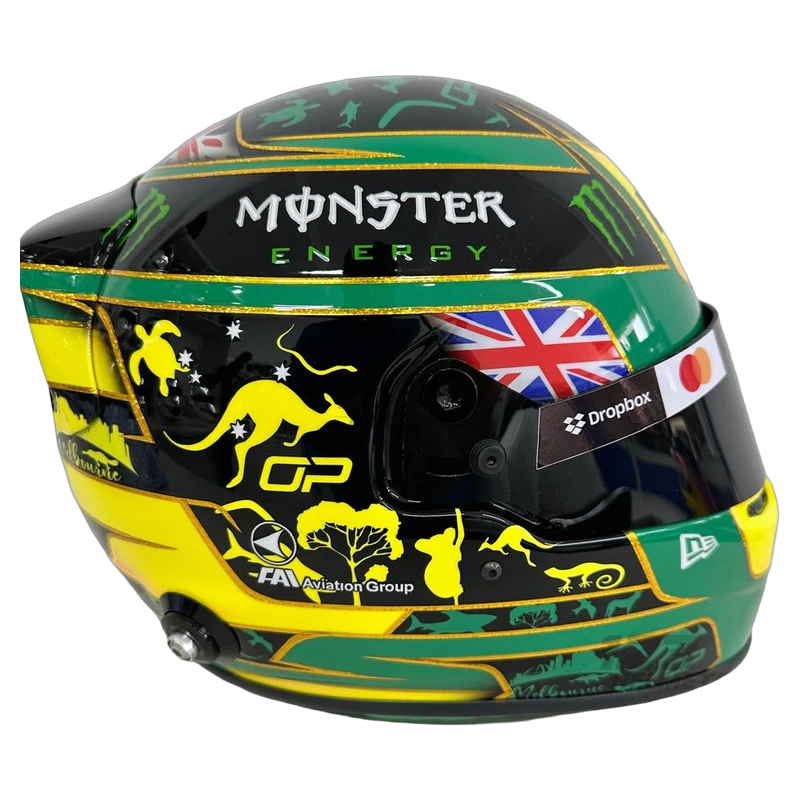
For collectors, Piastri’s 2025 helmet is one of the standout designs of the grid. The shell carries a deep papaya base with a black crown panel, the Australian flag motif at the rear, and a high-gloss visor strip that catches the Mediterranean light beautifully on display. A 1:1 full-size replica reproduces those paint transitions across roughly 29 × 25 × 35 cm of exhibition surface, with multiple lacquer layers giving the depth that flat photography cannot show.
Why Monaco helmets matter to collectors
Monaco is the one race where helmet design has a permanent record value. The principality’s backdrop — yachts, Casino Square, the Loews hairpin — makes every podium photograph an archival image. Drivers know it, sponsors know it, and design studios brief accordingly. A Monaco-spec helmet, even when it shares the base livery of the rest of the year, tends to be the version collectors prioritise for display.
The wider penalty picture
Six penalties for the same offence in the same race is unusual. The last time anything comparable happened was at a wet event where drivers misjudged the white line, but Monaco 2025 was a dry race where the cause was purely the chosen line into the pit lane.
The drivers caught
- Oscar Piastri — 0.1 km/h over
- George Russell — 0.1 km/h over
- Franco Colapinto — 0.1 km/h over
- Pierre Gasly — 0.1 km/h over
- Lewis Hamilton — 5-second time penalty, finished P2
The FIA has not indicated that the pit entry will be repainted or that the loop positions will move for 2026. The cleanest fix would be for drivers to take a wider line through the kink, but that costs lap time on the in-lap and works against everything the engineering data tells them to do. Expect the same conversation next May.
What it means for the championship
Piastri’s lead remains intact. The pit lane penalty was applied within the race result rather than as a grid drop, and the McLaren driver still scored heavily. The bigger story for the title fight is that Monaco confirmed the McLaren package handles low-speed street circuits as well as the high-downforce European venues, which sets up an interesting summer for any collector tracking championship-defining helmets.
Display picks from the Monaco weekend
From a pure visual standpoint, Monaco 2025 produced three helmets worth singling out for a display shelf or cabinet:
Oscar Piastri — McLaren papaya
The papaya-and-black combination is one of the most photogenic on the grid. The 1:1 replica reproduces the satin clearcoat and the contrast between the matte crown and the gloss visor strip. Footprint of around 29 × 25 × 35 cm, weight near 1.4 kg.
Lewis Hamilton — Ferrari red Monaco spec
Hamilton’s first Monaco in Ferrari red, regardless of the 5-second penalty, is a historic frame. The transition from his career-long yellow accents to scarlet is the kind of moment collectors mark with a dedicated display piece.
Charles Leclerc — home race livery
The local driver’s home race helmet always carries Monégasque references. Even when the result does not match the ambition, the Monaco-spec lid from the local driver is a collector default.
All three are produced as full-size 1:1 collector replicas for exhibition use only. They are display pieces, not protective equipment, and are sold as such.
“I wasn’t speeding. I think it’s just the way the pitlane is. I’ve done this pitlane for years. Pitlane limiter is on immediately.”
— Lewis Hamilton, Monaco GP post-race press conference
“I think it’s just the line that you take, which is the same line we’ve all taken for years where you come in, you kind of cut part of the white line.”
— Lewis Hamilton
FAQ
Q: Why were so many drivers penalised at Monaco?
All six drivers cut the pit entry kink on the right-hand side, which is the standard line used for years. The FIA’s transponder system measures average speed from the moment the first wheel crosses the entry loop, and the cut line produced a tiny overshoot averaged across the pit lane.
Q: By how much did Piastri exceed the pit lane limit?
Oscar Piastri was flagged at 0.1 km/h over the 80 km/h limit, the same margin as Russell, Colapinto and Gasly.
Q: Did the FIA find any equipment fault?
No. The governing body reviewed the timing lines and loop sensors after the race and confirmed no abnormalities. The cause was the geometric line drivers took into the pit lane.
Q: What penalty did Hamilton receive and how did he still finish P2?
Hamilton was given a 5-second time penalty, applied to his race time. Because his gap to the car behind was larger than 5 seconds at the finish, he retained second place.
Q: Is the Piastri 2025 helmet available as a display replica?
Yes. The papaya and black McLaren design is produced as a full-size 1:1 collector replica for exhibition use only. It is a display piece, not protective equipment.
Shop Oscar Piastri Collection
Display and collector replicas only. Not certified for protective use. Full-size 1:1 scale.
This article was written with the help of AI tools. Editorial policy