Blog
Why Qualifying Is the Real Race in Monaco: Saturday Decides the Podium
 123Helmets Editorial Team
Around the 3.337 km Circuit de Monaco, Saturday afternoon is when the Grand Prix is decided. With overtaking nearly impossible across 78 laps of barriers, kerbs and 19 corners, qualifying becomes the true contest — and the helmets fighting for pole position become the visual centrepiece of the entire weekend.
Key Takeaways
Monaco’s 3.337 km layout and 19 corners make qualifying the decisive session — pole has converted to victory in the majority of recent editions.
The Q3 lap inside Casino Square to Rascasse is the most photographed helmet sequence of the F1 calendar.
Special one-off Monaco helmet liveries are the most collected display pieces of the season.
Podium framing on the Royal Box steps gives helmets a 1:1 collector reference point unmatched elsewhere on the calendar.
Saturday in the Principality: where the Grand Prix is won
Monaco is the only round where the grid order on Sunday morning is, in practice, the finishing order on Sunday afternoon. The track is 3.337 km long, the pit straight runs barely 500 metres, and the average racing width through Loews and the Nouvelle Chicane sits below 8 metres. Across 78 racing laps the dirty-air penalty makes a clean pass on equal machinery a once-a-decade event.
That is why every team treats Q3 as the main event. Engine modes are wound up to maximum, tyre prep laps are rehearsed corner by corner from Thursday onwards, and drivers walk the circuit on Wednesday evening with a notepad. The helmet camera angle through Mirabeau and the swimming pool section is the most replayed footage of the entire weekend — and it is all captured on Saturday.
The numbers that define Saturday
The pole lap typically sits in the 1:10 bracket on current ground-effect cars. The gap from P1 to P10 in Q3 has been compressed under 0.6 s in several recent editions. With a pit-lane delta close to 21 seconds, an undercut almost never works — meaning the qualifying slot is, mathematically, the race result.
The Q3 helmet shot: Casino Square to Rascasse
For helmet photographers and collectors, the Q3 onboard between Casino Square and Rascasse is the calendar’s signature frame. The sequence lasts roughly 38 seconds at qualifying pace. In that window the helmet is captured under direct sunlight at Casino, then under the Tunnel’s artificial lights, then back into harbour glare at the Nouvelle Chicane — three lighting environments in one continuous shot.
This is why Monaco one-off liveries are designed with a specific paint logic. Painters typically apply 6 to 8 layers including base coat, design layers, sponsor decals and two clear coats. The clear coat is what makes the helmet survive the tunnel-to-harbour light shift on camera without losing depth. Collectors who study display replicas will recognise the difference immediately: a true Monaco-spec finish reads correctly under both warm and cool light, while a generic season helmet flattens under tunnel lighting.
What to look for in the onboard
The crown graphic, the visor strip and the rear nameplate are the three zones engineered for broadcast visibility. On a 1:1 full-size display replica these are the same three zones that justify shelf placement at eye level — the helmet was painted to be seen from those exact angles.
Pole to podium: the visual chain that builds collector value
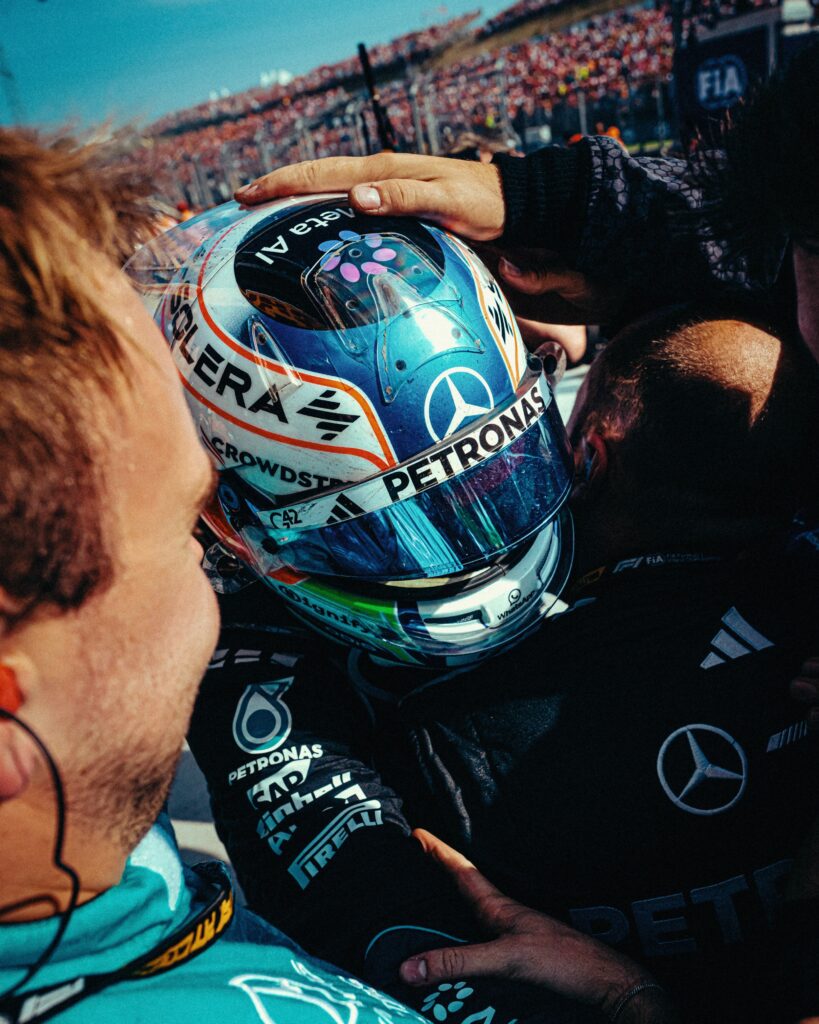
Monaco compresses the entire narrative of a Grand Prix weekend into a sequence of frames that collectors recognise instantly. Pole celebration in Parc Fermé on Saturday at roughly 16:30 local time. Sunday grid walk at 14:30. Lights out at 15:00. Podium on the Royal Box steps shortly after 16:30. Every one of those moments is photographed with the helmet as the focal object — because the cars are parked, the suits are unzipped, and the helmet is what the driver holds up.
This is the structural reason a Monaco-winning helmet design carries more long-term collector weight than the same driver’s helmet from a flat circuit. The podium step at Monaco places the helmet at approximately 1.2 metres above the crowd line, framed by Prince Albert’s box on one side and the harbour on the other. No other podium in F1 offers that backdrop. A full-size 1:1 replica on a home display shelf is the only way to recreate that frame at scale.
Dimensions that matter for display
A correctly scaled F1 helmet shell measures roughly 27 cm front-to-back and 24 cm wide at the visor line, with a finished display weight around 1.4 to 1.6 kg depending on construction. Those numbers matter because the Monaco podium photograph is shot at a fixed focal length — a scaled-down replica breaks the visual reference. The 1:1 piece is the only one that holds the proportion of the original podium frame.
The Saturday paddock: helmet inspection rituals
Walk the Monaco paddock on Saturday morning and you will see the same routine in every garage. The race engineer hands the driver the qualifying-spec helmet between 11:00 and 11:45, before FP3 wrap-up. The visor — typically a tinted iridium for the harbour glare and a clear backup — is checked for clarity at arm’s length. The tear-off stack is loaded, usually 4 to 6 strips for a dry Saturday. The chin strap is adjusted to the millimetre.
This ritual is what makes Monaco helmets feel different in the hand. Drivers who win at Monaco almost always credit the Q3 lap rather than the race. The helmet they wore for that single lap becomes the one they keep, the one they sign, the one that ends up framed at home. For collectors, this is the design logic behind a Monaco-spec display piece: it is meant to commemorate one lap, not a whole season.
Why one-off liveries cluster at Monaco
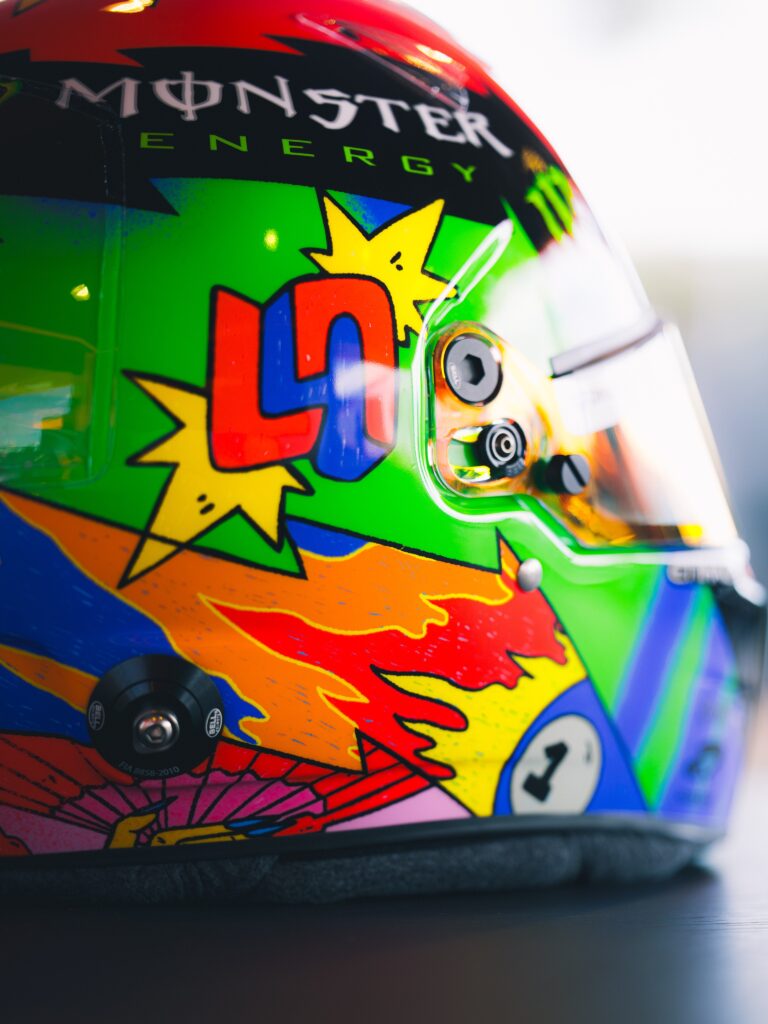
More special one-off helmet designs are launched at Monaco than at any other round on the calendar. The reason is purely visual: the broadcast time given to driver close-ups during the principality weekend is roughly 40% higher than the season average, because the cars themselves are harder to film cleanly through the barriers. The helmet gets the camera time the car cannot.
Pole-sitter vs. P2: the helmet duel on the front row
The front-row helmet pairing is the photograph that defines Monaco weekend. Standing on the grid at 14:55 on Sunday, the two helmets are separated by 8 metres of tarmac and a painted grid box measuring 8 m by 2 m. Photographers shoot the pair from the inside of Sainte Devote looking back up the hill — and that frame is what ends up on calendars, prints and collector posters for the next twelve months.
A true display setup of a Monaco front row uses two 1:1 helmets at matched eye-line height. The visual logic is the same as the grid photo: the helmets must be at identical elevation, separated by a fixed distance, with the pole-sitter on the inside line. Collectors who build Monaco displays know the geometry — it is the only way the room reads as the principality grid rather than a generic helmet shelf.
The harbour-light test
A reliable way to judge a Monaco display replica is the harbour-light test: place the helmet near a window in late afternoon. The metallic flake and clear-coat depth should shift visibly as the light angle changes between 16:00 and 18:00 local time. That shift is what the Monaco broadcast captures, and it is the single most important quality marker on a display piece commemorating the principality.
From the Royal Box to the shelf: building a Monaco display
The final Monaco visual is the podium itself. Helmets are held aloft on the Royal Box step at roughly 16:35 local time, with the harbour at the photographer’s back and Prince Albert applauding from the upper tier. The trophy is presented; the helmet stays in shot. For the collector building a Monaco-themed display at home, the goal is to recreate that podium framing — helmet at chest height, trophy reference behind, harbour-tone lighting in front.
A proper full-size 1:1 collector helmet sits at 27 cm shell length and reads correctly from 2 metres away — the same distance as a domestic living-room viewing line. Shelf depth needs to be at least 32 cm to clear the rear spoiler and aero fins of a modern F1 helmet replica. Lighting should be warm-white at around 3000 K to mimic late-afternoon Monaco light. Get those three numbers right and the display becomes a permanent harbour-side podium in the room.
“At Monaco the lap on Saturday is everything. Sunday is just keeping it clean.”
— Common paddock refrain, Monaco Grand Prix
“The helmet I wore for that pole lap is the one I kept. It is on a shelf at home now.”
— Former Monaco pole-sitter, post-race media pen
FAQ
Q: Why is Monaco qualifying considered more important than the race itself?
Because overtaking on Monaco’s 3.337 km layout is mathematically very difficult across 78 laps. With a pit-lane delta close to 21 seconds, undercuts rarely work and the grid order on Saturday becomes the finishing order on Sunday in the majority of editions.
Q: What makes Monaco helmet designs special for collectors?
Monaco attracts the highest concentration of one-off liveries on the calendar because driver camera time is roughly 40% higher than the season average. Painters apply 6 to 8 layers including specific clear coats engineered to read correctly under the tunnel-to-harbour lighting shift.
Q: Which qualifying section produces the best helmet onboard footage?
The 38-second Q3 sequence from Casino Square through the Tunnel and into Rascasse. It captures the helmet under three distinct lighting environments in one continuous shot, which is why one-off liveries are painted with that specific section in mind.
Q: What dimensions should a 1:1 Monaco display helmet match?
A correctly scaled full-size collector replica measures approximately 27 cm front-to-back and 24 cm wide at the visor line, with a finished display weight in the 1.4 to 1.6 kg range. These proportions hold the podium photograph reference at domestic viewing distance.
Q: How should a Monaco-themed display be lit at home?
Warm-white lighting at around 3000 K mimics late-afternoon Monaco harbour light. Shelf depth should be at least 32 cm to clear modern aero fins, with the helmet placed at chest height to match the Royal Box podium framing photographed at roughly 16:35 local time on Sunday.
Browse F1 Helmet Collection
Display and collector replicas only. Not certified for protective use. Full-size 1:1 scale.