Blog
The Two Worrying Trends for Russell Against Antonelli in F1 2026
 123Helmets Editorial Team
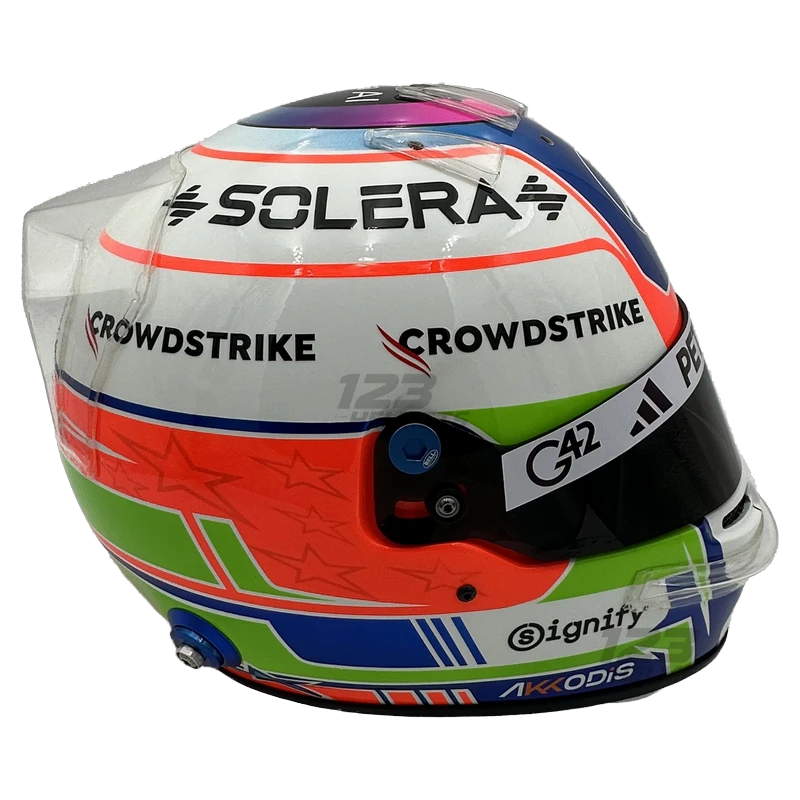
George Russell started 2026 with a lights-to-flag win in Melbourne, yet by the time the F1 paddock left Monaco, two patterns had hardened into genuine problems. The Canadian retirement that cost him 43 points was the headline, but the qualifying gap to Andrea Kimi Antonelli on low-energy circuits is the deeper concern — and the one display collectors tracking the championship duel will want to watch closely as the W17 livery story develops.
Key Takeaways
Russell’s Canadian Grand Prix retirement cost him 43 points in the 2026 standings against Antonelli.
Monaco marked the fifth qualifying defeat to Antonelli, with Russell four tenths adrift in sixth.
On low-energy circuits — Miami, Montreal, Monte Carlo — Antonelli’s aggressive steering inputs warm the W17 tyres more effectively.
Russell’s smoother driving style, once an asset, appears mismatched to the 2026 Mercedes operating window.
Melbourne high to Canadian low: how the momentum flipped
The 2026 season opened with a clean statement from Russell. A lights-to-flag victory in Melbourne suggested the Mercedes number one had absorbed the lessons of a difficult 2025 and was ready to lead the team into a new technical era. The W17, freshly liveried in its updated silver-and-black scheme, looked like a car built around him.
Then the variables started to bite. China brought a safety car cycle that fell on the wrong side of his strategy. Japan added a reliability concern. Canada delivered the worst outcome of all — a retirement that knocked him 43 points behind in the standings, a deficit that reframed the entire title conversation.
For collectors building a 2026 display shelf, the Melbourne-winning helmet design will hold a different weight by season’s end. It is the artefact from the moment Russell looked like the clear favourite inside the Mercedes garage — before Antonelli’s run of clean weekends made that assumption look premature.
The 43-point swing in context
A 43-point gap mid-season is not unrecoverable, but it changes the maths. Russell now needs Antonelli to drop a weekend rather than simply matching him. The 2026 calendar still has the heavy-energy circuits where the W17 has shown stronger balance for Russell, but the run of low-energy tracks gave Antonelli a cushion that was not in any pre-season forecast.
The Miami warning sign nobody acted on
The first hint that something deeper was happening came in Miami. Russell qualified four tenths behind Antonelli in both the sprint session and grand prix qualifying — a margin too consistent to be a single-lap error. At the time, Russell pointed to the Miami Autodrome’s smooth asphalt as a bogey-track quirk. The team accepted that explanation. The data, with hindsight, was telling a different story.
Miami sits in the low-energy category. Long stretches of low-grip surface, a shortage of high-load corners to drive heat into the tyre carcass, and a layout that punishes any driver who cannot generate temperature on the out-lap. Antonelli’s qualifying laps showed sharper steering inputs through the slower sequences — the kind of mid-corner aggression that loads the front axle hard and brings the tyre into its working window faster.
Why the helmet-cam footage matters
Onboard cameras and helmet-cam angles from Miami showed Antonelli’s head movement under braking and turn-in. The rookie was working the wheel more visibly than Russell, and the lap-time gap correlated. For anyone collecting full-size 1:1 replica helmets from this era, those camera angles are part of the visual record — the moment a generational handover began to look plausible on track.
Montreal and Monte Carlo confirm the pattern
Canada was meant to be the reset. Russell did outqualify Antonelli in Montreal, but the margin was narrow and his own words were unflattering. He was, by his own admission, “nowhere until the last lap of Q3” in both sessions, pulling what he called a “special” lap from a weekend that had otherwise been a struggle. A pole that requires a miracle final attempt is not a healthy pole.
Then came Monaco. On the tightest, slowest, most tyre-warm-up-sensitive circuit on the calendar, Russell was beaten decisively. Antonelli took pole. Russell qualified sixth, four tenths adrift. The gap was not a single mistake — it was the same Miami signature, repeated.
“I don’t really know what’s going on to be honest. It’s clearly something with my driving that’s not helping the car at the moment.”
That admission, from a driver normally precise about his own performance, is the clearest sign that the issue is not a one-weekend anomaly. Three low-energy weekends, three versions of the same problem.
The Monaco livery moment
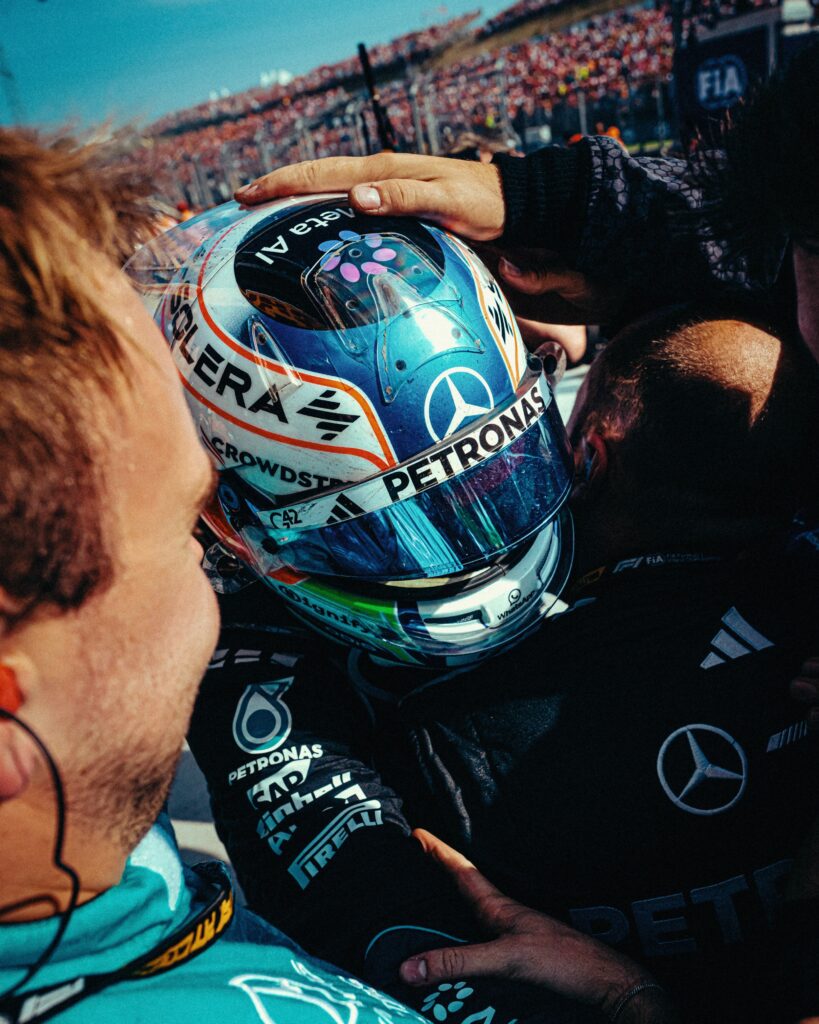
Monaco always produces the season’s most photographed liveries, and the 2026 edition was no exception. Antonelli’s pole-day helmet, captured against the harbour backdrop on qualifying Saturday, is already one of the standout display references of the year. Russell’s sixth-place start, by contrast, leaves a different artefact — a reminder that even a championship-grade driver can be locked out of a car’s operating window by something as subtle as steering input philosophy.
The driving-style mismatch with the W17
Russell’s smooth style has been a calling card since his Williams years. Minimal steering correction, early throttle application, a measured approach to kerbs. Against the high-downforce ground-effect cars of recent seasons, that style extracted clean lap time. The 2026 regulation reset has shifted the requirements.
The W17 appears to reward a more aggressive turn of the wheel through low-speed corners — the kind of input that loads the front tyre quickly and generates the heat the rear axle needs on circuits where lateral energy is scarce. Antonelli, coming through the junior categories under the current generation of tyres, drives that way instinctively. Russell does not.
Can a driving style be retrained mid-season?
It can be adjusted, but rarely overhauled. Drivers spend years building muscle memory, and the instinctive inputs under qualifying pressure are the hardest to rewrite. Russell’s challenge is to find a compromise — enough of Antonelli’s mid-corner aggression to bring the tyres on, without losing the smoothness that still pays dividends on the high-energy circuits where the W17 is more forgiving.
What the rest of 2026 looks like from here
The calendar offers Russell some relief. Silverstone, Spa, Monza and Suzuka all sit in the high-energy category, where tyre warm-up is less of a variable and where his style historically delivers. If he can stop the bleeding through the next low-energy weekend and capitalise on the European summer run, the 43-point deficit becomes a project rather than a verdict.
Antonelli, meanwhile, is building the kind of rookie season that defines a career. Five qualifying wins over a sitting Mercedes number one, a championship lead, and a driving signature that the current car appears to want. The display-piece narrative of 2026 is already half-written, and the helmets coming out of this season — Russell’s Melbourne winner, Antonelli’s Monaco pole helmet — will sit on collector shelves as the visual record of a handover that nobody predicted in March.
The collector angle
Full-size 1:1 replica helmets from transitional seasons hold particular weight in display collections. 2026 is shaping up to be exactly that kind of year — a new regulation cycle, a rookie outpacing his established team-mate, and a livery refresh on one of the sport’s most iconic cars. The exhibition-quality pieces from this campaign will tell a richer story than a single championship trophy.
“I don’t really know what’s going on to be honest. It’s clearly something with my driving that’s not helping the car at the moment.”
— George Russell after Monaco qualifying
“Nowhere until the last lap of Q3.”
— George Russell on his Canadian Grand Prix qualifying
FAQ
Q: How far behind Antonelli is Russell after Canada?
Russell’s retirement at the Canadian Grand Prix cost him 43 points relative to Antonelli, reframing the Mercedes internal championship battle mid-season.
Q: How many qualifying sessions has Russell lost to Antonelli in 2026?
Monaco marked the fifth qualifying defeat, with Russell finishing four tenths behind in sixth while Antonelli took pole.
Q: What links Miami, Montreal and Monaco for Russell?
All three are low-energy circuits where tyre warm-up is the dominant variable, and where Antonelli’s more aggressive steering inputs bring the W17 into its operating window faster than Russell’s smoother style.
Q: Was Russell’s Miami deficit really four tenths?
Yes — Russell qualified four tenths behind Antonelli in both the Miami sprint qualifying and grand prix qualifying sessions, a consistency that ruled out a one-off mistake.
Q: Why are 2026 Mercedes helmets significant for collectors?
The season captures a transitional moment — a new regulation cycle, a rookie outpacing an established team-mate, and a refreshed W17 livery. Full-size 1:1 replica helmets from this year are exhibition-quality display pieces that document the handover.
Browse F1 Helmet Collection
Display and collector replicas only. Not certified for protective use. Full-size 1:1 scale.
This article was written with the help of AI tools. Editorial policy