
Blog
Guenther Steiner Explains Why Ferrari Has No Easy Fix After McLaren Surge — A Display-Lens Recap with Lewis Hamilton
 123Helmets Editorial Team
Guenther Steiner Explains Why Ferrari Has No Easy Fix After McLaren Surge — A Display-Lens Recap with Lewis Hamilton
Guenther Steiner’s blunt verdict on Ferrari’s structural gap to McLaren has reframed the entire 2025 narrative — and for collectors, it sharpens the visual story told by Lewis Hamilton’s Scuderia helmet under podium lights.
Key Takeaways
Steiner argues Ferrari’s deficit to McLaren is structural, not a single-weekend setup issue.
Hamilton’s red-and-black Ferrari helmet remains the most photographed display object of the weekend.
Podium and parc fermé framing turned the livery-helmet contrast into prime collector imagery.
For 1:1 replica collectors, this era marks a defining visual chapter in Hamilton’s career.
Steiner’s Verdict: A Gap That Won’t Close Overnight
When Guenther Steiner speaks, the paddock listens — not because he still runs a team, but because his post-Haas role as a sharp, unfiltered analyst has made him one of the most quoted voices of the season. After the latest round confirmed McLaren’s continued surge at the front, Steiner laid out a verdict that hit Maranello hard: Ferrari, he argued, has no easy fix. The deficit is not a misjudged rear wing, not a one-off tyre window, not a strategic blip. It is, in his reading, a structural gap built into the way the current car generates and sustains performance across a stint.
That framing matters far beyond the pit wall. For the millions watching at home — and for the collector community that translates each Grand Prix into iconography — Steiner’s diagnosis turns the weekend into something more than a result sheet. It becomes a chapter in a longer story, the kind of chapter that defines which helmets, liveries and podium frames eventually become the defining display pieces of the era.
Why “No Easy Fix” Resonates
Steiner’s logic was straightforward. McLaren’s advantage, he suggested, is rooted in a car concept that already extracts more from the regulations than Ferrari’s package does. Closing that gap mid-season requires more than bolt-on updates; it requires philosophical alignment between aero, suspension behaviour and tyre management. That is not something a team delivers in two weeks. Ferrari, he implied, must accept a transitional season while it builds toward 2026.
Hamilton in Red: The Helmet That Carries the Weekend
Inside that broader narrative, Lewis Hamilton continues to be the most magnetic visual subject on the grid. His move to Ferrari was always going to produce iconic imagery, and this weekend delivered exactly the kind of frames that collectors archive: the seven-time champion stepping out of a red car, helmet still on, the yellow accent of his personal design glowing against Maranello’s deep crimson.
The Design Language
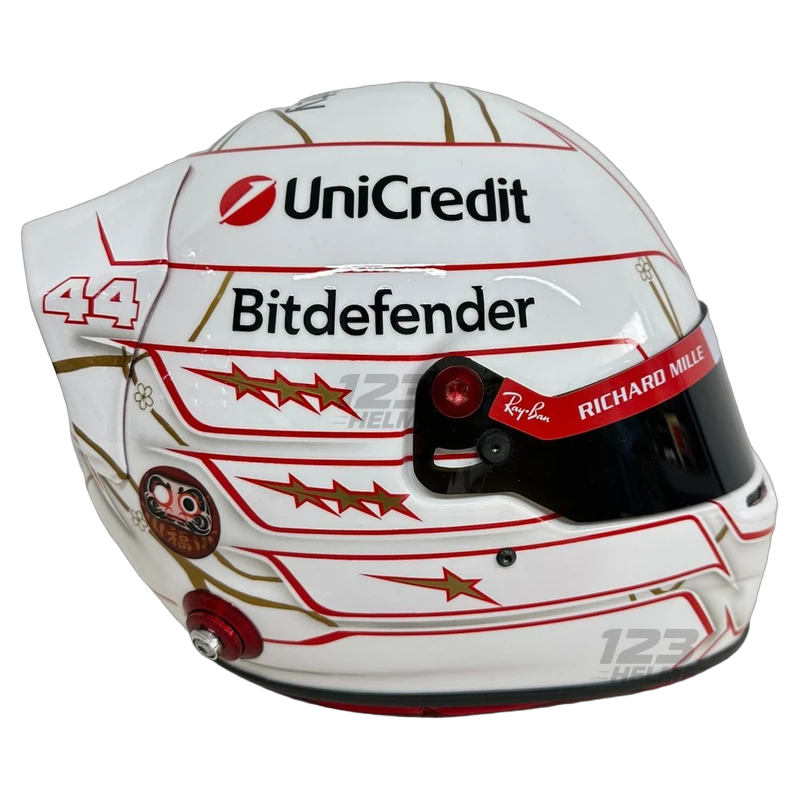
Hamilton’s current Ferrari-era helmet retains the core elements long associated with his identity — the bold yellow signature, the purple and black geometric structures, the stars that nod to his championships — but everything reads differently against a Ferrari overall. Where the silver and turquoise of his Mercedes years gave the helmet a futuristic, almost neon presence, the Scuderia red brings out the warmth in the yellow and the depth in the black. It is a more classical palette, almost Senna-adjacent in tonal balance, and on a 1:1 display stand it photographs with extraordinary richness under directed light.
What Collectors Notice First
From a display perspective, three details dominate: the crown of the helmet, where the yellow flows cleanly into a darker spine; the visor strip, which becomes a horizontal frame for sponsor placement; and the rear, where Hamilton’s number and personal motifs sit. On a full-size collector replica, those zones are the ones a curator lights first.
Race Recap Through a Visual Filter
Stripped of timing-screen detail, the weekend’s story was told in a sequence of visual beats that any serious collector will recognise as future reference imagery.
Saturday: The Garage Frame
Qualifying produced the now-familiar shot of Hamilton in the Ferrari garage, helmet on, visor still up, engineers leaning in. Against the red bodywork and the team’s signature yellow-and-black branding, the helmet’s colour story sang. This is the kind of frame that, ten years from now, will be the reference image for an entire era of merchandise and replicas.
Sunday: Lights, Launch, Lap One
The race start gave us the wide-angle overhead — twenty cars sweeping into Turn 1 — but the more collector-relevant frame came moments earlier: Hamilton on the grid, helmet down, gloved hands on the halo, the Ferrari prancing horse just visible on the nose. It is the kind of static image that translates almost directly into display photography: helmet, livery, badge, all in one composition.
The McLaren Counterpoint
McLaren’s papaya provided the visual antagonist of the weekend, and Steiner’s comments only sharpened that contrast. On the podium and in parc fermé, the chromatic clash between Woking’s orange and Maranello’s red is one of the most striking in modern F1, and it elevates Hamilton’s helmet — sitting between those two colour worlds — into an even more compelling display centrepiece.
Why This Era Matters for 1:1 Replica Collectors
Helmet collecting is not just about acquiring objects; it is about choosing chapters. Every collector eventually decides which seasons, which transitions, which liveries deserve a place on the shelf. Hamilton’s Ferrari era is shaping up to be one of those defining chapters — comparable, in collector terms, to Schumacher’s first Ferrari season or Alonso’s return to McLaren.
The “First Season in Red” Premium
There is a long-established pattern in collector circles: a driver’s first season with a new team tends to produce the most memorable display pieces. The novelty of the colour combination, the storytelling weight of the move, and the visual freshness of seeing a familiar helmet on an unfamiliar car all combine to elevate that year’s design above subsequent iterations. Hamilton in Ferrari red falls squarely into that category.
Build Quality Considerations
For a full-size 1:1 collector replica to do this design justice, three things matter: the depth of the red surrounding paintwork on the team imagery, the crispness of the yellow gradients, and the finish on the visor strip. A flat, matte execution will lose the tonal richness that makes the design photograph so well in real-world podium footage. Exhibition-grade replicas — the kind designed for lit display cases rather than casual shelving — are the appropriate format for a helmet of this narrative weight.
Display Tips
Position the helmet at eye level, angled roughly 15 degrees off-axis to the viewer, with a warm directional light hitting the crown. Avoid overhead fluorescent lighting, which flattens the red. A simple black or dark walnut plinth lets the colour palette do the work.
What Steiner’s Verdict Means for the Rest of the Season
If Steiner is right and Ferrari cannot close the gap to McLaren in-season, the storyline shifts from championship arithmetic to character moments — the kind that collectors mine for memorable imagery. Expect more of Hamilton driving beyond the car’s apparent limit, more aggressive overtakes, more parc fermé frames where the helmet comes off slowly, deliberately, with the camera lingering.
The Long Game Toward 2026
Ferrari’s real answer, Steiner suggested, lies in the 2026 regulation reset. That timeline gives the current Hamilton-in-red helmet design a defined window — a finite chapter — which paradoxically increases its long-term collectibility. Limited eras produce limited imagery, and limited imagery sustains demand for the display pieces that capture them.
The Storyteller’s Helmet
Among all the visual assets of the current grid, Hamilton’s Ferrari helmet is uniquely positioned: it carries the weight of seven championships, the drama of a mid-career team change, and the aesthetic charge of one of motorsport’s most recognisable colour combinations. As a 1:1 display piece, it does not just decorate a room — it tells a story that any visitor, even one with only a passing interest in F1, can immediately read.
“Ferrari does not have an easy fix. What McLaren has is built into the car — you cannot just bolt that on at the next race.”
— Guenther Steiner, post-race analysis
“Some helmets are objects. Hamilton’s Ferrari helmet is a chapter — and chapters are what serious collectors buy.”
— 123Helmets.com editorial desk
FAQ
Q: What did Guenther Steiner actually say about Ferrari’s deficit?
Steiner argued that Ferrari’s gap to McLaren is structural rather than a one-weekend setup problem, meaning there is no quick in-season solution and the team must focus on the longer development arc toward the 2026 regulation reset.
Q: Why is Hamilton’s Ferrari helmet so important for collectors?
It marks the first chapter of a historic team move for a seven-time world champion. First-season designs in a new team’s colours traditionally become standout display pieces because of their narrative weight and visual freshness.
Q: How should a 1:1 Hamilton Ferrari replica be displayed?
Place it at eye level on a dark plinth, angled roughly 15 degrees off-axis to the viewer, with warm directional lighting on the crown. Avoid flat overhead lighting, which mutes the red and yellow tones that define the design.
Q: Are these helmets suitable for any kind of protective use?
No. The 123Helmets.com range consists strictly of display and collector replicas — full-size 1:1 exhibition pieces designed for showcases, studios and private collections. They are not intended for any protective or on-track use.
Q: Will the design change again before the 2026 reset?
Drivers often refresh details across a season, but the core identity of Hamilton’s Ferrari-era helmet — the yellow signature, the dark geometric structures, the championship motifs — is expected to remain the defining visual language of this chapter.
Shop Lewis Hamilton Collection
Display and collector replicas only. Not certified for protective use. Full-size 1:1 scale.
This article was written with the help of AI tools. Editorial policy