Blog
Carlos Sainz and the 2026 F1 Rules Debate: A Williams Display Lens
 123Helmets Editorial Team
Carlos Sainz and the 2026 F1 Rules Debate: A Williams Display Lens
Carlos Sainz has stopped publicly criticising the incoming 2026 Formula 1 regulations — but the Spaniard still believes the framework is “not good enough.” For Williams collectors, his measured stance frames a fascinating chapter in the team’s modern identity, and his current helmet livery already stands as one of the most display-worthy pieces of the season.
Key Takeaways
Sainz publicly steps back from criticising the 2026 F1 regulations, while privately maintaining they fall short.
Williams’ 2025 campaign delivers strong narrative material for collectors building a modern Grove-era display.
The Sainz helmet livery — red, yellow and royal blue — reads beautifully under exhibition lighting in 1:1 scale.
A Williams-themed shelf gains depth when paired with team-colour replicas across multiple driver eras.
Sainz Softens His Tone, Not His Verdict
Carlos Sainz has been one of the most articulate voices in the Formula 1 paddock on the subject of the sport’s 2026 technical overhaul. The Spaniard, now wearing Williams royal blue, spent much of the season questioning whether the new power unit balance, the reintroduced active aerodynamics and the revised chassis dimensions would produce the kind of racing fans deserve. His criticism was never theatrical — it was technical, considered and rooted in the experience of a driver who has tested across multiple manufacturers.
Now, however, Sainz has signalled a shift. He has confirmed he is “not going to criticise it anymore,” while making it equally clear that, in his personal assessment, the 2026 package is “not good enough.” It is a nuanced stance: a driver acknowledging that the regulations are locked in, that public lobbying has run its course, and that the responsibility now shifts to engineers, teams and the FIA to extract the best possible spectacle from the framework on the table.
Why the shift matters for Williams
For a team rebuilding its competitive identity under James Vowles, having a senior driver who has chosen to redirect his energy from public commentary toward internal development is a meaningful asset. Williams enters 2026 with arguably its most ambitious technical roadmap in over a decade, and Sainz’s pivot from critic to constructor — at least in tone — aligns neatly with the Grove operation’s quiet, methodical approach.
The Race Weekend Through a Display Lens
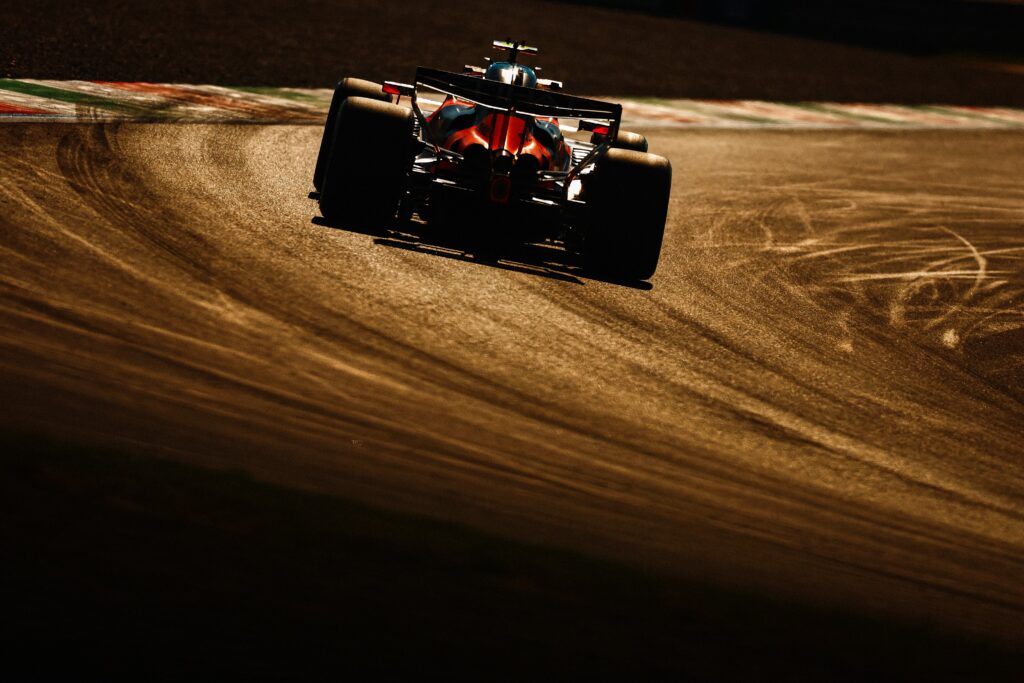
Strip away the politics and the regulatory headlines, and the on-track product remains the heart of every grand prix weekend. For collectors, the visual story is what endures: the helmet under the visor light in parc fermé, the team principal’s expression on the pit wall, the livery of the car catching the late-afternoon sun on the cool-down lap. These are the images that translate into display pieces years later.
Sainz’s weekend was, in characteristic fashion, a study in measured aggression. The Williams FW chassis is not yet a podium contender on raw pace, but the Spaniard has consistently extracted weekends that look better on paper than the car’s underlying performance suggests. That ability to maximise — to make a P9 feel like a P6 in narrative terms — is precisely what makes a driver’s helmet worth displaying. It represents not just speed, but craft.
Visual cues worth preserving
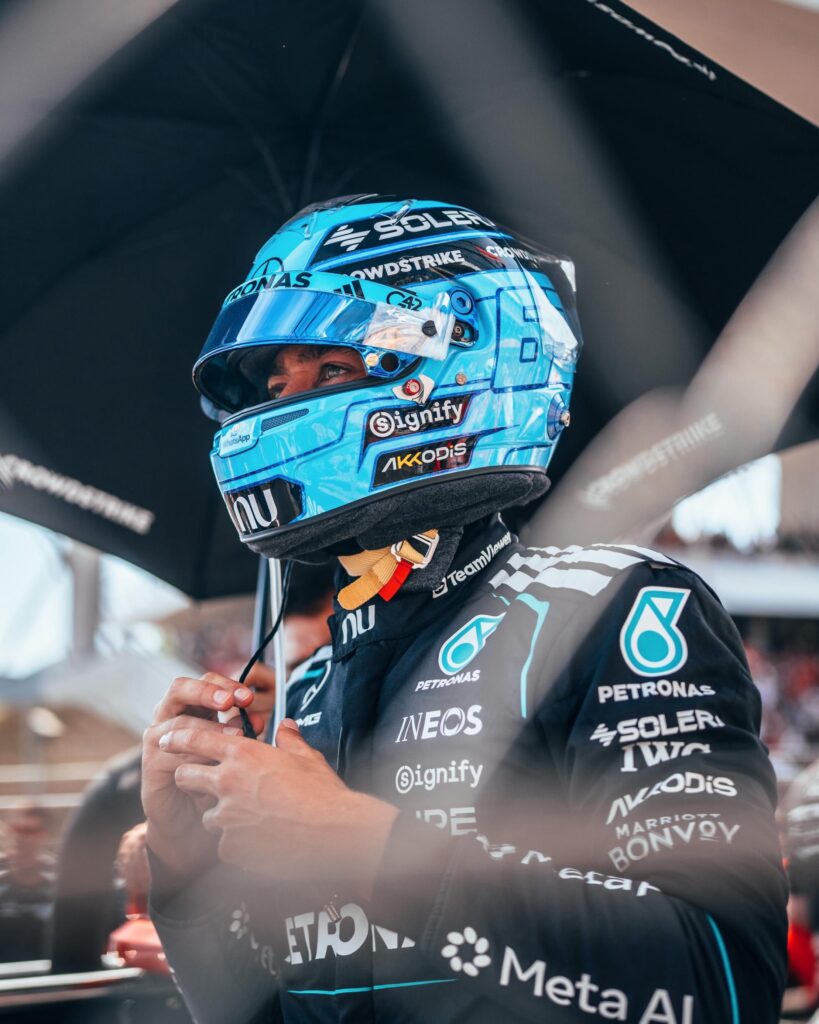
The current Williams livery, with its deep royal blue and crisp white accents, photographs beautifully against Sainz’s personal helmet design. The red-and-yellow Spanish flag motif, the matte finishes on the upper crown, and the contrasting gloss visor surround all create a piece that holds its own under directional lighting. For exhibition-quality 1:1 replicas, that contrast between matte and gloss is what separates a competent display item from a true centrepiece.
Helmet and Livery: Why the Sainz Williams Era Reads So Well
Helmet design in modern Formula 1 is a balancing act. Drivers are constrained by sponsor real estate, regulatory paint zones and the demands of broadcast visibility. Within those constraints, Sainz has maintained one of the most recognisable identities on the grid — a fact that carries directly over into the collector market.
The colour story
The Sainz helmet pairs Spanish national colours with a personal palette that has evolved subtly since his Toro Rosso debut. The red and yellow remain anchored to the upper section, while the lower band has shifted across his career to reflect each team’s identity. In the Williams era, that lower band sits in conversation with the team’s blue, creating a surprisingly harmonious overall composition when the helmet is photographed beside a model car or alongside team merchandise.
The display proposition
For collectors building a 2025–2026 Williams shelf, a full-size 1:1 Sainz replica functions as the natural anchor. It is bold enough to dominate a single-driver vignette, yet restrained enough in its colour blocking to coexist with an Albon piece or a heritage Williams replica from the FW14B or FW18 era. Pieces of this scale and finish are intended exclusively as display and collector items — exhibition-quality reproductions for shelves, cabinets and dedicated motorsport rooms.
What the 2026 Debate Means for the Collector Market
Regulation changes always reshape the collector landscape. The end of the V6 turbo-hybrid era as we currently know it, the shift toward greater electrical deployment and the cosmetic redesign of the cars all mean that 2025 helmets and liveries will, in retrospect, mark the closing chapter of a distinct visual epoch. Sainz’s first Williams season sits squarely within that closing chapter.
Why current pieces gain narrative weight
Collectors often underestimate how quickly a season transitions from “current” to “historical” in the cultural memory of the sport. The 2025 Williams campaign — Sainz’s debut year in royal blue, with all the regulatory turbulence swirling around it — is already accumulating the kind of context that makes a display piece more than decoration. It becomes a marker of a moment.
Pairing strategies
For those building a themed display, consider pairing a Sainz 2025 Williams replica with a heritage piece from the team’s championship years. The visual contrast between the modern matte-and-gloss treatment and the simpler paint schemes of the 1990s tells a story about how the sport, the helmets and the teams themselves have evolved. It also gives a Williams shelf a sense of continuity — from Mansell and Hill through to Sainz and Albon.
Sainz the Communicator: A Driver Who Curates His Own Legacy
One of the reasons Sainz’s helmets and Williams-era memorabilia have generated such steady collector interest is that the driver himself is unusually deliberate about how he presents his career. His decision to step back from public criticism of the 2026 rules is consistent with a broader pattern: he chooses his battles, manages his narrative, and treats his image with the care of someone who understands that a Formula 1 career produces artefacts that will outlast the driving years.
That self-curation matters for collectors. A driver who treats his helmet designs, his livery moments and his media appearances as part of a coherent personal brand produces memorabilia with a clearer aesthetic identity. Sainz’s pieces — whether tied to Toro Rosso, Renault, McLaren, Ferrari or now Williams — share a recognisable visual DNA. That continuity is what makes a multi-team Sainz shelf one of the more rewarding curatorial projects in modern Formula 1 collecting.
The Williams chapter as a centrepiece
Within that career-spanning collection, the Williams chapter holds a distinct position. It is the team where Sainz is no longer the rising prospect or the marquee replacement — he is the senior figure, the experienced voice, the driver shaping a project. That seniority gives the 2025 and 2026 helmets a different gravitational weight on a display shelf. They represent leadership, not transition.
Looking Ahead: The Visual Story of 2026
Whatever the technical merits or shortcomings of the 2026 regulations, the visual product is already being prepared. Teams have begun previewing concept liveries, helmet designers are working on next-season iterations, and the cultural conversation around the sport is shifting toward what the new cars will look like, sound like and feel like. Sainz, having declared his peace with the regulatory framework, will arrive at the 2026 season with a fresh helmet design, a Williams chassis built specifically for the new rules, and the opportunity to shape an entirely new chapter of his collector legacy.
For those building a display now, the recommendation is simple: anchor the shelf with a current-era Sainz Williams piece, leave room for the 2026 evolution, and treat the regulatory transition as a feature of the collection rather than a complication. Formula 1’s most rewarding eras to collect are precisely those moments when the sport is in flux — and 2025 into 2026 is unmistakably one of those moments.
“I’m not going to criticise it anymore — but the 2026 rules are not good enough.”
— Carlos Sainz
“The driver who curates his own image curates his collector legacy at the same time.”
— 123Helmets editorial
FAQ
Q: Why is Carlos Sainz no longer publicly criticising the 2026 F1 regulations?
Sainz has indicated that the regulations are now locked in and that further public criticism serves no constructive purpose. He still believes the framework is not good enough, but is redirecting his energy toward internal team development at Williams.
Q: What makes a Sainz Williams helmet replica appealing as a display piece?
The combination of Spanish red and yellow with Williams royal blue produces a balanced, photogenic colour story. In full-size 1:1 scale, the contrast between matte and gloss finishes makes it an exhibition-quality centrepiece for collectors.
Q: Are these helmets intended for any kind of on-track or protective use?
No. The replicas referenced here are display and collector items only. They are exhibition-quality 1:1 reproductions designed for shelves, cabinets and motorsport display rooms — not for any wearable or protective application.
Q: How should I pair a Sainz Williams replica with other pieces?
Consider pairing it with a heritage Williams replica from the team’s championship era, or with other Sainz pieces from his earlier teams. Both approaches create a coherent narrative shelf — one team-focused, one driver-focused.
Q: Will the 2026 regulation change affect the collectibility of 2025 helmets?
Historically, helmets from the final season of any technical era gain narrative weight over time. The 2025 Williams Sainz pieces sit at the close of the current regulatory chapter, which adds context and storytelling value to the display.
Shop Williams Helmets — full-size 1:1 collector and display replicas, exhibition quality, ready to anchor your motorsport shelf.
Display and collector replicas only. Not certified for protective use. Full-size 1:1 scale.
This article was written with the help of AI tools. Editorial policy
![[X]: IN THE TOP THREE Joining Max Verstappen and Kimi Antonelli on the podium today was Charles Leclerc, ended](https://123helmets.com/wp-content/uploads/2026/10/hero-x-kymillman-in-the-top-three-joining-max-verstappen-and-kimi-2026-768x1024.jpg)