
Blog
Rob Smedley Sounds the Alarm on Ferrari’s “Slightly Soul-Destroying” Upgrades — and What It Means for Hamilton’s Helmet Story
 123Helmets Editorial Team

Rob Smedley Sounds the Alarm on Ferrari’s “Slightly Soul-Destroying” Upgrades — and What It Means for Hamilton’s Helmet Story
Former Ferrari engineer Rob Smedley has lit a fuse under Maranello’s struggling 2024-spec successor, branding the team’s recent upgrade path “slightly soul-destroying”. For Lewis Hamilton, parachuted into the most scrutinised seat in motorsport, every weekend is now a balancing act between damage limitation, learning a new red machine, and producing the kind of visual moments — the helmet glints, the podium-adjacent gestures, the livery-on-livery dramas — that collectors and display enthusiasts will remember long after the timing sheets fade.
Key Takeaways
Rob Smedley described Ferrari’s recent upgrade trajectory as “slightly soul-destroying”, framing the technical narrative around Hamilton’s debut campaign in red.
Hamilton’s helmet program in Ferrari colours is becoming a central collector storyline, with each race adding new display-worthy visual chapters.
Livery, helmet and podium visuals now carry as much editorial weight as race results for fans curating 1:1 display replicas.
The Smedley critique reframes the season as a long-game collector arc rather than a short-term title fight.
Smedley’s Verdict: A Technical Storm Around a Red Helmet
When Rob Smedley speaks about Ferrari, the paddock listens. The former race engineer — once the voice in Felipe Massa’s ear during some of the Scuderia’s most cinematic seasons — has used his recent media appearances to question the direction of Maranello’s upgrade philosophy, calling parts of it “slightly soul-destroying” to watch from the outside.
For collectors who track Formula 1 not just by championship points but by visual identity, the Smedley intervention matters. It reframes the entire Hamilton-at-Ferrari narrative: this is no longer simply a story about a seven-time champion chasing an eighth crown. It is a story about a red helmet, a red car, and the very public attempt to drag a proud team back to the front of the grid.
Why the language hits so hard
“Soul-destroying” is not a phrase engineers use lightly. Smedley’s choice of words signals frustration with a pattern — upgrades that promise gains, deliver inconsistency, and force drivers like Hamilton and Charles Leclerc into a constant reset of expectations. From a display-replica perspective, this is the kind of editorial backdrop that turns a current-season helmet into a future historical artefact: the helmet worn during the rebuild, the one fans will point at years from now as the symbol of the turning point.
Hamilton in Red: The Helmet as the Story
Lewis Hamilton’s switch to Ferrari was always going to be more than a contract change. It was a visual event. The moment his characteristic yellow-accented helmet design first sat above a scarlet race suit, the collector world recalibrated. Every variation — every micro-tweak to the crown, every shift in the chin bar finish, every special-edition layout — instantly became a candidate for the display shelf.
Yellow on red: the contrast collectors crave
The reason Hamilton’s Ferrari-era helmets resonate so strongly as full-size 1:1 collector pieces is brutally simple: contrast. Yellow against Ferrari red is one of the most photogenic combinations in modern motorsport, and it photographs beautifully under paddock lights, in pit-lane reveals, and on a lit display plinth at home. For exhibition-quality replicas, that contrast translates into a piece that demands attention from across a room.
Reading the weekend through the visor
Against the Smedley backdrop, every Hamilton stint becomes a story told through the helmet camera. The on-board angle — visor up, eyes scanning, gloves on the wheel — is now the dominant visual language of his Ferrari chapter. Display collectors increasingly curate around this single frame: the helmet as it appears in the cockpit, perfectly lit, perfectly poised.
Race Recap Through a Collector’s Lens
Stripping the weekend back to its display-worthy beats, the recurring theme is one of fragments rather than fireworks. Hamilton’s Ferrari is fast in flashes, vulnerable in others, and constantly being recalibrated. That inconsistency is exactly what Smedley was reacting to — and it is exactly what gives this period such a distinctive collector identity.
Qualifying: the helmet under the visor light
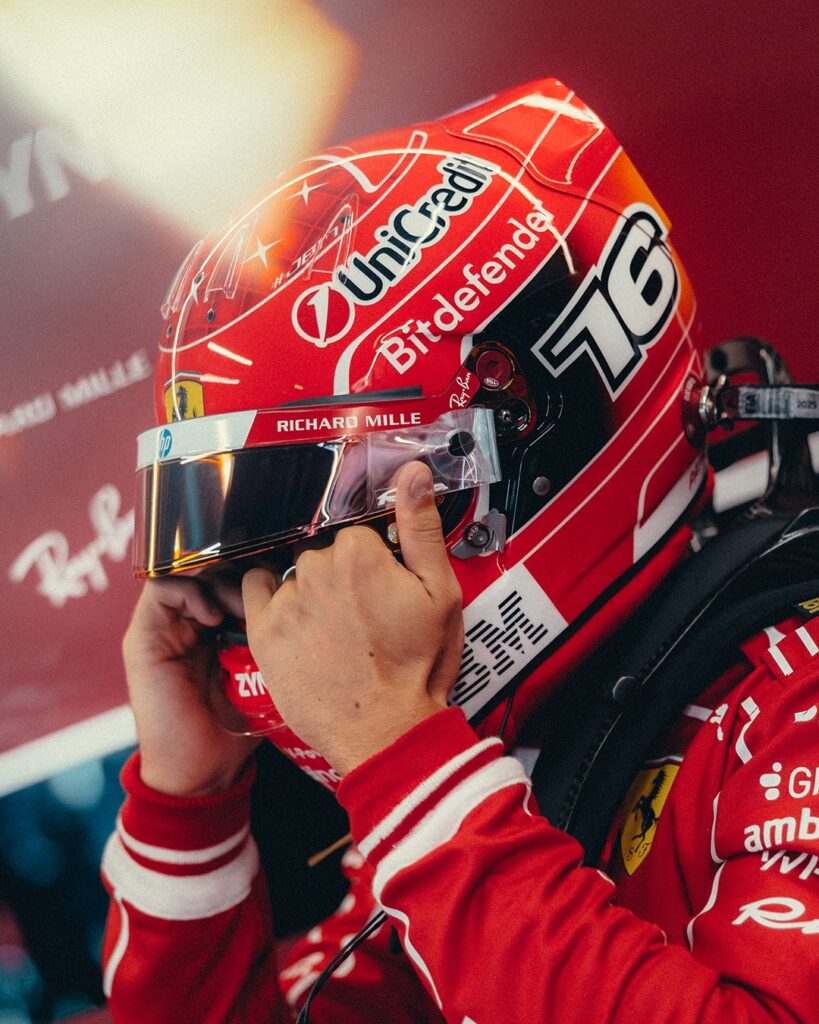
Saturday afternoons have become the most visually rich part of the weekend. The Ferrari garage, bathed in red light, framing Hamilton’s helmet as he prepares for a final run, produces the kind of image that translates directly into display ambition. A 1:1 replica on a backlit stand at home is, in effect, a reconstruction of that exact moment.
Race day: livery in motion
The race itself is where helmet and livery converge. The Ferrari’s deep red flanks, the sponsor placements, the contrast against trackside barriers and grandstand crowds — all of it forms the canvas against which Hamilton’s helmet sits. For collectors building dioramas or themed display rooms, this is the season that finally delivers a Hamilton-in-red full-grid aesthetic.
Podium-adjacent moments
Even when the podium remains out of reach, the post-race rituals — helmet off, hair tied back, eyes scanning the data screens — generate the editorial imagery that fuels collector culture. Smedley’s critique gives those moments extra weight: this is the visual record of a team in the middle of a difficult chapter, and every helmet pulled off in frustration becomes a piece of history.
The Smedley Effect: Why Critique Sharpens Collector Interest
It might seem counter-intuitive, but periods of internal turbulence at Ferrari have historically produced the most collected helmets. The mid-2000s Massa-Smedley era, the late-2010s Vettel push, the Leclerc breakthrough years — each generated iconic display pieces precisely because the narrative was charged.
From criticism to canon
When a respected voice like Smedley publicly questions the technical direction, it crystallises the era in the public memory. Years from now, the helmets worn during this specific upgrade cycle will be referenced as “the Smedley-era Ferraris” — the ones produced while the team was being openly challenged to do better. That cultural framing is gold for collectors building thematic displays.
Hamilton as the focal point
Hamilton’s arrival amplifies everything. He is the most photographed driver of the modern era, and his helmet is one of the most recognisable in the sport’s history. Place that helmet inside a Ferrari narrative under Smedley-level scrutiny, and you have a perfect storm of editorial and visual interest — exactly the conditions that turn a current-season replica into a long-term display centrepiece.
Building the Display: A Hamilton-Ferrari Curation Guide
For collectors planning to anchor a display around this specific Hamilton-at-Ferrari chapter, the Smedley narrative offers a clear curatorial spine. The goal is not to celebrate dominance — it is to document a transition.
The core piece
The foundation of any Hamilton-Ferrari display is the full-size 1:1 replica helmet in current-season livery. Exhibition-quality finish, accurate visor tint, correctly proportioned aero elements — these are the details that separate a casual ornament from a serious collector item. As a display piece, it carries the era on its surface.
Supporting visual language
Around the helmet, the rest of the display should echo the season’s mood. Think framed editorial prints of qualifying nights, scale livery details, and lighting that mirrors the deep red of the Ferrari garage. The Smedley quote itself — “slightly soul-destroying” — would not be out of place as a printed editorial caption beside the helmet, anchoring the piece to a precise moment in time.
Future-proofing the collection
Because this era is still unfolding, smart collectors are leaving room. A single helmet today may sit alongside a special-edition variant tomorrow, or a commemorative design marking a future breakthrough. The display should be built as a chapter, not a conclusion.
Looking Ahead: What the Next Phase Means for the Shelf
Smedley’s warning will not be the last critical voice this season. Ferrari operates under a microscope no other team experiences, and Hamilton’s presence has only intensified that scrutiny. From a collector and display perspective, however, this turbulence is precisely what makes the era so rich.
The helmet as historical record
Every full-size 1:1 replica on a shelf is, in effect, a snapshot of a moment the sport decided was significant. The Hamilton-Ferrari helmets of this period — produced while Smedley and others were openly questioning the team’s direction — are being minted into that historical record in real time.
The collector’s advantage
Fans who are paying attention now, while the narrative is still being written, are the ones who will own the most editorially complete displays five and ten years from now. The Smedley quote, the upgrade debate, the helmet visuals — they all fold into a single, coherent collector story that the casual observer will only recognise in retrospect.
“Slightly soul-destroying.”
— Rob Smedley, on Ferrari’s recent upgrade direction
“The helmets worn during a rebuild are the ones fans point at years later.”
— 123Helmets.com editorial desk
FAQ
Q: What exactly did Rob Smedley say about Ferrari?
Smedley described Ferrari’s recent upgrade trajectory as “slightly soul-destroying”, expressing public frustration with the inconsistency of the team’s development path during Hamilton’s debut Ferrari campaign.
Q: Why does Smedley’s critique matter for helmet collectors?
Periods of public scrutiny tend to crystallise an era in the sport’s memory. The helmets worn during such chapters often become the most editorially significant display pieces in the years that follow.
Q: Are the Hamilton-Ferrari helmet replicas usable on track?
No. All pieces referenced are full-size 1:1 collector replicas intended as display items and exhibition-quality collectibles only. They are not designed or certified for any protective or on-track use.
Q: What makes the yellow-and-red Hamilton design so collectable?
The contrast between Hamilton’s signature yellow accents and Ferrari’s deep red livery creates one of the most photogenic helmet combinations in modern F1, translating beautifully into lit display environments at home.
Q: How should I build a Hamilton-Ferrari themed display?
Anchor the display with a full-size 1:1 replica helmet in current Ferrari livery, then layer in editorial prints, lighting that mirrors the Ferrari garage palette, and leave space for future season-specific variants as the era unfolds.
Shop Lewis Hamilton Collection
Display and collector replicas only. Not certified for protective use. Full-size 1:1 scale.
This article was written with the help of AI tools. Editorial policy