- Keke Rosberg
- Nigel Mansell
- Jenson Button
- Nico Rosberg
- Gilles Villeneuve
- Mika Hakkinen
- Jackie Stewart
- Charles Leclerc
- Lewis Hamilton
- Max Verstappen
- Lando Norris
- Ayrton Senna
- Michael Schumacher
- Fernando Alonso
- Oscar Piastri
- George Russell
- Kimi Antonelli
- Nico Hülkenberg
- Gabriel Bortoleto
- Pierre Gasly
- Franco Colapinto
- Carlos Sainz
- Oliver Bearman
- Sergio Pérez
- Valtteri Bottas
- Isack Hadjar
- Alain Prost
- James Hunt
Verstappen and Hadjar Surprised by Red Bull Pace at Barcelona Qualifying
Posted by
 123Helmets Editorial Team
123Helmets Editorial Team
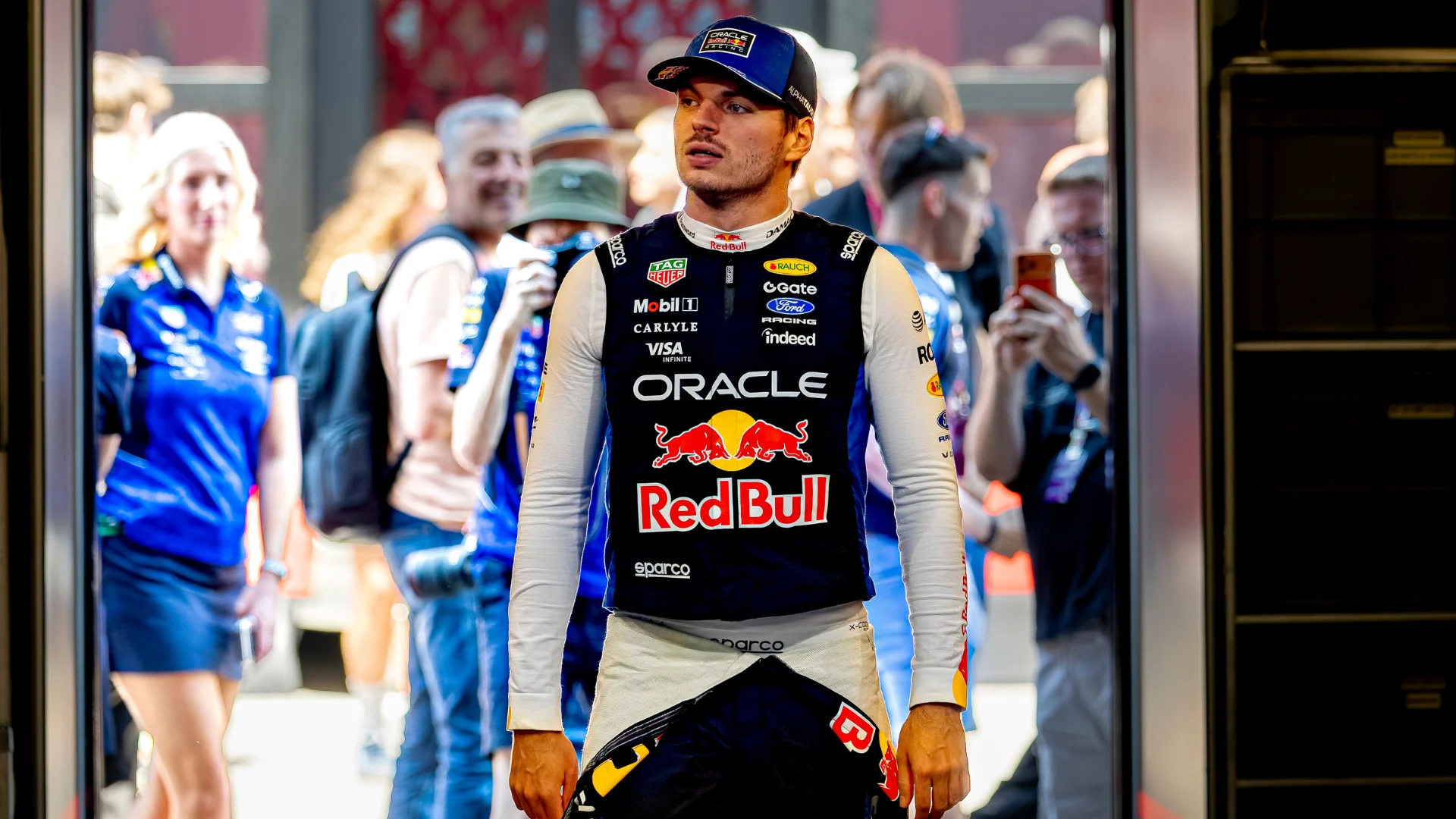
Barcelona GP Qualifying Recap
Max Verstappen admitted he walked into Barcelona qualifying expecting to be ‘miles off’ the pace — then found himself just four tenths from pole. Here is what the session meant for Red Bull’s RB22, and why the third row is a genuine launchpad for Sunday’s 66-lap race.
Key Takeaways
Verstappen qualified P5, within four tenths of George Russell’s pole time — far better than the P7–P8 he had anticipated before the session.
A red flag mid-Q3 disrupted the rhythm of drivers who had already completed their first flying lap, including Verstappen and Oscar Piastri.
Hadjar qualified P6, less than one tenth behind Kimi Antonelli in P3, making the gap to the podium row agonisingly small.
Sunday’s 66-lap race at Barcelona is expected to feature high temperatures and multiple pit stops, placing strategy at the heart of the result.
A Session That Defied Expectations
Saturday afternoon at the Circuit de Barcelona-Catalunya produced one of the more unexpected qualifying results of the season so far. Max Verstappen, a four-time Formula 1 World Champion accustomed to fighting at the front, walked into Q3 with measured expectations. Speaking after the session, he was frank: he had anticipated finishing somewhere between seventh and eighth on the grid. What he found instead was a car capable of splitting the gap to pole down to less than four tenths of a second.
George Russell took pole position for Mercedes, but the margin separating him from the Red Bull RB22 was not the gulf it had been in recent outings. Both Verstappen and rookie Isack Hadjar ended the session on the third row — P5 and P6 respectively — representing a meaningful step in performance that neither driver had fully predicted heading into Saturday’s work.
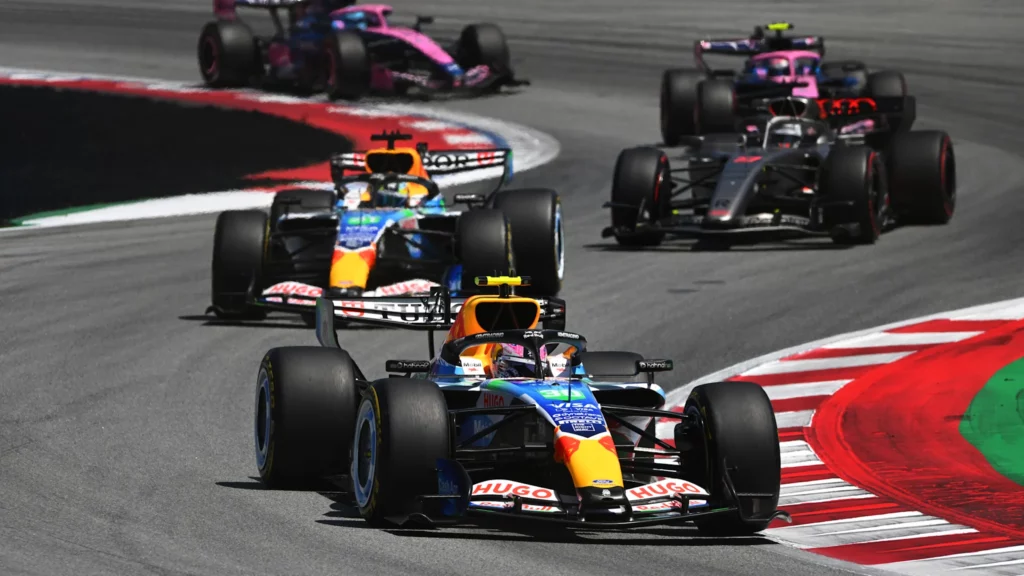
That kind of qualifying story has a clear visual dimension for collectors and replica fans. The Red Bull RB22 livery under the harsh Barcelona sunshine, the blue and yellow bodywork, the Oracle branding catching the light in the final sector — these are the freeze-frame moments that define a display-worthy piece. A full-size 1:1 replica helmet from this weekend carries exactly that context: a race where Red Bull returned to relevance in a way nobody saw coming.
Verstappen on the Red Flag, the Rhythm, and What He Lost
Verstappen was precise about where time slipped away. His best opportunity was not the lap he ultimately set — it was the first flying lap in Q3, the one interrupted by a red flag. Only he and Oscar Piastri had completed that lap before the session was halted, meaning both drivers then spent approximately 10 minutes stationary in the pit lane before the session resumed.
For a driver operating at the absolute limit of a car’s capability, that wait matters. The ideal Q3 process, as Verstappen described it, is tight and continuous: complete a lap, return to the pits, refuel, fit new tyres, review what you lost, and go again. Breaking that loop with a 10-minute pause disrupts the physical and mental rhythm that produces a tenth here, a tenth there.
“I went into Qualifying thinking that we would be miles off and just be P7, P8, but this was promising.”
His final sector on the decisive lap saw the RB22 begin sliding, pulling him off the optimal line. That moment — a driver fighting a car that has given more than expected but not quite enough — is precisely the kind of session that defines a racing helmet’s story. The visor that framed that final sector at Barcelona, the livery that carried Verstappen through a qualifying he had mentally prepared to lose, becomes part of the collector narrative that a 1:1 display replica captures permanently.
Despite finishing P5, Verstappen’s reading of the session was clear: the result looked decent on paper, but there was a genuine P3 available if the final sector had gone differently. That is not a consolation — it is a data point about where the RB22 actually is relative to the field at this circuit.
Hadjar’s Barcelona Debut on the Third Row
Isack Hadjar’s qualifying position tells a story that runs parallel to Verstappen’s. The French rookie qualified P6, a result that looks solid until you examine the gap to third place: Kimi Antonelli’s P3 was less than one tenth of a second quicker. In a session where Hadjar had spent Friday and Saturday morning genuinely struggling, ending up that close to the podium row demanded some processing.
“I don’t even know how we are three tenths off pole because we’ve been a second off the whole time,” Hadjar said after qualifying. That comment captures something important about how circuits can shift the competitive order. Barcelona’s particular demands — the long, fast corners, the heavy front-end loading, the traction zones — played to the RB22’s characteristics in a way that other recent venues had not.
For collectors tracking Hadjar’s debut season in Red Bull colours, this qualifying session at Barcelona is an early career moment worth noting. A driver in his first year alongside a four-time champion, delivering a lap within three tenths of pole — the helmet from this weekend will one day reflect a résumé being built in real time. Full-size 1:1 display replicas from breakthrough qualifying sessions carry a specific weight that becomes clearer with distance.
The 66-Lap Race: Strategy, Heat, and Opportunity
Sunday’s race at the Circuit de Barcelona-Catalunya runs to 66 laps. Hadjar described it in plain terms before the lights went out: it should be fun. High ambient temperatures are forecast for race day, which historically accelerates tyre degradation at a circuit already known for punishing rubber. Multiple pit stops are expected, which means the grid positions set on Saturday afternoon are not necessarily the positions that will define the result.
Starting P5 and P6 on the third row, both Red Bull drivers have a realistic path to the podium if strategy and tyre management align. The RB22’s pace in qualifying — a car that closed a gap that had been running at roughly one second in practice down to four tenths over a single lap — suggests the underlying performance is present. Converting that into race pace over 66 laps in elevated temperatures is a different question, but the answer looked more encouraging after Saturday than it had on Friday.
For those following the visual narrative of the race, the Barcelona circuit has long been a backdrop for some of the most photographed moments in the sport. The long straight leading to Turn 1, the sweeping Sector 2 sequence, the final chicane under afternoon light — these are the frames from which display-quality moments are drawn. A race that started with genuine uncertainty about Red Bull’s pace, and delivered a third-row lockout, is precisely the kind of weekend that generates lasting collector interest.
What the RB22 Livery Means for Display Collectors
The Red Bull RB22 livery running at the 2025 Spanish Grand Prix carries the Oracle branding, the deep navy base, and the bold yellow and red accent lines that have become one of the most recognised visual identities in the sport. When reproduced on a full-size 1:1 collector replica helmet, every element of that livery is rendered at exhibition quality — not as a reduced souvenir, but as a display piece built to the exact dimensions of a race-worn item.
For context, a standard full-size F1 replica helmet at 1:1 scale typically measures approximately 27 × 35 cm and weighs around 1.45 kg, with visor panels running at approximately 3 mm in thickness to replicate the visual profile of the race version. These are display and collector items only — not certified for protective use, not intended for road or track application. Their purpose is permanent exhibition: on a shelf, in a cabinet, as part of a dedicated display that marks a specific race, season, or career moment.
The Barcelona 2025 qualifying session — where Verstappen beat his own expectations by three grid places — is the kind of weekend that adds meaning to the replica it generates. A helmet that sits on a display stand does not just represent a design. It represents a race, a session, a moment where a car and a driver surprised themselves. That narrative is what distinguishes a collector piece from a decorative object.
Why This Weekend Is a Collector Marker for Verstappen
Verstappen’s four World Championship titles make him the most decorated active driver in the sport. Replica helmets associated with his race weekends carry a weight of provenance that few other drivers can match. But beyond the titles, it is the individual sessions — the ones where the car was not expected to perform and did — that create the most specific collector interest.
Barcelona 2025 qualifying is one of those sessions. A driver who expected P7 or P8, who described the gap as ‘a lot smaller’, who missed P3 by a slide in the final sector after a 10-minute red flag interruption — that is a story with texture. The helmet worn across a weekend like this is not simply merchandise. It is a timestamp on a season in progress, a point where the narrative shifted.
Full-size 1:1 display replicas from this phase of the 2025 season offer collectors the chance to own that timestamp in physical form. Whether mounted in a display case or exhibited as a standalone piece, the Verstappen Barcelona 2025 helmet replica marks the weekend Red Bull closed the gap — and made the paddock take notice again. As a display piece and exhibition-quality collector item, it belongs in any serious F1 collection.
“I went into Qualifying thinking that we would be miles off and just be P7, P8, but this was promising.”
— Max Verstappen, post-qualifying press conference, Barcelona 2025
“I don’t even know how we are three tenths off pole because we’ve been a second off the whole time. That’s a bit surprising and being so close to P3 is a bit disappointing.”
— Isack Hadjar, post-qualifying press conference, Barcelona 2025
FAQ
Q: Where did Max Verstappen qualify for the 2025 Spanish Grand Prix?
Verstappen qualified P5 at the Circuit de Barcelona-Catalunya, within four tenths of polesitter George Russell, starting from the third row alongside teammate Isack Hadjar in P6.
Q: Why did Verstappen lose time in Q3 at Barcelona?
A red flag mid-Q3 left Verstappen and Piastri — the only drivers to have completed a flying lap before the stoppage — waiting approximately 10 minutes in the pits, breaking their rhythm. On his final lap, Verstappen also began sliding in the final sector, pulling him off the ideal line and costing him what he believed was a realistic shot at P3.
Q: How long is the 2025 Spanish Grand Prix?
The race at Barcelona runs to 66 laps. High temperatures and multiple pit stops are expected, making tyre strategy a central factor in the final result.
Q: Are the Max Verstappen replica helmets at 123Helmets.com suitable for use in races or on the road?
No. All replica helmets on 123Helmets.com are full-size 1:1 display and collector pieces only. They are not certified for protective use and are not intended for road, race, or track application. They are exhibition-quality items designed for display.
Q: What makes the Barcelona 2025 qualifying helmet a significant collector piece?
It marks the session where Verstappen beat his own grid expectation by three positions, closing a gap that had been running near one second in practice down to under four tenths from pole. That combination of a specific race context and a narrative shift within a season is what gives a display replica collector relevance beyond the design itself.
Shop Max Verstappen Collection — own a full-size 1:1 display replica from one of the most surprising qualifying sessions of the 2025 season. Exhibition-quality collector pieces, built to exact scale.
Display and collector replicas only. Not certified for protective use. Full-size 1:1 scale.