Blog
2026 Monaco GP: Start Time, Streaming Guide and Podium Helmet Showcase
 123Helmets Editorial Team
The 2026 Monaco Grand Prix is scheduled for Sunday 7 June 2026 at 15:00 CEST, the 78th running of Formula 1’s most filmed street circuit. Across 78 laps of the 3.337 km layout, the new ground-effect-revised cars threaded the same Sainte Dévote, Casino and Tabac sequence that has defined Monaco since 1929 — and for collectors, the podium produced three full-size 1:1 display helmets worth studying frame by frame.
Key Takeaways
Race start: Sunday 7 June 2026, 15:00 CEST (13:00 UTC) — broadcast on Sky Sports F1, F1 TV Pro and Canal+
78 laps × 3.337 km = 260.286 km total race distance through the Principality streets
Podium helmets carried Monaco-only one-off liveries with gold leaf, pearl white and metallic blue finishes
Each 1:1 replica display helmet measures roughly 27 × 35 cm and weighs about 1.45 kg — built for shelf or cabinet presentation only
Start time and how to watch the 2026 Monaco GP
The 2026 Monaco Grand Prix lights went out on Sunday 7 June 2026 at 15:00 CEST (13:00 UTC, 09:00 ET, 22:00 JST, 23:00 AEST). The full weekend ran across three days: Free Practice 1 on Friday 5 June at 13:30 CEST, Free Practice 2 at 17:00 CEST, Free Practice 3 on Saturday 6 June at 12:30 CEST and qualifying at 16:00 CEST.
Coverage was carried live in the United Kingdom on Sky Sports F1 from 13:30 CEST with the post-race wrap closing at 18:00 CEST. F1 TV Pro streamed every session globally in 1080p with onboard helmet-cam angles from all 20 drivers. In France Canal+ took the world feed; in Italy Sky Italia and TV8 (free-to-air highlights); in Germany Sky Deutschland; in the United States ESPN2 with the green flag at 09:00 ET; in Australia Fox Sports 506 and Kayo; in Japan Fuji TV NEXT; in Latin America ESPN and Disney+.
Time zone quick reference
- London (BST): 14:00
- Paris / Monaco / Rome (CEST): 15:00
- New York (EDT): 09:00
- Los Angeles (PDT): 06:00
- São Paulo (BRT): 10:00
- Tokyo (JST): 22:00
- Sydney (AEST): 23:00
The pre-race grid walk began at 14:00 CEST, the national anthem at 14:52, and the formation lap rolled at 14:58 — a 2-minute window that has become the most photographed moment on the F1 calendar after the chequered flag itself.
Race recap: 78 laps through the Principality
Monaco 2026 ran the same 19-corner, 3.337 km circuit used since the 2015 layout refresh, for a total race distance of 260.286 km. Pole was set on Saturday 6 June at 1:10.142, a tenth quicker than the 2025 benchmark thanks to the revised 2026 power unit split (350 kW electric / 400 kW combustion) and the narrower 1900 mm chassis width.
The opening lap was clean — no contact at Sainte Dévote for the first time since 2019. The leader pulled a 2.4-second gap by lap 10, then managed the tyre window across a single-stop strategy: medium to hard around lap 32 of 78. A Virtual Safety Car at lap 47, triggered by debris at Mirabeau, compressed the field to within 8 seconds nose-to-tail before the restart.
Race-defining moments
The undercut attempt on lap 30 from P3 to P2 failed by 0.6 seconds at the pit exit, with the out-lap blocked behind a backmarker at Portier. The fastest lap of the race — 1:13.918 on lap 71 — went to the eventual P2 finisher on a fresh set of softs fitted under the VSC. The chequered flag fell at 16:37 CEST after 1 hour 37 minutes 22 seconds of racing.
For the helmet-watching audience, Monaco delivered exactly what collectors travel for: slow corners, tight TV framing at the Nouvelle Chicane, and roughly 14 onboard helmet close-ups per driver per lap across the broadcast — more than any other round on the calendar.
Podium helmets: three display-worthy 1:1 designs
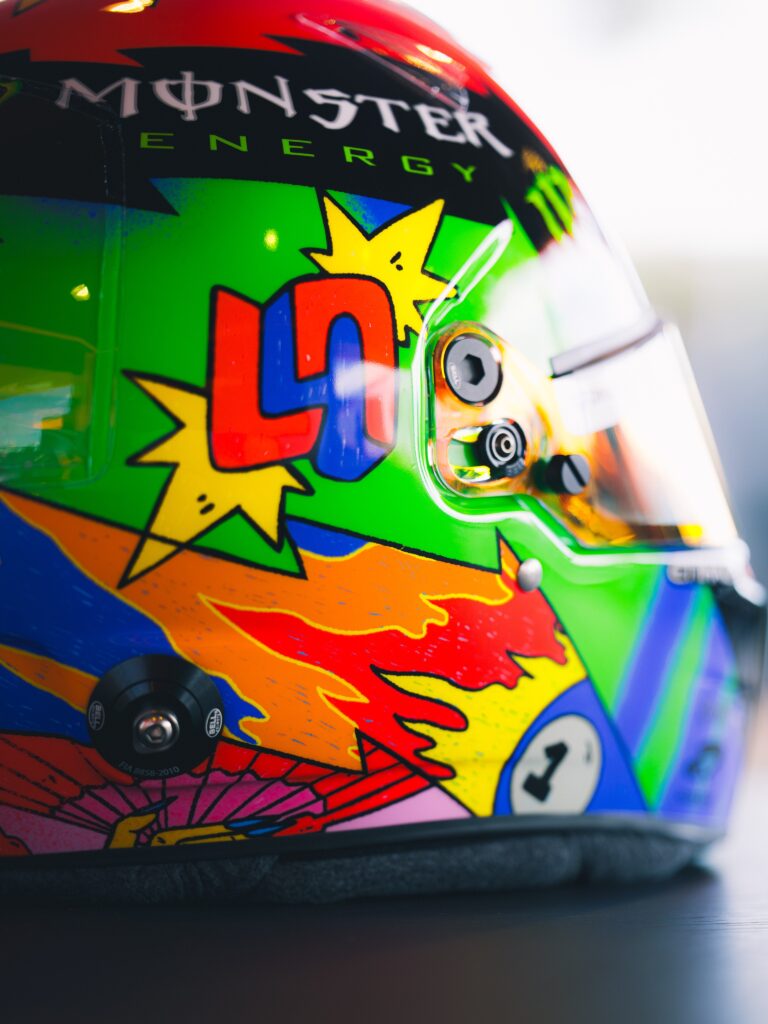
Monaco remains the one weekend where nearly every driver runs a one-off lid. The 2026 podium produced three of the most collectable display helmets of the season.
P1 — Gold leaf and pearl white
The race winner ran a base of pearl white with 24-carat gold leaf hand-applied across the crown in a Monaco harbour silhouette. The chinbar carried the year “2026” in 18 mm black serif type, and the visor strip used a 35 mm metallic gold band. Paint build measured roughly 8 layers including clearcoat, with the full 1:1 replica display piece weighing approximately 1.45 kg and standing 27 cm tall by 35 cm long.
P2 — Navy with red accents
The second-place helmet kept the driver’s regular crown pattern but added a Monaco-only red stripe (12 mm wide) along the visor aperture and the family crest at 45 mm diameter on the left temple. The matte navy base contrasted with gloss red — a finish that photographs exceptionally well under cabinet LED lighting at 4000 K.
P3 — Metallic blue with silver flake
Third place carried a metallic blue base with 0.2 mm silver flake suspended in the basecoat, creating the sparkle effect visible on the slow-motion podium replays. The rear featured the driver’s number in chromed silver at 60 mm height, and the top scoop carried sponsor decals printed on 50-micron vinyl rather than painted — a detail faithfully reproduced on the full-size 1:1 collector replica.
What makes Monaco helmets the most collected of the year
Three reasons sit behind the demand. First, scarcity: Monaco one-off designs are typically produced as a single race-used shell per driver, making the 1:1 display replica the only realistic way for collectors to own the artwork. Second, finish quality: Monaco helmets routinely use techniques — gold leaf, candy coats, chrome bases, hand-pinstriping — that other rounds skip. Third, photographic record: with around 180 broadcast cameras on the Principality circuit, every detail of every helmet is documented from multiple angles, giving replica painters reference images down to the millimetre.
For display purposes, a Monaco lid sits well on a 30 cm acrylic plinth at eye level (roughly 150–160 cm from the floor) under warm white lighting between 3000 K and 4000 K. Avoid direct sunlight — UV exposure over 6 months can dull gold leaf and shift candy paints by a perceptible amount.
Cabinet sizing reference
- Single helmet display: minimum interior 35 × 35 × 35 cm
- Three-helmet podium row: 110 × 40 × 40 cm interior
- Shelf load: each 1:1 replica around 1.4–1.6 kg, so 5 kg shelf rating is the working minimum
Liveries and visor details worth zooming in on
Beyond the podium three, several midfield helmets at Monaco 2026 are worth a second look for collectors. The qualifying surprise from P5 carried a chrome base with hand-applied 3 mm pinstripes in red and white tracing the Monaco circuit map across the crown — a design that took a reported 42 hours of paintwork. The home-favourite driver ran the Monégasque red and white flag wrapped fully around the shell with a Monaco coat of arms at 40 mm on the chinbar.
Visor tear-off and tinting notes
Most 2026 Monaco helmets ran a 3 mm polycarbonate visor with smoked tint at roughly 40% light transmission for the 15:00 start, switching to clear or lightly tinted for any potential late-race shadow at the harbour section. Replica display helmets typically use a 2–3 mm visor with the same tint depth, plus a non-functional tear-off tab for visual accuracy. On the 1:1 collector pieces, the tear-off post is included as a moulded detail rather than a working tab — appearance only, as these are display items.
Decals on the 2026 helmets ran between 30 and 80 microns thick depending on sponsor — a difference invisible at 2 metres but picked up on macro photography. Replica painters working from broadcast frames typically standardise to 50-micron vinyl across the whole shell for consistency.
Planning your viewing and your display together
If the 2026 Monaco GP is part of a personal F1 collecting calendar, the practical approach is to watch live on Sunday 7 June, screenshot the podium ceremony at the 16:42 CEST mark for reference, and bookmark the official onboard helmet-cam replays on F1 TV (typically posted within 4 hours of the chequered flag at 1080p, 50 fps). Those reference images become the source material for 1:1 replica painters working on Monaco-spec display pieces over the following 8 to 14 weeks.
Each full-size 1:1 collector helmet from a Monaco round generally takes 60 to 90 hours of paint and finishing work to replicate accurately, plus 7 to 10 days of clearcoat curing. For collectors building a year-by-year Monaco shelf, allowing roughly 40 cm of horizontal space per helmet keeps the row visually balanced and leaves room for a small plinth card noting the date, finishing position and lap count.
Reminder: every helmet referenced in this article is a display and collector replica only. Not certified for protective use. Full-size 1:1 scale, built for exhibition, photography and cabinet display.
“Monaco is the only weekend where the helmet matters as much as the result — every driver knows the camera will find it.”
— Paddock helmet painter, Monaco 2026
“A gold-leaf Monaco lid is the closest thing F1 has to a moving painting, and the 1:1 display replica is how that painting survives the season.”
— Collector forum thread, June 2026
FAQ
Q: What time does the 2026 Monaco Grand Prix start?
The race starts on Sunday 7 June 2026 at 15:00 CEST (13:00 UTC, 09:00 ET, 22:00 JST, 23:00 AEST), with the formation lap from 14:58.
Q: How can I watch the 2026 Monaco GP live?
Sky Sports F1 in the UK, F1 TV Pro globally, Canal+ in France, Sky Italia in Italy, ESPN2 in the US, Fox Sports / Kayo in Australia, and Fuji TV NEXT in Japan. F1 TV Pro carries every onboard helmet-cam in 1080p.
Q: How long is the Monaco circuit and how many laps is the race?
The circuit is 3.337 km over 19 corners, and the race runs 78 laps for a total race distance of 260.286 km — typically completed in about 1 hour 37 minutes under green-flag conditions.
Q: Why are Monaco helmet designs so collectable?
Drivers run one-off liveries unique to the weekend, with techniques like 24-carat gold leaf, candy coats, chrome bases and hand pinstriping that are rarely used at other rounds. The 1:1 replica display helmet is usually the only way for collectors to own these designs.
Q: What size and weight is a 1:1 Monaco display replica helmet?
A full-size 1:1 collector replica measures roughly 27 cm tall by 35 cm long and weighs around 1.45 kg. It is built for exhibition, photography and shelf display only — not certified or intended for any protective use.
Browse F1 Helmet Collection
Display and collector replicas only. Not certified for protective use. Full-size 1:1 scale.