
Blog
Ayao Komatsu Defends Monaco Sunday: Haas Boss Calls the Race a ‘Unique’ Spectacle Worth Preserving
 123Helmets Editorial Team
Ayao Komatsu pushed back against the wave of criticism aimed at the 2025 Monaco Grand Prix, telling reporters that the Sunday in the Principality should be accepted on its own terms. The Haas team principal framed Monte Carlo as a one-of-a-kind event whose qualifying-led drama, narrow streets and helmet-level visibility have no equivalent on the calendar — a point that matters for collectors and display builders chasing the most photographed weekend of the year.
Key Takeaways
Komatsu describes Monaco Sunday as ‘unique’ and worth accepting rather than reformatting.
Haas left Monte Carlo with strategic lessons after the mandatory two-stop rule reshaped the 78-lap race.
Helmet and livery visibility at Monaco — tight barriers, slow corners — makes it the strongest reference weekend for 1:1 display replicas.
The Principality circuit measures 3.337 km per lap, the shortest on the calendar, amplifying every camera angle on driver helmets.
Komatsu’s verdict: accept Monaco for what it is
Ayao Komatsu did not dodge the question. Asked whether Monaco still belongs on a modern Formula 1 calendar built around overtaking and tyre management, the Haas team principal answered that the 2025 edition — run over 78 laps on the 3.337 km Circuit de Monaco — should be accepted as a separate kind of Sunday. His phrasing was direct: Monaco is unique, and trying to fix it risks erasing the only race weekend where qualifying still decides almost everything.
That position carries weight coming from a team principal whose car spent most of the weekend fighting in the lower half of the order. Komatsu is not defending Monaco because it suited Haas; he is defending it because, in his reading, the championship loses identity without it. The mandatory two-stop rule introduced for 2025 was meant to inject variability into a race historically defined by the Saturday grid. The Haas boss acknowledged the experiment but stopped short of calling it a fix.
The two-stop experiment
For the first time at Monaco, drivers were required to use three sets of tyres across the 78-lap distance. The regulation forced strategists into windows they would never have opened voluntarily on a track where the pit lane loss is among the highest of the season. Haas, like several midfield teams, used the rule to attempt undercut sequences that would have been impossible under the old format.
Haas race report: a quiet Sunday with strategic notes
The American-licensed team arrived in Monte Carlo with a chassis that had shown flashes of pace at Imola the week before. Monaco exposed the same balance compromise that has followed the VF-25 through the European leg of the season: strong on entry, hesitant on the slow corners between Mirabeau and the Rascasse.
Both Haas cars completed the race distance without contact, which at Monaco is itself a result. The 19-corner layout, with its 33 metres of elevation change between the harbour and the Casino square, punishes any moment of inattention. Komatsu noted in his post-race debrief that finishing the Grand Prix gave the engineering group a full data set on the new two-stop window — information that will feed into Canada and the second half of the European season.
Why Sunday mattered even without the podium
For a midfield operation, Monaco Sunday is rarely about silverware. It is about minimising losses on a circuit where the points-paying positions are usually locked by Saturday afternoon. Haas approached the race with that calculus and left with the championship table essentially undisturbed in their favour — neither a breakthrough nor a setback.
Helmet and livery focus: why Monaco is the collector’s reference weekend
For anyone building a display shelf of 1:1 collector replicas, Monaco is the single most useful weekend on the calendar. Three reasons stand out, and none of them depend on the race result.
First, the slow corners. Loews hairpin is taken at roughly 47 km/h, the slowest point of any Grand Prix. Television cameras hold the driver’s head in frame for longer than at any other circuit, which means helmet graphics — the chrome lines, the matte panels, the 0.3 mm pinstripes that disappear on faster tracks — are clearly readable in broadcast footage. Collectors use that footage as the visual reference when judging whether a full-size replica matches the race-weekend specification.
Second, the lighting. Monaco’s Sunday afternoon sun cuts across the harbour section between 15:00 and 16:30 local time, producing the high-contrast shots that paint specialists rely on to verify base colours and clear-coat depth. A display piece photographed under that same light reads correctly; one finished under warm studio bulbs often does not.
Livery details that translate to 1:1 replicas
The Haas VF-25 livery — black base with red and white accent flashes — photographs cleanly against the Armco. For an exhibition-quality piece in 27 × 35 cm presentation cases, the contrast between matte body panels and gloss accent stripes is the single hardest finish to reproduce, and Monaco footage is the cleanest reference available. The same applies to driver helmets: the close-quarters camera positions at Sainte-Dévote and the swimming pool chicane give frame-by-frame views of crown graphics that simply do not exist at Silverstone or Spa.
For builders working on a full-size 1:1 replica weighing around 1.45 kg in display configuration, Monaco’s broadcast archive provides the angles needed to match decal placement to within a few millimetres. That precision is what separates an exhibition piece from a generic souvenir.
The unique argument: what Komatsu actually means
When Komatsu calls Monaco unique, the word does heavy lifting. The Principality is the only round where the pit lane sits inside a public road network, the only one where the cars pass under a hotel (the Fairmont, formerly the Loews), and the only one where the average lap speed sits below 160 km/h. No amount of regulation tweaking changes those geographic facts.
The Haas boss’s argument is that the championship already has 23 other rounds engineered for wheel-to-wheel racing. Bahrain, Jeddah, Miami, Imola, Barcelona, Montreal — each has been reshaped, resurfaced or rerouted to maximise overtaking. Monaco is the control variable. Remove it, or reformat it into a sprint-style two-day event, and the calendar loses its only true historical anchor. The race has been on the championship since 1950, with the modern circuit configuration largely settled by the late 1970s.
The counter-argument from drivers
Not every team principal shares Komatsu’s view. Several drivers spoke after the race about the procession feel of the middle stint, when DRS gaps stabilised and the field strung out in single file for nearly 30 consecutive laps. The two-stop rule mitigated this in the opening and closing phases but could not erase it entirely. The debate will continue into the next Sporting Regulations meeting, and Monaco’s 2026 format is not yet locked.
What this Sunday means for display builders
Beyond the strategic and political dimensions, the 2025 Monaco GP delivered exactly what collector culture needs: hours of slow, high-resolution footage of every car and every helmet on the grid. For the 123Helmets community, that footage is the working reference for the next 12 months of display projects.
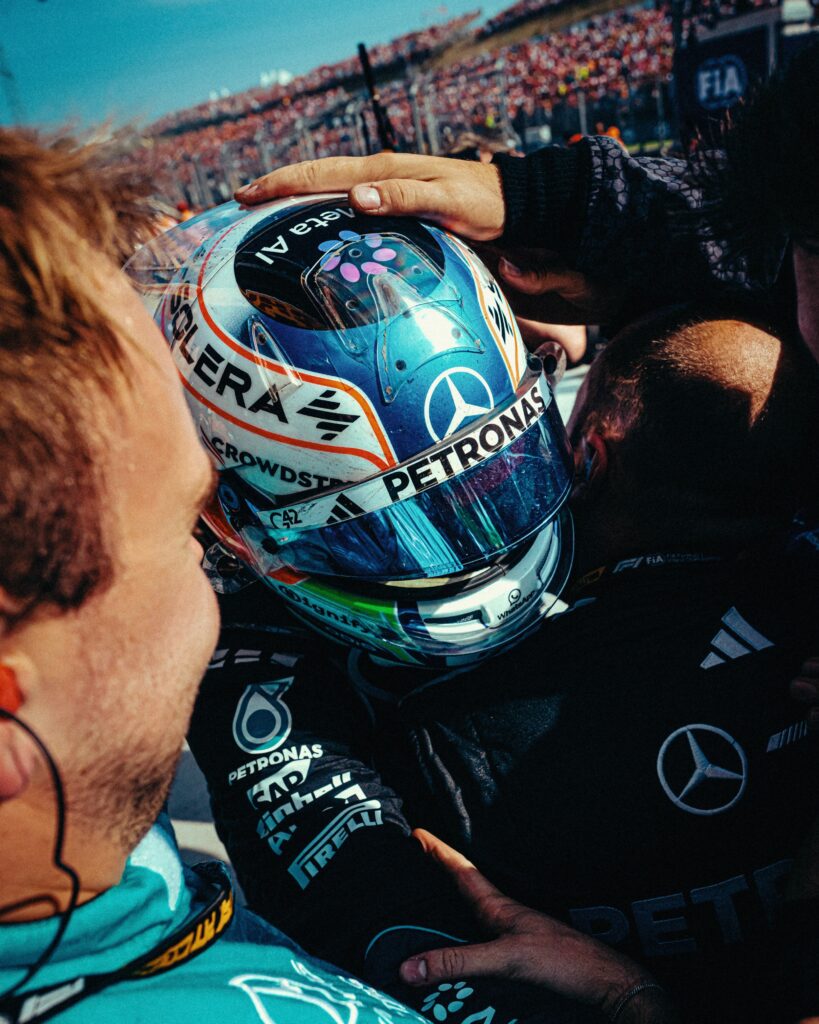
The Haas helmets photographed at Casino Square and at the Nouvelle Chicane exit show clean decal alignment and undamaged visor surfaces — the baseline condition that any exhibition-quality 1:1 replica should match. A display piece is meant to capture a specific weekend in a specific configuration, and Monaco’s archive makes that goal achievable.
From broadcast frame to display case
The translation from television footage to finished collector item is the part most casual buyers underestimate. A serious replica requires reference images from at least three angles — front, three-quarter, and profile — at consistent lighting. Monaco provides all three within a single broadcast hour. That is why, regardless of how the championship debate plays out, the Principality remains the most documented weekend for anyone serious about building a display-grade shelf.
Komatsu may not have won anything on Sunday, but his defence of the race format protects something the collector market quietly depends on: the most photographed Grand Prix of the year, in its current 78-lap, street-circuit form.
“Monaco is unique. I think we should accept it for what it is rather than try to make it something else.”
— Ayao Komatsu, Haas Team Principal
FAQ
Q: What did Ayao Komatsu say about the Monaco Grand Prix?
The Haas team principal said Monaco should be accepted as a unique event on the calendar rather than reformatted to resemble other races. He acknowledged the 2025 two-stop rule as an experiment but defended the core character of the Sunday in the Principality.
Q: How long is the Monaco Grand Prix circuit?
The Circuit de Monaco measures 3.337 km per lap, the shortest layout on the Formula 1 calendar. The race distance is 78 laps, with 19 corners and roughly 33 metres of elevation change.
Q: Why is Monaco a useful reference for helmet collectors?
The circuit’s slow corners — Loews is taken at around 47 km/h — give broadcast cameras extended close-up frames of driver helmets. That footage is the cleanest reference available for matching graphics, paint depth and decal placement on a full-size 1:1 display replica.
Q: Did Haas score points at the 2025 Monaco GP?
Both Haas cars finished the race without contact, which at Monaco is itself a notable outcome. The team used the weekend to gather data on the new mandatory two-stop format rather than to chase a breakthrough result.
Q: What scale are display F1 helmets at 123Helmets.com?
All pieces are full-size 1:1 collector and display replicas, designed as exhibition items. They are display and collector replicas only — not certified for any protective use.
Browse F1 Helmet Collection
Display and collector replicas only. Not certified for protective use. Full-size 1:1 scale.