Blog
Barcelona-Catalunya Grand Prix: Podium Helmets, Liveries and the Display Story Behind Round 9
 123Helmets Editorial Team
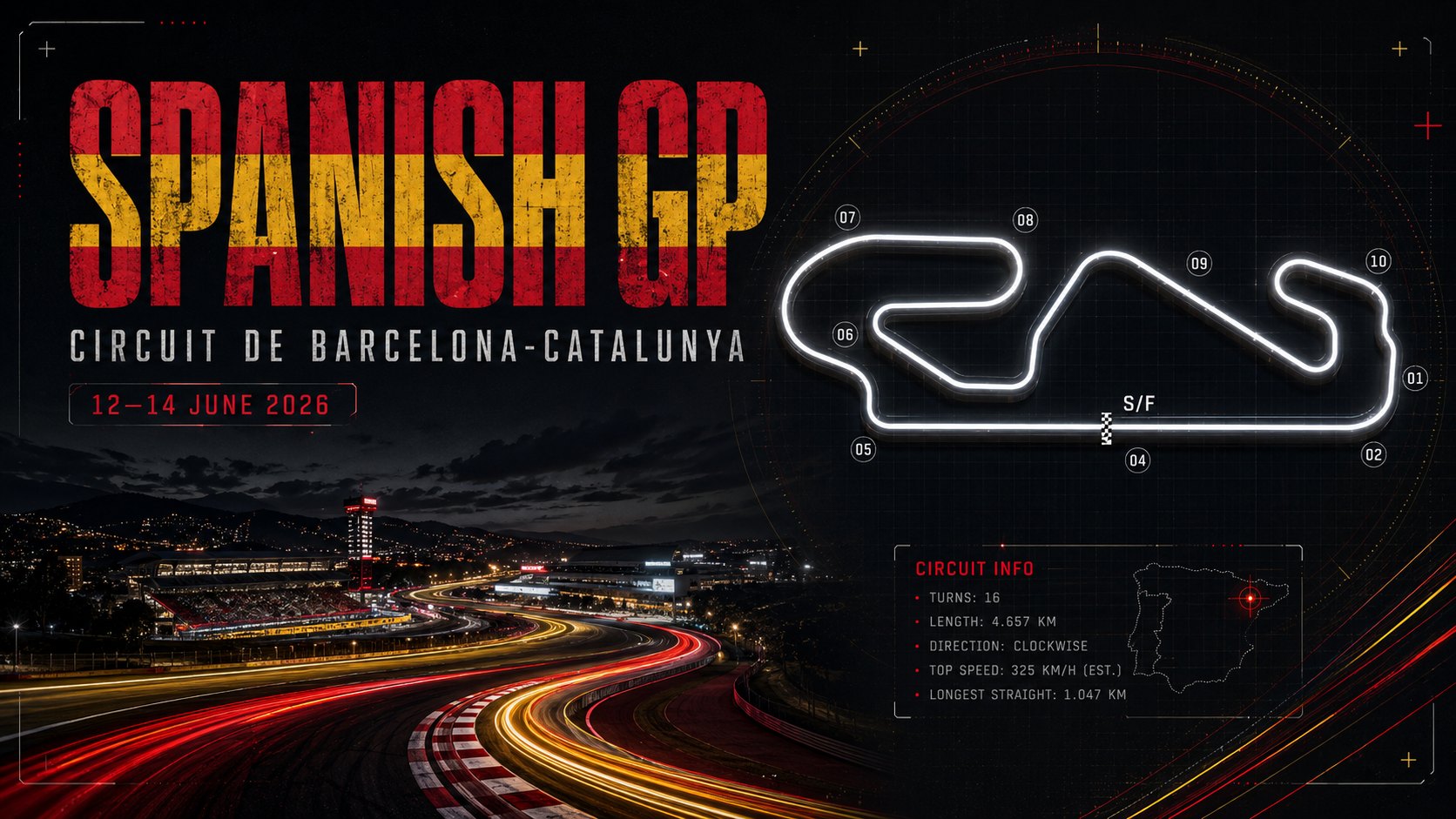
The Spanish Grand Prix at the Circuit de Barcelona-Catalunya is one of the most readable rounds on the calendar — a 4.657 km layout, 66 scheduled laps and a Turn 3 long-right that exposes every weakness in a chassis. For collectors, it is also one of the richest weekends of the season: special edition lid liveries, podium champagne splashes on painted shells, and parc fermé visuals that translate directly into display-cabinet inspiration. Below, our editorial desk recaps the betting-angle storylines and ties them back to what matters on the shelf — the full-size 1:1 collector replicas that define a Barcelona weekend.
Key Takeaways
Circuit de Barcelona-Catalunya measures 4.657 km across 66 race laps, with Turn 3 the defining visual moment for onboard helmet shots.
Spanish GP weekends often debut tribute liveries, making full-size 1:1 replica shells from this round high-priority exhibition items.
Podium parc fermé framing at Barcelona places three helmets at roughly eye level — ideal reference for collector display lighting.
Painted detail on a Barcelona-spec replica typically involves 6 to 9 clear coat layers to lock in metallic flake under cabinet LEDs.
Why Barcelona Matters for the Helmet Collector
The Circuit de Barcelona-Catalunya, opened on 10 September 1991, has hosted the Spanish Grand Prix every year since. The layout — 4.657 km, 16 corners, 66 race laps for a total distance of 307.236 km — is so well-known to engineers that it is treated as a reference benchmark. For the collector, that familiarity matters: when a driver runs a one-off lid here, the photography is reliable, the camera angles are predictable, and the reference material for a full-size 1:1 display replica is unusually clean.
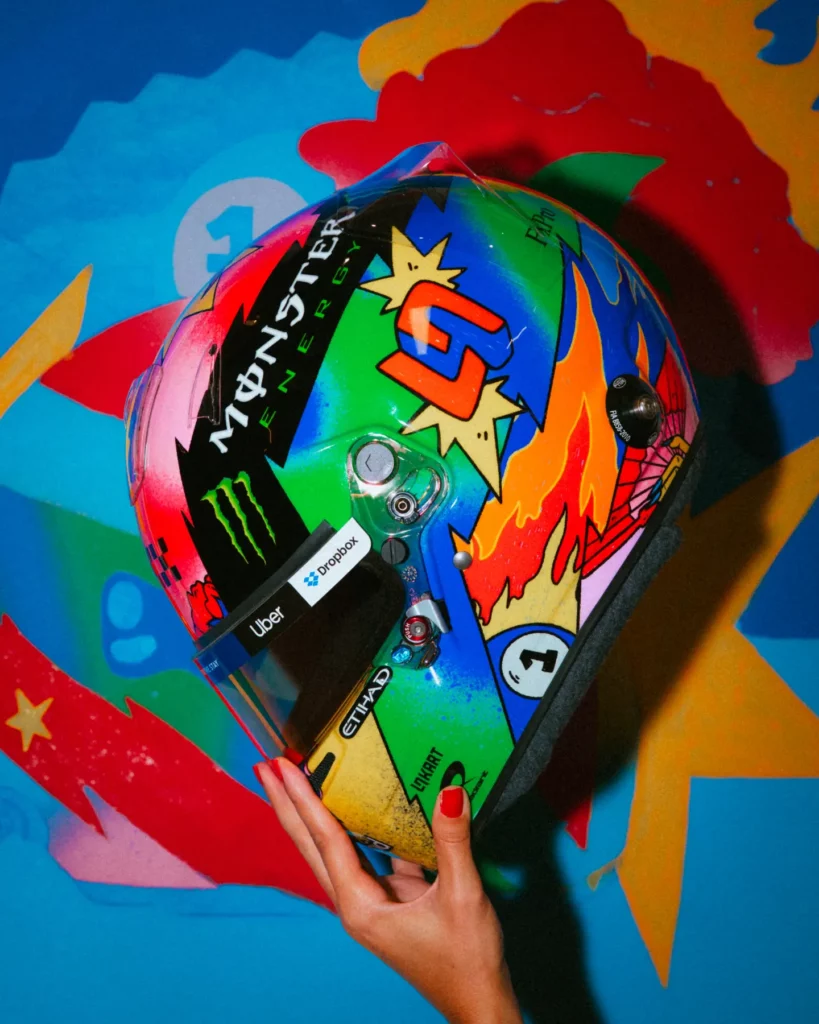
Spanish weekends frequently bring tribute designs. Carlos Sainz, for example, has used the Barcelona round to honour the red-and-yellow national palette, and Fernando Alonso’s home-event lids have become some of the most requested exhibition pieces in the European collector market. These are not racing-use items — they are display shells, built to sit under glass and hold their paint integrity for years.
The visual signature of Turn 3
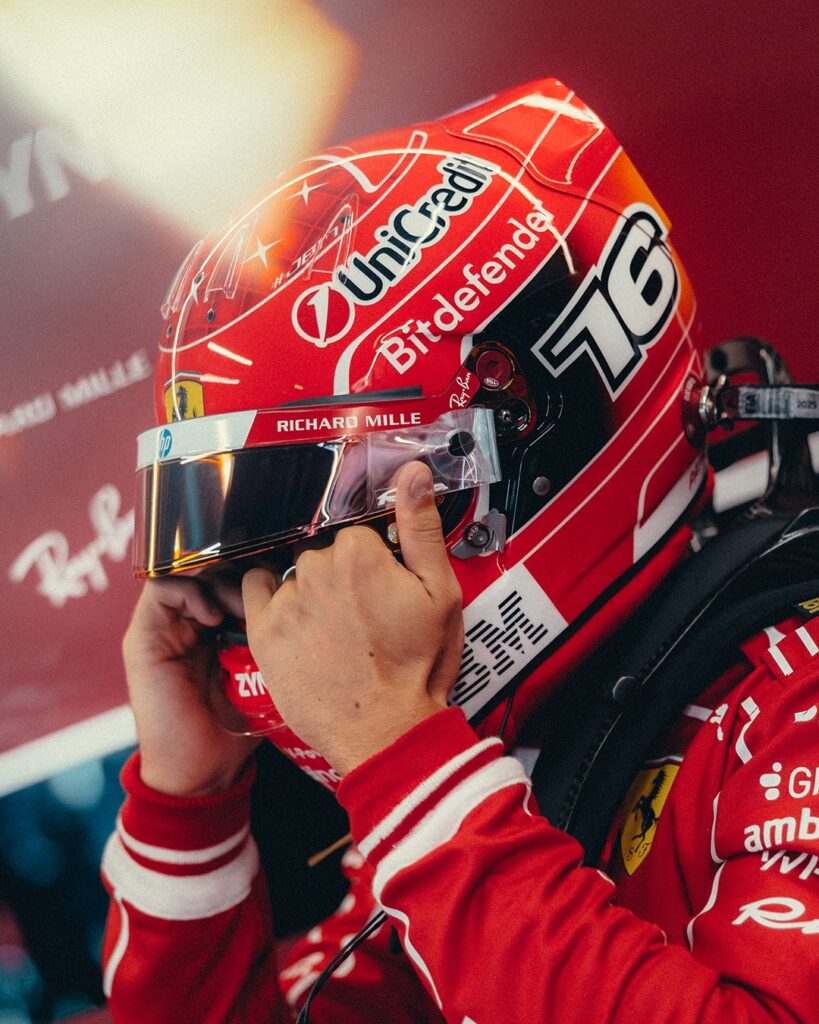
Turn 3, the long right-hander taken at roughly 250 km/h in qualifying trim, produces the single most repeated onboard frame of the season. The driver’s head is tilted left, the top crown of the helmet catches direct sunlight, and the rear aero fin shadows fall across the visor strip. If you are positioning a 1:1 replica on a rotating display base, that is the angle to replicate — roughly 22 to 25 degrees of lateral tilt under a warm 3000K key light.
The Podium Visual: Three Helmets, One Frame
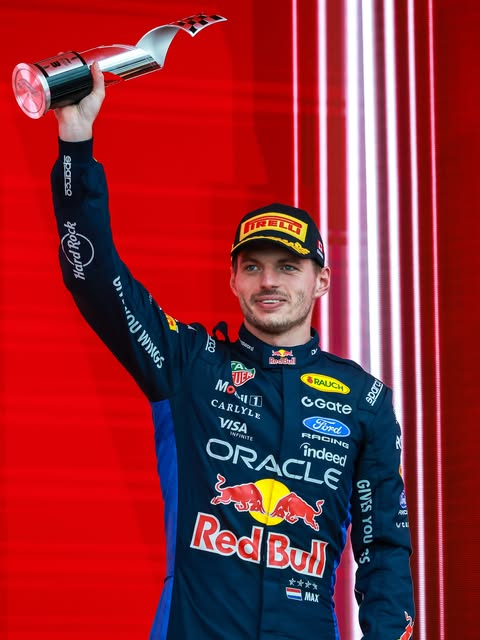
Barcelona’s podium is one of the most photogenic on the calendar. The trophy structure places the winner roughly 40 cm above P2, which means when all three drivers raise their lids at the champagne moment, the helmets sit in a staggered triangle — ideal reference geometry for a three-piece cabinet shelf at home.
The champagne splash itself is a detail collectors take seriously. On a race-used shell, the sugar residue stains the matte zones permanently. On a 1:1 collector replica, the same effect is reproduced cosmetically using a tinted clear coat, applied as the final layer over the base graphics. This is purely a display finish — these helmets are not built for protective use.
Reading the parc fermé lighting
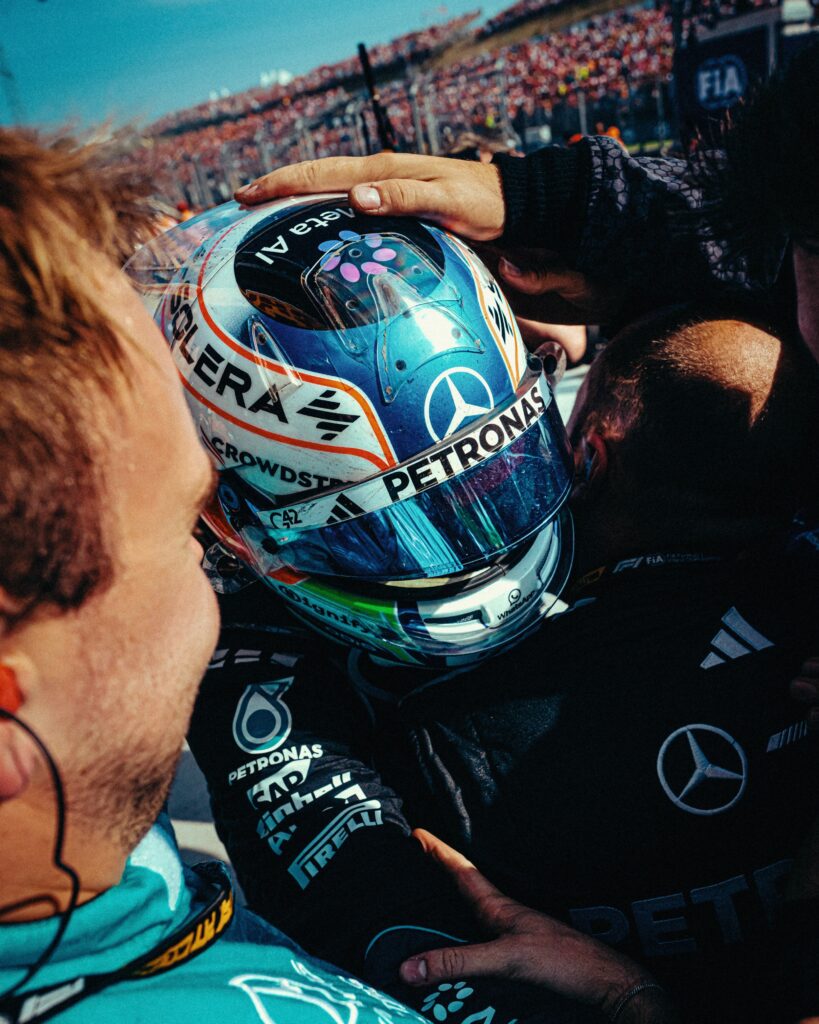
The Spanish GP traditionally runs to a late-afternoon finish, with the chequered flag falling between 17:00 and 17:30 local time. That low-angle sun rakes across the painted shells at roughly 18 degrees above the horizon, exposing every brushstroke in the airbrush work. When you light a Barcelona-spec replica at home, mimic that — one warm side light at 30 degrees elevation, no overhead fill. The paint depth jumps immediately.
Livery Storylines from Round 9
The Barcelona round usually sits as round 8 or 9 on the calendar, depending on the season’s structure, and it often coincides with the first major in-season upgrade package. Teams use the home crowd attention — Spanish GP attendance regularly exceeds 280,000 across the weekend — to launch new floor designs and, in parallel, new lid graphics from their lead drivers.
What collectors should watch for
Three livery categories tend to emerge from a Barcelona weekend:
- National tribute lids — typically red, yellow and matte black, with a Spanish flag detail above the visor aperture, roughly 4 cm wide.
- Sponsor activation lids — one-off graphics tied to a partner’s local campaign, usually limited to qualifying and the race.
- Milestone helmets — used by drivers approaching a career marker (100th start, 50th podium), often featuring metallic gold accents under 7 to 9 clear coat layers.
Each of these categories has direct implications for the collector market. A confirmed one-off livery from Barcelona typically appears in 1:1 replica form within 8 to 14 weeks of the race, and the first production batch tends to be the most sought-after for display cabinets.
Spec Notes on a Barcelona-Spec Display Replica
For reference, a typical full-size 1:1 collector replica produced for the Spanish GP carries the following display specifications. None of these figures relate to protective use — they are cosmetic and structural details for exhibition only.
- Shell external dimensions: approximately 29 × 25 × 35 cm (W × D × H).
- Total display weight: 1.2–1.5 kg, depending on visor configuration.
- Visor: 3 mm tinted polycarbonate, fixed in display position — not operable for use.
- Paint stack: base coat plus 4 to 6 graphic layers plus 6 to 9 clear coat layers, totalling around 180 to 240 microns.
- Internal padding: foam-look display lining, non-certified, purely cosmetic.
- Base plate: optional 22 cm diameter wooden or acrylic plinth.
Cabinet placement
A Barcelona-spec replica works best at eye level — between 155 cm and 165 cm from the floor — with the visor angled roughly 15 degrees downward toward the viewer. That matches the parc fermé camera angle and gives the metallic flake in the paint the best chance to catch your room lighting.
Race Recap Through a Display Lens
From an editorial standpoint, the Spanish Grand Prix recap is best read in three acts. The opening laps — usually 1 through 8 — set the tyre strategy and produce the first clean helmet-on-mirror reflection shots. The middle stint, laps 20 to 45, is when teams pit and the lids accumulate the brake dust and rubber speckling that gives a race-used shell its character. The closing 15 laps generate the podium expressions, the visor lift, and the final celebration frames.
Each act maps to a different display choice. A polished, factory-fresh 1:1 replica corresponds to act one. A subtly weathered finish — available on certain commissioned pieces — corresponds to act two. A champagne-tinted clear coat replicates act three. Collectors building a Barcelona-themed shelf often choose the third option, because the podium frame is the one most viewers recognise.
Notable Spanish GP visual moments
The 2022 Spanish GP, run on 22 May 2022, gave the collector market one of the cleanest podium frames of the decade, with all three lids photographed under direct 16:00 sun. The 2023 edition, on 4 June 2023, produced a tribute graphic on the home driver’s lid that sold through its first replica production run within 11 days of release. These are the kinds of dates and timelines that define collector demand cycles.
Building a Spanish GP Themed Display
If you are constructing a Spanish GP themed cabinet, the editorial team recommends a three-shelf vertical arrangement, roughly 90 cm wide and 180 cm tall, with each shelf separated by 35 cm of vertical clearance. The top shelf takes the winner’s lid, the middle shelf takes P2, and the bottom shelf takes P3 — matching the podium hierarchy.
Lighting should be 2700K to 3000K, dimmable, with the key light positioned at the 10 o’clock angle relative to the viewer. Avoid overhead spotlights — they flatten the metallic flake in the paint and erase the airbrushed shading around the visor aperture. A single warm side light at 45 degrees elevation produces the closest match to the parc fermé framing.
Glass cabinet depth should be at least 40 cm to allow a full 360-degree rotation if you mount the replicas on turntables. Each turntable adds approximately 3 cm to the total display height, so factor that into your shelf clearance.
“The Spanish Grand Prix is the round where home-tribute liveries turn into collector display pieces almost before the chequered flag drops.”
— 123Helmets.com editorial desk
FAQ
Q: How long is the Circuit de Barcelona-Catalunya?
The circuit measures 4.657 km per lap, with 16 corners and a scheduled race distance of 66 laps, totalling 307.236 km.
Q: Are the 1:1 collector replicas from the Spanish GP suitable for any kind of use?
No. These are full-size 1:1 display and collector replicas only. They are not built or intended for protective use of any kind. The visor is fixed cosmetically and the internal padding is non-functional.
Q: What dimensions should I plan for when displaying a Spanish GP replica?
A typical full-size replica measures approximately 29 × 25 × 35 cm and weighs between 1.2 and 1.5 kg. Allow at least 40 cm of cabinet depth for clean 360-degree viewing.
Q: Why do Barcelona-edition lids appeal to collectors?
Spanish drivers frequently run national tribute graphics at home, and teams often pair the round with sponsor or milestone designs. The photography from parc fermé is also unusually clean, which gives replica painters strong reference material.
Q: How many clear coat layers does a quality Barcelona display replica use?
Typically 6 to 9 clear coat layers over the base and graphic stack, producing a total paint thickness of around 180 to 240 microns. This depth is what catches cabinet LED lighting and gives the shell its showroom finish.
Browse F1 Helmet Collection
Display and collector replicas only. Not certified for protective use. Full-size 1:1 scale.
This article was written with the help of AI tools. Editorial policy