
Blog
Brembo Voices ‘Astonishment’ After Leclerc Monaco Crash Blame
 123Helmets Editorial Team

Charles Leclerc’s Monaco Grand Prix ended against the Anthony Noghes barriers on a Safety Car restart, the SF-26 pitching nose-first into the wall while running third. The fallout — pointed radio messages, a brake-supplier statement and a paddock debrief — turned a home-race heartbreak into one of the season’s most discussed display moments for Ferrari collectors.
Key Takeaways
Leclerc crashed at Anthony Noghes on a Safety Car restart while running 3rd in the SF-26
The Monegasque blamed the brakes on team radio, citing 3 of 4 brakes not working on data
Brembo, a Ferrari partner for over 50 years, issued a formal statement of ‘great astonishment’
The crashed Monaco-spec SF-26 livery becomes a sought-after reference for full-size 1:1 display helmets
Anthony Noghes — the moment Monaco unravelled
Running 3rd at his home circuit, Charles Leclerc looked set for a Monaco podium until the Safety Car restart at Anthony Noghes. The SF-26 turned in, snapped into opposite lock, and pitched nose-first into the outside barrier. Race over.
For a driver who had only days earlier signed a long-term extension with the Scuderia, the timing was brutal. Cameras caught the #16 climbing out, hands raised, before the radio message that lit up paddock screens worldwide: “These f***ing brakes!”
What the in-car footage shows
The onboard angle from the SF-26 paints the picture collectors will replay for years. A gentle steering input on cold tyres, no apparent lift, and a car that simply refuses to slow into the right-hander. The red Ferrari, the white-and-red Leclerc helmet, the Monaco barriers — three visual elements that already define the season’s most photographed crash sequence.
Leclerc’s brake claim: 3 of 4 not working
Speaking to media including Motorsport Week after the race, Leclerc was specific about what he felt — and what the data showed him.
“Out of the four brakes, I had three brakes not working,” he said. “The front left was working well, the front right was half working, and the two rear brakes were not working at all. And when I say at all, it’s that on data, there’s no deceleration at all. It’s like the callipers were not even in the car.”
A driver looking for answers
The #16 was filmed in animated discussion with Team Principal Fred Vasseur and Deputy Jerome D’Ambrosio in the Ferrari garage. The tone was not the usual post-race debrief — it was a driver demanding to know how a podium had been lost on the streets where, only days earlier, he had been the favourite.
For display purposes, this race weekend already represents a defining chapter in the SF-26 story. The crashed-spec Monaco livery, the helmet design Leclerc carried through the principality, and the on-board telemetry imagery are all reference points collectors track when sourcing exhibition pieces.
Brembo’s ‘great astonishment’ statement
By Sunday evening, the brake supplier had responded. Brembo, a Ferrari technical partner for over 50 years, issued a statement to push back on the public framing of the crash.
“The Brembo Group expresses great astonishment regarding what happened to Charles Leclerc during the Monaco Grand Prix and is very surprised by the statements made by the driver after the race.”
The Italian company added that its partnership with Scuderia Ferrari “has been ongoing for over 50 years and also extends to other brands within the group, such as AP Racing clutches and Ohlins shock absorbers, confirming the solidity and breadth of the collaboration.”
Crucially, Brembo stated the company was “currently unaware of the causes of the problems encountered by Charles Leclerc” — a careful diplomatic line that neither accepts the driver’s reading nor publicly contradicts a partner Ferrari has just re-signed long-term.
Why the response matters
In F1, supplier statements are rare. Brembo’s decision to go public underlines how loud Leclerc’s radio call had become across global broadcasts within hours. For Ferrari, managing the relationship with a 50-year partner now sits alongside the technical investigation as a priority for the week ahead.
Helmet and livery focus — the Monaco display moment
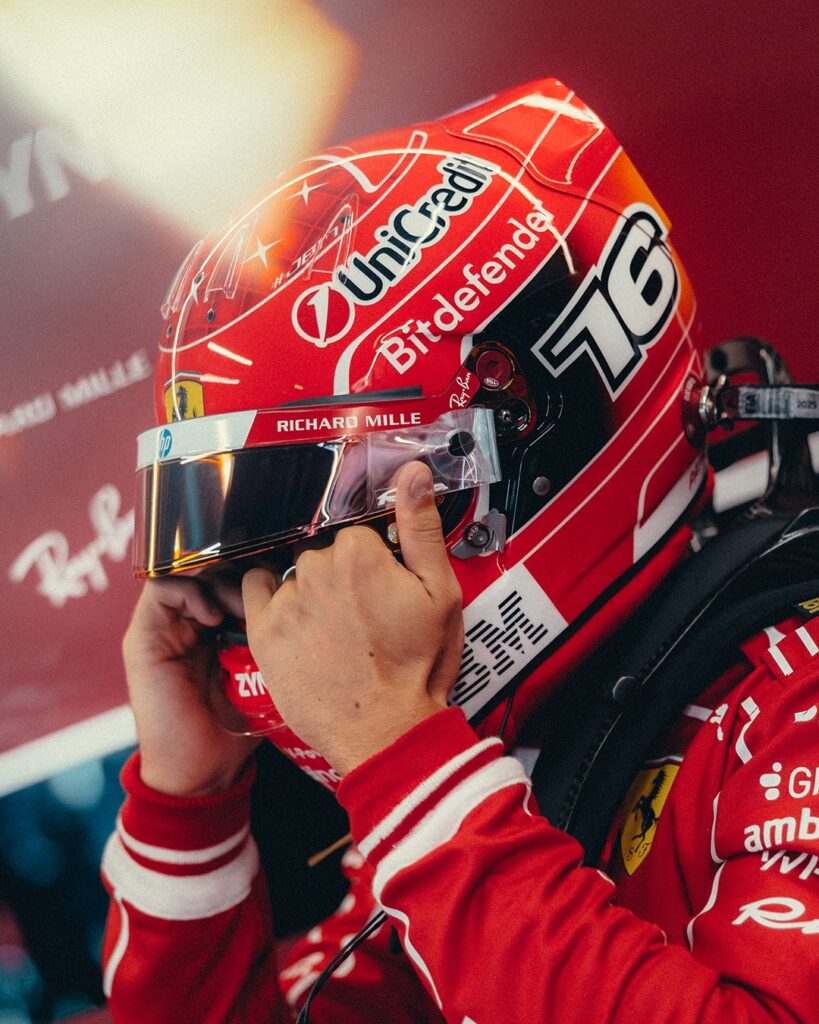
From a collector’s perspective, Monaco crashes always produce defining visual archives. The Leclerc Monaco helmet — the home-race specification carried by the Monegasque through Casino Square, the Swimming Pool and Rascasse — is the single most photographed lid of the weekend, second only on the year to his season-opener design.
The SF-26 livery against the barrier
The contrast of the bright Ferrari red against the white Anthony Noghes barriers, captured at the exact moment of nose-first contact, has become the defining still image of the Grand Prix. For exhibition pieces, this is the reference frame collectors point to when discussing the 2026 Ferrari aesthetic: the matte-and-gloss split on the bodywork, the yellow Scuderia shield, and the #16 picked out on the engine cover.
Helmet details worth noting
The Leclerc Monaco helmet carries the driver’s red-and-white principality colours, his personal sponsor markings, and the small Monegasque flag motif on the chinbar. A full-size 1:1 collector replica of this design captures the exact geometry seen at parc fermé — a display piece that records the weekend exactly as the broadcast cameras did, without any of the impact damage. For exhibition shelves, that pristine version is what makes the piece sit alongside the broadcast story rather than against it.
What it means for Ferrari and the championship
Ferrari leave Monaco with a result that statistically and emotionally hurts. A 3rd place was on the table; zero points went on the board. For a team that had built the weekend around a home race for its lead driver, and signed that driver to a long-term extension days before, the optics are difficult.
The Vasseur–D’Ambrosio debrief
The Sunday debrief between Leclerc, Fred Vasseur and Jerome D’Ambrosio will set the tone for the next two race weekends. Three questions sit on the table: what the data actually shows on the four corners of the SF-26 at the moment of the incident, how the public narrative is managed alongside Brembo, and whether any procedural change is needed for restart conditions.
For collectors, the Monaco weekend already has its place in the 2026 Ferrari display story — a moment when a driver, a team and a 50-year supplier publicly disagreed on what happened in 4 seconds at Anthony Noghes.
“Out of the four brakes, I had three brakes not working. The front left was working well, the front right was half working, and the two rear brakes were not working at all.”
— Charles Leclerc, post-race media
“The Brembo Group expresses great astonishment regarding what happened to Charles Leclerc during the Monaco Grand Prix and is very surprised by the statements made by the driver after the race.”
— Brembo official statement
FAQ
Q: What happened to Charles Leclerc at the Monaco Grand Prix?
Leclerc crashed nose-first into the outside barrier at Anthony Noghes on a Safety Car restart while running 3rd. He blamed the brakes on team radio and in post-race media, ending his home race on the spot.
Q: What did Leclerc say about the SF-26 brakes?
He stated that 3 of the 4 brakes were not working: the front left was fine, the front right was half working, and both rear brakes showed no deceleration on data — as if, in his words, “the callipers were not even in the car.”
Q: How did Brembo respond to Leclerc’s comments?
Brembo issued a statement on Sunday evening expressing “great astonishment” and surprise at the driver’s remarks, noting its partnership with Ferrari has run for over 50 years and that the company was currently unaware of the cause of the problem.
Q: Why is the Leclerc Monaco helmet popular with collectors?
It carries Leclerc’s home-race principality colours, the Monegasque flag motif on the chinbar, and pairs visually with the SF-26 livery in one of the most photographed Grands Prix of the season — a defining reference for full-size 1:1 display replicas.
Q: Are 123Helmets pieces wearable?
No. All 123Helmets pieces are full-size 1:1 collector and display replicas, intended only as exhibition items. They are not certified for protective use of any kind.
Shop Charles Leclerc Collection
Display and collector replicas only. Not certified for protective use. Full-size 1:1 scale.
This article was written with the help of AI tools. Editorial policy