
Blog
Canadian Sprint Odds and What the Markets Predict: A Visual Recap for Helmet Collectors
 123Helmets Editorial Team
Canadian Sprint Odds and What the Markets Predict: A Visual Recap for Helmet Collectors
The Canadian Sprint weekend at Circuit Gilles Villeneuve always delivers a unique cocktail of unpredictability, market intrigue and stunning helmet visuals against the Île Notre-Dame backdrop. From maple-leaf liveries to chrome-finished crowns catching the St. Lawrence light, we break down what the betting markets are predicting, how the smart money is moving, and which podium scenes are destined to become display-worthy moments for collectors.
Key Takeaways
Betting markets favour Red Bull and McLaren for Montreal Sprint pole, but historical volatility at Circuit Gilles Villeneuve makes outsider bets statistically relevant.
Special Canadian GP helmet liveries — particularly maple-leaf motifs and chrome accents — consistently rank among the most collectable display pieces each season.
Sprint format compresses strategy windows, amplifying helmet camera close-ups on the grid and producing iconic visuals for full-size 1:1 replica collectors.
Podium ceremonies in Montreal, framed by the iconic ‘Bienvenue’ wall, create some of the most photographed helmet moments of the calendar year.
Reading the Montreal Sprint market
The Canadian Grand Prix Sprint format has rapidly become one of the most analytically scrutinised events on the calendar. Bookmakers and prediction markets converge in the days leading up to the weekend, blending qualifying simulations, historical lap data and weather modelling into a single set of odds. For 2024 and the seasons that followed, the markets have consistently leaned toward the top-three constructor monopoly, but Montreal’s character — a low-grip street-style circuit with heavy braking zones and unforgiving walls — has a habit of rewriting probability models in a single session.
What makes the Canadian Sprint so distinctive from a market perspective is the limited running time. With only one free practice session before the Sprint Shootout, teams have less data, drivers have less feel, and bookmakers have less to work with. The result is wider odds spreads, more value in mid-grid bets, and a higher likelihood of unexpected names appearing in the top six. For helmet collectors watching the action, this translates into a higher chance of seeing rare livery moments under podium spotlights.
Why the odds shift faster in Montreal
Compared to Imola or Silverstone, Montreal sees some of the largest pre-Sprint odds movements of the year. The reasons are well documented: rapidly evolving track surface from green to rubbered-in, frequent safety car probability (statistically the highest of any current calendar venue), and the famous ‘Wall of Champions’ at Turn 14 that has claimed multiple world champions. Each of these factors injects variance into market predictions, and variance is precisely what creates memorable on-track moments — the kind that translate into iconic helmet photography.
Pre-Sprint helmet reveals and the Canadian tradition
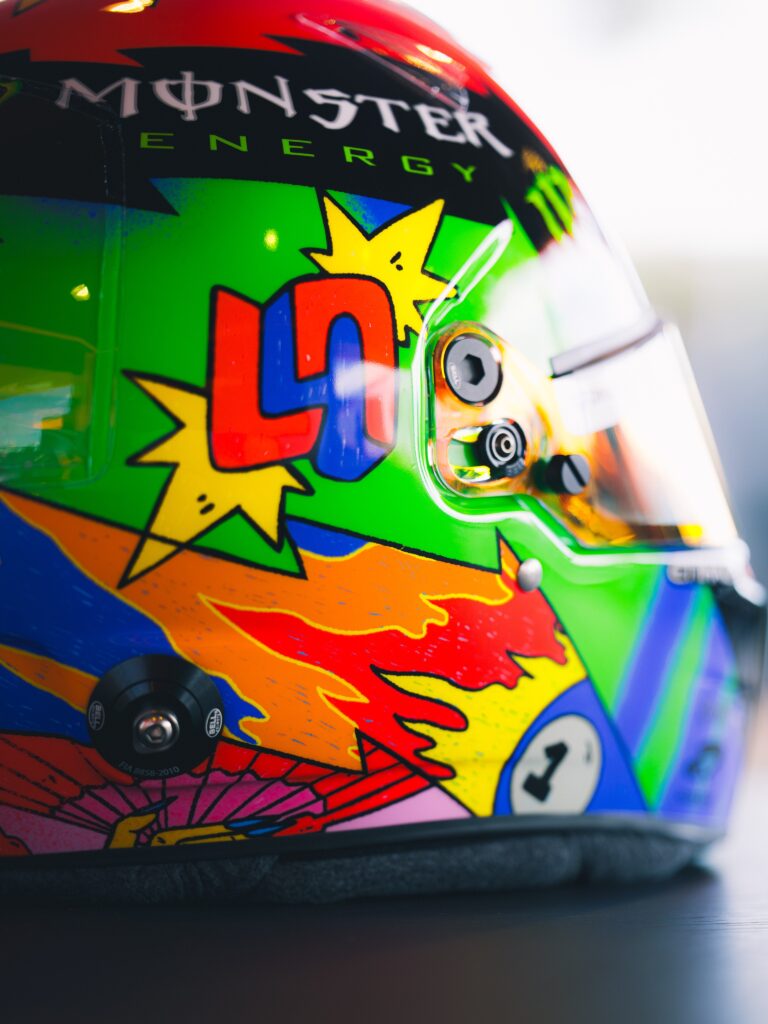
Few rounds on the calendar inspire as many special-edition helmet designs as the Canadian Grand Prix. The tradition runs deep: drivers have long honoured Gilles Villeneuve, the local fan culture, and the visual signature of the maple leaf with one-off paint schemes. In recent seasons, we have seen everything from full chrome bases reflecting the Biosphère’s geodesic dome to subtle Quebec flag accents tucked into the chin bar.
The maple-leaf motif as a collector benchmark
For display-focused collectors, Canadian GP helmets occupy a special category. The visual storytelling is immediate and recognisable: red and white dominate, often paired with metallic finishes that photograph beautifully under both Montreal’s overcast skies and its dramatic late-afternoon sun. A full-size 1:1 replica with a Canadian GP livery acts as a temporal marker in any collection — a piece that anchors a specific weekend, a specific result, a specific helmet-cam moment that fans remember.
Chrome, satin and the photography challenge
Montreal’s lighting is notoriously dynamic. The paddock sits on an island, surrounded by water, with shifting cloud cover and reflective surfaces everywhere. Helmet finishers have learned to design with this in mind, favouring satin clearcoats over high-gloss in some cases to reduce hotspots on broadcast cameras. For collectors evaluating display pieces, understanding these finishing nuances helps in selecting replicas that capture the intended visual effect — whether mounted under warm tungsten gallery lighting or daylight-balanced LED.
Sprint Shootout: what the markets got right (and wrong)
The Sprint Shootout format — three short qualifying segments with mandatory tyre compounds — was designed to inject jeopardy, and Montreal delivers on that promise. Markets that opened the weekend with heavy favourites often saw dramatic recalibration after SQ1, when soft-tyre management on a cool, evolving surface caught out established names. The pattern repeats: teams that nail the out-lap warm-up cycle find tenths that disappear for others, and the resulting grid produces Sprint races with genuine wheel-to-wheel battles into Turn 1.
Front-row visuals and the helmet-cam era
From a visual storytelling perspective, the Sprint grid in Montreal is one of the most photogenic of the season. The pit straight runs alongside the rowing basin, the grandstands rise sharply, and the helmet-cam footage broadcast in recent seasons has elevated the driver’s-eye perspective to an art form. Collectors who follow specific drivers often cite Montreal helmet-cam laps as the moments that crystallised their decision to acquire a particular 1:1 display replica. The combination of high-speed chicane visuals, the famous hairpin, and the long back straight gives every driver’s helmet a chance to be framed against multiple iconic backdrops.
The Sprint race itself: podium visuals and display moments
A 100-kilometre Sprint at Circuit Gilles Villeneuve is short enough to require aggressive starts and long enough to allow strategy to unfold. The result is a race that almost always produces a memorable lead change, a safety car intervention, or a final-lap drama at the chicane. For helmet collectors, the Sprint podium is often where the most striking display imagery is created — three drivers, three helmets, three carefully designed liveries presented under the Canadian flag.
The ‘Bienvenue au Canada’ wall as a framing device
Photographers and broadcast directors have long used the painted welcome wall on the inside of Turn 13 as a framing device for podium and parc fermé shots. The result is that helmets photographed in Montreal carry an instantly recognisable visual context. A full-size 1:1 replica displayed in a collector’s home or gallery, paired with a printed photograph of that specific Montreal moment, creates a narrative pairing that few other circuits can match.
Trophy lifts and helmet-off moments
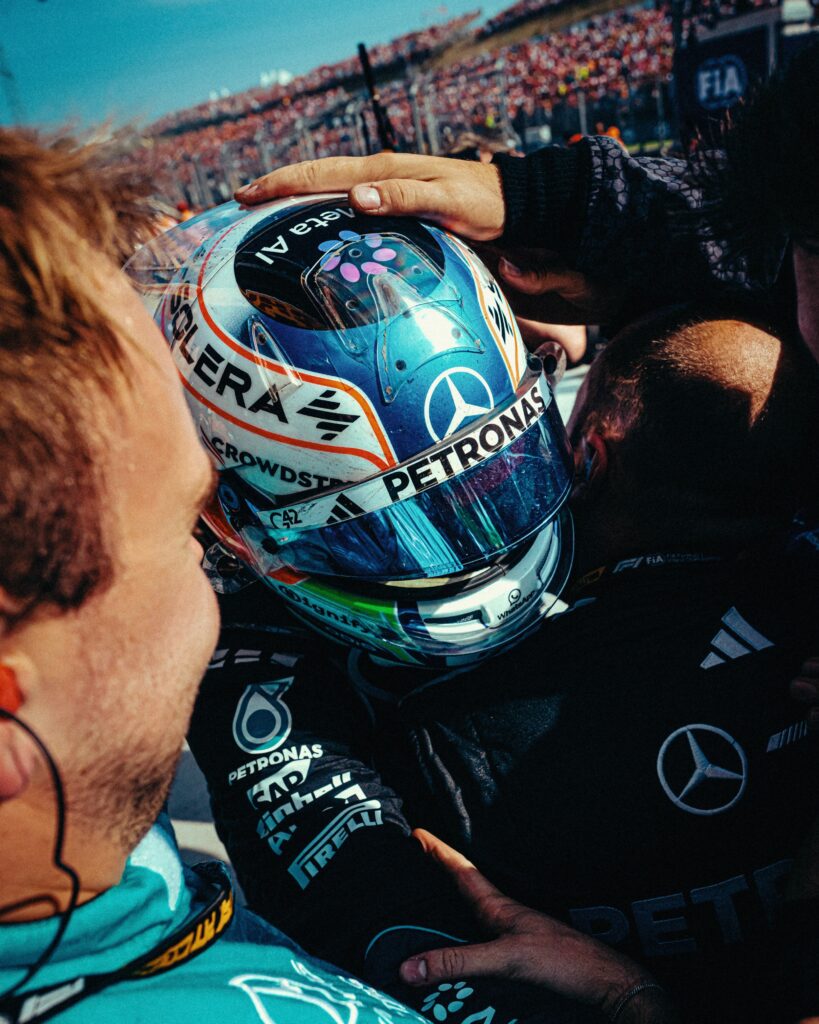
The Sprint podium protocol differs slightly from the Grand Prix ceremony, but the helmet-removal moment on the cool-down lap and in parc fermé remains one of the most documented visuals of the weekend. Drivers often take a beat in Montreal to acknowledge the crowd along the long pit straight, and the helmet visor — frequently tear-off-laden and marked by rubber pickup — becomes a character piece in its own right. These are the references collectors study when evaluating the authenticity of a display replica’s weathering and detailing.
What the markets predict for the Grand Prix itself
Sprint results feed directly into Sunday’s Grand Prix odds, but the relationship is rarely linear. A driver who wins the Saturday Sprint may start the main race from a compromised grid position depending on qualifying, and Montreal’s high safety-car probability means strategy gambles often outweigh outright pace. Markets typically tighten significantly after the Sprint, with the favourites’ odds shortening only modestly because the bookmakers know how quickly fortunes can shift around the Île Notre-Dame.
Weather as the great variable
Rain in Montreal is almost a guarantee at some point across the weekend, and wet-weather odds open up entirely new market scenarios. From a helmet perspective, wet races produce some of the most evocative imagery of the season — visors streaked with spray, rain lights glowing through mist, and helmet liveries glistening against the wet asphalt. Collectors often regard wet-race Montreal helmets as particularly desirable display pieces because of the visual drama embedded in their photographic record.
The constructors’ championship lens
Beyond individual driver odds, the Canadian Sprint weekend often shifts the constructors’ championship narrative. Mid-season points swings are common here, and the helmet liveries on the podium frequently signal where the momentum is heading for the second half of the year. For collectors building a season-long display, the Montreal podium helmets serve as a midpoint chapter marker — a visual reference for how the championship story is unfolding.
Building a Montreal-themed display
For collectors inspired by the Canadian Sprint weekend, building a themed display around the Montreal round offers rich creative possibilities. A full-size 1:1 replica helmet anchors the centrepiece, but the surrounding context — printed photography, a small Quebec flag, a framed Gilles Villeneuve tribute — transforms a single object into a curated scene. Exhibition-quality display cases with adjustable LED lighting allow collectors to recreate the broadcast lighting conditions of the Montreal paddock, bringing out the chrome and satin finishes that define so many Canadian GP helmet designs.
Pairing helmets with circuit context
Some of the most compelling private collections we have seen pair their Montreal helmet replicas with framed track maps, printed lap charts from the Sprint, or even small acrylic models of the Biosphère and the Gilles Villeneuve circuit. The result is a display that tells a complete weekend story — the odds, the qualifying surprise, the Sprint drama, the podium visual — all anchored by the helmet itself as the central narrative object.
“Montreal rewards bravery in the braking zones and punishes hesitation at the chicane — and that’s exactly why the helmet visuals from this weekend always end up in the collector’s hall of fame.”
— 123Helmets editorial desk
FAQ
Q: Why are Canadian Grand Prix helmets so popular among collectors?
The combination of special-edition maple-leaf liveries, chrome and satin finishes designed for Montreal’s dynamic lighting, and the iconic visual backdrop of Circuit Gilles Villeneuve makes Canadian GP helmets particularly photogenic. Full-size 1:1 display replicas of these designs anchor a collection with strong narrative and visual identity.
Q: How do Sprint format weekends affect helmet visibility on broadcasts?
The compressed schedule of Sprint weekends means more grid walks, more close-up helmet-cam segments and more parc fermé reaction moments. This increased visibility creates more reference imagery for collectors evaluating display replicas and their finishing details.
Q: What makes Montreal odds so volatile compared to other circuits?
Limited practice running, a green track surface that evolves rapidly, the highest safety car probability on the calendar, and the unforgiving Wall of Champions all contribute to wide odds spreads and frequent market recalibration throughout the weekend.
Q: Are the helmet replicas you reference suitable for actual track use?
No. All pieces in this category are display and collector replicas only — full-size 1:1 scale, exhibition quality, designed for showcase and curated display purposes. They are not certified for protective or on-track use.
Q: How should I light a Montreal-themed helmet display?
Adjustable LED lighting in the 3000K to 4000K range works well for chrome and satin Canadian GP finishes, mimicking the mixed natural and broadcast lighting of the Île Notre-Dame paddock. Avoid harsh single-point spotlights, which create hotspots on metallic finishes.
Browse F1 Helmet Collection
Display and collector replicas only. Not certified for protective use. Full-size 1:1 scale.