Blog
Las Vegas Locked In Until 2037: A New F1 Era on the Strip and What It Means for Display Collectors
 123Helmets Editorial Team
Formula 1 has extended its contract to race in Las Vegas through 2037, locking in more than a decade of night racing on the Strip. For collectors, that means a long runway of fresh liveries, special helmet designs and podium imagery built around one of the most visually loaded events on the calendar — exactly the kind of material that drives display piece demand.
Key Takeaways
Formula 1 has extended its Las Vegas Grand Prix deal through the 2037 season, securing 14 more editions on the Strip.
The 6.201 km street layout keeps producing high-contrast night visuals — ideal reference for full-size 1:1 replica helmets used as display pieces.
Special one-off liveries and helmet designs tied to Las Vegas continue to be among the most requested collector items of the season.
Long-term calendar stability through 2037 gives collectors confidence when planning exhibition-quality display builds around the race.
The Extension: F1 on the Strip Through 2037
Formula 1 and Las Vegas have signed a contract extension that keeps the race on the calendar until 2037. The original deal, struck around the inaugural 2023 event, was due to expire after 2025. The new agreement adds more than a decade of guaranteed night races down Las Vegas Boulevard, with the 6.201 km circuit and its 17 corners staying as the base layout.
The Las Vegas Grand Prix is run by Liberty Media’s own promoter arm rather than a third party, which is unusual on the calendar. That structure made the extension straightforward: F1 essentially renewed a deal with itself, locking in the Saturday night slot that has become a fixed point in November.
For a race that only returned in 2023 after a 41-year gap from the early-1980s Caesars Palace events, the jump from a three-year pilot to a 2037 horizon is a strong signal. It changes how teams, sponsors and — for collectors — helmet design studios plan special editions around the event.
Why 2037 Matters for Collectors
A 14-season runway means almost certain annual special liveries, one-off helmet designs and podium graphics tied to Las Vegas. Each of those creates new reference material for full-size 1:1 replica helmets built as display pieces. When a race only has a 3-year contract, design studios hold back. With a 2037 deadline, they commit.
Race Recap: Night Racing, Long Straights and Cold Asphalt
The Las Vegas Grand Prix runs at night, with lights-out scheduled around 22:00 local time on Saturday. Track temperatures drop well below daytime readings, and the combination of cold asphalt, long straights and 90-degree street corners makes for a circuit that rewards mechanical grip and brave braking.
The lap is 6.201 km long, which puts it among the longer layouts on the modern calendar. Drivers reach top speeds on the run down Las Vegas Boulevard, then have to manage tyre temperatures through the slower technical section near the Sphere. The race is scheduled over 50 laps for a total distance of 309.958 km.
What the Cameras Captured
Night racing is the entire visual identity of this round. The neon backdrop, the reflected light on carbon bodywork and the way helmet visors catch the strip lighting on the main straight make Las Vegas one of the most photogenic events of the year. For anyone building a display shelf or glass case, the imagery generated over a single weekend is enough to justify a dedicated Vegas-themed section.
Podium Visuals Worth Framing
The podium structure is built directly on the pit straight, with the Sphere and the Strip skyline behind it. That backdrop has already become a recognisable frame, sitting alongside Monaco’s harbour and Spa’s Eau Rouge as instantly identifiable race imagery. Replica helmets photographed under similar lighting — warm side light, dark background — pick up the same theatrical quality.
Helmet Designs: The Vegas Special Edition Effect
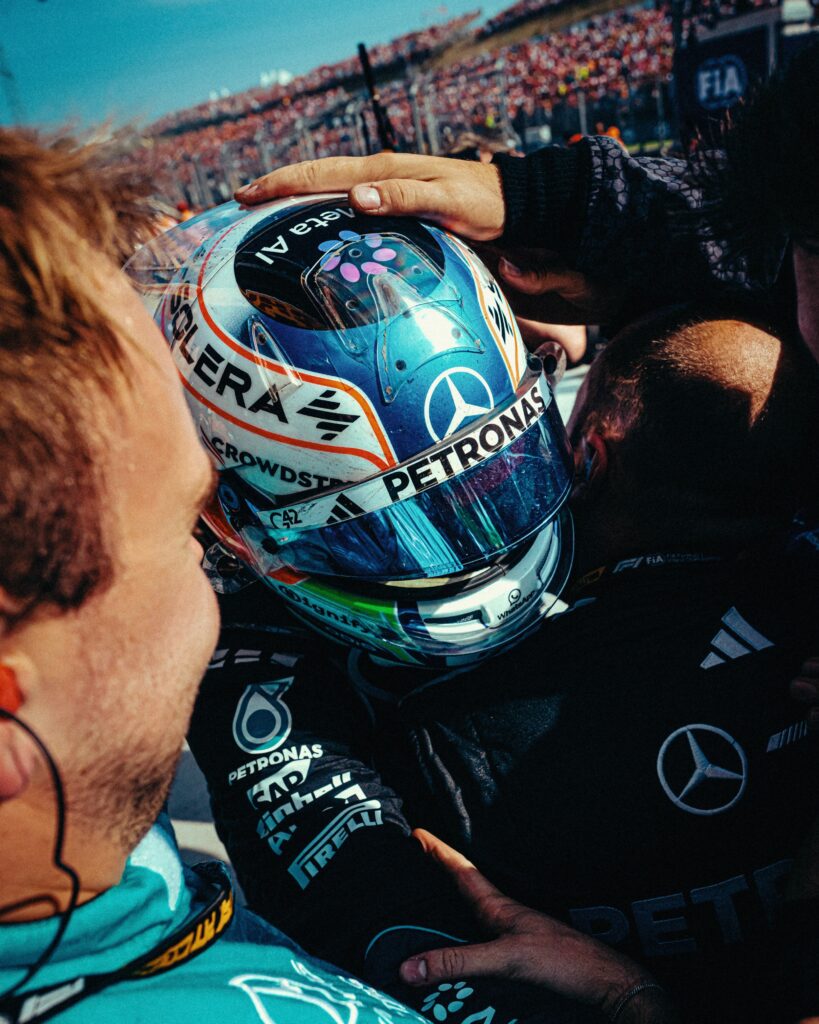
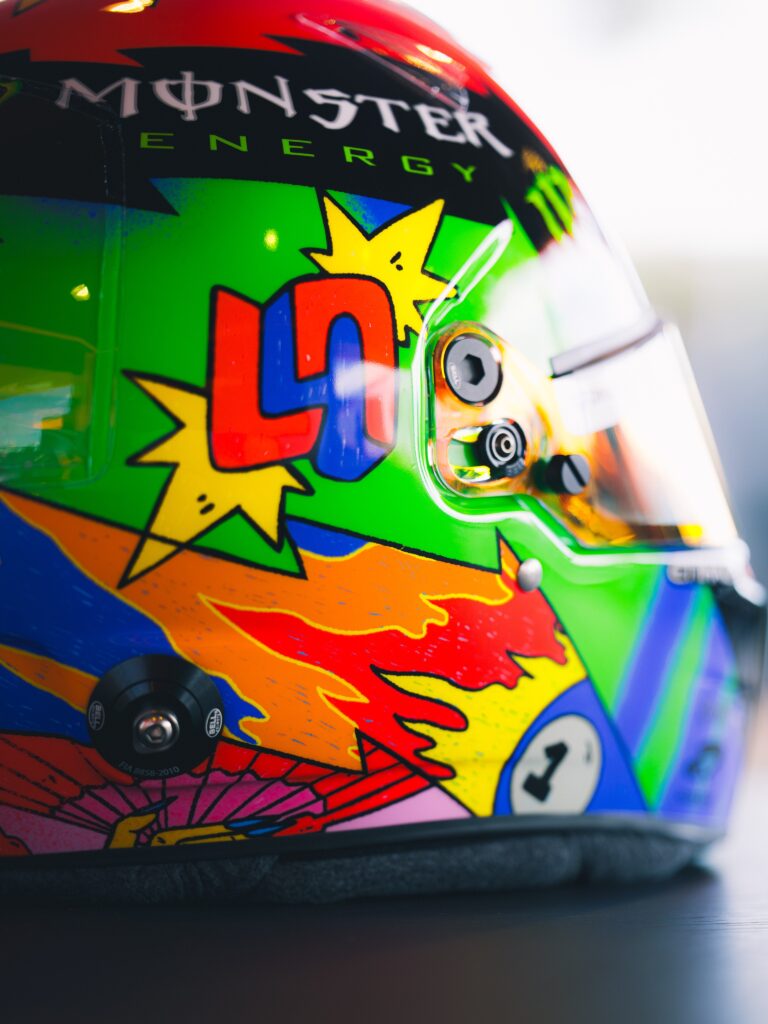
Since 2023, the Las Vegas Grand Prix has triggered more one-off helmet designs per grid than almost any other race outside Monaco and a driver’s home round. Chrome finishes, neon accents, playing-card motifs, dice graphics and Strip-style typography have all appeared on race weekend helmets.
That matters for the display replica market. A standard season helmet design is produced and sold as a 1:1 collector item across the year. A one-off Vegas special is, by definition, limited to a single weekend of on-track use, which makes the replica version more attractive as an exhibition-quality piece. With the contract now running to 2037, that pattern is locked in for at least 14 more editions.
Common Visual Themes
The recurring design language across Las Vegas specials tends to include:
- Mirror chrome or candy-coat base layers, often built up in 6 to 8 paint passes for depth.
- Neon pink, electric blue and acid green accents that read well under stadium lighting.
- Card suit icons, roulette graphics and Art Deco type drawn from classic Strip signage.
- Dark visor tear-offs to manage the contrast between the lit straight and the darker infield sections.
When those designs are translated into a full-size 1:1 replica for display, the chrome base is usually the most demanding step. A clean mirror finish needs a controlled environment and multiple clear coats, which is why proper exhibition-quality replicas are priced and built differently from generic souvenirs.
Liveries on the Strip: Special Editions and Sponsor Activations
The car liveries seen at Las Vegas tend to follow the same logic as the helmets. Teams use the race as a showcase for sponsor activations, with chrome wraps, blacked-out base colours and neon highlights appearing on cars that otherwise run a standard season scheme. Some teams have introduced fully unique one-off liveries for the weekend.
For display collectors, the helmet usually carries the special design further than the car. A team livery refresh has to work across two cars for one weekend; a driver’s Vegas helmet can be a clean, standalone design with no commercial constraints beyond logo placement. That is why the helmet replica often becomes the lead display piece from the Las Vegas round rather than a scale model car.
Setting Up a Vegas-Themed Display
If the goal is a small Vegas-focused shelf or cabinet, a clean approach is one full-size 1:1 replica helmet on a dedicated stand, lit from a single warm side source at roughly 45 degrees, against a matte black background. A typical helmet display footprint sits around 27 × 35 cm including the base, and the replica weight is usually around 1.2 to 1.5 kg depending on shell construction. That weight and footprint are worth checking before mounting on a wall shelf rather than a solid cabinet.
What the 2037 Deal Changes for the Calendar
The Las Vegas extension is part of a broader pattern. F1 has been locking in long-term contracts at several venues, with multi-year deals already confirmed at other rounds. A 2037 endpoint for Las Vegas, alongside other long contracts, gives the calendar a stable spine through the next decade.
For collectors, calendar stability matters more than it sounds. When a race is on a rolling short-term deal, special editions tied to that venue feel disposable. When the race is contracted through 2037, those editions become part of a long series — Vegas 2023, 2024, 2025 and onwards — which is exactly how collector value builds over time. A run of annual Las Vegas helmet designs, displayed together, becomes a far stronger exhibition than a single one-off.
Looking Ahead to the Next Editions
The next races on the Strip will continue under the existing 6.201 km, 50-lap, night-race format. Expect more chrome, more neon, and more driver-specific Vegas designs to fuel the display replica market through the rest of the decade and into the 2030s.
“Las Vegas is now a permanent fixture, and that changes how we think about the design pieces that come out of the weekend — they’re part of a long series, not a one-off curiosity.”
— 123Helmets editorial desk
FAQ
Q: How long is the new Las Vegas Grand Prix contract?
Formula 1 has extended its Las Vegas Grand Prix deal through the 2037 season, adding more than a decade to the original contract that was set to expire after 2025.
Q: What is the length of the Las Vegas circuit?
The Las Vegas Strip Circuit is 6.201 km long with 17 corners. The race runs over 50 laps for a total distance of 309.958 km, held at night down Las Vegas Boulevard.
Q: Why are Las Vegas helmet designs popular with collectors?
Drivers regularly run one-off special designs for the Vegas weekend, often with chrome finishes and neon accents. Because they are used for a single race, the full-size 1:1 replicas become standout display pieces rather than standard season items.
Q: Are these replica helmets meant to be worn?
No. The helmets we cover are display and collector replicas only. They are full-size 1:1 scale exhibition-quality pieces built for display, not for any protective or wearable use.
Q: How much space does a 1:1 replica helmet need on a shelf?
A typical full-size 1:1 replica with its display base needs around 27 × 35 cm of footprint and weighs roughly 1.2 to 1.5 kg, depending on shell construction. Check shelf depth and load before mounting.
Browse F1 Helmet Collection
Display and collector replicas only. Not certified for protective use. Full-size 1:1 scale.