Blog
Ferrari in Austria: Can the Momentum Last?
 123Helmets Editorial Team
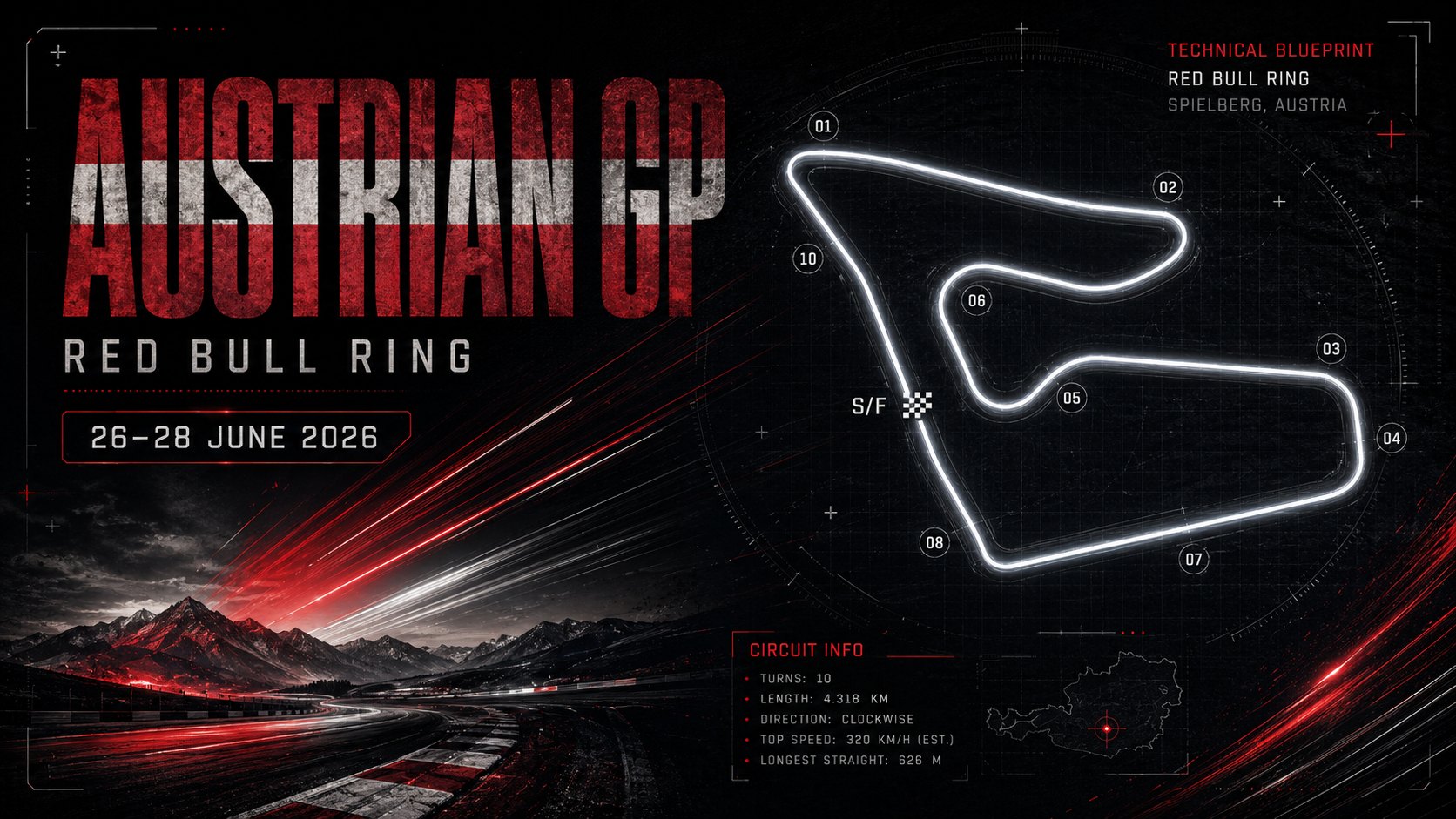
Lewis Hamilton’s Barcelona victory gave Ferrari their first win of the 2026 season and sent the Italian squad into Austria carrying genuine belief. With a fresh power unit upgrade and new Shell fuel compound in the car, the Scuderia arrived at the Red Bull Ring asking one straightforward question: can they do it again?
Key Takeaways
Hamilton’s Barcelona win was Ferrari’s first victory of the 2026 season, ending a drought and confirming the team’s competitive revival.
Ferrari brought their first power unit upgrade of 2026 to Austria, paired with a new Shell fuel compound for additional performance.
The Scuderia’s Barcelona result was built on a heavily updated car, sharp strategy and clean execution — all of which must now transfer to a very different circuit.
The Red Bull Ring’s fast, low-downforce layout will test Ferrari’s upgrade package in a way Barcelona’s technical sector did not.
Hamilton’s Barcelona Win: What It Actually Meant
Lewis Hamilton’s victory in Barcelona was Ferrari’s first win of the 2026 Formula 1 season, and it landed with weight far beyond a single points haul. The result confirmed that the seven-time World Champion’s integration at Maranello has produced something real — a car-driver combination sharp enough to beat Mercedes when conditions align. Hamilton did not simply inherit the win; Ferrari nailed the build-up, the strategy and the qualifying lap, arriving in Spain with a heavily updated chassis that justified every kilometre of simulator time invested since winter testing.
For collectors and display enthusiasts, Barcelona was the kind of weekend that defines a helmet season. Hamilton’s Ferrari lid — the red and white colour scheme now carrying the Scuderia’s 2026 identity — crossed the line first under the Catalan sun, making that specific design one of the most photographed pieces of racing headgear from the early part of this campaign. A full-size 1:1 replica of the helmet Hamilton wore across that race weekend captures a genuinely historic moment: the first Ferrari win of 2026, and evidence that the Italian squad is no longer racing from behind.
The significance for the championship picture is equally clear. Mercedes had been setting the pace through the opening rounds, but Ferrari’s Barcelona performance — built on a car update rather than a circuit quirk — demonstrated that the gap is closeable. Austria, therefore, is not just another race. It is Ferrari’s first chance to show that Barcelona was a trend, not an outlier.
The Power Unit Upgrade: What Ferrari Brought to Austria
Ferrari arrived at the Red Bull Ring with their first internal combustion engine upgrade of the 2026 season, bundled with a revised fuel compound developed in partnership with Shell. This is the most significant step the Scuderia has taken on the engine side since pre-season, and it arrives at a circuit where straight-line speed matters — the Red Bull Ring’s layout is compact at 4.318 km per lap and features three heavy braking zones, but the long run from Turn 3 to Turn 4 rewards peak power as directly as almost anywhere on the calendar.
The Shell fuel partnership is not cosmetic. Changes at the molecular level of the fuel blend can shift combustion efficiency in ways that translate into measurable lap time, and Ferrari have been working with Shell throughout 2026 to find those margins. Pairing a new fuel with a new engine specification in a single weekend carries risk — diagnosing problems becomes harder when two variables change simultaneously — but Ferrari’s confidence coming out of Barcelona meant the timing felt right.
From a display and collector standpoint, the Austrian weekend also marks the first race at which Ferrari’s upgraded visual identity — the livery changes that accompanied the power unit rollout — will appear on circuit. Any full-size 1:1 replica helmet or display piece representing the 2026 Austrian Grand Prix will carry that specific configuration, making it a distinct artefact from the Barcelona winner.
The Red Bull Ring Layout and Ferrari’s Challenge
The Red Bull Ring presents a fundamentally different aerodynamic challenge from Barcelona, and Ferrari must prove their 2026 car works in low-to-medium downforce trim. Barcelona’s Circuit de Catalunya is a well-understood reference track that rewards balanced aerodynamic packages and strong mechanical grip through its technical middle sector. Austria strips much of that complexity away: 71 laps around a 4.318 km circuit, with short, punchy corners and long acceleration zones that expose any deficit in straight-line power.
Mercedes have shown strong top-speed numbers throughout the 2026 season, which means Austria’s layout should, in theory, suit them more than it suits Ferrari. The Scuderia’s task is to close that gap using the new power unit specification and to extract enough lap time from the car’s chassis balance to offset any remaining engine delta. Hamilton’s racecraft in traffic — demonstrated clearly in Spain — will also be tested again: the Red Bull Ring’s narrow track width makes overtaking difficult, and clean air at the front of the field matters enormously.
The Styrian hills venue also has a history of unpredictable weather windows in late June, and Ferrari’s strategy team will need to be as sharp as they were in Barcelona if the safety car or a rain shower compresses the field. In 2026, the Austrian Grand Prix weekend falls on a calendar slot that has repeatedly produced dramatic race outcomes, and Ferrari will be hoping to be on the right side of that chaos rather than absorbed by it.
Podium Visuals and the Display Case Appeal of Ferrari’s 2026 Livery
Ferrari’s 2026 livery is among the most photographed in the paddock, and the Austrian weekend is already generating significant collector interest before a wheel has turned in anger. The Scuderia’s red — slightly deeper in shade compared to the 2024 specification — reads exceptionally well against the green Styrian backdrop of the Red Bull Ring grandstands, producing podium imagery that translates directly into strong display aesthetics for replica helmets and exhibition pieces.
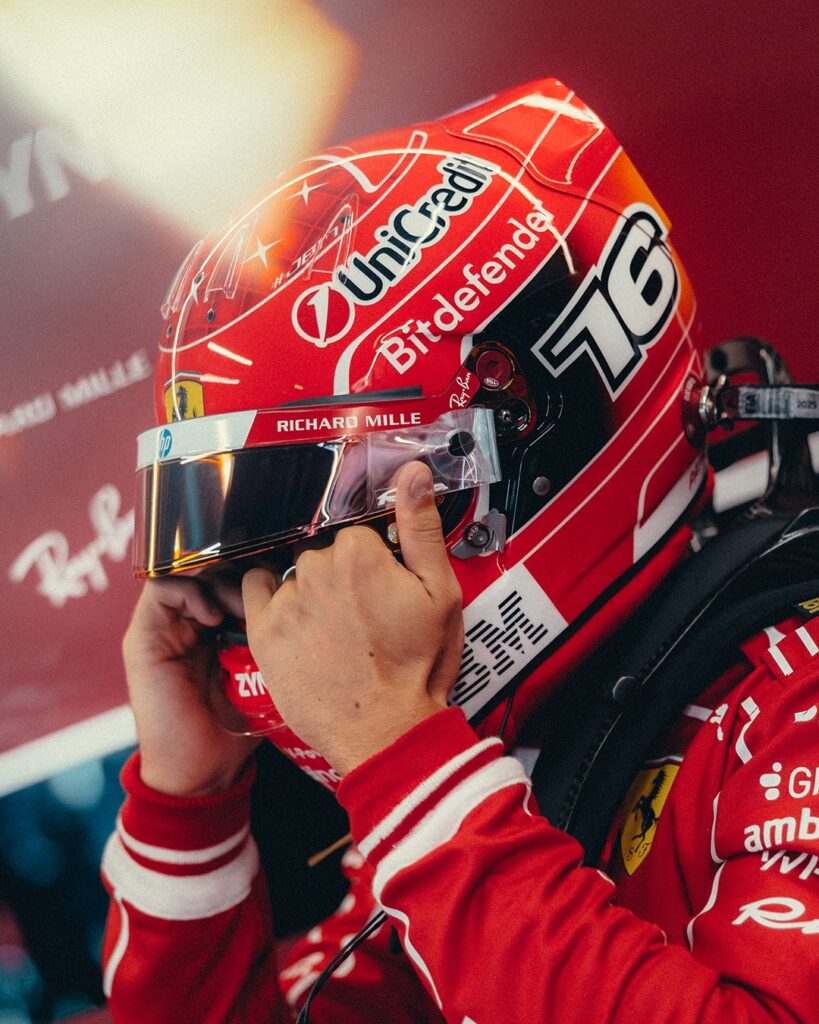
A full-size 1:1 replica helmet representing Hamilton’s 2026 Ferrari season carries specific design markers: the white band through the visor area, the Shell and HP branding placements introduced for this campaign, and the matte-to-gloss finish contrast that Ferrari’s lid supplier developed alongside the team for the new season. Exhibition-quality pieces at this scale typically sit at approximately 29 × 25 × 35 cm in overall footprint when mounted on a standard display stand, and the weight of a properly constructed full-size replica — non-certified, collector-only — runs close to 1.2–1.5 kg, giving it the physical presence that smaller-scale pieces cannot replicate.
The Barcelona victory helmet is already being discussed as a candidate for one of the season’s most significant display pieces, but Austria carries its own narrative weight. A second consecutive Ferrari win would make the Austrian Grand Prix lid the marker of the moment the Scuderia turned a single result into a genuine championship challenge. For anyone building a 2026 season display collection, the difference between a Barcelona replica and an Austrian Grand Prix replica is the difference between a comeback story and a title fight.
What Makes a Race Helmet Display-Worthy?
Display-worthy does not mean expensive by default. It means the helmet replica represents a moment — a race, a driver, a result — that has narrative and visual significance. The 2026 Austrian Grand Prix sits at the intersection of Ferrari’s power unit story, Hamilton’s personal revival arc and the team’s championship push against Mercedes. That combination, captured in a full-size 1:1 exhibition replica, is precisely what serious collectors look for when choosing which pieces to place at the centre of a display.
Mercedes vs Ferrari: Where the Championship Stands
Mercedes lead the 2026 Constructors’ Championship heading into Austria, and Ferrari’s Barcelona win cut into that advantage without eliminating it. The gap between the two teams is the defining story of the 2026 season so far, with every race offering a new data point on whether Ferrari’s updates are producing structural pace or circuit-specific performance. Austria will answer that question more clearly than most venues because its characteristics differ so sharply from Barcelona’s.
Hamilton’s personal championship position has improved with the Barcelona result, and the seven-time World Champion now heads to Austria as a genuine title contender rather than a supporting narrative. His helmet — instantly recognisable in Ferrari red — has become one of the most watched objects in the paddock this season, and every appearance on the podium adds collector value to the 2026 Ferrari lid as a display object.
Ferrari’s technical partnership with Ferrari — the Scuderia’s internal development pipeline — has produced updates at a faster rate in 2026 than in the previous two seasons, suggesting that the Barcelona performance is the result of a genuine programme acceleration rather than a one-off. If the power unit upgrade performs in Austria, the conversation will shift from ‘can Ferrari win again?’ to ‘can Mercedes stop them?’
Why Austrian Grand Prix Helmets Belong in Any 2026 Collection
The 2026 Austrian Grand Prix is a collector marker regardless of the race result, because it represents Ferrari’s first appearance at a high-speed power circuit with their upgraded engine specification. Any full-size 1:1 replica helmet from this weekend — Lewis Hamilton‘s Ferrari lid or the team’s general 2026 Austrian Grand Prix design — captures that specific chapter of the season’s technical and competitive story.
Display replicas are not simply decorative objects. At full 1:1 scale, they hold the exact proportions of the race-used originals, allowing collectors to appreciate the visor geometry — typically a 26 mm polycarbonate lens opening on a standard full-face design — the air intake placement and the surface finish that distinguishes one team’s helmets from another. Ferrari’s 2026 specification uses a multi-layer paint process that gives the red its depth, and exhibition-quality replicas reproduce that layering to a standard that smaller collectibles cannot approach.
The Austrian Grand Prix has historically produced clean, high-contrast podium imagery — the Red Bull Ring’s open hillside setting and bright late-June light make for ideal photography conditions. For a display piece, that matters: the helmet you place on a stand should evoke the visual memory of the race weekend, and the 2026 Austrian Grand Prix, with Ferrari chasing back-to-back wins under Styrian skies, has the makings of exactly that kind of moment.
“Ferrari have the stomach for a fight this season, having nailed the build-up, strategy and performance in Spain with a heavily updated car.”
— 2026 Austrian Grand Prix paddock assessment
“Hamilton’s sensational victory in Barcelona was not just the latest step in his revival this year, but also further evidence that Ferrari have the stomach for a fight this season.”
— F1 paddock report, 2026
FAQ
Q: Did Ferrari win the 2026 Austrian Grand Prix?
The 2026 Austrian Grand Prix takes place after Ferrari’s first win of the season in Barcelona, and the Scuderia arrived in Austria as the form team with a new power unit upgrade. The race result will confirm whether Ferrari can sustain that momentum at a high-speed, low-downforce circuit.
Q: What helmet did Lewis Hamilton wear at the 2026 Austrian Grand Prix?
Hamilton wore Ferrari’s 2026 season design in Scuderia red and white, carrying the HP and Shell branding placements specific to Ferrari’s 2026 livery specification. This is the same design family as the Barcelona winner’s helmet, updated with Austrian Grand Prix race-specific details.
Q: What is the difference between a display replica helmet and a race-used helmet?
A display replica helmet is a full-size 1:1 collector piece produced for exhibition and display purposes only — it carries no safety certification and is not intended for protective use on track. Race-used helmets are certified protective equipment; display replicas reproduce the visual design at accurate scale for collector display.
Q: Why is the 2026 Austrian Grand Prix significant for Ferrari collectors?
The 2026 Austrian Grand Prix is the first race at which Ferrari ran their upgraded power unit and Shell fuel compound, making it a technically distinct chapter of the season. A full-size 1:1 replica helmet from this weekend represents that specific moment in Ferrari’s 2026 championship push.
Q: What are the typical dimensions of a full-size 1:1 Ferrari replica helmet?
A full-size 1:1 Ferrari replica helmet for display typically measures approximately 29 × 25 × 35 cm in overall footprint when mounted, with a weight close to 1.2–1.5 kg for a properly constructed exhibition-quality piece. These dimensions match the proportions of the race-used originals, making them the preferred scale for serious collectors.
Shop Ferrari Helmets — add Hamilton’s 2026 season to your display collection with our full-size 1:1 exhibition replicas. Each piece captures the exact colour specification, branding placement and finish of the Scuderia’s 2026 race design. Display only, not certified for protective use.
Display and collector replicas only. Not certified for protective use. Full-size 1:1 scale.
This article was written with the help of AI tools. Editorial policy