Blog
Barcelona GP 2026: Russell on Tyres & Podium Looks
 123Helmets Editorial Team
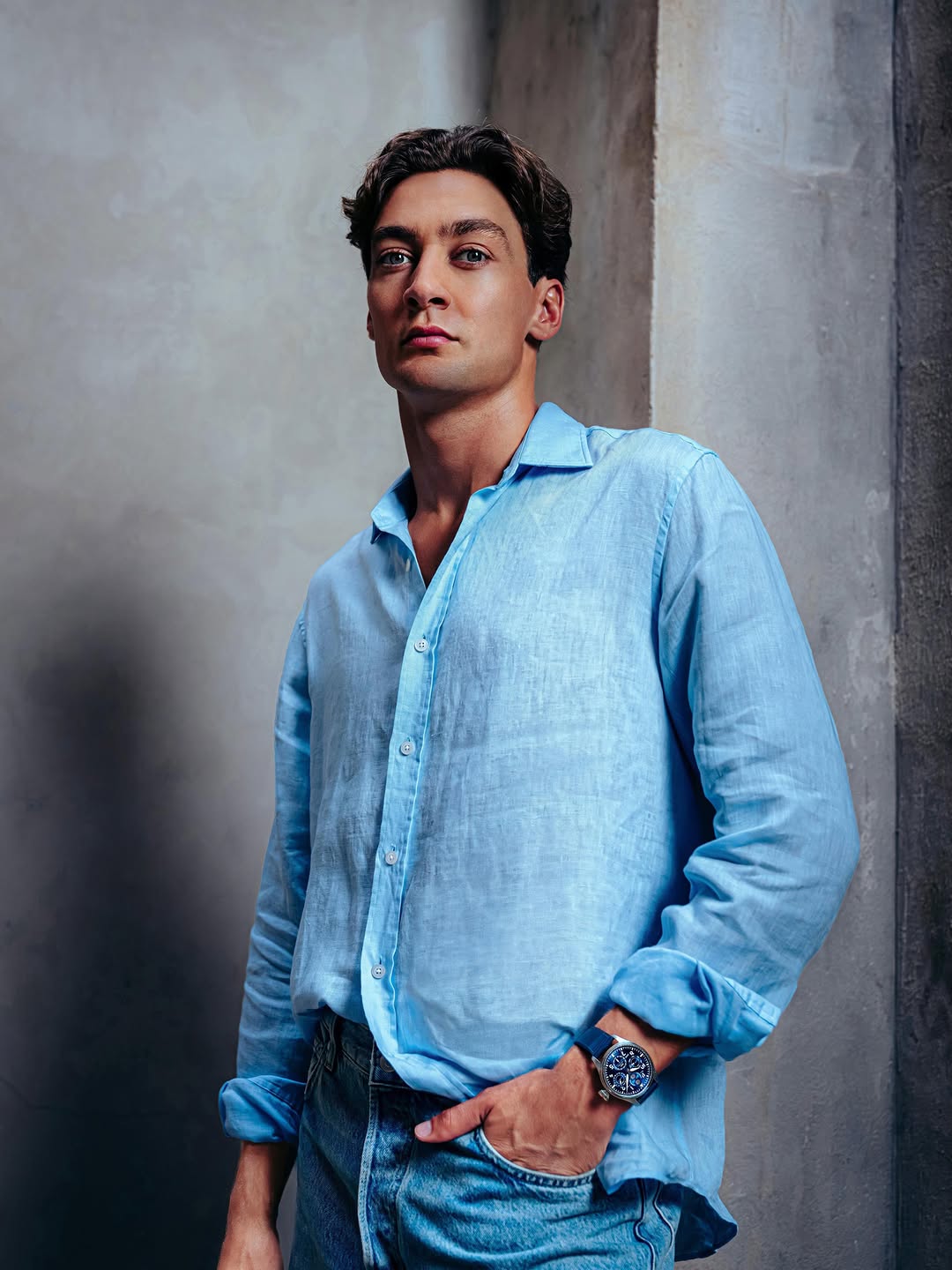
George Russell took pole at the 2026 Barcelona Grand Prix and immediately flagged what everyone in the paddock already suspected: the softer Pirelli compounds chosen for Circuit de Barcelona-Catalunya were going to punish anyone who tried to nurse their way through on a single stop. High degradation, compressed pace gaps between all three compounds, and a track layout that loads energy into tyres lap after lap made for one of the most strategically open race weekends of the season — and one of the most visually dramatic for anyone tracking the podium finishers’ helmet and livery choices.
Key Takeaways
Pirelli selected the C2, C3 and C4 compounds for Barcelona 2026 — a softer grade than previous years, producing higher-than-expected degradation.
The medium compound was losing around three tenths per lap across the opening 10–12 laps of a stint before degrading faster beyond that window.
Russell said a one-stop was not possible and placed the likely strategy ‘closer to a three than a one’, making the C4 a genuine race-tyre option.
Russell’s Mercedes livery and helmet design at Barcelona 2026 made his pole-position moment one of the most display-worthy of the season so far.
Pole Position and the Tyre Warning Nobody Could Ignore
George Russell claimed pole position at the 2026 Barcelona Grand Prix and immediately told reporters a one-stop strategy was not going to be possible. That is a blunt starting point for any race-day forecast, but the data from Friday’s running made it hard to argue with. Pirelli had opted for a softer compound selection than in recent years at Circuit de Barcelona-Catalunya, bringing the C2, C3 and C4 to Spain rather than stepping up to harder grades. The result was degradation numbers that surprised even the teams who had modelled the circuit’s tyre behaviour over the winter.
Barcelona’s layout is the key factor. The circuit’s concentration of high-speed and longer-radius corners — the kind that load sustained lateral forces into the tyre contact patch rather than sharp, brief spikes — makes temperature management across a full stint genuinely difficult. Drivers cannot simply coast a corner to give the rubber a rest; the energy input is nearly continuous through the technical middle sector.
Russell’s Mercedes sat at the sharp end of the grid, and his post-qualifying assessment carried the authority of a driver who had just pushed the car as hard as it would go over a single lap. The picture he painted for race day was one of constant strategic calculation rather than any comfortable cruise to a straightforward result.
What the Long-Run Data Actually Said
Friday’s FP2 long runs showed the medium compound — the C3 — dropping roughly three tenths of a second per lap across the first 10 to 12 laps of a stint. That figure is significant because it compounds quickly: 10 laps at 0.3 seconds per lap is already three full seconds of pace loss before degradation accelerates further beyond that threshold. Once a set of mediums pushed past the 12-lap mark, the drop-off steepened, which is exactly the kind of data that closes the door on a one-stop plan.
What made Barcelona 2026 strategically unusual was the narrow pace delta between all three Pirelli grades. Normally a harder compound buys meaningfully better longevity at the cost of peak pace, letting teams offset a slower tyre with fewer pit stops. Here, the C2, C3 and C4 behaved closely enough that the trade-off became blurry. Russell noted directly that the tyre choice itself would not make a large difference to race outcome — a statement that effectively tells rival strategists there is no silver-bullet compound to undercut on.
This dynamic mirrors what the paddock observed in 2025 at the same venue, when C2s and C3s were the compounds on offer and teams found a similarly compressed performance window between them. The addition of the C4 in 2026 as the softest option did not break that pattern; if anything, it extended it. Russell confirmed the C4 still looked like a usable race tyre rather than a qualifying-only gamble.
Three-Stop as the Base Case
When asked directly about expected strategy, Russell placed the answer firmly: closer to three stops than to one. The language was careful — he did not rule out a two-stop working for some cars — but the framing made clear that anyone planning a single stop was gambling against the data. With small compound deltas and significant per-lap deg, the arithmetic of tyre life makes extra pit visits the rational choice even accounting for the time lost in the pit lane.
Russell’s Helmet and Mercedes Livery at Barcelona 2026
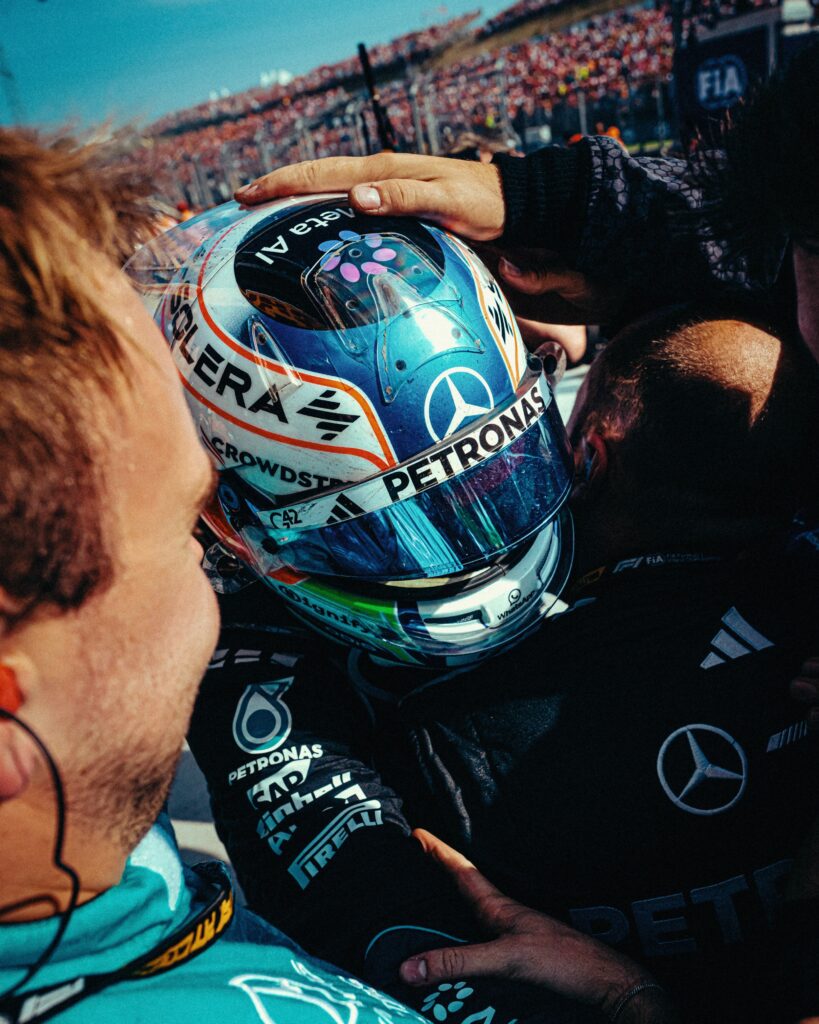
Russell’s pole lap at Barcelona in 2026 was also one of the cleaner visual moments of the season from a collector’s perspective. His helmet design for the Spanish Grand Prix retained the angular white and silver base that has defined his Mercedes years, with the circuit-specific detailing that makes Grand Prix weekend helmets distinct from his standard race-season lid. The silver and black of the W16 car framed the helmet on the grid in a combination that photographs starkly against Barcelona’s sun-bleached pit lane backdrop.
For anyone building a display of 2026 season highlights, the Barcelona pole moment checks several boxes. It sits at a point in the season calendar where championship positions are taking shape, the lighting at Circuit de Barcelona-Catalunya gives liveries strong contrast in official photography, and Russell’s position at the front of the grid means the car and helmet were both in full, unobstructed view during the formation lap and podium ceremony.
Full-size 1:1 replica helmets capturing race-weekend designs like this one are display pieces and collector items — not certified for any protective use — but they carry the exact graphic proportions and finish that make a specific Grand Prix weekend identifiable at a glance. The Barcelona 2026 round is the kind of event where those visual details matter: a pole sitter, a high-degradation race story, and a livery that has been refined over several seasons into something immediately recognisable.
Strategic Variation and What It Means for the Race Story
High tyre degradation with small compound deltas produces the widest possible spread of race strategies, and Barcelona 2026 delivered exactly that scenario. When no single compound is clearly fastest and all of them wear at a pace that makes extended stints painful, teams diverge on timing windows, compound sequences and the number of stops they are willing to take. That divergence is what creates on-track action that goes beyond wheel-to-wheel battles — cars on different strategies are effectively running different races, and the final classification can look very different from the lap-50 order.
Russell’s comment that ‘there’ll be a lot of variation’ was an understatement in terms of strategic interest. With the C4 as a realistic race tyre, some teams would open on the softest compound to build early gap before switching to harder rubber, while others would protect the C2 for a later stint when track position matters more. The compressed pace deltas meant neither approach carried an obvious lap-time advantage — execution and timing became the differentiating factors.
For spectators focused on the visual side of the weekend — the liveries, the helmet designs, the podium presentation — that strategic variation also produced extended screen time for a wider group of drivers. Cars cycling through pit stops at different moments kept multiple teams’ colour schemes in the spotlight across the full race duration, rather than letting a single strategy group dominate the broadcast.
Why Barcelona 2026 Is a Landmark Display Moment
The 2026 Spanish Grand Prix sits in the season as one of the clearest illustrations of how regulation-era cars perform under genuine tyre pressure, and Russell’s pole position places him at the centre of that story. A full-size 1:1 display replica of a race-weekend helmet from this event carries the specific graphic details that tie it to a defined moment in the 2026 calendar — not a generic season design, but the precise lid worn at one of the season’s strategically most complex rounds.
Exhibition-quality collector replicas at 1:1 scale reproduce the exact proportions of the original helmet design, including the visor treatment, sponsor placement and finish that distinguish a Barcelona 2026 piece from earlier rounds. These are display items and collector pieces only, with no protective certification of any kind, but their value lies precisely in that specificity: the ability to point to a shelf and say this is Barcelona, 2026, pole position.
Russell’s trajectory across the 2026 season has made his helmet designs increasingly sought after as collector reference points. The combination of front-running results, a livery that reads clearly in display conditions, and race weekends with strong narrative context — such as the tyre degradation story at Barcelona — gives individual Grand Prix helmets a layer of meaning beyond the aesthetic. They document a specific technical and strategic moment in the sport’s history.
The Podium Visual and What Stands Out
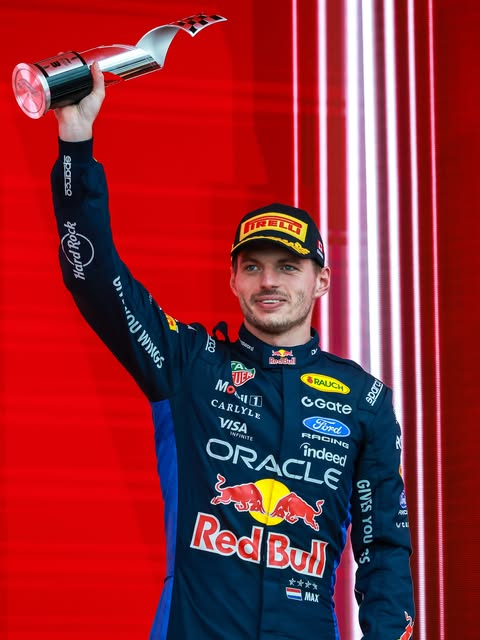
Podium ceremonies at Barcelona tend to produce some of the season’s cleaner display imagery because the circuit’s facilities frame the top three cars and helmets in strong light with an uncluttered background. For a collector focused on the 2026 season, the Spanish GP podium is one of the rounds worth documenting — the helmet details are visible, the liveries are fully presented, and the story behind the result (compound choices, stop counts, degradation management) gives the display piece context that holds up in conversation.
Russell, Hamilton and the Bigger 2026 Picture
Russell’s Barcelona pole came at a point in the 2026 season where the internal Mercedes dynamic remains one of the most-watched storylines in the paddock. Lewis Hamilton returned to the 2026 grid after his move to Ferrari, and the reset of the Russell–Hamilton relationship — both now competing in separate teams — adds a layer of historical context to any race weekend where they appear in proximity on the timing screens.
Hamilton had dealt with a neck injury at the start of the 2025 season according to his own account, and the physical demands of the 2026 cars under the revised technical regulations have continued to test drivers’ conditioning. Barcelona’s circuit characteristics — the sustained high-speed loading that also destroys tyres — place similar demands on driver physiology across a full race distance. The comparison between the two drivers’ race management at a track this physically demanding is, by 2026, a study in contrasting approaches shaped by years of different engineering cultures.
For the helmet and livery collector, that narrative adds another dimension to a Barcelona 2026 piece. A Russell lid from this weekend sits in the context of a season where Mercedes is pushing hard for results, where tyre strategy is reshaping race outcomes, and where the driver himself called the tactical landscape with enough precision that the race unfolded close to his pre-event forecast. That combination of on-track authority and visual identity is exactly what makes a specific Grand Prix helmet worth displaying.
“I think closer to a three than a one. I don’t think a one-stop is going to be possible at all. It’s not clear what the best tyre is; it’s quite interesting, on a track surface like this, all three tyre compounds look quite similar.”
— George Russell, post-qualifying press conference, 2026 Barcelona Grand Prix
“Everybody was running the C3s and the C2s last year, and obviously with the C4 this year, it still looks not a bad race tyre. So, there’ll be a lot of variation, but I don’t think a different tyre will make that much of a difference.”
— George Russell, 2026 Spanish Grand Prix qualifying
FAQ
Q: Why was the 2026 Barcelona Grand Prix likely to be a two or three-stop race?
The medium compound was degrading at roughly three tenths per lap across the first 10 to 12 laps of a stint, making a one-stop strategy unworkable. Pole sitter George Russell stated a one-stop ‘is not going to be possible at all’ and described the expected strategy as closer to three stops than one.
Q: Which Pirelli compounds were selected for the 2026 Spanish Grand Prix?
Pirelli brought the C2, C3 and C4 compounds to Barcelona in 2026, a softer grade selection than in previous years at the same venue. This choice produced higher-than-expected degradation and compressed the pace delta between the three options.
Q: What made Barcelona’s circuit layout particularly tough on tyres in 2026?
Circuit de Barcelona-Catalunya’s high-speed and longer-radius corners put sustained energy into the tyre contact patch throughout each lap. That continuous loading made it difficult for drivers to manage tyre temperatures across a full stint, accelerating wear beyond what the softer compound selection alone would predict.
Q: Is a George Russell Barcelona 2026 replica helmet a wearable safety product?
No. Full-size 1:1 replica helmets from this event are display pieces and collector items only. They carry no protective certification of any kind and are not intended for road, race or track use — their purpose is exhibition and collection.
Q: Why is the 2026 Barcelona GP considered a notable collector moment for helmet displays?
Russell’s pole position placed his helmet and the Mercedes livery at the centre of the race weekend’s visual story, under Barcelona’s strong natural light and against the circuit’s clean podium presentation. The race’s strategic complexity — multi-stop tyre management, compressed compound deltas — gives the event specific narrative context that distinguishes a 2026 Barcelona piece from other rounds in the season.
Browse F1 Helmet Collection — display and collector replicas from the 2026 season and beyond, including race-weekend designs from the Spanish Grand Prix.
Display and collector replicas only. Not certified for protective use. Full-size 1:1 scale.
This article was written with the help of AI tools. Editorial policy