- Keke Rosberg
- Nigel Mansell
- Jenson Button
- Nico Rosberg
- Gilles Villeneuve
- Mika Hakkinen
- Jackie Stewart
- Charles Leclerc
- Lewis Hamilton
- Max Verstappen
- Lando Norris
- Ayrton Senna
- Michael Schumacher
- Fernando Alonso
- Oscar Piastri
- George Russell
- Kimi Antonelli
- Nico Hülkenberg
- Gabriel Bortoleto
- Pierre Gasly
- Franco Colapinto
- Carlos Sainz
- Oliver Bearman
- Sergio Pérez
- Valtteri Bottas
- Isack Hadjar
- Alain Prost
- James Hunt
Gasly’s Monaco GP Penalty Saga: How One Pitlane Call Could Rewrite F1’s Rulebook
Posted by
 123Helmets Editorial Team
123Helmets Editorial Team

Monaco GP Penalty Review
Pierre Gasly’s Monaco Grand Prix podium was taken, restored, and is now under formal appeal — a sequence that has put F1’s timing infrastructure, its stewards, and its competitive fairness on trial at the same time.
Key Takeaways
Formula One Management’s sensor error — not Gasly’s driving — triggered the entire penalty chain at Monaco 2025.
McLaren, Mercedes and Red Bull have formally lodged a right-of-review appeal against the stewards’ decision to restore Gasly’s podium finish.
Alpine was the only team to challenge its pitlane-speed penalty; every other penalised team served theirs and received no compensation.
The display-worthy Monaco livery Gasly ran now sits at the centre of one of the most consequential regulatory disputes in recent F1 history.
What Actually Happened in Monaco’s Pitlane
Formula One Management’s official timing system measured the distance between two pitlane speed sensors incorrectly, producing a false positive that flagged Pierre Gasly for exceeding the 60 km/h pitlane limit during the Monaco Grand Prix. That is the established fact at the root of every development that followed. FOM operates the timing infrastructure used by both race control and the stewards; when that system returned a speed violation against Gasly’s Alpine, stewards acted on its data and issued two penalties. What neither stewards nor rival teams knew at that moment was that the sensor spacing was wrong.
Alpine’s engineers did know — or at least suspected — because the telemetry recorded directly from Gasly’s car told a different story. The team’s own data showed the Frenchman had not broken 60 km/h at any point in the pitlane. Rather than accept the penalty and absorb the sporting loss, Alpine submitted a formal request for review, presenting that onboard data as new evidence. The stewards examined it, accepted the argument, and cancelled both penalties, restoring Gasly’s podium position.
For a race held on a 3.337 km street circuit where position changes happen in the pitlane as often as on track, the cascade effect on the final standings was significant enough to cost rival drivers meaningful championship points — which is precisely why McLaren, Mercedes and Red Bull did not simply move on.
The Formal Appeal and Who Filed It
McLaren, Mercedes and Red Bull have formally lodged a right-of-review appeal against the stewards’ decision to reinstate Gasly’s Monaco podium, opening a new legal chapter in a dispute that has already run through multiple regulatory stages. The three teams announced their intention to appeal shortly after the stewards’ ruling and have since confirmed the paperwork with the FIA’s judicial bodies. That process — a right of review — is distinct from a standard appeal; it requires the appellant to demonstrate that new evidence or a significant new fact exists that was not available at the time of the original decision.
The core argument available to McLaren, Mercedes and Red Bull is not that Gasly sped in the pitlane — the sensor error has been acknowledged — but that the process of restoring his result creates an imbalance that the regulations do not adequately address. Every other team that received a pitlane-speed penalty during Monaco either served it at their next stop or, in Mercedes’ case, at least acknowledged the obligation to do so. None of those teams had their penalties reviewed. Alpine was the only outfit that challenged the system, and it was the only outfit rewarded for doing so.
If the appeal proceeds and succeeds, the stewards’ reinstatement is overturned. If it fails, Gasly keeps his podium and the regulatory question of what teams owe each other when timing errors occur remains unanswered in any binding way.
The Pandora’s Box Problem: Unequal Treatment and Future Precedent
The deepest regulatory risk here is not about Monaco specifically — it is about what happens at every future race where a team suspects a timing system error but chooses to serve its penalty and move on. Before Monaco 2025, the assumed standard was that FOM’s official timing data was authoritative; teams built their pitlane strategies around that assumption and, when penalised, typically absorbed the result rather than mount a legal challenge. Alpine’s success in reversing Gasly’s penalties demolishes that assumption entirely.
Any team that now serves a pitlane-speed penalty without first checking whether its own telemetry contradicts the FOM data is leaving a potential review mechanism on the table. That creates pressure on every team’s sporting department to cross-reference onboard speed data against official timing on every single lap that passes through the pitlane entry. That is not an unreasonable technical ask for an F1 team — the data exists — but it changes the competitive dynamic in a way the regulations were not written to anticipate.
The more immediate unfairness is simpler: teams that trusted the official system and served their Monaco penalties received nothing. Alpine challenged the system and got a podium back. There is no mechanism in the current regulations to retroactively compensate teams that accepted penalities that were, in principle, based on the same flawed sensor data. Whether those other penalties were also incorrectly issued is a question that may now never be formally examined.
What FOM’s Sensor Error Means for Timing Credibility
FOM’s timing system is the single source of truth for pitlane speed enforcement in Formula 1. The sensor array measures vehicle speed by calculating the time taken to travel a known fixed distance between two detection points. When that fixed distance is logged incorrectly in the system — as happened at Monaco — every speed calculation derived from those two sensors is wrong by a proportional margin. The error is systematic, not random, meaning every car that passed those specific sensors during the affected period received a potentially inaccurate reading.
FOM has not publicly detailed the magnitude of the distance error or how many cars were affected beyond Gasly’s case. Until that transparency exists, the scope of the problem at Monaco cannot be fully assessed by anyone outside FOM’s own engineering team.
Gasly’s Monaco Helmet and Livery: A Podium Worth Preserving
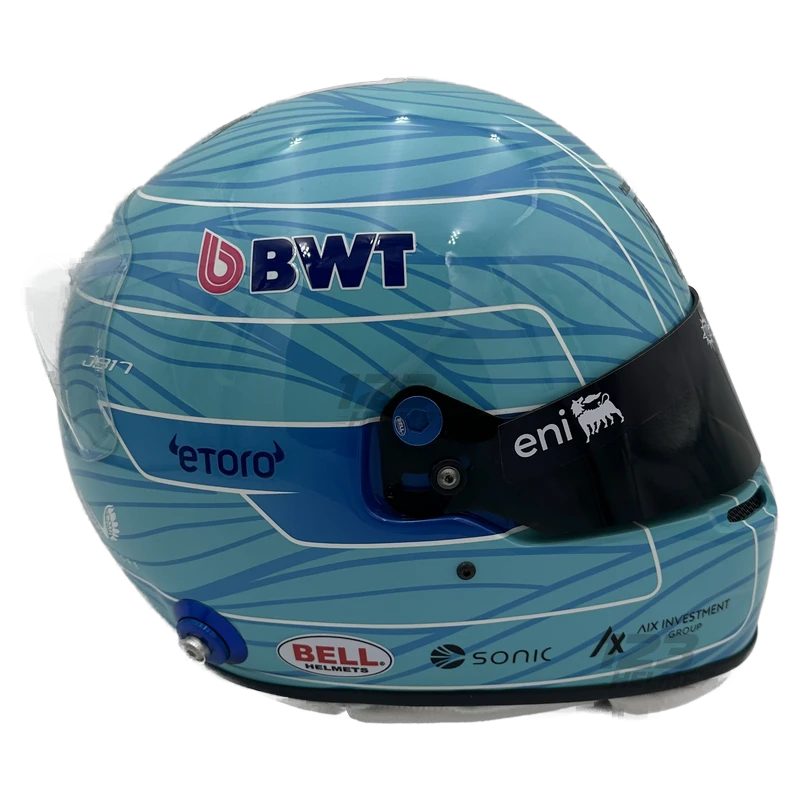
Whatever the final regulatory verdict, Gasly’s Monaco appearance produced one of the most visually striking pitlane-to-podium sequences of the 2025 season — and the helmet and car livery he ran on the streets of Monte Carlo are already collector-grade moments frozen in time. Alpine’s 2025 Monaco livery carried the team’s characteristic colour blocking against the backdrop of the principality’s barriers, and Gasly’s personal helmet design for the race complemented that palette in a way that photographers and fans will reference long after the points dispute is settled.
For display and exhibition purposes, the Monaco race represents exactly the kind of historically loaded weekend that elevates a full-size 1:1 replica helmet from decorative object to genuine collector piece. A podium that was stripped, restored, and is now under formal appeal is, by any measure, one of the most documented and debated finishes of the modern era. The helmet Gasly wore — or a full-size 1:1 replica of it — carries that entire narrative in its paint layers and visor geometry.
Full-size 1:1 replica helmets produced at exhibition quality typically replicate the precise graphic layout of the race-used design, including sponsor placement, visor band colouring, and any race-specific modifications the driver or team made for that particular event. As a display piece, the Monaco 2025 Gasly helmet sits at the intersection of sporting controversy and aesthetic precision — the kind of combination that makes a collector item worth acquiring before the regulatory dust settles and the narrative becomes fixed history.
What Mercedes and the Championship Picture Actually Stand to Lose
Mercedes joined the appeal because Lewis Hamilton’s championship position is directly affected by Gasly’s reinstated podium points. In a season where Hamilton has been publicly identified as chasing a title challenge, every point shift in the upper reaches of the standings carries weight that earlier-season results did not. Restoring Gasly’s podium displaced drivers further down the Monaco finishing order in the official standings, and those displaced points belong to competitors Hamilton needs to overhaul.
Red Bull’s motivation is similar in structure if different in detail: any points conceded to Alpine in the constructors’ standings, or to Gasly in the drivers’ standings, compress the margins Red Bull is trying to manage in its own championship arithmetic. McLaren, meanwhile, had a driver directly affected by the position reshuffle that followed Gasly’s reinstatement, giving the Woking team both a sporting and a reputational reason to pursue the appeal.
The right-of-review process does not have a fixed public timeline, meaning the Monaco points situation could remain in legal limbo across multiple subsequent race weekends. Championship standings published after each race technically remain provisional until all pending judicial processes are resolved — a state of uncertainty that serves nobody’s planning, least of all the teams trying to build a constructors’ title campaign race by race.
Whether the Rules Can Actually Resolve This
The regulations as written were not designed for a scenario where the official timing infrastructure itself is the source of error rather than a team or driver action. The right-of-review mechanism exists to correct injustices when new evidence emerges, and Alpine used it correctly. But the rules contain no reciprocal mechanism to review penalties that were served by teams that did not appeal — even if those penalties were generated by the same faulty sensor reading. That asymmetry is the gap that McLaren, Mercedes and Red Bull are now trying to force the FIA’s judicial bodies to address. Whether those bodies have the regulatory tools to do so, or whether a rule change is the only real fix, is the question that will define how F1 emerges from this particular corner.
What Collectors Should Know About This Moment
Monaco Grand Prix helmets occupy a specific tier in F1 collector culture — the race’s visual identity, its history, and its compressed street-circuit drama make any design worn at Monte Carlo more historically dense than the same helmet run at a generic purpose-built venue. Gasly’s 2025 Monaco helmet is now attached to one of the most contested results in recent memory, which gives a full-size 1:1 display replica of that design a documentary weight that purely aesthetic pieces do not carry.
Exhibition-quality replica helmets at 1:1 scale reproduce the structural proportions of a racing helmet without any certification for protective use — they are display pieces and collector items, not safety equipment. The value of such a piece comes from what it represents: a specific driver, a specific race, and in this case a specific result that three major teams believe should not exist. That combination of visual drama and sporting controversy is exactly what separates a significant collector item from a generic souvenir.
As the appeal works through the FIA’s judicial process, the Monaco 2025 chapter in Gasly’s career remains open. Whether his podium survives or is overturned, the helmet he ran that weekend is already part of one of the most-discussed regulatory episodes in recent F1 history — and a 1:1 full-size replica of that design is a permanent, display-worthy record of it.
“Alpine showed through data recorded directly from the car that the French driver never exceeded 60 km/h — the stewards decided to scratch out the penalties because of the error made by FOM.”
— Stewards’ review findings, Monaco Grand Prix 2025
“This situation creates unequal treatment compared to those who instead served the penalty — they were right to challenge it, but the consequences reach far beyond Gasly’s case.”
— Post-Monaco regulatory analysis
FAQ
Q: Why was Gasly’s Monaco podium reinstated after being taken away?
The stewards reinstated Gasly’s podium because FOM’s official timing system had incorrectly measured the distance between two pitlane speed sensors, producing a false reading. Alpine presented onboard telemetry showing Gasly never exceeded 60 km/h, and the stewards accepted that data as grounds to cancel both penalties.
Q: Who has formally appealed the stewards’ decision to restore Gasly’s Monaco result?
McLaren, Mercedes and Red Bull have formally lodged a right-of-review appeal with the FIA’s judicial bodies. All three teams announced their intention to appeal shortly after the stewards’ reinstatement ruling and have since confirmed the formal filing.
Q: Why didn’t other penalised teams at Monaco get their penalties cancelled too?
Other teams that received pitlane-speed penalties at Monaco served those penalties at their next pitstop without submitting a formal request for review. Alpine was the only team to challenge its penalty using onboard car data. The regulations contain no automatic mechanism to retroactively review penalties that were served without a formal challenge.
Q: What is a right-of-review appeal in F1 and how is it different from a standard appeal?
A right-of-review appeal requires the filing team to demonstrate that a significant new fact or new evidence exists that was not available when the original decision was made. It is a higher threshold than a standard appeal and is handled by the FIA’s judicial bodies rather than the on-event stewards.
Q: Why is a full-size 1:1 replica of Gasly’s Monaco 2025 helmet considered display-worthy?
A full-size 1:1 replica of the Monaco 2025 Gasly helmet is a display-worthy collector item because it is attached to one of the most contested race results in recent F1 history — a podium that was stripped, reinstated, and is now under formal appeal by three major teams. Exhibition-quality replicas of this design carry that entire documented narrative as a permanent display piece.
Shop Pierre Gasly Collection — own a full-size 1:1 display replica of the helmet at the centre of F1’s most-debated result of 2025.
Display and collector replicas only. Not certified for protective use. Full-size 1:1 scale.