- Keke Rosberg
- Nigel Mansell
- Jenson Button
- Nico Rosberg
- Gilles Villeneuve
- Mika Hakkinen
- Jackie Stewart
- Charles Leclerc
- Lewis Hamilton
- Max Verstappen
- Lando Norris
- Ayrton Senna
- Michael Schumacher
- Fernando Alonso
- Oscar Piastri
- George Russell
- Kimi Antonelli
- Nico Hülkenberg
- Gabriel Bortoleto
- Pierre Gasly
- Franco Colapinto
- Carlos Sainz
- Oliver Bearman
- Sergio Pérez
- Valtteri Bottas
- Isack Hadjar
- Alain Prost
- James Hunt
How Ferrari Built the Perfect Trap to Beat Mercedes at the Barcelona GP
Posted by
 123Helmets Editorial Team
123Helmets Editorial Team
Barcelona GP Race Recap
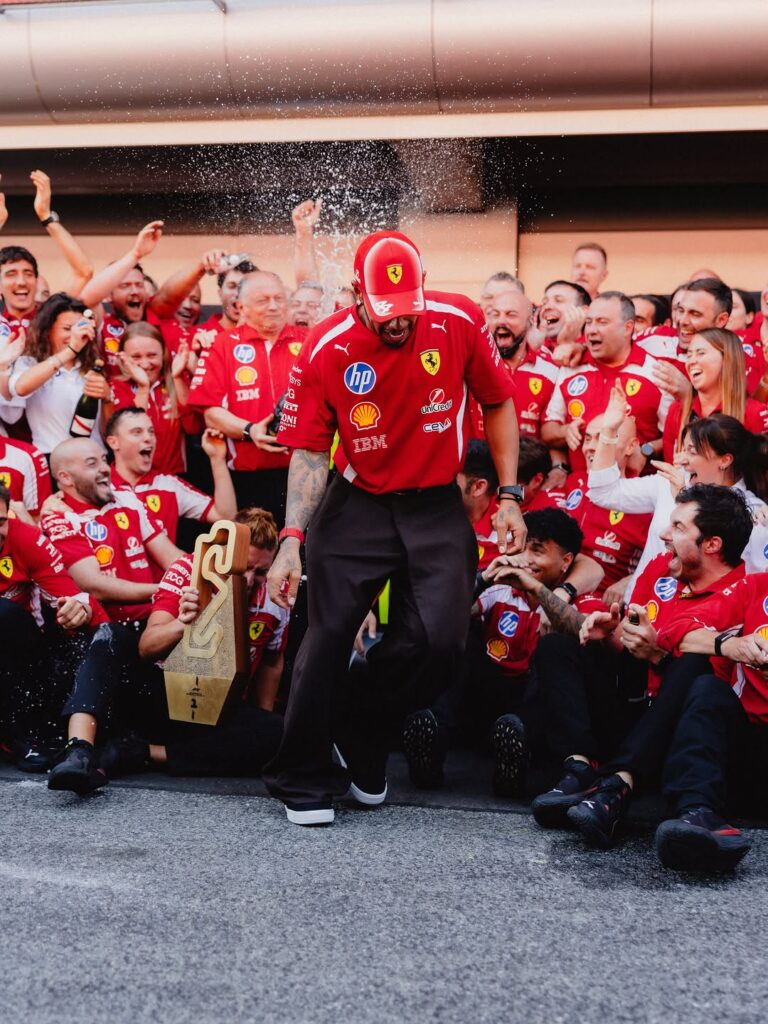
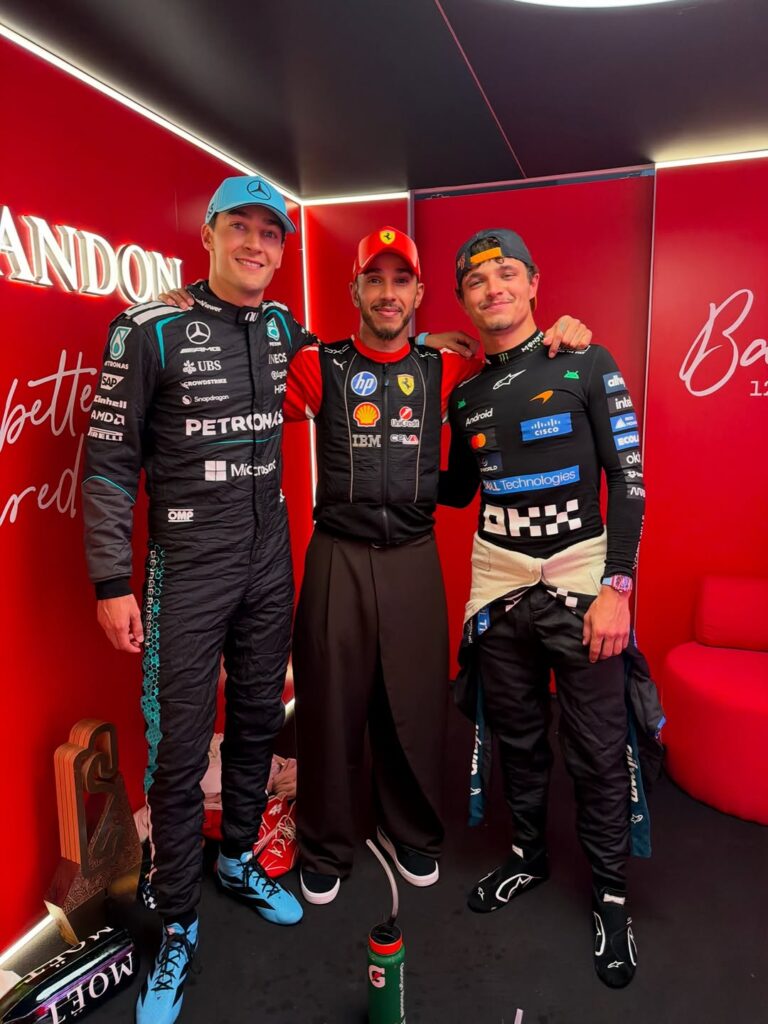
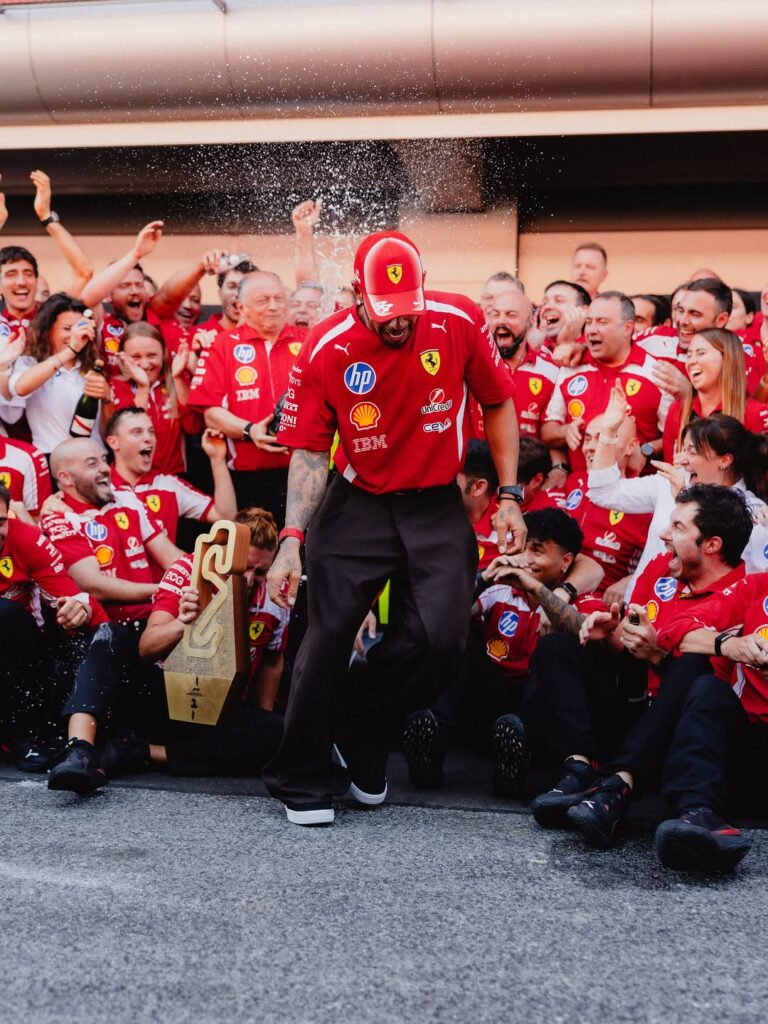
More than 500 days after first walking through the gates of Maranello, Lewis Hamilton delivered Ferrari’s most emotionally charged victory in years at the Barcelona GP — and the engineers had set the trap long before the lights went out.
Key Takeaways
Hamilton’s Barcelona win came more than 500 days after he first joined Ferrari — a victory built on strategy as much as pace.
Ferrari started on the soft compound deliberately, keeping both a two-stop and three-stop strategy open depending on how the race unfolded.
Russell held a gap of just over three seconds in the first stint — wide enough to neutralise the undercut but not wide enough to grant real strategic freedom.
The Virtual Safety Car arrived at precisely the right moment to seal Hamilton’s win, but the groundwork for that outcome was laid in pre-race simulation.
500 Days in the Making: Hamilton’s First Ferrari Win
Lewis Hamilton’s first victory in Ferrari red arrived more than 500 days after he walked through the gates of Maranello as a Ferrari driver — and it landed at the Barcelona GP with the full weight of everything those days carried. The tears held back on the podium communicated something no press conference answer could. This was not just a race win. It was the answer to every uncomfortable question raised across a complicated 2025 season.
The seven-time world champion had endured a transition period that tested his patience, his technical instincts, and his public composure. Barcelona changed the conversation entirely. Whatever doubts had accumulated during the months before — about the fit between Hamilton and the Ferrari SF-25, about whether the move from Mercedes had cost him his best competitive years — this result put them aside, at least for one afternoon on the Circuit de Barcelona-Catalunya.
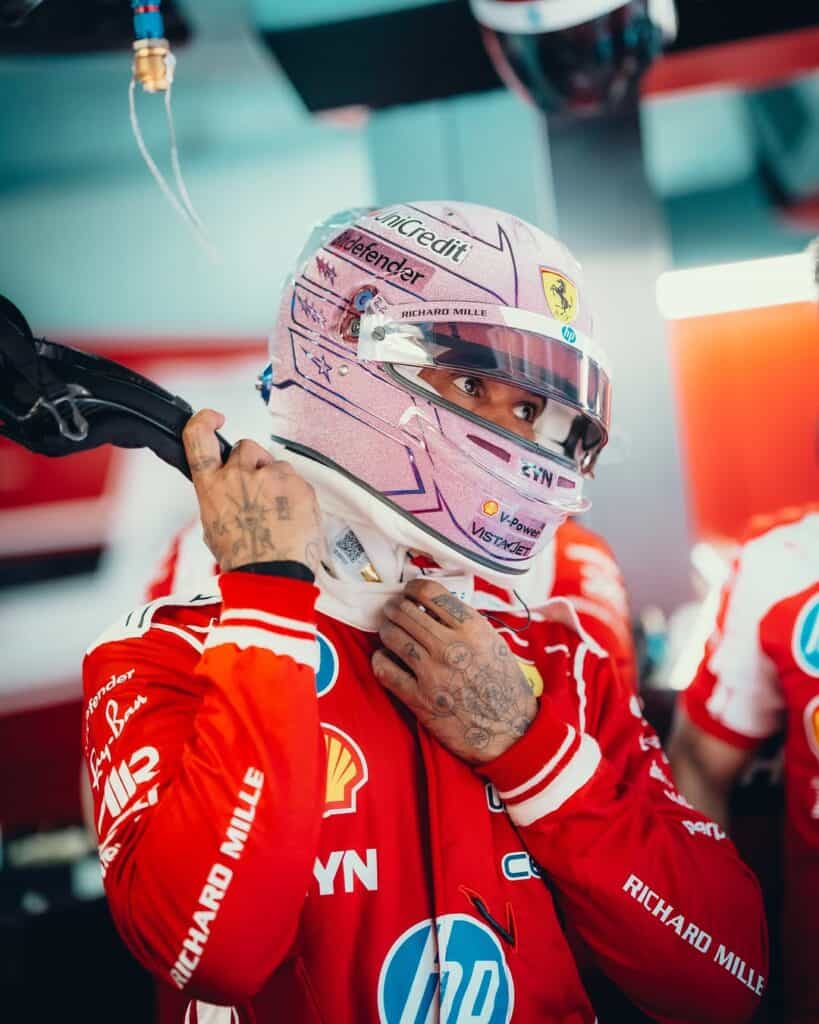
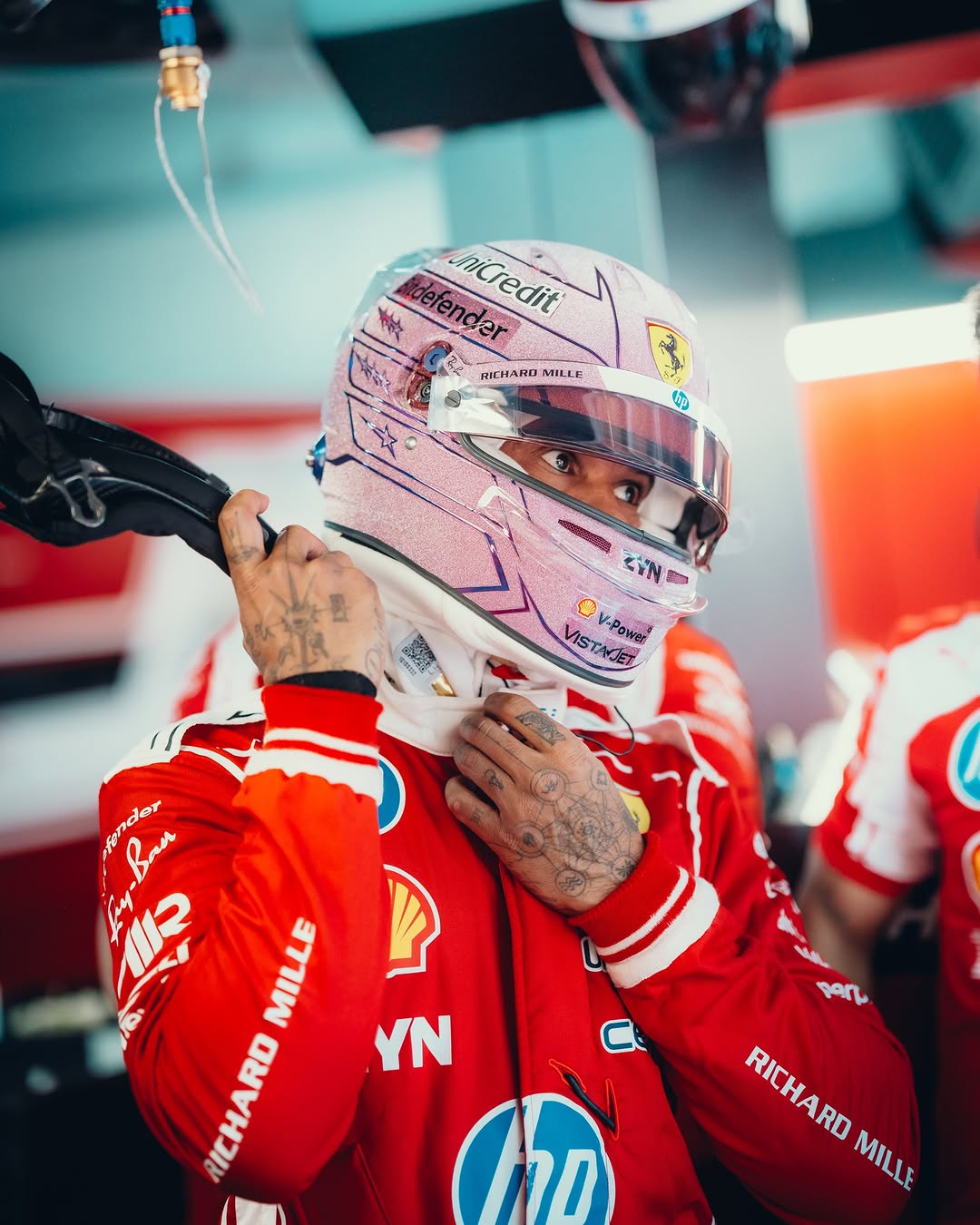
For collectors and display enthusiasts, the podium visuals from this race already rank among the most striking of the modern era. Hamilton in full Ferrari red livery, the Scuderia crest on his helmet, standing on the top step: a full-size 1:1 replica of his Barcelona race helmet captures a moment that will define the 2025 season regardless of how the championship finishes.
The Soft-Tyre Gambit That Opened the Door
Ferrari’s decision to start Hamilton on the soft compound was the single most consequential strategic call of the entire Barcelona GP weekend. The soft tyre gave Hamilton two things at once: an aggressive launch option that could contest the lead from the off, and an immediate pathway into a three-stop race if the pace and traffic picture demanded it.
Pre-race simulations run by the Maranello engineers showed that, under normal conditions, a two-stop and a three-stop strategy were essentially matched in total lap-time cost. The critical variable was traffic. With a compressed field, losing 7–8 seconds behind slower cars during an overtaking sequence could swing the result entirely. Ferrari’s choice of the soft compound was designed to keep both doors open for as long as possible rather than committing to a single outcome on the grid.
The architecture of that decision matters when you consider what it meant for Mercedes. By not locking Ferrari into one strategic path, the soft-tyre start forced George Russell and the Silver Arrows to react rather than dictate. Every lap of the first stint was a lap in which Mercedes had to manage uncertainty rather than simply execute a plan they had full confidence in.
Where Mercedes Left the Window Open
Russell’s first stint gap peaked at just above three seconds — a margin large enough to neutralise a straightforward undercut, but not large enough to give Mercedes genuine strategic freedom for the rest of the race. That gap is the number Toto Wolff will review most carefully when the team conducts its post-race debrief.
Three seconds is a threshold. Below it, an undercut becomes a genuine weapon because the attacking car can cover the pit-stop time loss and emerge ahead. Above roughly four to five seconds, the leading driver has enough cushion to respond in kind or to simply manage the offset. At just over three seconds, Russell sat in the least comfortable zone: not safe enough to ignore undercut risk, not close enough for Mercedes to throw the race into an aggressive counter-strategy with confidence.
Ferrari read this gap precisely. The Maranello engineers identified that Mercedes had not widened the margin enough in the opening stint to take control of the strategic picture. That reading — quiet, numerical, not visible on the broadcast — was the real moment the trap closed. Everything that followed was execution.
Toto Wolff’s Post-Race Assessment
After the chequered flag, Wolff did not conceal his frustration. From the Mercedes side, the potential to win the Barcelona GP had been genuine — for long stretches of the race, Russell had held what looked like the dominant position. But potential and result are different things, and Ferrari turned the gap between them into a victory.
The VSC Moment and the Three-Stop Execution
The Virtual Safety Car that arrived during the closing phase of the Barcelona GP gave Ferrari the timing window they needed to complete their three-stop strategy without losing net track position — and it arrived at precisely the moment the pre-race simulations had identified as the inflection point. That alignment between preparation and circumstance is what separates a well-executed race from a fortunate one.
A VSC compresses lap times across the field by bringing everyone to a reduced speed delta, which shortens the effective pit-stop cost. For a team already committed to a more aggressive strategy, a VSC arriving in the right stint can convert a marginal call into a comfortable one. Ferrari had modelled this scenario. When it arrived, the engineers did not hesitate.
Hamilton’s final stint on fresh rubber gave him the pace advantage he needed to hold position and manage the gap to the cars behind. The three-stop strategy, which had looked aggressive relative to Mercedes’ more conservative approach, ended the race as the correct call — not by luck, but because Ferrari had built the race plan around exactly this kind of opportunity appearing.
For the display and collector record: this is the race that will appear on limited-edition helmet replicas, race suit displays, and commemorative pieces for years. The podium image — Hamilton, Ferrari red, Barcelona — is now part of the permanent visual record of the 2025 season.
The Helmet and Livery: A Podium Built for Display
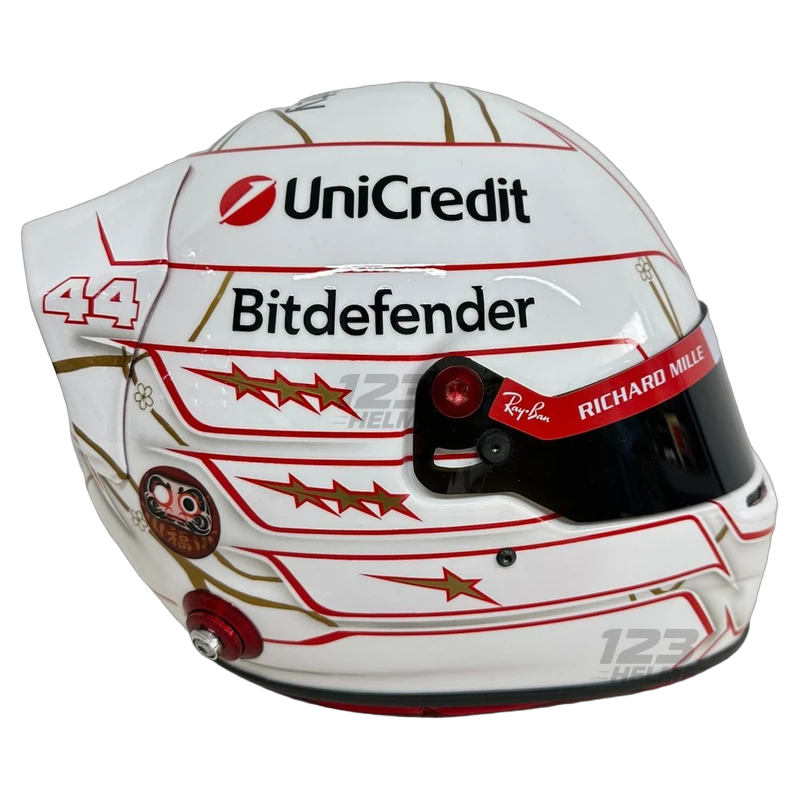
Hamilton’s Barcelona race helmet combined Ferrari’s traditional Rosso Corsa base with his personal design language — a collector piece that documents a historically significant moment in both his career and the Scuderia’s modern chapter. As a full-size 1:1 display replica, it captures the exact visual identity he wore on the day he ended the 500-day wait.
The Ferrari SF-25 livery at Barcelona ran in its standard 2025 configuration: the deep Scuderia red with the Cavallino Rampante on the nose and the Marlboro-adjacent white geometric panelling across the engine cover. Under the Barcelona sunlight, the contrast between the helmet’s personal graphic elements and the car’s livery created a podium image with strong visual definition — the kind of image that translates well into a display piece because the colour relationships are sharp and immediately readable at any viewing distance.
A full-size 1:1 replica helmet in this specification sits at approximately 27 × 35 cm in standard display footprint, making it compatible with most dedicated helmet display cases without modification. The visor on collector-grade replicas of this type is typically rendered at 3 mm thickness to maintain the proportional accuracy of the original shell profile. These are exhibition-quality pieces intended for display only — not certified for any protective use, road or track.
Why Barcelona 2025 Belongs in Any Serious Collection
The Barcelona GP of 2025 marks Hamilton’s first win with Ferrari, his first victory since joining the Scuderia, and the culmination of a strategic plan that the Maranello engineers had designed specifically around the circuit characteristics and Mercedes’ likely approach. A display replica from this race documents all three of those facts in a single object. For the collector, that density of meaning in one moment is rare.
What This Win Changes — and What It Confirms
Hamilton’s Barcelona victory confirms that the Ferrari-Hamilton combination is capable of winning in 2025, which is a different and more specific claim than saying the car is fast or the driver is performing well. Winning requires strategy, execution, timing, and pace to arrive in the right sequence on the same afternoon — and at Barcelona, all four aligned.
For Ferrari, this result carries weight beyond the championship points. It answers the external narrative that the Hamilton signing had produced friction, adaptation problems, or an uncomfortable fit between a driver shaped by Mercedes’ engineering culture and a team shaped by decades of its own. Whatever the truth of those stories across the season, the Barcelona podium is the counter-evidence that matters most.
For Hamilton personally, it is the first chapter of the Ferrari story told in the only currency that carries permanent meaning in Formula 1: a race win. The 500-day figure will appear in every retrospective of his career from this point forward — not as a mark of difficulty, but as the measure of how long it took to reach a moment that will not be forgotten.
The collector and display market responds to exactly this kind of moment. A helmet replica from a driver’s first win with a new constructor — especially one of Hamilton’s stature joining Ferrari — represents a fixed point in the sport’s history. The piece is not valuable because of what it might become; it is valuable because of what it already marks, as of 13 June 2025, on the Circuit de Barcelona-Catalunya.
“Those tears held back on the podium say more than any words ever could about the weight of Lewis Hamilton’s first Ferrari victory.”
— Race analysis, Barcelona GP 2025
“From his perspective, the potential to win a race that for long stretches had seemed in Mercedes’ hands was genuinely there.”
— Post-race assessment, Toto Wolff — Barcelona GP 2025
FAQ
Q: When did Lewis Hamilton win his first race for Ferrari?
Hamilton won his first race for Ferrari at the 2025 Barcelona GP, more than 500 days after first joining the Scuderia at Maranello.
Q: Why did Ferrari start Hamilton on the soft tyre at Barcelona?
Ferrari chose the soft compound to keep both a two-stop and a three-stop strategy available simultaneously, while also giving Hamilton a performance edge at the launch. Pre-race simulations showed the two strategies were evenly matched in total cost under normal conditions, so the soft tyre preserved maximum flexibility.
Q: What gap did Russell hold over Hamilton in the first stint?
Russell stretched the margin to just above three seconds during the first stint — enough to neutralise a direct undercut, but not enough to give Mercedes the strategic freedom needed to control the rest of the race.
Q: What role did the Virtual Safety Car play in Hamilton’s victory?
The VSC arrived at a moment that compressed the effective pit-stop cost, allowing Ferrari to complete Hamilton’s three-stop strategy without losing net track position. Ferrari had modelled this scenario in pre-race preparation and reacted immediately when it occurred.
Q: Is the Lewis Hamilton Barcelona 2025 Ferrari helmet available as a display replica?
Yes — full-size 1:1 scale display replicas of Hamilton’s 2025 Ferrari race helmet are available as collector and exhibition pieces. These replicas are not certified for protective use of any kind and are intended solely for display. Standard display footprint is approximately 27 × 35 cm.
Shop Lewis Hamilton Collection — own a full-size 1:1 display replica of the helmet from his historic first Ferrari victory. Exhibition-quality collector pieces. Not for protective use.
Display and collector replicas only. Not certified for protective use. Full-size 1:1 scale.