Blog
Russell’s Fight to Save His 2026 F1 Season
 123Helmets Editorial Team
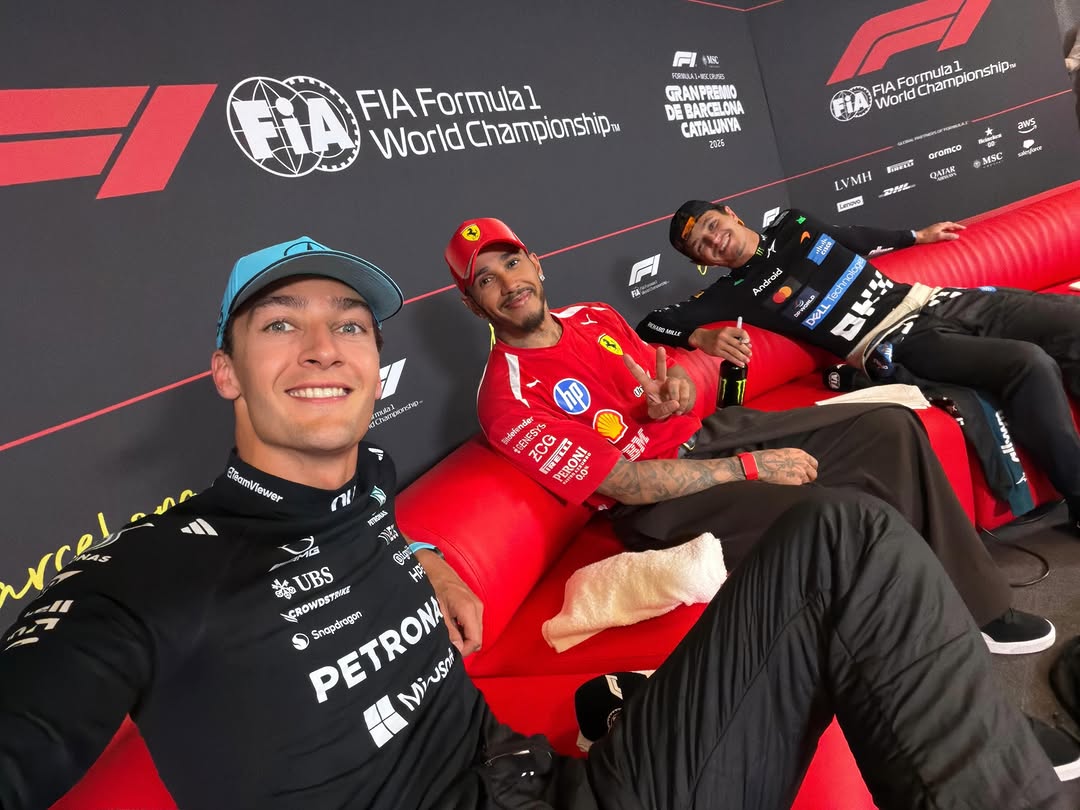
George Russell won the Melbourne season opener from pole, then watched his 2026 title campaign unravel through mechanical failure, a timing-system penalty, and a team-mate in career-defining form. Now 68 points behind, he heads to Barcelona with no margin for error — and a Mercedes W17 that still has the pace to turn it around.
Key Takeaways
Russell took a pole-to-flag victory in Melbourne, then saw his campaign stall through mechanical and operational failures rather than outright pace.
A timing-system glitch in Monaco triggered a pitlane speeding penalty; a Mercedes communication error converted it into a drive-through, costing him all points.
Kimi Antonelli’s form means Russell faces a 68-point internal deficit as well as the external championship fight — both problems need solving in parallel.
Rather than seeking an FIA explanation for Monaco, Russell is directing all energy toward the Spanish Grand Prix at Montmeló as his reset point.
A Perfect Start Unravels Fast
George Russell’s 2026 F1 season opened as well as any driver could ask: a pole position in Melbourne followed by a flag-to-flag win in the Australian Grand Prix, putting him immediately at the front of the championship conversation. That result established George Russell as Mercedes’ lead title contender and gave the team its most convincing early-season statement in years.
What followed erased most of that goodwill within weeks. In Canada, Russell was running ahead of team-mate Kimi Antonelli and appeared set for another strong result when the Mercedes W17’s power unit failed, taking him out of the race entirely. A retirement from a leading position is among the most damaging single-race outcomes a driver can absorb, and the timing — with Antonelli finishing strongly — made the championship arithmetic worse at a rate Russell could not control.
The Melbourne victory, the Canadian retirement, and the Monaco disaster have combined to leave Russell 68 points adrift in the standings. For context, Lando Norris erased a larger deficit than that during his 2025 title comeback, which is the clearest precedent that the 2026 season is not mathematically closed. But the window to act is narrowing race by race, and Barcelona on 2026-06-01 is the next opportunity to stop the bleeding.
What the W17 Livery Looked Like at Its Best
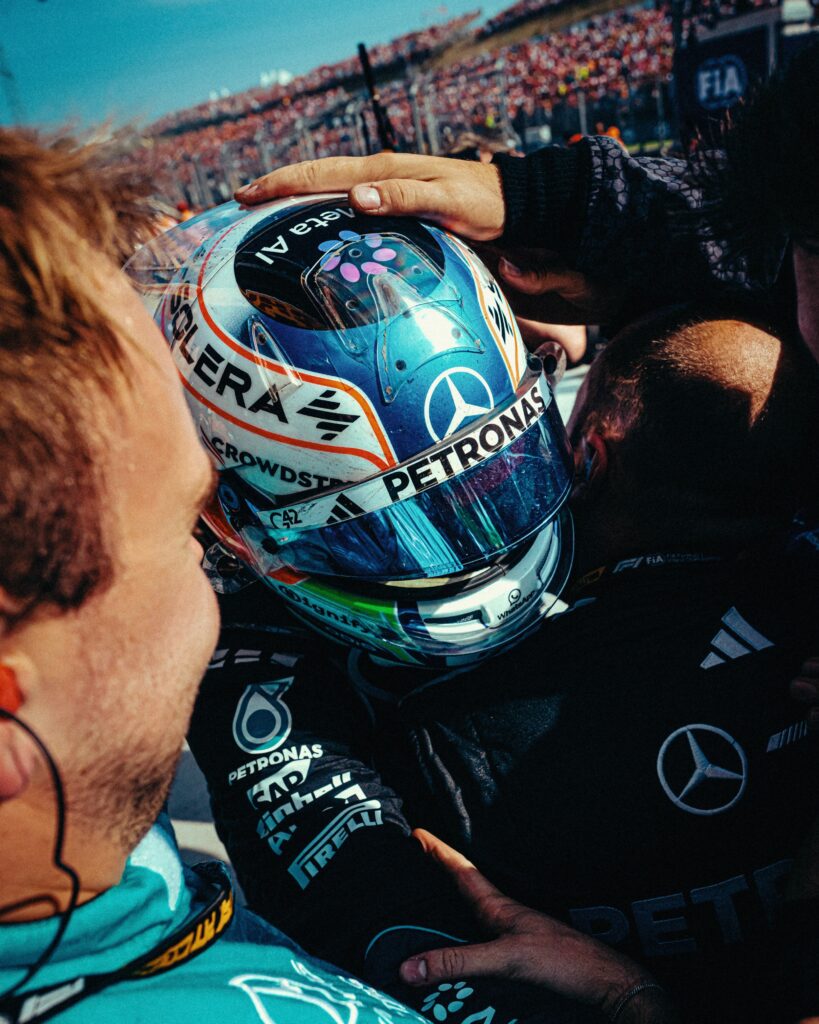
The Melbourne victory produced the kind of visual moment that defines a collector-worthy season: Russell’s full-face helmet — finished in Mercedes’ signature silver-to-teal fade with the 2026 livery’s sharper geometric panels — crossing the line under afternoon light. For anyone building a Mercedes display collection, the Australia race represents the high-water mark of the season so far. A full-size 1:1 replica helmet from that round captures the precise colourway at the moment the team looked dominant, before the campaign’s complications set in.
The Monaco Weekend That Summed Up Russell’s Troubles
Monaco 2026 condensed every frustration of Russell’s recent form into a single race weekend, starting in qualifying where Antonelli out-paced him to demonstrate that the internal battle is genuinely competitive rather than a one-sided hierarchy. Russell was already on the back foot before a lap was run in anger on Sunday.
During the race a timing-system glitch — originating outside the Mercedes garage — flagged Russell for a pitlane speeding infringement. The penalty itself was already a contentious outcome given the circumstances, but what turned a bad situation into a catastrophic one was a communication breakdown inside the team. Russell was not notified in time to serve the penalty at his next pit stop. Under the regulations, failing to serve a penalty within the required window converts it automatically into a drive-through, which is what Russell received. A drive-through penalty at Monaco, where overtaking is near-impossible, is effectively a race-ending sanction for any driver running in points contention.
The sequence — external timing error, internal communication failure, automatic penalty escalation — is one of those compounding scenarios that no simulator session prepares a team for. Russell ended the Monaco Grand Prix outside the points, adding zero to his championship tally at a circuit where he had been competitive enough to expect a top-six finish. Combined with the Canadian retirement, he lost two consecutive races worth of scoring potential through factors largely unrelated to his driving.
Russell’s Public Response and What It Signals
Russell’s post-Monaco tone was notably controlled. He described the weekend as “very frustrating when something seemingly totally out of your control and the team’s control ultimately completely destroys your weekend,” and confirmed he had not personally sought an explanation from F1 management or the FIA about the timing glitch. That decision — to not chase a post-mortem with the governing body — is a deliberate psychological reset rather than indifference. His stated priority is the next time he is in the cockpit of the W17 at Montmeló, not relitigating what cannot be changed in Monaco.
The Antonelli Factor
Kimi Antonelli’s 2026 form is the secondary pressure Russell cannot ignore, because the internal points deficit of 68 is compounding the external championship challenge simultaneously. Antonelli arrived in F1 carrying the weight of being Mercedes’ long-term succession plan, and through the opening rounds of 2026 he has performed with the kind of confidence that normally takes drivers a full season to develop.
In Canada, Antonelli was running behind Russell before the power unit failure changed the race order — meaning he was already being beaten by his team-mate when luck intervened. In Monaco, however, Antonelli was ahead of Russell in qualifying, which is a more direct indicator of single-lap pace between two cars running identical machinery. If Antonelli continues to qualify ahead at circuits where track position is decisive, Russell’s race-day recovery task becomes harder each week.
The comparison most frequently cited in Russell’s corner is Norris’s 2025 title comeback, which demonstrated that large points deficits inside the first third of a season can be overturned if the car is genuinely competitive. Mercedes has already proven the W17 can win from pole — Melbourne is the evidence — so the machinery argument is not a limiting factor. What Russell needs is a run of clean weekends, which he has not had since Australia.
What a Championship Helmet Collection Documents
For collectors tracking the 2026 season, the contrast between Russell’s Melbourne helmet — displayed in a full-size 1:1 exhibition-quality replica representing the season’s high point — and whatever design he runs at Barcelona creates a documentary record of the campaign’s arc. Display replicas at this scale (typically a shell depth of approximately 27 cm front-to-back) capture every livery detail: the Mercedes star logo placement, sponsor positioning, and the driver’s personal graphic elements that change subtly race to race. A replica from a race where Russell re-establishes himself will carry different collector significance than one from the current difficult stretch.
Barcelona as the Reset Race
The Spanish Grand Prix at Circuit de Barcelona-Catalunya is Russell’s first genuine opportunity to rebuild momentum, and the circuit characteristics suit the W17’s known strengths. Barcelona rewards a balanced car with good mechanical grip through its long, fast corners — the same qualities that made the Mercedes competitive enough to win in Melbourne. If the car behaves consistently at Montmeló, Russell has the qualifying pace and race-management ability to take a podium or better.
His preparation approach heading into Barcelona is notably forward-looking rather than defensive. Rather than managing the narrative around Monaco, Russell is treating Spain as the effective start of a new run. That framing is psychologically sound — it mirrors how championship contenders historically respond to mid-season setbacks — but it also means he needs results quickly. Every race Antonelli finishes ahead of him extends a deficit that is already substantial.
The structural factors that created Canada and Monaco — a power unit failure and an operational error — are the kind of one-off events that teams work hard not to repeat. Mercedes has the engineering depth to identify what caused both issues. Whether those fixes hold at Barcelona will tell a great deal about whether Russell’s season is a genuine recovery story or a longer-term struggle.
Podium Moments and the Collector Record They Create
A Barcelona podium for Russell would generate the kind of image — helmet raised, silver overalls, Mercedes teal timing screen in the background — that defines a display-worthy moment. Full-size 1:1 collector replicas of Russell’s 2026 Spanish Grand Prix helmet, should he finish on the podium, would capture that recovery narrative in physical form. The helmet shell at display scale replicates the exact visor tint (typically a 2 mm amber-tinted polycarbonate on race-day configurations), the personal sponsor placement, and the livery colourway at precisely the moment the season’s story changed. That specificity is what separates a race-dated replica from a generic driver helmet.
What Russell Needs to Turn 68 Points Into a Title Fight
Russell needs a sustained run of finishes — five or more consecutive races without mechanical retirement or operational penalty — to make the 68-point deficit manageable before the summer break. The arithmetic is not impossible: a race win typically delivers 25 points, and if Antonelli or the championship leader encounters their own bad luck, the gap can compress faster than it widened.
Three conditions need to be met simultaneously. The W17 must stay reliable, which is in the engineering team’s hands. The operational communication that failed in Monaco must be rebuilt, which is a procedural fix. And Russell himself must convert qualifying pace — which Melbourne proved he has — into race results without the interruptions that have cost him two rounds. None of those three requirements asks for something the team has not already demonstrated it can do.
The 2026 regulation cycle brought significant technical changes that redistributed performance across the grid, and Mercedes’ ability to front-run in Australia suggests the team adapted well. Russell arriving in Melbourne fastest was not an accident — the W17 was genuinely quick on a circuit that has historically been representative of wider performance trends. Recovering that form at Barcelona, a circuit with 16 corners and 4.655 km of lap distance, is the task in front of him.
For collectors and fans building a record of the 2026 season, Russell’s recovery attempt is the central narrative of the first half of the year. Each race helmet from this stretch — the Melbourne winner, the Monaco race that went wrong, and whatever Barcelona produces — forms a sequential display record of one of the more dramatic early-season stories in recent F1 history. As a full-size 1:1 exhibition-quality display piece, each helmet in that sequence carries a different weight depending on when in the story it was raced.
“It’s very frustrating when something seemingly totally out of your control and the team’s control ultimately completely destroys your weekend. I’ve got to be honest, I haven’t personally looked for an explanation because it’s history now.”
— George Russell, quoted by Motorsport.com after the 2026 Monaco Grand Prix
FAQ
Q: How many points is George Russell behind in the 2026 F1 championship?
Russell is 68 points behind the championship lead following his Monaco Grand Prix disqualification from the points. He won the Melbourne season opener but lost Canada to a power unit failure and Monaco to a penalty chain triggered by a timing-system error.
Q: What happened to Russell at the 2026 Monaco Grand Prix?
A timing-system glitch issued Russell a pitlane speeding penalty during the race. A communication error inside the Mercedes garage meant he did not serve it within the required window, automatically converting it to a drive-through penalty — effectively ending his race from a points-scoring position.
Q: Is Russell’s 2026 championship still mathematically recoverable?
Yes — a 68-point deficit inside the first third of a season is recoverable, with Lando Norris’s 2025 title comeback cited as the most recent precedent for a comparable recovery. Russell needs clean weekends and reliability the W17 has already shown it can provide.
Q: What does a George Russell 2026 replica helmet look like?
Russell’s 2026 race helmets feature Mercedes’ silver-to-teal gradient livery with the updated geometric panel design introduced for the regulation cycle. Full-size 1:1 display replicas reproduce the exact colourway, visor tint, and sponsor placement — making them exhibition-quality collector pieces rather than protective equipment.
Q: Are the George Russell replica helmets on 123Helmets safe to wear?
No — these are display and collector replicas only, produced at full 1:1 scale for exhibition purposes. They carry no safety certification (FIA, Snell, ECE, or DOT) and are not intended for road, race, or track use of any kind.
Shop Mercedes Helmets — add an exhibition-quality 1:1 full-size replica from Russell’s 2026 season to your display collection.
Display and collector replicas only. Not certified for protective use. Full-size 1:1 scale.
This article was written with the help of AI tools. Editorial policy