
Blog
Russell’s Barcelona GP Ruined by Pit Stop Error
 123Helmets Editorial Team
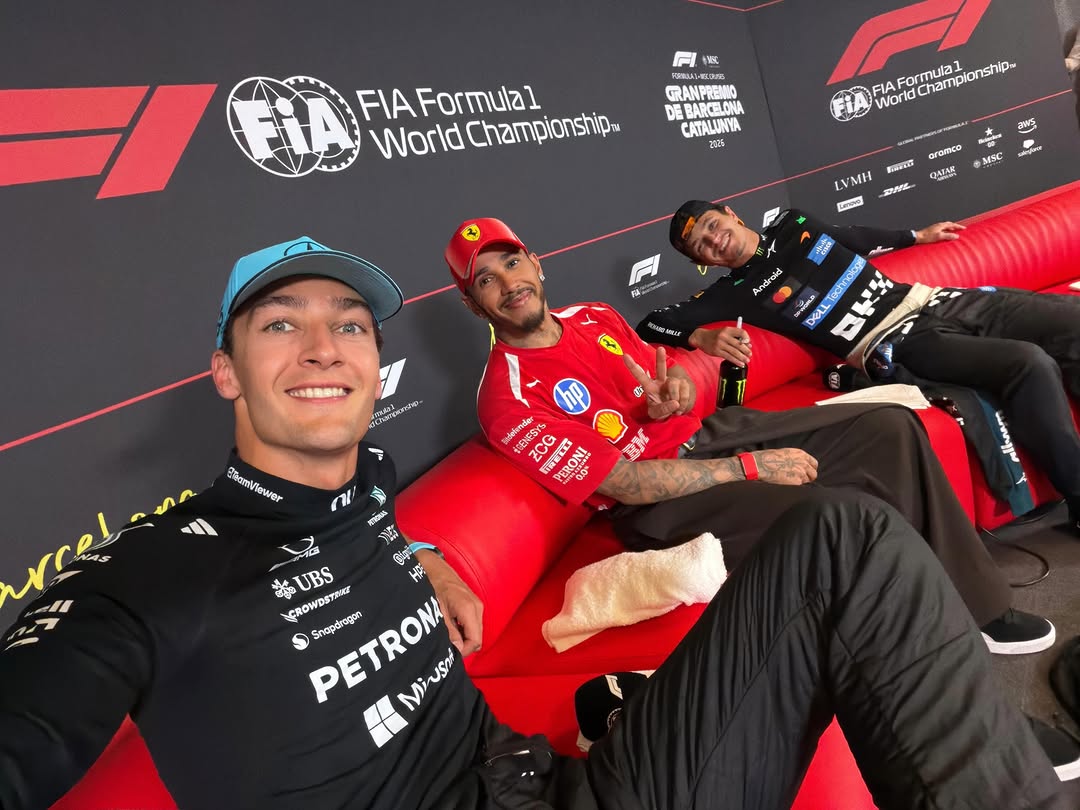
George Russell started from pole and crossed the line second at the 2026 Spanish Grand Prix, but a pit stop tool failure in the final stint cost him a genuine shot at victory — and left one of the season’s most striking silver-and-black liveries on the podium under a cloud of what-ifs.
Key Takeaways
Russell qualified on pole and finished second, but a faulty front-wing adjuster gun in the final pit stop forced him to run with a severe oversteer balance through the closing laps.
Bradley Lord confirmed the error publicly: the mechanics could not rotate the front flap correctly, leaving the car ‘very, very oversteer-y’ — the opposite of what Russell needed after reporting understeer.
Barcelona’s low-grip, high-degradation asphalt amplified the imbalance; what might have been a minor setup miss at another circuit became a podium-defining handicap at the Circuit de Barcelona-Catalunya.
The incident is a reminder of why pit-lane precision matters as much as pace — and why display replicas of Russell’s 2026 Mercedes lid capture a race weekend that was both a triumph and a near-miss.
Pole, Podium — and a Tool That Let Russell Down
George Russell took pole position at the Circuit de Barcelona-Catalunya, led the opening phase of the Spanish Grand Prix, and stood on the second step of the podium — yet his weekend was defined as much by a piece of broken equipment as by his driving. A faulty front-wing adjuster gun during the final pit stop meant the Mercedes crew could not complete the planned front flap adjustment, sending Russell back onto the track with the exact opposite balance to what the engineers had ordered.
The chain of events began well before the chequered flag. From roughly the midpoint of the race, both Mercedes drivers started reporting increasing understeer as tyre performance degraded. Russell’s second stint was no exception — he flagged the condition over the radio, and the plan going into the final stop was to add front downforce by rotating the flap through the slot in the nosecone. When the adjuster gun malfunctioned, that correction never happened.
Instead of a rebalanced, more neutral car, Russell rejoined with a heavily pointy front and an unstable rear — a setup that on any circuit would cost lap time, but at Barcelona, with its notorious combination of low grip and aggressive tyre degradation, it was particularly damaging. He held second place to the flag, but the pace he needed to threaten the leader was gone.
What Bradley Lord Said — and What It Means
Mercedes deputy team principal Bradley Lord gave an unusually direct explanation of the failure in the team’s post-race debrief. His words removed any ambiguity about what happened and who was affected.
“In our final pit stop, we actually incorrectly adjusted the front wing owing to a problem with the adjuster gun, and that meant that he was working with a very, very oversteer-y balance that certainly compromised his pace in the final stages.”
The phrase ‘compromised his pace’ is team-speak for a measurable performance loss. On a street or medium-speed circuit that loss might be absorbed; at Barcelona, where thermal degradation punishes any car that is not in perfect balance, even a small swing toward oversteer accelerates rear tyre wear and forces the driver to manage rather than attack. Russell had to do exactly that through the final stint.
Lord’s transparency is notable. Admitting a tool failure in public — rather than attributing the result to strategy or driver circumstances — signals that Mercedes is treating this as an operational issue to be fixed, not explained away. For collectors and fans, it also anchors this particular race in the memory: a silver helmet on a silver car, podium-bound but working harder than it should have been.
The Understeer-to-Oversteer Swing: Why It Matters at Barcelona
The Circuit de Barcelona-Catalunya is one of the most demanding tracks on the F1 calendar for tyre management, combining high-speed corners that load the front axle heavily with long straights that offer the rubber no recovery time. A car reporting understeer mid-race at Barcelona is typically running too little front downforce relative to the rear — the planned fix is to close the front flap, increasing front-end load and rebalancing the aerodynamic map.
When that adjustment goes the wrong way — or, in Russell’s case, does not happen at all — the car swings toward oversteer. The rear end becomes less stable, the driver must reduce entry speed into slow corners to avoid snap, and rear tyre temperature climbs faster than ideal. Each of those effects costs lap time independently; combined, they compounded Russell’s deficit in the final stint.
Barcelona’s tarmac has a relatively low friction coefficient compared with circuits like Silverstone or Spa, which means any balance error is magnified. A car that is 2–3 percentage points off its optimal aero balance at a high-grip venue might lose a few tenths; at the Circuit de Barcelona-Catalunya, the same imbalance can translate to half a second or more per lap once the tyres have started to grain. For reference, the gap between a podium finish and a race win at this circuit has historically been measured in fractions of a second across the final 10 laps.
Kimi Antonelli, also on a Mercedes chassis, had been closing rapidly on Russell before the final stop, which underlines how sensitive the cars were to balance that afternoon. Russell’s oversteer car had no margin left to manage a chase from behind while also protecting pace to the front.
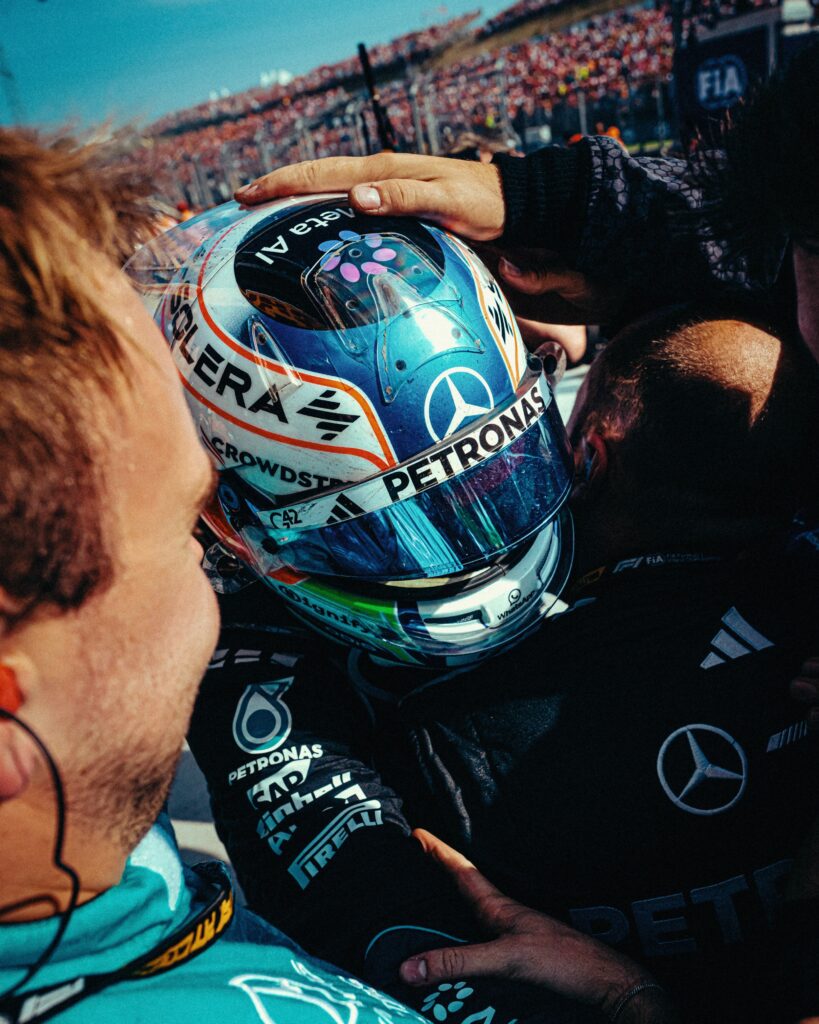
Russell’s Helmet and Livery: A Display-Worthy Podium Moment
Beyond the race result, the 2026 Spanish Grand Prix produced some of the most striking visual moments of the season so far — and that is precisely why a full-size 1:1 collector replica of Russell’s lid from this weekend belongs in any serious F1 display collection.
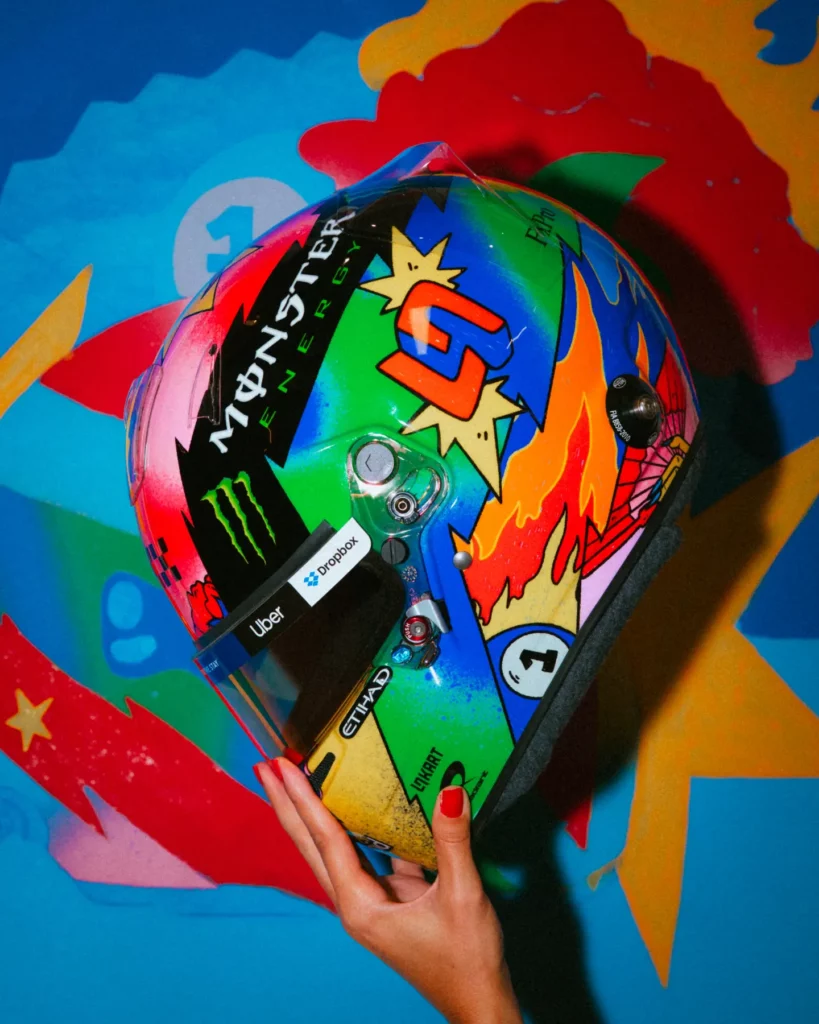
Russell raced in his current design, a high-contrast scheme built on a dark base with sharp geometric detailing that reads clearly under Barcelona’s strong Mediterranean light. Photographed from the cockpit during the pole lap or on the podium in P2, the helmet is the centrepiece of a race weekend that combines sporting achievement — a front-row start, a top-two finish — with a genuine tactical story.
Full-size 1:1 display replicas of this helmet are produced at exactly 29 × 25 × 35 cm in outer dimension, matching the geometry of the race item. Paintwork on exhibition-quality pieces of this type typically runs to multiple base and clear layers, with a visor panel scaled to the same proportions as the unit Russell wore at the Circuit de Barcelona-Catalunya. Weight on finished collector pieces of this category runs close to 1.2–1.5 kg, giving them the physical presence of the real article on a shelf or in a display case.
For a race like Barcelona 2026 — pole, podium, a publicly acknowledged operational drama — the helmet is not just memorabilia. It is a three-dimensional reference point for a specific chapter in George Russell‘s career: the weekend he did everything right behind the wheel and was still let down by 30 grams of broken metal in the pit lane.
What the Error Reveals About Modern F1 Pit Lane Execution
A single tool failure costing a potential race win illustrates how razor-thin the margins of modern Formula 1 pit lane operations have become. Teams rehearse pit stops thousands of times across a season to reduce human error to near zero, but mechanical tool failure sits in a different risk category — it is an equipment reliability problem, not a training problem.
The front-wing adjuster mechanism on a current F1 car is accessed through a precise slot in the nosecone. The adjuster gun must engage that slot cleanly, rotate to a specified angle, and disengage — all within the window of a tyre change that itself lasts under 3 seconds for the wheel guns. If the gun jams, strips, or fails to engage, the mechanic has no time within a normal stop to improvise. The crew either wave the car out with the wrong setting or hold the car for extra seconds, both of which cost position.
In Russell’s case, the car was waved out — preserving track position but accepting the balance penalty. That trade-off was arguably correct in the moment; a stationary car on a hot pit lane loses more time than a slow final stint. But the ‘very, very oversteer-y balance’ that Lord described suggests the penalty was severe enough that the decision, with hindsight, was close.
For 123Helmets.com collectors, the broader point is that every race weekend is a layered event: qualifying performance, race strategy, pit lane execution, and driver management all feed the final classification. Barcelona 2026 is a weekend where Russell’s driving was not the limiting factor — and a display replica of his helmet captures that nuance in a way that a race result alone cannot.
Collecting the Barcelona 2026 Chapter
The 2026 Spanish Grand Prix is a collector-relevant race for several reasons that extend beyond the final standings. Russell’s pole position makes the weekend a milestone lap in his season — pole laps are the clearest single-lap expression of a driver’s pace, unaffected by traffic, tyre management, or strategy.
The second-place finish, meanwhile, carries its own weight precisely because of what Lord confirmed afterward. A podium achieved despite a pit stop equipment failure, on a circuit as demanding as Barcelona, is a harder result to replicate than a podium on a forgiving track with a perfect car. That context makes a full-size 1:1 replica of Russell’s 2026 helmet from this event a more specific and meaningful display piece than a generic season helmet.
Exhibition-quality replicas at 123Helmets.com are produced as display pieces and collector items only. They carry no FIA, Snell, ECE, DOT, or any other safety certification, and are not intended for road or track use — they are built to be seen, not worn. At 1:1 scale, the geometry, finish, and visor proportions correspond directly to the helmet Russell wore at the Circuit de Barcelona-Catalunya on race day 2026.
Whether displayed on a shelf alongside a Barcelona circuit map, positioned next to a scale model of the W16, or shown in a dedicated F1 collection room, the Russell Barcelona 2026 replica anchors a specific, documented moment in the 2026 championship — a race where the fastest car on Saturday was one tool failure away from taking Sunday’s top step as well.
“In our final pit stop, we actually incorrectly adjusted the front wing owing to a problem with the adjuster gun, and that meant that he was working with a very, very oversteer-y balance that certainly compromised his pace in the final stages.”
— Bradley Lord, Mercedes Deputy Team Principal
FAQ
Q: What went wrong during George Russell’s pit stop at the 2026 Barcelona GP?
A faulty adjuster gun prevented mechanics from correctly rotating the front wing flap during Russell’s final pit stop. The intended adjustment was to add front downforce to correct the understeer Russell had reported — instead, the car left the pit lane with an oversteer balance that hurt his pace through the closing laps.
Q: Did the pit stop error cost Russell the race win in Barcelona?
Mercedes deputy team principal Bradley Lord confirmed the error ‘certainly compromised his pace in the final stages.’ Russell finished second, having started from pole. Whether the correct front-wing setting would have been enough to overhaul the race leader cannot be stated with certainty, but the team’s own assessment is that his competitive pace was measurably reduced.
Q: Why is Barcelona particularly unforgiving for a car with the wrong balance?
The Circuit de Barcelona-Catalunya has a low-grip surface and high tyre degradation rates, meaning any aero or mechanical imbalance accelerates wear and costs lap time faster than at most other venues. An oversteer car at Barcelona loads the rear tyres harder than optimal, which raises temperatures and causes the rubber to degrade more quickly through the final stint.
Q: What is a full-size 1:1 replica F1 helmet and what is it used for?
A full-size 1:1 replica F1 helmet is a display and collector item produced at exact race-scale dimensions — typically around 29 × 25 × 35 cm — to replicate the visual appearance of a driver’s race helmet. These pieces carry no safety certification of any kind and are not intended for use on road or track; they are exhibition-quality display items made for collectors and fans.
Q: Why is the Barcelona 2026 Russell helmet worth collecting?
The Barcelona 2026 weekend combines a pole position, a podium finish, and a publicly documented mechanical drama — all within a single race weekend. That combination of on-track achievement and behind-the-scenes context makes the corresponding helmet a more specific collector reference point than a generic season piece. It marks a chapter in Russell’s 2026 campaign that is defined as much by what went wrong in the pit lane as by what went right on the circuit.
Shop Mercedes Helmets — add the Barcelona 2026 chapter to your collection. Every piece is a full-size 1:1 display replica, exhibition quality, built to be seen.
Display and collector replicas only. Not certified for protective use. Full-size 1:1 scale.
This article was written with the help of AI tools. Editorial policy