Blog
Hamilton’s Motorhome Reset: How a Mental Break Unlocked a Barcelona Front Row
 123Helmets Editorial Team
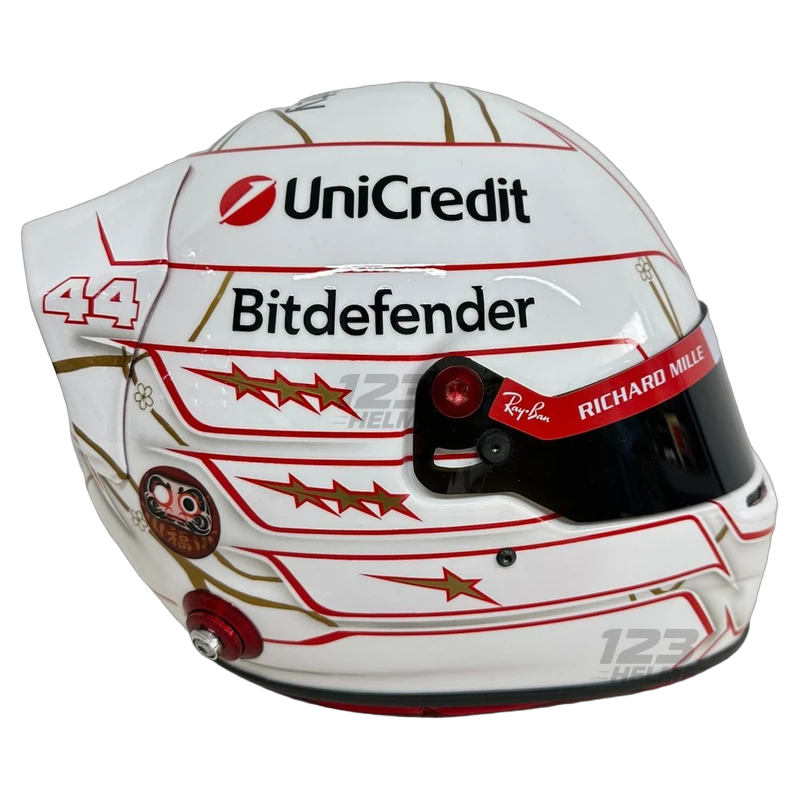
Lewis Hamilton arrived at Saturday qualifying in Barcelona carrying three sessions of doubt. He left it with a front-row start and a story about walking away from the garage that every helmet collector will want framed alongside their replica.
Key Takeaways
Hamilton qualified second at the 2026 Spanish GP, just 0.064 seconds behind pole-sitter George Russell.
A deliberate walk back to his motorhome between FP3 and Q1 served as the turning point in his entire weekend.
Missing FP1 — with Dino Beganovic taking the car — created an unusually large setup offset that left Hamilton over a second off the pace in FP2.
The Barcelona result is Hamilton’s second consecutive front-row start at Ferrari, following two second-place finishes in the previous two rounds.
A Weekend Built on Doubt
Some qualifying laps are earned in the garage. Some are earned on the circuit. Hamilton’s front-row slot at the 2026 Spanish Grand Prix was earned in a motorhome, somewhere between FP3 and the first timed run of the afternoon.
The Circuit de Barcelona-Catalunya is unforgiving at the best of times — a track that rewards precise setup work across all three practice sessions. When Hamilton handed his car to Dino Beganovic for FP1, the conventional thinking was that one missed session was manageable. It rarely costs a driver much. This weekend, it cost him more than expected.
“Missing FP1 was… normally, it’s OK to miss FP1, but it had a huge offset,” Hamilton explained after qualifying. That offset — a term referring to the gap between the car’s baseline configuration and the optimal setup window — meant every adjustment made during FP2 and FP3 was working against a reference point that Hamilton had never personally experienced on this circuit in this specification of car.
The result: in FP2 he was over a second off the pace. In FP3, the gap had closed but he was still four tenths to five tenths adrift of where he needed to be. For a driver of 41 years old who has started from the front row more times than almost anyone alive, those numbers carry psychological weight.
The Walk That Changed the Qualifying Session
What Hamilton did next is worth examining as carefully as any lap time. Rather than stay in the garage and pile more data on top of an already complicated picture, he left the circuit altogether. He walked back to his motorhome, took whatever time he needed, and returned ahead of Q1.
“I went and left the track between FP3 and qualifying, I went back to my motorhome, came back, and then in Q1, I was first,” he said.
That single sentence — delivered with a quiet satisfaction that only a seven-time world champion can manage — tells the whole story. The car had not been rebuilt. The tyres had not changed. The track temperature was the same. What had changed was the mental state of the driver behind the wheel.
It is easy to underestimate how much of a qualifying lap lives in the driver’s head rather than in the data. These are laps executed on tyres that, as Hamilton himself noted, “only last one lap.” You have two shots per session — potentially three if a cool-down lap is attempted, though the car balance after the tyre degrades makes that third run a poor reference. The margin for mental noise is essentially zero.
By clearing that noise with a deliberate physical break, Hamilton found what the data and the debrief sessions had not given him: a clean starting point.
Q1 to Q3 — Reading the Sessions
Hamilton’s own account of qualifying paints a picture of three sessions with three distinct characters. Q1 was the reward for the motorhome reset — he went fastest, the car balance felt right, and for the first time all weekend he was working with rather than against the circuit.
Q2 introduced the complications that Barcelona qualifying routinely delivers. Traffic on out-laps, positioning games between teams, and the compressed timing of the session meant Hamilton’s run was less clean. “Q2 was a little bit harder with traffic and everything,” he acknowledged. But he progressed, which was all that mattered.
Q3 came down to 0.064 seconds. That gap — 64 thousandths of a second across a lap that runs close to 1 minute 14 seconds at this circuit — separated Hamilton in second from George Russell on pole. Russell, his former Mercedes teammate, took the top spot. Hamilton, driving the Ferrari in its red livery, took the front-row position alongside him.
In the process, Hamilton bumped Andrea Kimi Antonelli to third. For the Alpine-backed Antonelli, it marked the first time in 2026 that the championship leader had been pushed off the front row — a notable statistical moment in what has been a dominant run at the front of the grid for the young Italian driver.
“Congrats to George, but we’re in a good position to be able to fight tomorrow, so we have a race,” Hamilton said. At 41 years old, back in red, starting second at the Circuit de Barcelona-Catalunya — it was a line delivered with the measured confidence of someone who knows exactly what front-row starts can become.
The Ferrari Red That Belongs in a Display Case
For collectors and display enthusiasts, a qualifying session like this one produces exactly the kind of visual moment that defines an era. Hamilton in the Ferrari cockpit, the Scuderia red under the Barcelona afternoon light, sliding into second on the timing screens with 0.064 seconds to spare — it is the sort of scene that replica helmet manufacturers build their catalogues around.
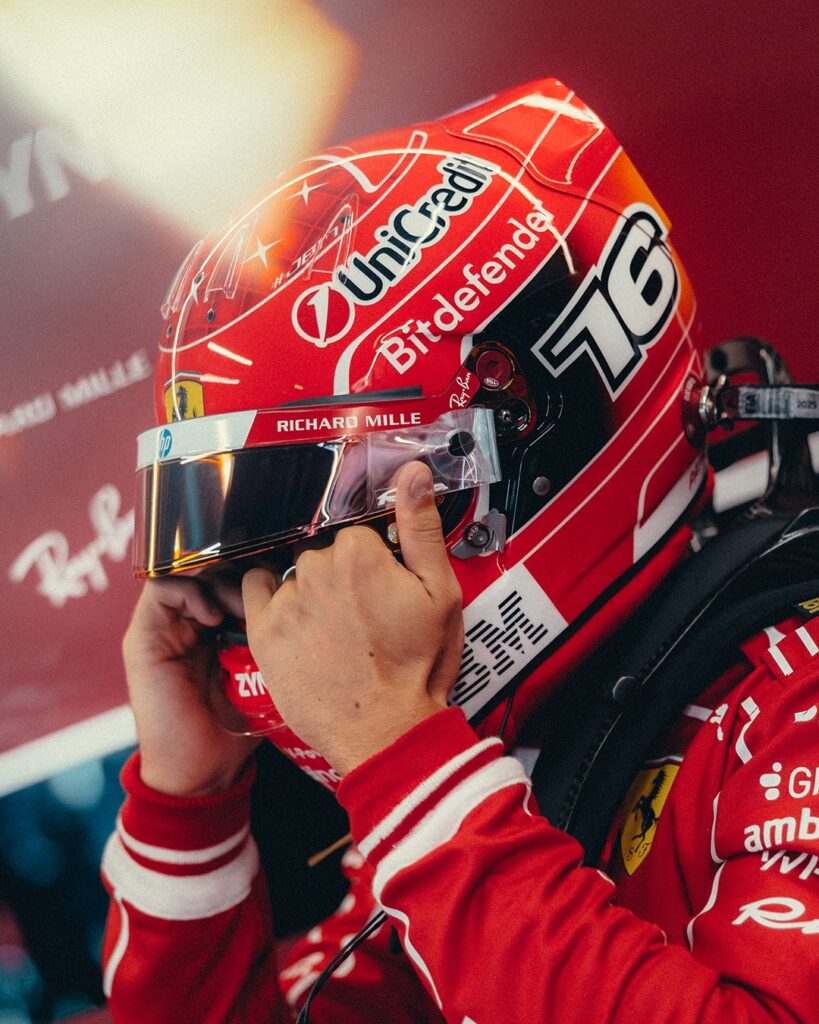
The helmet Hamilton wore across this qualifying session carries the design language of his first full Ferrari campaign: the red base, the personal branding that has followed him from Mercedes but now sits within a wholly different colour architecture, and the visor tint selected for the Spanish sun. Full-size 1:1 display replicas of Hamilton’s Ferrari-era helmets reproduce these details at scale, with the kind of finish quality suited to exhibition and collection rather than storage.
A collector-grade 1:1 replica of this period in Hamilton’s career captures something specific: the transition. This is not the man in silver who defined a decade at Mercedes. This is the version of Hamilton who is still placing himself on the front row of grands prix while wearing the red of Maranello, working through difficult weekends, and finding a way back. That narrative has weight on a display shelf in a way that few other chapters of his career can match right now.
For display purposes, the Ferrari helmet replica sits at full 1:1 scale — the same dimensions as the helmet worn in the car — and is produced as a collector item suited for home display, office exhibition, or dedicated motorsport collections. These are display pieces only, not certified for any protective use.
Back-to-Back Front Rows: What the Pattern Shows
Saturday in Barcelona did not arrive in isolation. Hamilton’s front-row slot follows two consecutive second-place race finishes in the rounds immediately before Spain. A driver who was still finding his feet at Ferrari in the opening weeks of the season has now established a run of results that places him firmly in the conversation about race wins.
The Barcelona result also demonstrates something about how Hamilton now extracts performance. He is not, at this stage of his career, going to outwork the data in a Friday afternoon practice session. What he can do — and what the motorhome story illustrates — is manage the psychological dimension of a race weekend with the kind of precision that comes only from experience. He knows when to absorb information and when to stop absorbing it. That judgement, on this particular Saturday, was worth more than any additional data run in FP3 would have been.
From a Ferrari team perspective, Sunday presents exactly the scenario they would have drawn up: their driver starting second, alongside a former teammate who he knows well, with Antonelli — the championship leader — directly behind. The tyre strategy options that open up from P2 on a circuit like Barcelona, where the long straights and the final sector reward early undercut moves, give Hamilton genuine tools for the race.
“It feels great to be up here with them,” Hamilton said after qualifying. After a weekend that had him five tenths adrift in FP3, that feeling was earned in about the most unconventional way possible — by walking away.
A Moment Worth Displaying
There is a particular category of motorsport moment that transcends the race result. A qualifying lap, a single session, a grid slot taken against the odds — these are the snapshots that collectors reach for when they build a display around a driver’s career. Hamilton’s 2026 Spanish GP qualifying sits in that category.
The full-size 1:1 Hamilton Ferrari replica helmet captures the visual identity of exactly this period: red livery, the Circuit de Barcelona-Catalunya weekend, a driver who was over a second off the pace on Friday and within 0.064 seconds of pole on Saturday. For anyone building a Hamilton-era display that represents the Ferrari chapter, this is the qualifying session that the collection is waiting for.
These replica helmets are exhibition-quality collector pieces — display items produced at full 1:1 scale for collectors, enthusiasts, and anyone who wants the physical object that connects them to the sport’s most discussed driver transition of the current generation. Not wearable, not certified, not designed for any use other than display and collection. Just the object itself, at the right scale, carrying the right story.
“I went and left the track between FP3 and qualifying, I went back to my motorhome, came back, and then in Q1, I was first.”
— Lewis Hamilton, post-qualifying press conference, 2026 Spanish GP
“Congrats to George, but we’re in a good position to be able to fight tomorrow, so we have a race.”
— Lewis Hamilton, 2026 Spanish GP qualifying
“Missing FP1 was… normally, it’s OK to miss FP1, but it had a huge offset, so every time… I was just over a second off.”
— Lewis Hamilton, 2026 Spanish GP qualifying debrief
FAQ
Q: How did Lewis Hamilton qualify at the 2026 Spanish Grand Prix?
Hamilton qualified second at the 2026 Spanish GP at Circuit de Barcelona-Catalunya, finishing 0.064 seconds behind pole-sitter George Russell. It was his second consecutive front-row start at Ferrari.
Q: Why did Hamilton struggle in practice before qualifying in Barcelona?
Hamilton missed FP1 — handing the car to Dino Beganovic — and encountered a large setup offset as a result. In FP2 he was over a second off the pace, and in FP3 he was still four to five tenths adrift before turning things around.
Q: What unusual recovery method did Hamilton use before qualifying?
Between FP3 and Q1, Hamilton left the circuit and walked back to his motorhome. He returned for qualifying in a reset mental state and went fastest in Q1, describing it as a turning point in his entire weekend.
Q: Are Lewis Hamilton Ferrari helmet replicas available as display items?
Yes. Full-size 1:1 Hamilton Ferrari era replica helmets are available as collector and display pieces at exhibition quality. These are display replicas only — not certified for protective use and not designed for road or track wear.
Q: What happened to Kimi Antonelli in Barcelona qualifying?
Andrea Kimi Antonelli was pushed to third in qualifying by Hamilton’s second-place time. It marked the first occasion in 2026 that the championship leader had been bumped off the front row.
Shop Lewis Hamilton Collection
Display and collector replicas only. Not certified for protective use. Full-size 1:1 scale.
This article was written with the help of AI tools. Editorial policy