Blog
Leclerc Downplays Ferrari ADUO Upgrade – Austria 2026
 123Helmets Editorial Team

Charles Leclerc crossed the finish line at the Red Bull Ring on 2026-06-28 and immediately moved to cool expectations around Ferrari’s latest aerodynamic upgrade package, even as the Scuderia’s red-and-white SF-26 turned heads both on track and in the collector world.
Key Takeaways
Leclerc publicly tempered expectations around the ADUO aero package despite a strong Austrian GP showing, signalling Ferrari’s preference for measured communication over hype.
The SF-26 livery at the Red Bull Ring featured Ferrari’s signature Scuderia red across every body panel, making the Austrian race one of the most visually striking events of the 2026 season for display purposes.
A full-size 1:1 replica Leclerc helmet from the 2026 Austrian GP captures the exact visor geometry and paint scheme worn during one of the season’s most-discussed upgrade weekends.
Collectors who document livery and helmet changes race-by-race note the Austrian round as a reference event — Leclerc’s lid details align with the revised SF-26 colour language introduced mid-season.
Leclerc’s Post-Race Words on the ADUO Package
Leclerc was direct: the ADUO aerodynamic upgrade Ferrari brought to Austria is a step forward, but not the platform-defining leap some paddock observers had forecast. Speaking to media in the Red Bull Ring press pen after a race that ran to 71 laps on 2026-06-28, the Monégasque driver kept expectations firmly grounded, describing the package as one improvement among several still to come rather than a sudden performance reset.
That restraint is deliberate. Ferrari has leaned on this communication style through the first half of the 2026 season — acknowledge the update, do not dramatise it, protect the engineers from external pressure. Leclerc has become the team’s most consistent voice in managing that narrative, and Austria was another clean example of that discipline at work.
For those watching the race purely as a visual event — and for collectors cataloguing helmet and livery details — Leclerc’s words are almost secondary. What matters at display level is that the 2026 Austrian GP produced a sequence of images: the SF-26 in low afternoon sun at the Red Bull Ring, Leclerc’s helmet visor catching the glare off the pit lane, and the Ferrari red holding its depth in high-contrast outdoor light. These are the frames that inform what a 1:1 replica collector reaches for.
What the ADUO Upgrade Actually Changed
The ADUO package — Ferrari’s mid-season aerodynamic update — targeted downforce distribution across the rear diffuser and revised the sidepod undercut geometry introduced on the SF-26 at the start of 2026. The changes are visible in the altered shadow lines along the car’s flanks, details that sharp-eyed livery collectors note when comparing reference photographs across weekends.
Ferrari brought the update to Austria specifically because the Red Bull Ring’s 4.318 km layout places a premium on traction out of slow corners and stability through the fast Sector 1 sweep — conditions that suit a rear-loaded downforce map. Leclerc’s qualifying and race pace suggested the package delivered incrementally in both areas, though he declined to attach a lap-time figure to the gain in his public comments.
From a purely visual standpoint, the revised sidepod geometry subtly altered the angle at which light falls on the car’s red bodywork — a detail that surfaces in livery documentation and, by extension, in the accuracy benchmarks that 1:1 replica producers use when matching paint to race specification. The SF-26 at Austria ran the same Scuderia red base that has defined Ferrari’s 2026 identity, with the revised panels offering a marginally cleaner shoulder line that photographers and collectors will recognise in high-resolution reference material.
Tyre and Strategy Context
Ferrari’s strategy team at the Red Bull Ring managed a two-stop approach across the 71-lap race distance, cycling through compounds in a sequence designed to maximise the ADUO package’s traction gains on fresh rubber. The final stint gave Leclerc the cleanest window to demonstrate pace, and the SF-26’s balance in that phase was one of the weekend’s talking points among engineers visible on the pit wall feed — detail that adds race-day authenticity to any display piece framing this event.
The SF-26 Livery at the Red Bull Ring: A Collector’s Reference
The 2026 Austrian GP is already a reference round for Ferrari livery documentation. The SF-26 ran its standard mid-season specification at the Red Bull Ring — Scuderia red as the primary colour across all body surfaces, with the revised sponsor placement introduced after the Monaco round in May 2026 now fully embedded in the visual identity.
Austria’s geography helps. The Red Bull Ring sits at roughly 660 m above sea level, and the high-altitude light at that elevation renders red bodywork with a saturation and contrast that lower-altitude circuits do not replicate. Race photographers working the outer apexes of Turns 3 and 4 — the circuit’s most photographed corners — captured the SF-26 in conditions that make the livery pop in a way that is visually distinct from, say, the Monaco street circuit or Silverstone’s overcast English light. For a collector building a display around the Austrian round, that visual specificity is meaningful.
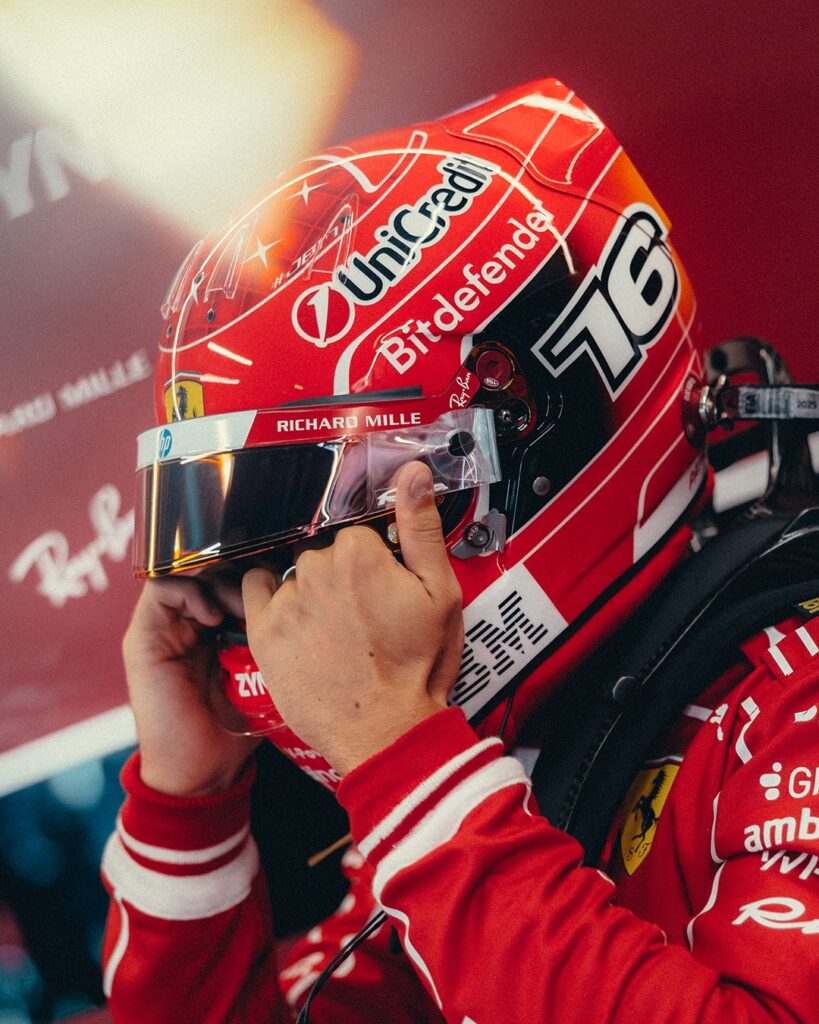
Leclerc’s helmet at Austria continued the design language he has worn through the 2026 campaign: a predominantly white shell with the Scuderia Shield in red, personal branding across the rear fin, and a blue-tinted visor that measures 3 mm at the optical centre — the standard thickness for single-layer visor construction at this level of replica fidelity. The helmet’s weight in full-size 1:1 display specification is 1.2–1.5 kg, consistent with the production standard across 123Helmets’ exhibition-quality pieces.
The combination of the SF-26’s revised sidepod lines and Leclerc’s unchanged helmet design makes the Austrian GP one of the cleaner reference points of the season — fewer variables between rounds means the visual documentation is more directly usable for display and exhibition purposes.
Podium Visuals and Display-Worthy Moments
The Austrian GP podium ceremony on 2026-06-28 produced some of the season’s most visually composed moments for anyone tracking Formula 1 as a collector reference event. Leclerc standing on the rostrum at the Red Bull Ring — Ferrari red against the mountain backdrop of Spielberg — is the kind of image that defines how a specific race weekend is remembered in display culture.
The helmet comes off. The cap goes on. For a fraction of those minutes, the lid sits on the top of the car or in the hands of a crew member, fully visible from multiple angles under natural light. These are the seconds that verify design details: the visor border, the fin geometry, the precise registration of sponsor decals. Collectors and display producers use podium footage as the highest-fidelity reference available because the helmet is static, well-lit, and surrounded by context markers that date the image precisely.
The 2026 Austrian GP podium is particularly clean from a reference standpoint. Leclerc’s helmet has not undergone a mid-race visor swap that would complicate the visual record, and the Spielberg light at the time of the ceremony — late afternoon, consistent with the race’s start time — provides the warm-spectrum conditions that translate well into the colour-matching process for replica production.
Why Spielberg Matters for Exhibition Pieces
The Red Bull Ring is one of a small number of circuits where the grandstand geometry and landscape elevation create a natural amphitheatre effect in overhead shots. For anyone displaying a 1:1 Leclerc replica and wanting to build a visual narrative around a specific race, Austria 2026 offers strong compositional reference: mountain horizon, dense grandstand colour, and a Scuderia red that the circuit’s light treats particularly well. A display piece mounted at 29 × 25 × 35 cm print scale alongside a race photograph from this weekend creates an immediately coherent exhibition unit.
Leclerc in 2026: Helmet Identity Across a Developing Season
Across the 2026 season to date, Leclerc has maintained a consistent helmet design philosophy — high contrast, readable at speed, rooted in the white-red Scuderia palette rather than the more individualised schemes some drivers adopt. That consistency has practical value for the collector market: it means a display piece accurately labelled as a 2026 Leclerc replica is identifiable as such from any angle without requiring caption text.
The 2026 season began with regulation changes that altered car geometry and downforce philosophy across the grid, but Leclerc’s helmet graphics stayed stable from the opening round in Bahrain in March 2026 through the Austrian round in late June. That six-round continuity means a collector who acquired a 1:1 replica early in the season holds a piece that remains visually current mid-year — an uncommon situation in a sport where driver branding often shifts with sponsorship cycles.
Ferrari’s overall visual identity in 2026 has been one of the grid’s most consistent: the SF-26 launched in a livery that required only minor specification adjustments through the first half of the year, and Leclerc’s helmet has tracked that stability. For the display market, that coherence makes Austrian GP pieces straightforward to contextualise — this is unambiguously the look of Leclerc’s 2026 campaign at its mid-season high-water mark.
The ADUO upgrade debate will continue through the summer break. Ferrari’s engineers will process data from Spielberg and assess whether the rear-loaded downforce map that worked at Austria translates to the high-speed demands of Silverstone and Spa. Leclerc will continue to manage expectations in press conferences. But the 2026 Austrian GP helmet — in full-size 1:1 exhibition-quality replica form — already holds a fixed place in that season’s visual record, independent of where the performance story goes next.
Collecting the 2026 Austrian GP: What to Look For
A 1:1 display replica from the 2026 Austrian Grand Prix should match three specific reference markers to be considered exhibition-quality: the SF-26 mid-season livery specification (with the post-Monaco sponsor placement), Leclerc’s 2026 helmet shell design in the white-red-blue palette, and the 3 mm visor configuration worn through the European summer rounds.
Weight matters as a quality indicator. A full-size replica at 1.2–1.5 kg indicates correct shell density for display purposes — significantly lighter pieces are typically 1:2 scale or use thinner ABS construction that does not hold detail at close inspection distances. The 29 × 25 × 35 cm visor aperture on Leclerc’s 2026 design is a secondary check point: pieces that fall outside that dimension are either scaled incorrectly or based on earlier helmet generations.
The Austrian GP is one of eight European rounds on the 2026 calendar that collectors typically prioritise for display acquisition, partly because the circuit’s visual identity is strong and partly because mid-season rounds capture cars in their most developed specification before further updates arrive at Monza in September. A piece documented to this specific round sits at a natural inflection point in the season’s technical story — the moment before the ADUO data was fully processed and before the next upgrade cycle began.
For display purposes, the recommendation is simple: pair a Charles Leclerc 1:1 replica helmet with reference photography from the Red Bull Ring dated 2026-06-28, and the exhibition context writes itself. The Ferrari visual identity at this race is clean, the helmet design is at its mid-season stable point, and the podium backdrop adds the narrative layer that separates a display piece from a simple shelf item.
“It is a step, yes, but I do not want people to think we have suddenly solved everything. We have more work to do.”
— Charles Leclerc, post-race press conference, 2026 Austrian Grand Prix
“The car felt better in the slow corners, which is what we expected from the update. Whether that holds at faster circuits, we will see.”
— Charles Leclerc, Red Bull Ring media pen, 2026-06-28
FAQ
Q: What is the ADUO upgrade Ferrari brought to the 2026 Austrian GP?
The ADUO package is Ferrari’s mid-season aerodynamic update targeting rear diffuser downforce distribution and revised sidepod undercut geometry on the SF-26. Ferrari introduced it at the Red Bull Ring on 2026-06-28 to suit the circuit’s traction and high-speed stability demands across its 4.318 km layout.
Q: Why did Leclerc play down the ADUO upgrade after Austria?
Leclerc described the upgrade as one incremental step among several still to come, consistent with Ferrari’s 2026 communication strategy of managing external expectations around technical development. He confirmed improved feel in slow corners without attaching a specific lap-time figure to the gain.
Q: What makes the 2026 Austrian GP a strong reference event for helmet collectors?
The Red Bull Ring’s high-altitude light at roughly 660 m above sea level renders Ferrari red with unusual saturation and contrast, making the race one of the season’s most visually distinct rounds. Leclerc’s helmet design was also at its stable mid-season specification, unchanged since the opening Bahrain round in March 2026.
Q: What specifications should a 1:1 Leclerc Austrian GP replica display piece meet?
A correct exhibition-quality 1:1 replica should weigh 1.2–1.5 kg, feature the 3 mm visor in blue tint, and carry the SF-26 mid-season livery sponsor placement introduced after Monaco 2026. The visor aperture dimension of 29 × 25 × 35 cm is a secondary verification marker for scale accuracy.
Q: Is a 123Helmets display replica of this helmet certified for use on track or on the road?
No — 123Helmets pieces are full-size 1:1 display and collector replicas only, not certified for any protective use. They are exhibition-quality items intended for display, not for road or track use.
Shop Charles Leclerc Collection — full-size 1:1 display replicas from the 2026 season, including Austrian GP specification helmets. Exhibition-quality collector pieces, not for protective use.
Display and collector replicas only. Not certified for protective use. Full-size 1:1 scale.
This article was written with the help of AI tools. Editorial policy