Blog
Leclerc Locks In P3 in Barcelona FP3 — A Helmet and Livery Collector’s View
 123Helmets Editorial Team

George Russell posted the session’s quickest time at 1m 16.258s in Free Practice 3 ahead of the 2026 Gran Premio de Barcelona-Catalunya, but it was Charles Leclerc’s Ferrari that caught the eye — third on the timing sheet, scarlet livery glinting in 50°C track temperatures, and every bit as display-worthy as anything in a collector’s cabinet.
Key Takeaways
George Russell set the FP3 benchmark at 1m 16.258s, 0.242 seconds clear of Antonelli and well ahead of Leclerc’s Ferrari in third.
Track temperature hit 50°C at Circuit de Barcelona-Catalunya, making tyre management and helmet livery photography conditions extremely demanding.
Leclerc ran the Pirelli soft compound alongside Norris in early laps, posting times within one-tenth of each other before Russell’s Mercedes surged clear.
Kimi Antonelli received a post-session reprimand for erratic driving — a reminder that championship pressure produces the most visually dramatic helmet-to-helmet moments on track.
Russell’s Benchmark and What It Means for the Grid
Free Practice 3 at the Circuit de Barcelona-Catalunya on 2026-06-13 belonged to George Russell. The Mercedes driver posted a 1m 16.258s on his first meaningful flying lap at the halfway point of the one-hour session, putting 0.242 seconds between himself and team-mate Kimi Antonelli in second. McLaren’s Oscar Piastri slotted in behind, with Charles Leclerc completing the top four for Ferrari — locking in a front-row-adjacent starting point for the afternoon’s qualifying simulations.
The session was slow to ignite. Most teams held their cars in the garage past the 20-minute mark, treating FP3 as a dry run for Saturday qualifying rather than a standalone performance exercise. Only the Cadillacs of Valtteri Bottas and Sergio Perez, plus Alpine and McLaren, ventured out early for system checks after breaking the overnight curfew. That restraint made the eventual flurry of lap times — when traffic finally cleared and the track rubbered in — all the more striking.
Lando Norris broke the ice with the first representative lap: a 1m 16.609s on Pirelli soft tyres. Leclerc matched that pace almost immediately, slotting within one-tenth of Norris as the two traded positions on the timing screen. Then Russell arrived, rewrote the top of the sheet, and the session’s narrative was set.
Leclerc’s Ferrari in the Heat — P3 on a Knife Edge
Charles Leclerc’s third-place finish in FP3 was earned in conditions that tested every car on the grid. With track temperatures reaching 50 degrees Celsius, the Circuit de Barcelona-Catalunya’s abrasive surface pushed tyre degradation into the foreground and made clean laps increasingly difficult to string together across a full session. Leclerc and Norris traded positions in the early running before Russell’s late surge reshuffled the order permanently.
Championship leader Antonelli, meanwhile, struggled. Seventh overall and 0.8 seconds off Russell’s pace, the Mercedes driver encountered traffic on his final push laps — a consequence of the compressed nature of late-session qualifying simulations in a packed garage window. That traffic-induced deficit handed Leclerc a clear advantage: Ferrari’s timing of its soft-tyre runs gave Leclerc clean air and a clean lap, and the Scuderia’s setup for Barcelona’s smooth, sweeping corners paid dividends.
A red flag mid-session — triggered when Bottas beached his Cadillac in the gravel at Turn 10 exit after reporting a lost brake pedal — compressed the remaining running into just 21 minutes. That kind of disruption rewards teams with quick setup response and drivers who can switch on tyres immediately. Leclerc held P3 through that final window.
The Ferrari Livery at Barcelona — A Display Study
For collectors and display enthusiasts, Barcelona offers one of the cleanest visual backdrops on the F1 calendar. The Circuit de Barcelona-Catalunya’s wide pit lane and open grandstand sightlines mean the cars are visible in full — no Monaco tunnel shadow, no Spa treeline. Ferrari’s 2026 livery, in its signature Scuderia red with revised sponsor placement, sits under full Catalonian sunlight in a way that rewards photographic capture and — by extension — replica display pieces that aim to recreate those exact colour temperatures.
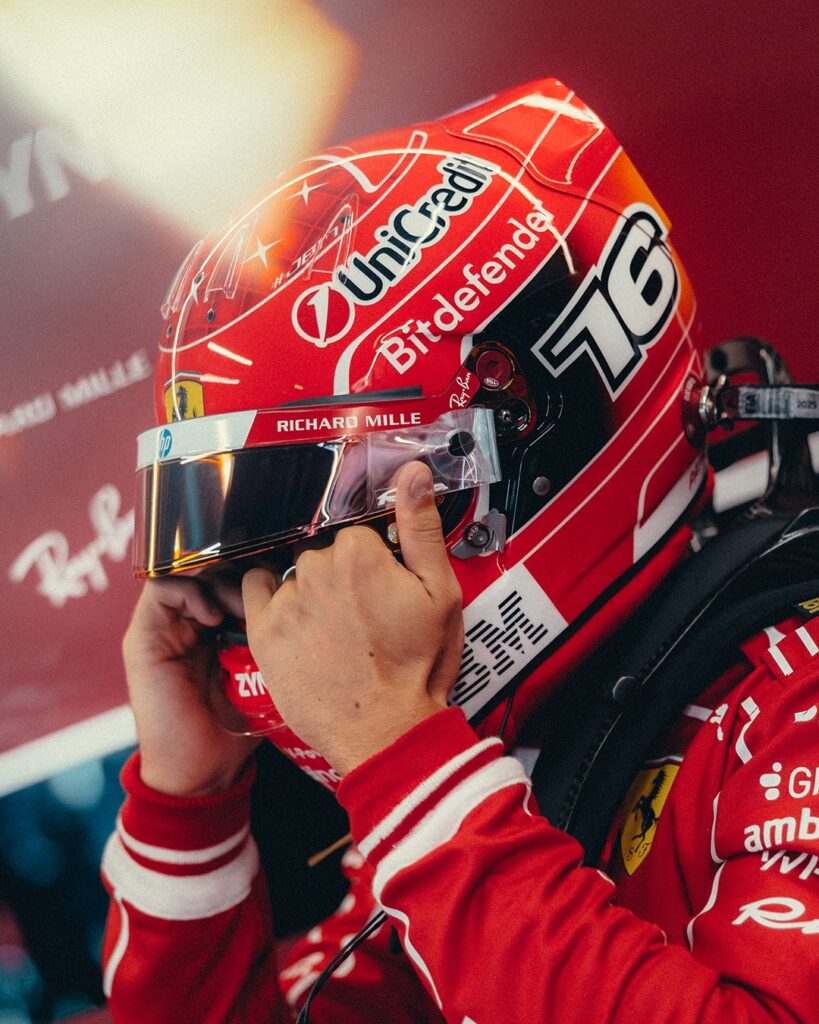
Leclerc’s helmet at Barcelona follows the design language he has used through the 2026 campaign: a predominantly red shell that mirrors the Ferrari colour family, accented with white and dark graphic elements across the crown and visor surround. On a 1:1 full-size display replica, that colour relationship between helmet and livery is precisely what makes a matched Ferrari collection so visually coherent — the helmet does not compete with the car’s palette, it extends it.
At 50°C track temperature, the way light behaves on high-gloss automotive paint changes. Colours read differently under thermal haze than they do in cooler morning light — something professional collectors who photograph their display pieces in natural light will recognise immediately. The Barcelona afternoon session, with its intense overhead sun, is precisely the kind of environment where a well-executed replica gloss finish earns its production cost.
The Red Flag Moment — Drama Made Permanent
At roughly the 39-minute mark, Valtteri Bottas reported a lost brake pedal over team radio and found his Cadillac stranded in the gravel trap at Turn 10. Race control deployed the red flag immediately. The incident itself was unremarkable by motor sport standards, but the frozen image it created — cars stopped across the circuit, Leclerc’s Ferrari stationary on track against the Barcelona skyline — is exactly the kind of editorial moment that defines a race weekend’s visual memory.
For collectors, these stoppage moments carry weight. A helmet associated with a specific session, a specific incident, a specific lap time, becomes more than a display piece — it becomes a timestamp. Leclerc’s P3 at Barcelona FP3 on 2026-06-13 is one such timestamp: a session interrupted, a ranking held, a livery performing in conditions few other circuits replicate.
The session resumed with 21 minutes left on the clock. Drivers pushed hard to maximise track evolution, but the order at the top held. Russell, Piastri, Leclerc. The heat did not change the result — it only underlined it.
Collecting the 2026 Barcelona Moment — Leclerc’s Display Legacy
Full-size 1:1 replica helmets exist precisely to capture moments like Barcelona FP3 2026. A collector’s display piece is not just an object — it is a reference point. When Leclerc sits P3 behind Russell and Piastri, holding Ferrari’s honour in 50-degree heat on a disrupted session, the helmet associated with that weekend carries the full weight of the context.
Exhibition-quality replicas of the Charles Leclerc 2026 race helmet reproduce the exact graphic geometry, colour values, and finish specifications used on the race item. These are display pieces — not certified for protective use, not rated for road or track use — but built to full-size 1:1 scale so that proportions, visor geometry, and livery match what appears on circuit. For any Ferrari collector building a themed display around the 2026 season, a Barcelona-session replica is a natural anchor piece.
The Antonelli reprimand for erratic driving, Russell’s session-topping 1m 16.258s, the red flag at Turn 10, the 0.8-second gap between P1 and P7 — these numbers and events form the factual skeleton around which a display collection tells its story. Leclerc’s P3 is part of that story, and it is one worth displaying.
“I lost my brake pedal.”
— Valtteri Bottas, Cadillac, over team radio — Barcelona FP3 2026, Turn 10 incident
FAQ
Q: What was Charles Leclerc’s finishing position in Barcelona FP3 2026?
Leclerc finished third in Free Practice 3 at the Circuit de Barcelona-Catalunya, behind George Russell (1m 16.258s) and Oscar Piastri, running on Pirelli soft tyres.
Q: Why was there a red flag in FP3 at Barcelona?
Valtteri Bottas lost his brake pedal approaching Turn 10 exit and beached his Cadillac in the gravel trap. Race control deployed the red flag, leaving 21 minutes of running remaining when the session resumed.
Q: What track temperature was recorded during Barcelona FP3?
Track temperature at the Circuit de Barcelona-Catalunya reached 50 degrees Celsius during the session, creating significant tyre management challenges for all drivers.
Q: Are Charles Leclerc replica helmets available for display and collecting?
Yes. Full-size 1:1 display replica helmets based on Leclerc’s 2026 race design are available as collector and exhibition pieces. These are display items only — not certified for protective, road, or track use.
Q: What happened to championship leader Antonelli in Barcelona FP3?
Kimi Antonelli finished seventh, 0.8 seconds off Russell’s benchmark, after encountering traffic on his final qualifying simulation laps. He received a post-session reprimand for erratic driving.
Shop Charles Leclerc Collection — full-size 1:1 display replica helmets from the 2026 season, exhibition quality, built for the serious Ferrari collector.
Display and collector replicas only. Not certified for protective use. Full-size 1:1 scale.
This article was written with the help of AI tools. Editorial policy