Blog
Leclerc ‘Very Ashamed’ After Barcelona Q3 Crash: The Helmet and Livery Story Behind a Lost Front Row
 123Helmets Editorial Team

Charles Leclerc arrived at the Circuit de Barcelona-Catalunya carrying genuine pace, a refined Ferrari livery, and every reason to expect a front-row start. Then Turn 4 happened. A snap of oversteer on his first flying lap in Q3 sent the SF-25 head-on into the barrier, turning a near-pole weekend into a P10 grid slot for Sunday’s 66-lap race. What remains — beyond the shame Leclerc expressed openly — is a display-worthy chapter in the visual history of the 2026 Ferrari campaign.
Key Takeaways
Leclerc finished second in Q2, just 0.5 tenths behind George Russell’s pole time, before crashing on his first Q3 flying lap at Turn 4.
The incident brought out a red flag and locked Leclerc into P10 for a 66-lap race at Circuit de Barcelona-Catalunya.
Lewis Hamilton backed up Ferrari’s Q2 pace, finishing 0.064 seconds behind Russell — confirming the SF-25 had genuine front-row potential on the day.
The 2026 Spanish GP qualifying session stands as a collector reference point: the Ferrari red-and-white livery and Leclerc’s helmet design were at their most visible under the Barcelona lights before the crash ended the session early.
A Q2 That Promised Everything
For a few minutes on Saturday afternoon in Barcelona, Charles Leclerc looked like the driver most likely to challenge George Russell for pole position at the Circuit de Barcelona-Catalunya. His Q2 lap was swift enough to place him second on the combined session timesheet, finishing just half a tenth behind the Mercedes driver who would ultimately take pole. That margin — roughly 0.050 seconds across a lap that stretches well beyond 75 seconds — is the kind of gap that disappears with a single clean sector.
Leclerc was candid about what that lap meant. “Q2 lap was really good, I think all corners we were the strongest nearly,” he said after the session. The one exception he flagged was Turn 4 — the long, sweeping right-hander that opens the middle sector of the Barcelona circuit. It would, in a matter of minutes, become the reason his qualifying ended on a flatbed truck rather than on the front row.
Lewis Hamilton reinforced the Ferrari picture from Q2, setting the second fastest time in the session just 0.064 seconds behind Russell. Two Ferraris, locked and loaded for Q3, positioned to fight for the top two grid slots. The red-and-white SF-25 livery — one of the cleaner Ferrari designs of the modern era — was photographed extensively in those moments, making the qualifying session a strong visual reference for anyone who follows the team’s 2026 aesthetic.
The Turn 4 Moment That Ended Leclerc’s Q3
On his first flying lap in Q3, Leclerc carried too much entry speed into Turn 4. He had deliberately released the brakes earlier than in Q2, attempting to carry momentum through the corner. “I released the brakes and I think I carried quite a lot more speed in, which was okay mid-corner,” he explained, “but I ended up on the dirtier part of the track and lost the car.”
The result was a snap of oversteer on the corner exit, the SF-25 spearing directly into the barrier with heavy head-on contact. The impact was significant enough to bring out a red flag that halted Q3 for all drivers. Leclerc was unharmed — an important note before anything else — but the session was effectively over for him. His Q3 time stood as no time at all, slotting him P10 on the grid for Sunday.
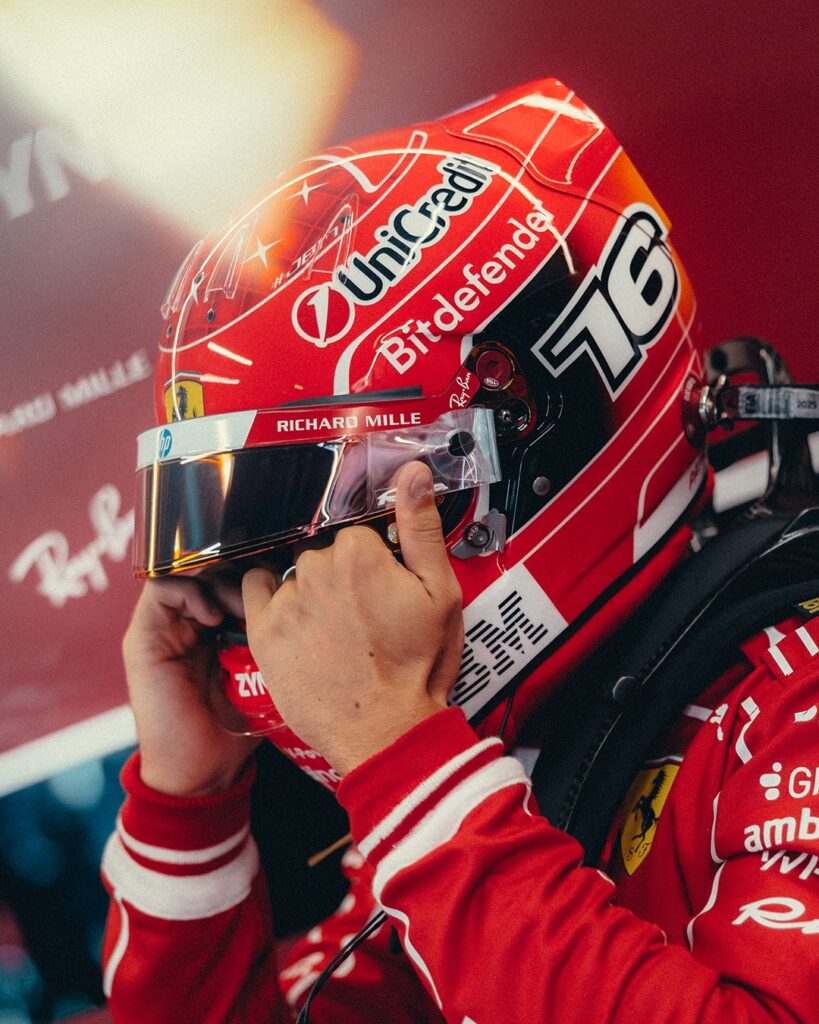
For collectors and display enthusiasts, this is one of those qualifying sessions that crystallises a driver and a livery in a single dramatic frame. The Ferrari helmet Leclerc wore throughout the 2026 Spanish GP weekend — a design that carries his characteristic use of deep red with contrasting panels — was visible at the precise moment the car made contact. These are the moments that define a season’s visual record.
Leclerc’s Words: Accountability Without Deflection
What followed the crash was one of the more honest post-qualifying statements of the 2026 season. Leclerc did not cite track conditions, tyre warm-up windows, or any external factor as the primary cause. “There’s no excuses, it’s a mistake,” he said flatly.
He went further, placing the Barcelona incident alongside his Monaco weekend — where a mechanical issue cost him — as part of a run of near-misses that had left him carrying a growing frustration. “Feeling very ashamed of coming here to speak in front of the camera after another ‘what if’,” he said. “Unfortunately last week was the same with what if we didn’t have that issue in Monaco. This weekend is what if I didn’t do that mistake.”
The raw nature of that admission — public, on camera, addressed directly to the fans who support Ferrari — is the kind of moment that marks a driver’s character as clearly as any race result. Leclerc added: “I feel ashamed for disappointing so many people that are supporting us. It must be tough to stick with me.” The sentiment resonated immediately across the paddock and the wider fan base. Whether it translates into a strong Sunday recovery from P10 is a separate question, but the accountability was absolute.
The SF-25 Livery and Helmet in a Display Context
The 2026 Spanish Grand Prix weekend placed the Ferrari SF-25 livery in an unusually high-visibility setting. The Circuit de Barcelona-Catalunya’s broad run-off areas and camera-friendly corner geometry meant that both the car and Leclerc’s helmet were extensively documented throughout practice, qualifying, and — after the crash — in the aftermath shots that circulated across broadcast and photography feeds.
For the collector market, the Barcelona round has a specific significance. Leclerc’s 2026 helmet design uses a deep red base as its primary surface, with geometric accent panelling that references his earlier Monaco and Monza-specific designs while maintaining continuity across the full season run. A full-size 1:1 replica of this helmet — produced at display quality, with a 4 mm polycarbonate visor typical of exhibition-standard replicas — captures the exact livery worn during one of the most-discussed qualifying sessions of the year.
Display replicas of this type are produced at a weight of approximately 1.2–1.5 kg, matching the external dimensions and surface finish of the race-used original at 1:1 scale. The shell geometry, vent positioning, and sponsor placement are all reproduced at the same 29 × 25 × 35 cm footprint that makes these pieces genuinely comparable to the helmet that sat on Leclerc’s head on Saturday afternoon at Barcelona. As a display piece or collector item, the 2026 Spanish GP version occupies a clear narrative moment in the Ferrari season.
P10 and the 66-Lap Sunday Equation
Starting P10 from a session where the car was capable of P1 or P2 is the kind of deficit that defines a driver’s Sunday. The Circuit de Barcelona-Catalunya presents 66 laps of a track where overtaking has historically been difficult, though DRS zones on the main straight offer the clearest opportunity for position gains.
Leclerc acknowledged the optimism that remained despite the grid position. “The feeling is back and still optimistic for tomorrow but I should be starting higher up and I don’t because of a mistake of mine,” he said. Ferrari’s race pace in 2026 has generally been strong enough to give him a platform, and a P10 start with fresh strategy options is not a closed door — but it is a much harder one to open than a front-row slot would have been.
Hamilton, starting from the second row by virtue of Q3 pace, will carry the Ferrari flag from a stronger grid position on Sunday. The contrast between the two Ferrari drivers’ Saturday outcomes — one capitalising on the car’s genuine pace, one losing it in a single corner — will be the defining subplot of Ferrari’s Barcelona race weekend narrative.
Why This Qualifying Session Belongs in the Collector Record
Not every race weekend produces a defining collector moment, but the 2026 Spanish GP qualifying session has several elements that make it a meaningful point in the Leclerc visual record. The speed was genuine — a Q2 time 0.050 seconds off pole on a circuit that has hosted F1 since 1991. The crash was dramatic and clearly documented. The post-session interview was one of the most direct pieces of self-criticism a driver of Leclerc’s profile has delivered in recent memory. And the Ferrari livery was at its most camera-prominent throughout.
A full-size 1:1 display replica of the Leclerc 2026 helmet captures all of that context in a single physical object. As an exhibition-quality collector item, it places the viewer at the precise point in the season where Ferrari had the tools to lead the championship fight but lost ground through a single human error — and where the driver responded with total public accountability rather than deflection.
That combination — pace, drama, honesty — is exactly the kind of multi-layered story that collector pieces are meant to preserve. The 2026 Barcelona qualifying helmet belongs on any serious Leclerc display shelf not despite the crash, but partly because of what followed it.
“Feeling very ashamed of coming here to speak in front of the camera after another ‘what if’. I feel ashamed for disappointing so many people that are supporting us. It must be tough to stick with me.”
— Charles Leclerc, post-qualifying, Circuit de Barcelona-Catalunya, 2026 Spanish GP
“Q2 lap was really good, I think all corners we were the strongest nearly. There’s no excuses, it’s a mistake.”
— Charles Leclerc, 2026 Spanish GP Qualifying
FAQ
Q: What happened to Charles Leclerc in Q3 at the 2026 Spanish Grand Prix?
Leclerc crashed on his first flying lap in Q3 at Turn 4, suffering a snap of oversteer on corner exit that sent the SF-25 head-on into the barrier. He was unharmed but the incident triggered a red flag and left him P10 on the grid for the 66-lap race.
Q: How close was Leclerc to pole position before the Q3 crash?
In Q2, Leclerc finished second fastest, just half a tenth behind eventual polesitter George Russell. Lewis Hamilton was also second in Q3 qualifying, only 0.064 seconds behind Russell, confirming Ferrari had genuine front-row pace on the day.
Q: What did Leclerc say after the qualifying crash in Barcelona?
Leclerc was direct and took full responsibility. He said there were ‘no excuses’ for the error and described feeling ‘very ashamed’ — both for the on-track mistake and for what he called disappointing the fans who support him and Ferrari.
Q: What makes the 2026 Spanish GP a significant moment for Leclerc helmet collectors?
The Barcelona round combined peak qualifying speed, a high-profile crash, and one of Leclerc’s most candid public statements of the season — all while the Ferrari SF-25 livery and his 2026 helmet design were extensively documented. As a display collector item, a full-size 1:1 replica of the helmet worn that weekend captures a clearly defined narrative moment in the season.
Q: What are the typical specifications of a full-size 1:1 Leclerc display replica helmet?
Exhibition-quality full-size 1:1 display replicas typically weigh approximately 1.2–1.5 kg and match the original’s 29 × 25 × 35 cm shell footprint. They are produced as collector and display pieces only, not certified for any protective, road, or track use.
Shop Charles Leclerc Collection — full-size 1:1 display replica helmets, exhibition quality, collector-grade finish. Own a piece of the 2026 Ferrari season.
Display and collector replicas only. Not certified for protective use. Full-size 1:1 scale.
This article was written with the help of AI tools. Editorial policy